Charlie Kirk Debates College Students on Why Democracy Is Not an American Value
Enjoying this? Share it with someone who needs to see it.
Up Next
Charlie Kirk Challenges University of Washington Students on Democracy, Immigration, Feminism, and the Value of College Education
49:26
Charlie Kirk Explains Why America Is Not a Democracy and the Electoral College Protects Against Mob Rule
8:02
Charlie Kirk Defends Electoral College and Constitutional Republic Against Democracy Claims at College Campus Event
8:32
Charlie Kirk Debates College Students on Why Democracy Is Not an American Value
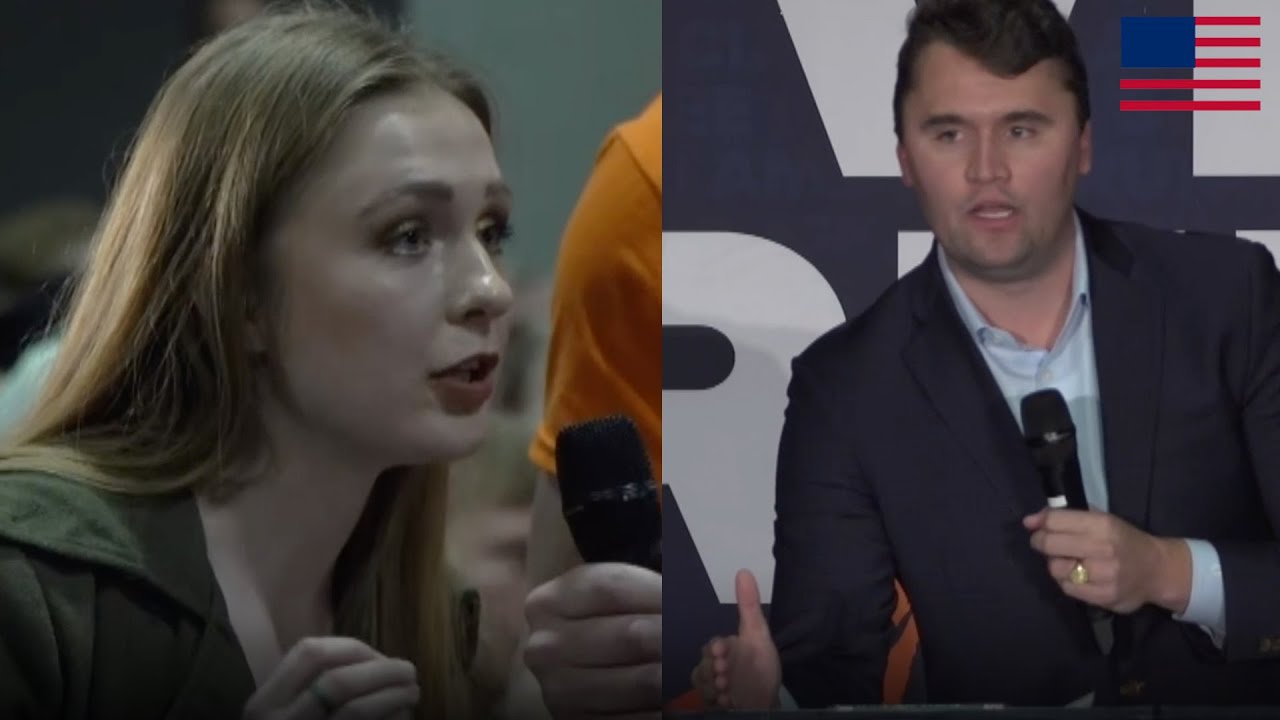
Charlie Kirk engages in back-to-back debates with college students who challenge his assertion that democracy is not an American value. Kirk argues the distinction between democracy and a constitutional republic is not merely semantic but fundamental, pointing out that the word "democracy" appears nowhere in the Constitution and was actually discussed negatively in the Federalist Papers. The students push back, arguing that voting and elected representation constitute democracy, while Kirk insists that what America has is representative government with constitutional protections, not majority rule. The exchange reveals a deep divide in how Americans understand their own system of government and the values that underpin it.
When a student asks Charlie Kirk if he views democracy as an American value important to the fabric of the country, his response is immediate and unequivocal: "No." Kirk immediately challenges the student to find the word democracy in the U.S. Constitution, prompting an admission that the word doesn't appear in the founding document. Kirk presses further, asking where democracy is mentioned in the writings of the founding fathers. The student attempts to pivot, noting that many founding fathers held elitist viewpoints about who should participate in governance, but Kirk redirects the conversation back to his central point.
Kirk explains that democracy is actually mentioned negatively in the Federalist Papers as a problem to be avoided. He clarifies his position: "I am pro-representative government but I'm not pro-democracy. That's a big difference and that distinction is important." When asked to define democracy, Kirk describes it as "majority rule no matter what" with no provisions for checks and balances, no inalienable rights, and no separation of powers—simply whatever the majority wants, as quickly as possible.
Education Versus Wisdom
The conversation shifts when the student argues that citizens should be as educated as possible to participate in civic life. Kirk counters that citizens should be "as wise as possible," arguing that education and wisdom are not the same thing. He goes further, asserting that college actually "disincentivizes the cultivation of wisdom." The student challenges this, pointing to the hypersaturation of polarizing media and echo chambers, questioning whether being self-taught could provide a thorough education when people are likely to get trapped in information bubbles.
Kirk responds that his learning extends beyond formal education—he meets people, listens to different perspectives, and learns through various means beyond "sitting in a classroom listening to a professor drone on for 90 minutes and pretending to read his book and paying 20,000 a semester to cheat on the exam." The student counters that college is what you make of it and that academia has standards, including peer-reviewed research requirements that don't apply to starting a podcast.
The Real Problem With Higher Education
When the student suggests that the right's rhetoric against higher education makes it easier to control less-educated people, Kirk rejects this as conspiracy thinking. He offers his own explanation for conservative criticism of higher education: it has created "an ungrateful unprepared generation that goes into the American body politic and does not share the core American values of freedom of speech, gratitude for our founding, consent of the governed." Kirk argues that modern higher education is "hyper radical" and against American traditions, norms, and customs, creating what he calls "the woke mind virus."
Kirk emphasizes that conservatives aren't anti-learning—he learns every day. The problem, he argues, is that students are "learning largely trash and crap" rather than pursuing "truth, beauty or goodness" and not trying to "inculcate wisdom or good character." When the student points out that there's no oversight on online political commentary to ensure pursuit of wisdom and goodness, and that Kirk profits from polarizing content, Kirk reframes the criticism. He argues that the audience rewards him because they find value in his content, and that what he says resonates with people. "It's easy to attack me as exploitation," Kirk says. "What I say is actually very popular and resonates people."
Round Two: A Constitutional Challenge
A second student approaches to debate Kirk's claim that democracy is not an American value. The student argues that democracy is an American value because it's "established in our constitution" through the creation of elections in Article One, Section Two. Kirk again asks where the word democracy appears in the Constitution, and when the student admits the word doesn't appear but its "definition" does, Kirk emphasizes the semantic importance. He returns to the Federalist Papers, explaining that the founders spoke negatively about democracy.
Kirk distinguishes between democracy and a constitutional republic: "In a democracy, the majority always wins with almost no breaks and no slowdowns of a check and balance system to protect freedoms and liberties. In a constitutional republic, the government starts with certain truth claims that are transcendent and irrefutable. Life, liberty, pursuit of happiness, the government is here to promote the general welfare, things of this nature." The student acknowledges that America isn't a "pure democracy" but argues it's ridiculous to say America isn't a democracy when citizens still vote.
Representative Government Versus Democracy
Kirk insists that voting is representative government, not democracy, and encourages the student to think more deeply about the distinction. The student argues that politicians still need to win a majority of votes, but Kirk corrects this: presidents need to win a plurality of the Electoral College, which isn't a direct majority vote. He explains that citizens don't actually vote directly—they vote for people to vote for them in the Electoral College. "That's what you do with House, the House, the Senate, and the Electoral College. You actually aren't voting yourself. You're voting for people to go vote for you."
When the student argues that these representatives are elected "through democracy," Kirk again pushes back on the semantics and asks the student to define the difference between a republic and a democracy. The student explains that in a republic, you have representatives, and in a democracy, you elect leaders—claiming America is both. Kirk challenges this, explaining what an actual democracy looks like: "They'd say, 'Hey, today we're going to have an up or down vote on universal healthcare. Go to the ballot box.' That's what a democracy you vote. Every person will vote on every single issue in a democracy."
The Definition of Democracy
Kirk asks the student to define democracy. The student responds that it's "a system or government that's ran by elected leaders." Kirk firmly rejects this definition and points to the dictionary definition the student looks up: "a system of government by the whole population." Kirk seizes on this: "Exactly. I am right. That's not what we have. We delegate our authority to elected leaders." The student insists politicians still need a majority, but Kirk explains that America uses pluralities and supermajorities—for example, requiring 66% or 61% of votes for certain actions.
In Kirk's view, a republican style of government is intentionally slower and more arduous, with natural rights that are enshrined and that the majority cannot overturn. "They are actually at odds with one another," Kirk says of democracy and constitutional republicanism. As the debate continues, Kirk challenges the student: "Go take five minutes, come back, and show me where the word democracy is in the Constitution. You can't find it cuz it doesn't exist."