
Up Next

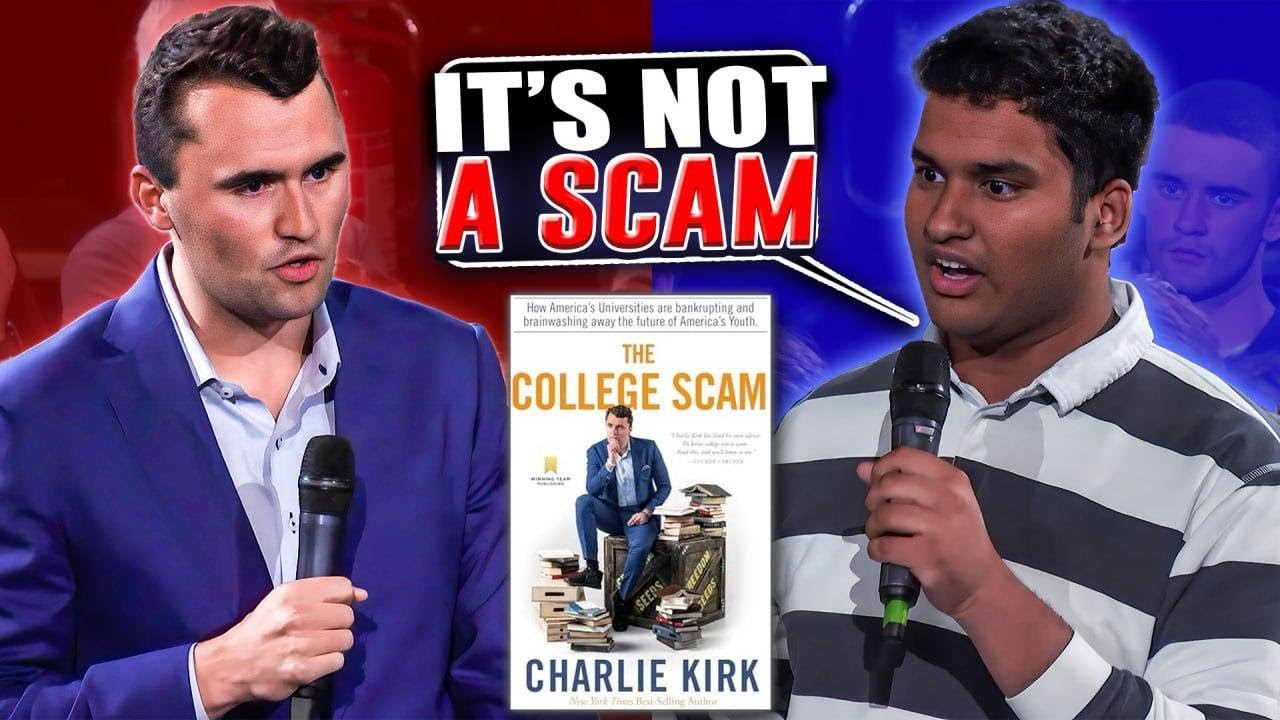
Charlie Kirk Debates College Student on Whether Higher Education Is a Scam at Cal State Fullerton
11:14

Charlie Kirk Debates College Student on STEM Degrees, Liberal Arts, and the LeBron vs Jordan GOAT Debate
12:44
Charlie Kirk on Why Universities Fail to Teach Wisdom Over Knowledge and the Eternal Questions
0:57
Related Books
Browse Conservative Books


Charlie Kirk Debates College Students: Why Universities Are Running a Dishonest Scheme on Young Americans
Charlie Kirk confronts college students with a harsh reality: the system they've bought into might be selling them a lie. In a direct exchange with students who believe a college degree guarantees career success, Kirk challenges the fundamental assumption that higher education is necessary for most careers. He argues that universities perpetuate a dishonest scheme by convincing students they must attend college to succeed, when half of them will end up in jobs that don't require a degree. Kirk exposes how institutions reinforce this narrative to keep students enrolled, while professors refuse to acknowledge that many would be better off pursuing alternative paths. This confrontation highlights the growing disconnect between the promises of higher education and the economic realities graduates face.
Defining the College Scam
Charlie Kirk opened the debate by establishing his framework for why he considers college a scam. He defined a scam as "a dishonest scheme" and immediately challenged the students on their expectations. When he asked if they expected to have a good career after attending college, the affirmative response set up his central argument.
The Reality Check: Degrees Don't Match Jobs
Kirk delivered a stark reality to the audience: half of the people in the room will end up in jobs that don't require a college degree. This statement challenges the fundamental value proposition of higher education. When students suggested this outcome would be "on them" - implying personal failure - Kirk pushed back forcefully. "No, it's not. No, it's not," he insisted, rejecting the notion that students should bear sole responsibility for a systemic problem.
The Lie They've All Been Told
Kirk asked the audience how many had been told it was necessary to go to college. As hands went up throughout the room, he made his point clear: "They've all been lied to and scammed." This framing positions the college decision not as a free choice made with accurate information, but as the result of deliberate misinformation from trusted sources.
How Universities Perpetuate the System
According to Kirk, universities actively reinforce the narrative that students must stay enrolled. He mimicked the institutional messaging: "Gotta stay here. Gotta stay here." But his counterclaim struck at the heart of the debate: "No, you don't. Actually, you're gonna get a better job by not going here."
The Professor Problem
Kirk concluded by pointing out a conflict of interest that prevents honest guidance: "And your professors won't tell you that." This suggests that those in positions to guide students toward better decisions have incentives to keep them enrolled, regardless of whether college serves their best interests. The implication is that the entire educational establishment - from high school counselors to university faculty - benefits from maintaining the myth that college is necessary for success.
Video Transcript
[00:00] I'm here to debate college is a scam. In
[00:02] my opinion, the definition of a scam is
[00:04] a dishonest scheme. It
[00:06] >> it is dishonest. Is there an expectation
[00:07] that if you guys go to college, you're
[00:08] going to have a good career?
[00:10] >> Yeah. Half the people in this audience
[00:12] if you get a job, it will not require a
[00:13] college degree.
[00:14] >> But that's on them.
[00:15] >> No, it's not. No, it's not. A lot of
[00:17] people think it's necessary to be here.
[00:18] How many of you guys have been told it's
[00:19] necessary to go to college? Raise your
[00:20] hand. They've all been lied to and
[00:22] scammed. And the university reinforces
[00:23] it. Gotta stay here. Gotta stay here.
[00:25] No, you don't. Actually, you're gonna
[00:26] get a better job by not going here. And
[00:28] your professors won't tell you that.



Comments
Be the first to comment on this video.