2,422 videos 1,389,747,653 views US Joined Aug 30, 2018
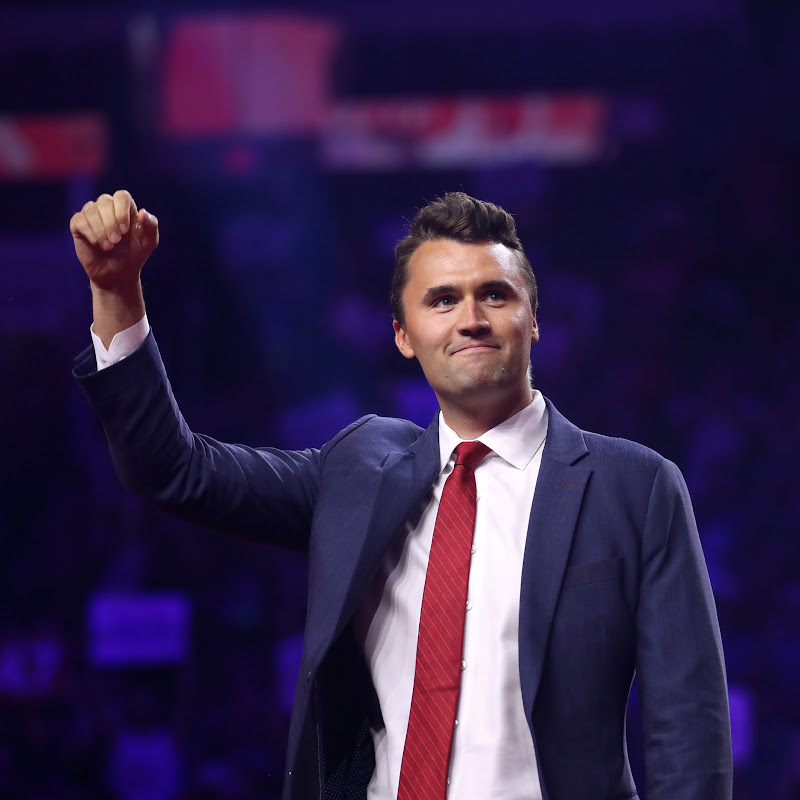
Charlie Kirk is the Founder and President of Turning Point USA, the largest and fastest growing conservative youth activist organization in the country with over 250,000 student members, over 150 full-time staff, and a presence on over 2,000 high school and college campuses nationwide. Charlie is also the Chairman of Students for Trump, which aims to activate one million new college voters on campuses in battleground states in the lead up to the 2020 presidential election. His social media reaches over 100 million people per month and according to Axios, he is one of the "top 10 most engaged" Twitter handles in the world. He is also the host of “The Charlie Kirk Show,” which regularly ranks among the top news shows on Apple podcast charts.
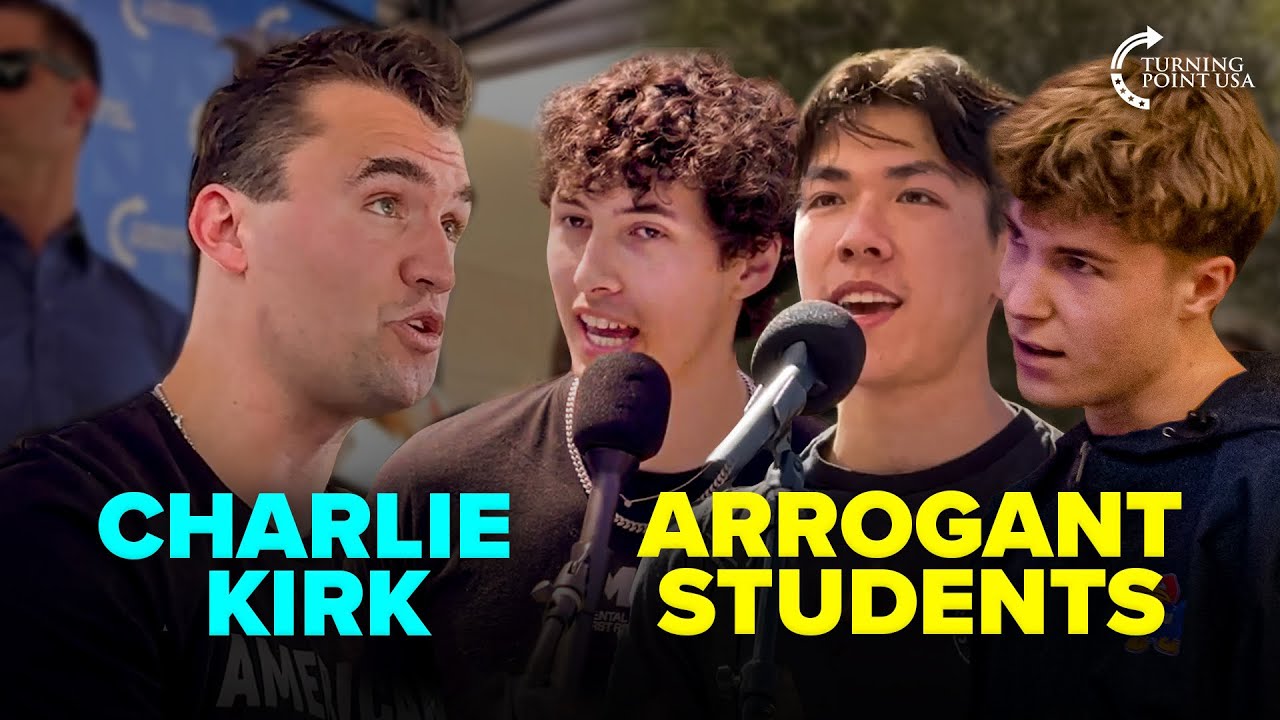
Charlie Kirk Challenges UNLV Student: Is College Actually a Scam or a Smart Investment?
Charlie Kirk engages in a spirited debate with a UNLV student about the value of college education. The student, whose friend is a Turning Point USA club vice president at Fresno State, challenges Kirk's assertion that college is a scam. Kirk presents data showing only half of college graduates use their degrees, highlights 5,000 new millionaires who are plumbers and electricians, and points to 11 million job openings paying over $80,000 that don't require degrees. The conversation reveals the tension between traditional educational paths and alternative career routes, with Kirk arguing that trade schools often provide better returns on investment than four-year universities. A second student defends his alma mater, Biola University, leading to a discussion about what metrics determine when a Christian university has strayed from its mission.
During a recent event at UNLV, Charlie Kirk engaged with students on one of his most controversial positions: that college is largely a scam. A student named Ed, whose friend serves as vice president of the Turning Point USA club at Fresno State, challenged Kirk to define what he means by "scam" and to explain what he believes the purpose of college should be.
Kirk acknowledged that his position comes with asterisks and exceptions, but he turned to the audience to make his point. He asked how many students were forced to take classes they considered a waste of time. Nearly every hand went up, illustrating widespread frustration with general education requirements that many students find irrelevant to their goals.
The Statistics Behind the Argument
Kirk presented several data points to support his position. First, he noted that only half of college graduates will actually use their degree when they find employment. This means that half of students are accumulating debt and spending years studying for credentials they won't need in their eventual careers.
He then highlighted an article about a new class of millionaires: 5,000 new millionaires in the past year who are plumbers, electricians, and welders. Kirk pointed out that many 24-year-olds in Las Vegas are making $2 million per year running plumbing businesses without ever attending a four-year college. These entrepreneurs typically attended trade schools instead.
Kirk also referenced 11 million job openings across the country that pay more than $80,000 annually and don't require a college degree, though they do require some training. He argued that four-year colleges are largely failing to benefit this generation, with exceptions for specific career paths like doctors, lawyers, and engineers.
The Student Pushes Back
Ed countered with research from Harvard Business School showing that even when employers claim not to require college degrees, they still prefer and predominantly hire candidates with degrees. This suggests that despite the availability of non-degree pathways, credentialism remains deeply embedded in hiring practices.
Kirk then shifted the conversation to graduation rates, asking Ed what he thought the national college graduation rate was. Ed estimated the high-50s or mid-50s range, which Kirk confirmed as accurate. This means that nearly half of students who start college never finish, often leaving with debt but no degree.
Ed shared his own experience as someone who had dropped out of college but was now returning. Kirk wished him the best while maintaining that there hasn't been nearly enough criticism of colleges from a cost and return-on-investment perspective. He argued that college has been a "third rail" of American life, immune from the scrutiny it deserves.
Wages and Economics
When Ed cited that the median plumber makes approximately $61,500, Kirk countered that wages in Clark County, Nevada are significantly higher than the national median. He emphasized that his broader message to the country is about the shortage of skilled tradespeople, which exists because society pushes young people to study subjects that don't matter, accumulate debt, and pursue jobs that don't exist.
The two didn't reach full agreement, but Ed thanked Kirk for the discussion and promised to relay greetings to his friend at Fresno State.
Defending Biola University
A second student approached with a different concern. He was a 2018 graduate of Biola University, where he had been a member of the Torrey Honors College and served as student body president. He referenced a recent clip where Kirk suggested that Biola had "slipped in its stature as a Christian school."
Kirk clarified that he might have been "a little spicier" than he should have been but expressed concerns about Ed Stetzer, the head of Biola's theology department. He claimed that many students graduating from Biola no longer believe in the inerrancy of scripture, the virgin birth, or core tenets of the Christian faith. Kirk suggested there has been significant deconstructionism introduced at Biola over the past five years.
Defining Educational Excellence
The student asked Kirk what metrics he uses to determine when a university has strayed too far from its purpose. Kirk responded by pointing to Hillsdale College as America's greatest college because it understands that education should be the pursuit of truth, goodness, and beauty—not just learning whatever you want. Education should point toward something higher, not confuse or point downward.
The Biola graduate found this interesting because the Torrey Honors Institute's tagline is "the pursuit of goodness, truth, and beauty." He described it as a great books program based on Platonic understanding of scripture. He also noted that his two brothers currently attend Biola and have been there for three years, and he doesn't believe Kirk's assessment about students denying fundamental Christian doctrine is accurate.
Kirk acknowledged that he might need to do better research on the current state of Biola, and praised the student for defending something he loves. The exchange demonstrated the importance of alumni holding institutions accountable while also defending them when they believe criticism is unfair.
The Broader Cultural Conversation
Kirk's campus tour continues to spark debates about the value of higher education at a time when student debt has reached crisis levels and many graduates struggle to find employment in their fields. His arguments resonate with concerns about credential inflation, the rising cost of tuition, and questions about whether traditional four-year degrees remain the best path for most young people.
The trades offer an increasingly attractive alternative, with high wages, job security, and no student debt. Yet cultural attitudes remain slow to change, with many parents still viewing four-year college as the default path to success. Kirk's provocative framing—calling college a "scam"—is designed to challenge these assumptions and open up space for a more honest conversation about education, economics, and the future of work in America.