
Up Next

Charlie Kirk Debates White Privilege and DEI With College Student on Merit Versus Race-Based Policies
11:49

Charlie Kirk Debates DEI, Airline Pilot Standards, and Black Family Structure with Concerned Citizen
9:35
Charlie Kirk Debates Student on Affirmative Action, DEI, and the Pursuit of Excellence Over Diversity
8:00
Related Books
Browse Conservative Books


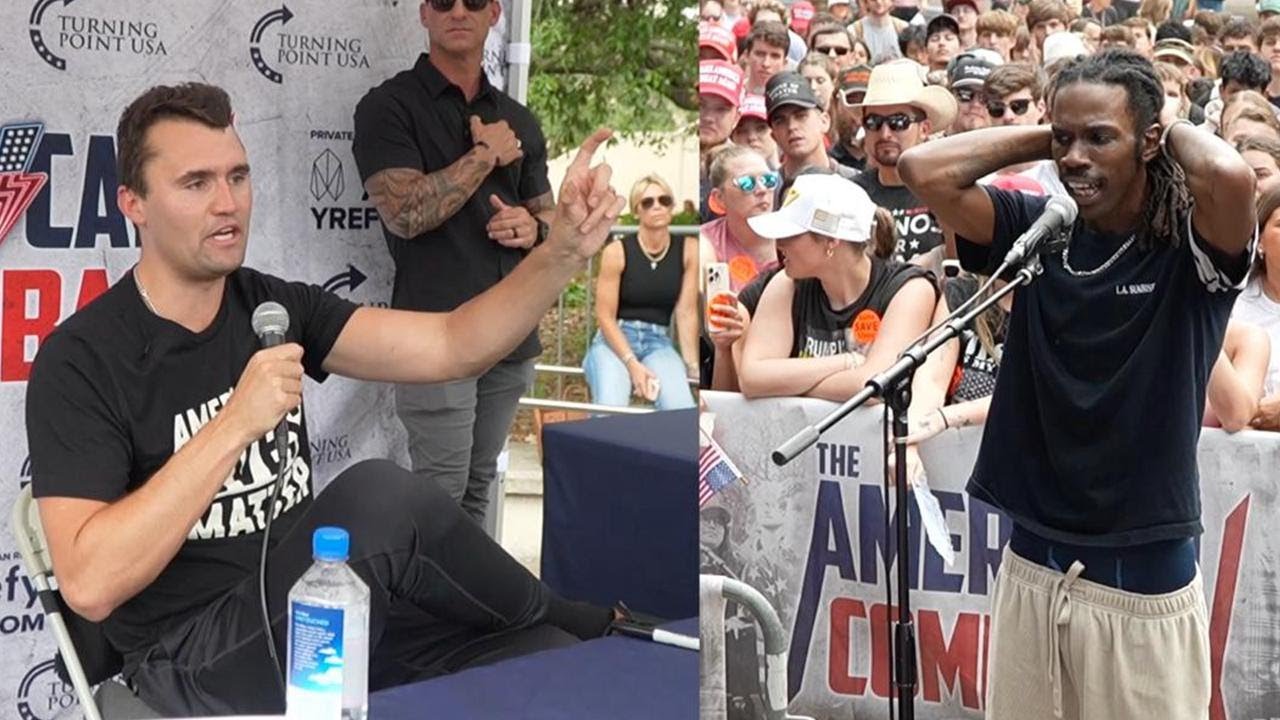
Charlie Kirk Debates SimpleBlackTheory on DEI, Merit, and Blind Hiring at Turning Point Event
Charlie Kirk faces off against SimpleBlackTheory in a heated debate over diversity, equity, and inclusion policies versus merit-based hiring. The discussion covers blind hiring practices, United Airlines pilot programs, Google's hiring committees, and historical desegregation in professional sports. Kirk argues that DEI initiatives compromise excellence by prioritizing race over qualifications, while SimpleBlackTheory contends that DEI encompasses workplace safety measures and equitable access. The exchange highlights fundamental disagreements over whether diversity initiatives help or harm organizational excellence, with both participants drawing on examples from Harvard admissions, NBA history, and aviation industry standards.
The Opening Salvo on Blind Hiring
Charlie Kirk squares off with SimpleBlackTheory in what becomes an intense examination of merit versus diversity in hiring practices. The debate opens with SimpleBlackTheory challenging Kirk on the concept of blind hiring—a recruitment process where race, age, and gender are concealed from hiring managers. When Kirk states his opposition to blind hiring, SimpleBlackTheory presses him on the apparent contradiction, arguing that blind hiring represents pure meritocracy.
Kirk clarifies his position by explaining that certain demographic factors can legitimately factor into merit assessments. He offers the example of hiring an Amazon warehouse worker, questioning whether excluding information about a candidate being 69 years old versus 24 would serve the employer's interests. SimpleBlackTheory accuses Kirk of moving the goalpost, insisting that if Kirk truly supports meritocracy, he should embrace blind hiring completely.
Defining the Terms of Engagement
Kirk draws a sharp distinction between natural diversity that emerges through merit and forced diversity through DEI initiatives. He states unequivocally that if diversity happens naturally through meritocracy, that's a positive outcome. However, DEI represents something fundamentally different—the forcible manipulation of institutions to achieve specific racial compositions.
Using sports as an example, Kirk argues that if half of Texas A&M's student body were black because of merit alone, that would be admirable. Similarly, if the NBA is 75% black or the NFL is half black based purely on merit, that's exactly how it should work. The core principle, according to Kirk, is excellence and meritocracy over race in every possible circumstance.
The NBA Integration Argument
SimpleBlackTheory attempts to reframe the conversation by bringing up historical NBA segregation. He asks whether allowing black players into the NBA constituted a form of DEI or diversity initiative. Kirk rejects this framing entirely, arguing that what existed before integration was actually a form of racial discrimination—essentially "white preference" or "white supremacy."
According to Kirk, ending segregation wasn't about implementing DEI; it was about removing racial stereotyping and discrimination. The result was that the quality of play improved dramatically. Kirk emphasizes the crucial difference: DEI seeks to bring back a form of how Major League Baseball and the NBA operated before desegregation, just with different racial preferences. What improved sports wasn't diversity for diversity's sake, but the removal of artificial barriers that prevented merit from determining who played.
Executive Order 11246 and the DEI Mandate
The debate shifts to Executive Order 11246, which SimpleBlackTheory identifies as the foundational document establishing DEI in federal contracting and employment. When pressed on the specifics, Kirk acknowledges he's not intimately familiar with every detail of the executive order but maintains that any policy explicitly incorporating the word "diversity" represents forced diversity.
SimpleBlackTheory argues that DEI encompasses far more than racial hiring quotas. According to his interpretation, DEI includes workplace safety measures, providing tampons and pads in women's restrooms, allowing Trader Joe's employees to sit while working to accommodate disabilities, and onboarding processes that explain sexual harassment policies. He contends that executive order 11246 focuses on creating safer and more equitable work environments, not just hiring practices.
Kirk dismisses this expansive definition, insisting that DEI fundamentally means racial quotas and forced demographic manipulation. The presence of the word "diversity" in any executive order or corporate policy signals an intention to prioritize race over merit.
The Google Case Study
SimpleBlackTheory introduces Google as evidence that DEI initiatives can coexist with organizational excellence. He points to Google's hiring committee process, which incorporates diverse perspectives while maintaining extraordinarily high standards—only 0.2% of applicants receive job offers. In his view, this demonstrates that diversity and merit aren't mutually exclusive.
Kirk counters that Google, despite its success, has actually lost competitive ground over the past decade. The company failed to compete effectively in social media, losing battles against Facebook and Instagram. Google's attempts to create Zoom and Skype competitors also fell flat. Kirk notes that while predictions from ten years ago suggested Google would become the first three trillion dollar company, Microsoft actually achieved that milestone first. Google's market capitalization under Alphabet has missed expectations compared to Netflix, Amazon, Apple, and Microsoft over the past two years.
The implication in Kirk's argument is clear: Google succeeded because it was built on merit, and any adoption of DEI policies has contributed to its relative decline, not its success. SimpleBlackTheory pushes back, arguing that if Google uses DEI in its hiring committee and remains one of the world's premier companies, this proves DEI doesn't necessarily compromise merit.
The Fundamental Question of Skin Color
Kirk repeatedly returns to what he considers the central question: Why should skin color matter at all in hiring decisions? He challenges SimpleBlackTheory to explain what differences exist between him as a white man and SimpleBlackTheory as a black man that would justify considering race in employment decisions.
This line of questioning reflects Kirk's broader philosophy that character and capability should be the only factors in hiring, admissions, and advancement. He accuses SimpleBlackTheory of being "race obsessed," comparing his worldview to that of the KKK because of the constant focus on racial categories. Kirk argues that he focuses on character while his opponent fixates on race.
SimpleBlackTheory attempts to redirect the conversation back to the specific policies and their actual implementation, but Kirk insists on the principle: any consideration of race in decision-making constitutes racial discrimination, regardless of the stated intentions behind it.
The United Airlines Pilot Program Controversy
The debate intensifies when discussing United Airlines' pilot diversity initiative, which Kirk has previously criticized. SimpleBlackTheory accuses Kirk of misrepresenting the program, claiming Kirk told people that United was simply hiring women of color to reach 40-50% representation. According to SimpleBlackTheory, the reality is that United created training programs to increase the pipeline of women and people of color becoming pilots, with requirements identical to any other pilot training program.
Kirk doesn't back down from his criticism. He frames the issue as a mathematical and practical problem: if you're attempting to go from 4% of pilots being black to 50% being black, you will inevitably lower standards. Kirk argues this isn't speculation but demonstrated reality—when institutions pursue dramatic demographic shifts quickly, they compromise excellence to achieve diversity targets.
The discussion extends to air traffic controllers, with Kirk referencing a Department of Transportation lawsuit from 2016-2017 involving over 15 whistleblowers who alleged that standards for air traffic controllers and pilots were lowered in pursuit of diversity. SimpleBlackTheory disputes this characterization, claiming the FAA actually made requirements harder by adding more scenarios to testing.
Harvard, Affirmative Action, and Supreme Court Defiance
Kirk connects the DEI debate to recent Supreme Court decisions striking down affirmative action in college admissions. He references the Students for Fair Admissions case against Harvard, arguing that it demonstrated how black students could gain admission with significantly lower qualifications than Asian or white students with comparable backgrounds.
According to Kirk, affirmative action is simply DEI philosophy in practice—the same principle applied to college admissions. He accuses institutions of actively defying the Supreme Court decision or contorting their policies to continue pursuing racial preferences while technically complying with the ruling.
This represents a pattern Kirk sees across American institutions: the pursuit of diversity consistently requires lowering standards. Whether at Harvard, Yale, in the military, or at airlines, Kirk argues that every time an organization prioritizes diversity, it becomes less excellent. The trade-off is inevitable and observable across sectors.
The Merit Question in Aviation
Kirk poses what he considers a definitive question: when boarding a United Airlines flight, would you rather have a pilot who is qualified or one who is diverse? SimpleBlackTheory objects to the framing, arguing that it creates a false binary—as if qualification and diversity are mutually exclusive categories.
Kirk insists the distinction is real and meaningful. In his view, when airlines or any organization sets demographic targets that don't reflect the natural distribution of qualified candidates, they must necessarily compromise standards to meet those targets. This creates what he describes as "putting a square peg through a round hole"—forcing something that isn't happening naturally.
SimpleBlackTheory counters by asking whether Kirk demands to see pilot credentials before boarding any flight, or whether he trusts that airlines hire competently regardless of diversity initiatives. He argues that becoming a pilot is based purely on skill, not height, physicality, or other factors. If the training standards remain constant, the demographic composition of pilots shouldn't affect passenger safety.
The Broader Vision for America
As the debate reaches its conclusion, Kirk articulates his fundamental principle: America should be built on content and merit, not on the forced retribalization of the country along racial lines. He wants a society where excellence determines outcomes, where the best person gets the job regardless of their skin color, and where no one receives advantages or disadvantages based on immutable characteristics.
SimpleBlackTheory's argument throughout the exchange centers on a different understanding of DEI—one that encompasses workplace accommodations, safety measures, anti-discrimination protections, and pipeline development programs, not simply racial quotas. From his perspective, many policies labeled as DEI actually promote fairness and access rather than compromising standards.
The debate reveals a fundamental disagreement not just about specific policies, but about how to interpret history, define terms, and measure success. Kirk sees DEI as inherently discriminatory, a return to racial categorization that America should have left behind. SimpleBlackTheory sees it as addressing systemic barriers and creating genuinely equitable access to opportunities.
Video Transcript
[00:00] All right. So, uh, let's restart. Uh,
[00:03] Mr. Simple, you've said some very nasty
[00:04] things about me online, so the floor is
[00:07] yours. Thank you. Thank you. Uh, so, uh,
[00:09] simple question, Simple Black Theory.
[00:11] Um, what do you think about blind
[00:14] hiring? Are you for blind hiring? No.
[00:17] No. So, why not? Because blind hiring,
[00:20] for those who don't know, is based on
[00:21] merit where you don't. So, what's blind
[00:24] hiring? Blind hiring would be that you
[00:25] do not put the race actually when you
[00:27] submit for, you know, actually you don't
[00:28] even see the person when you interview
[00:30] them for a job. No, no, no. That's
[00:31] that's one part of blind hiring. There's
[00:33] multiple ways to do blind hiring. But at
[00:35] the end of the day, blind hiring is
[00:36] exactly not knowing the person's race,
[00:38] age, or gender. That's based on merit.
[00:41] Like you said, you want merit, correct?
[00:43] Well, hold on. Those things can factor
[00:45] into merit as well. For example, if I'm
[00:47] trying to hire for an Amazon warehouse
[00:49] worker and all of a sudden I find out
[00:51] that they're at 69 with one year left
[00:52] from retirement and the age is not
[00:54] disclosed. Wouldn't I prefer to have a
[00:56] 24 year old man than a 69year-old woman
[00:58] who's overweight? You're moving the
[00:59] goalpost. Let's bring it back here. So,
[01:01] no, the whole point was about blind
[01:02] hiring. No, you just said you said race,
[01:05] sex, and age, right, is not
[01:07] incorporated. Correct. I think you
[01:09] should have a full picture of of a human
[01:11] being is when you hire them. So, you
[01:13] care about diversity? No, actually, I
[01:15] don't. How? Why? Because that's
[01:17] basically merit. You're focusing solely
[01:19] on merit. You said you want meritocracy.
[01:21] Just to be clear, I want I I if
[01:23] diversity happens naturally through
[01:24] meritocracy, great. If all of a sudden
[01:26] we have people that Well, no, no, it's
[01:28] not. DI is by force. No, no, no. I got
[01:31] to I got to interject. DEI is that we
[01:33] are going to forcibly make an
[01:34] institution more colorful. We're going
[01:36] to forcibly make an institution more
[01:38] black. Where if all of a sudden if half
[01:40] of Texas&M was black because it was all
[01:42] on merit, praise God, that's an amazing
[01:44] thing. It doesn't matter if all of a
[01:46] sudden, for example, if the NBA is 75%
[01:48] black because it's on merit, great.
[01:50] Terrific. If the NFL is half black
[01:52] because on merit, we don't want to force
[01:54] race. We want excellence and meritocracy
[01:56] over race in every possible
[01:58] circumstance.
[01:59] [Music]
[02:00] Right. Yeah. My turn. Okay. So, let's
[02:03] get into the NBA for instance, right?
[02:05] Can we both agree at one point black
[02:07] people weren't allowed into the NBA and
[02:09] then they allowed them to be in the NBA?
[02:11] Wouldn't that be considered diversity?
[02:12] Wouldn't that be DEI? No, no, no. It's
[02:14] actually the opposite. You see, you're
[02:16] mistaken, my friend. It's actually we're
[02:18] getting rid of any racial stereotyping.
[02:20] What happened was actually a form No,
[02:22] DEI is racial stereotyping. So, what
[02:24] actually was before was a form of white
[02:27] preference, DEI, which is white
[02:29] supremacy or whatever. And then we got
[02:30] rid of it. We said we're not going to
[02:32] discriminate it. And the quality of play
[02:34] got better. Do you guys see the
[02:35] difference between the two? You see,
[02:37] it's very important. Well, no, actually,
[02:39] I'm talking to both you and the crowd,
[02:40] right? Me? I'm talking to both. Right.
[02:42] So what ended up h what you want is you
[02:44] actually want to bring back a form of
[02:46] how Major League Baseball and the NBA
[02:48] used to work before we desegregated. So
[02:51] we can agree that executive order 11246
[02:54] is what basically brought in DEI.
[02:56] Correct. I I'm not I think that might be
[02:58] it. Is that the affirmative action one?
[03:00] I don't know. No, it's not the format.
[03:01] It's for DI. So within that executive
[03:03] order, where does it say that they're
[03:06] solely focused on making people get into
[03:08] jobs? For instance, like United
[03:10] Airlines, right? You mentioned that.
[03:12] Well, let's pause that. I want to get to
[03:13] here. So, for an example of DEI is
[03:16] basically your daughter, right? She
[03:17] decides to get a job, right? And
[03:19] unfortunately, it's that time of the
[03:20] month. She goes into the bathroom. Calm
[03:24] down. Calm down. Calm down. She goes
[03:25] into the bathroom. Stop. She's going
[03:28] into the bathroom. You're losing the
[03:29] audience, man. I don't care. I'm talking
[03:30] to you. So, she she goes into the
[03:32] bathroom, right? And she gets a
[03:35] She goes into the bathroom and gets a
[03:37] tampon or a pad that's been given from
[03:39] the job. That is DEI. That is literally
[03:42] Yes.
[03:43] Yeah. Yeah. Yeah. Yeah. You You don't
[03:44] know. You don't know. You don't know.
[03:46] That's great. So, if you don't know DEI,
[03:49] interrupt me so he can win. Go ahead.
[03:50] You want to do that, right? Or be quiet.
[03:52] We can talk. Thank you. So, right.
[03:55] [Applause]
[04:00] Can I continue? Thank you. So, my thing
[04:02] is dead. All right. So yes, because in
[04:05] so in executive order 11246, they say
[04:08] that DEI is focusing on a safer
[04:10] environment and a more equitable
[04:12] environment within the workplace and the
[04:14] hiring process. Let's look at Google.
[04:16] Google actually does DEI. You know how
[04:18] they did a DEI? Give me an example. Do
[04:20] you know Google's DI? I'm pretty sure
[04:22] you don't. And they shouldn't. Of course
[04:23] not. And what is their DEI initiative?
[04:24] There was there I actually don't know
[04:27] the specifics because I don't I don't
[04:28] know every company specifics. However,
[04:31] let me ask you a question. when you're
[04:32] hiring somebody, would you rather hire
[04:34] someone that's black or someone that
[04:36] there is excellent? So, that's what
[04:38] we're talking about. That's not what DEI
[04:40] is. Actually, it is. So, let let me let
[04:42] me prove it to you. As I said, according
[04:44] to the student for fair admission
[04:46] Supreme Court case, black students were
[04:48] able to get into Harvard with
[04:50] affirmative action, not DEI. Affirmative
[04:53] action. Time out. Time out. Time out.
[04:56] Time out. You're getting too worked up
[04:57] here, man. Okay. Time out. Affirmative
[05:00] action is DEI in practice. You see DEI
[05:03] is a theory. Wasn't it struck down by
[05:05] Supreme Court? Yes. And they still
[05:07] ignore it. Why are you bringing it up?
[05:08] Because they're still ignoring it. My
[05:10] friend, let's focus on my question. I
[05:11] actually Let's get back to the core
[05:14] macro tenant which is which I think is
[05:16] very important. Correct. Which is
[05:18] wouldn't you prefer a country built on
[05:20] excellence and merit, not one based on
[05:22] forced pigmentation diversity. Why does
[05:25] somebody's skin color matter? No. Tell
[05:27] me what what what differences do you as
[05:30] a black man and me as a white man have
[05:31] and why does it matter? Okay. So why
[05:33] does it matter? So let's look at cuz
[05:36] again you don't understand what DI is
[05:37] and and you're trying to put into one
[05:39] stance which is not so
[05:42] thank you. So back to this question. So
[05:44] in executive order and and and correct
[05:45] me if I'm wrong. You don't know
[05:47] executive order 11246. Correct. So I
[05:49] mean I I have an idea of what President
[05:51] Trump signed. Correct. But because he
[05:53] got he got rid of that executive order.
[05:55] Right. And in that executive order, it
[05:57] says literally, y'all can Google it,
[05:59] too. It says that DEI focuses on both
[06:02] the workplace and hiring. Now, got it.
[06:05] So, now let me explain. Now, let me
[06:06] explain it. Does it have the word
[06:07] diversity? Yes. We should not have any
[06:09] force diversity. Period. End of story.
[06:11] It's not forced diversity. It does not
[06:12] for say force diversity, and I'll put
[06:14] money on that, too. Does it say
[06:15] diversity? It says diversity. Yes. Well,
[06:16] then it's forced diversity. Force
[06:18] diversity. What is it? It's a
[06:19] suggestion. So, so correct me if I'm
[06:22] wrong. Tell me if I'm lying. Does it say
[06:23] force diversity in the executive order?
[06:25] is the word diversity. Does it say force
[06:27] diversity? Wait, hold on. Let me get
[06:28] this straight. Executive order with the
[06:30] word diversity. Can I give you an
[06:31] example of DI initiative? Let me give
[06:33] you an example of DI initiative so you
[06:34] have a better understanding. So let's
[06:36] look at Google, right? Google's one of
[06:37] the hardest companies to actually get
[06:39] into. In fact, I believe it's a 0.2%
[06:41] chance that you actually get the job,
[06:42] right? They actually run a DI
[06:44] initiative. Their DI initiative is
[06:46] called a hiring committee where they
[06:48] have a diverse group of people working.
[06:50] Awful. How? So you're telling me Google
[06:53] sucks? Google actually is honestly
[06:56] honestly honestly chat GPT is way better
[06:58] than Google recently. I don't know about
[07:00] you guys. No, but honestly to your point
[07:03] though Google has lost its competitive
[07:04] edge in a lot of ways the last 10 years.
[07:06] They're Hold on a second again. Google
[07:08] does a lot right but hold on. Google has
[07:10] lost the social media war. Google tried
[07:12] to launch a Facebook competitor
[07:13] Instagram competitor failed. They tried
[07:15] to also launch a Zoom and Skype
[07:18] conversation guys. No problem. Google's
[07:19] marketap Google's market cap otherwise
[07:22] known as Alphabet has actually missed
[07:24] expectations over the last 2 years
[07:26] versus Netflix, Amazon and Apple and
[07:28] Microsoft. In fact, there was a
[07:30] prediction 10 years ago that Google
[07:31] would be the first $3 trillion company.
[07:33] Turns out that it was actually Microsoft
[07:35] that was the first $3 trillion company.
[07:37] Now, of course, Alphabet is a very good
[07:38] company on a lot of different ways. But
[07:40] if your argument right now is like,
[07:42] well, because the one of the biggest
[07:43] companies on the planet has embraced a
[07:45] bad idea, what is your argument exactly?
[07:47] They're still one of the best companies
[07:48] in the world. Not because of that.
[07:50] Because they were built by merit and
[07:51] it's being destroyed by diversity and
[07:53] they use DEI to get that merit. Listen,
[07:56] if if they're hiring people, yes, it
[07:58] makes sense. If if you're doing a hiring
[08:00] process and you have a hiring committee
[08:01] that is DEI and they're hiring the
[08:03] people that's making the company as
[08:05] great as we just said, how your argument
[08:08] your argument is that DEI takes away
[08:10] merit. If we see that Google is doing
[08:12] well and they're using DEI, how the hell
[08:14] are you saying that DEI is not making
[08:16] merit? First of all, Google has not had
[08:18] this hiring committee around since its
[08:19] inception. They have no not since it
[08:20] inception, but they had it for a while
[08:22] and the people in the committee are been
[08:24] there for a while, which is very
[08:26] diverse. Secondly, you you have not
[08:28] answered this fundamental question
[08:29] though, which is can you tell me when a
[08:32] organization gets forcibly more diverse,
[08:34] it gets better?
[08:36] Google. Again, I just proved to you
[08:38] Google is Google. Okay, I just gave you
[08:40] Google. They use DEI. Not only are they
[08:43] one of the best companies Oh, yeah. I
[08:45] hate that argument. Great. I mean,
[08:46] again, it's just they're fine. I'm not
[08:48] going to like totally kind of crap on
[08:50] Google, but like more importantly and
[08:52] more more broadly, I do think you have
[08:55] to answer the question. Why does skin
[08:58] color matter at all in hiring? Answer
[09:00] that question. Why does skin color
[09:02] matter? So, if we look at basketball,
[09:05] because you love talking about that,
[09:06] right? Can we both agree that at one
[09:08] point there was no black athletes and
[09:11] then what happens? They diversified.
[09:13] They got rid of forced segregation which
[09:15] is a form of DEI. So and that
[09:16] diversified the the basketball because
[09:18] it was based on merit. But it
[09:20] diversified. Yes. But not by force. No,
[09:22] hold on a second. Very much. Hold on.
[09:23] But if your argument is that if you want
[09:25] to make things more merit-based, then
[09:27] let's do it. It is more merit based.
[09:30] They made it diversifying. They
[09:31] diversified basketball bringing black
[09:34] people who are good in it. Nothing.
[09:36] Nothing you're saying is making any
[09:38] sense because what they did, the NBA
[09:41] went to pure merit. Pure excellence. Are
[09:45] you good at this? That's all they cared
[09:47] about in the They allowed black people
[09:48] in, right? Exactly. Because prior cuz
[09:51] Hold on. Because you know what they had
[09:53] prior was a form of racial stereotyping.
[09:56] And you want more racial stereotyping.
[09:58] Your worldview is indecipherable from
[10:00] the KKK. What you want, it's
[10:03] indecipherable cuz you are race
[10:04] obsessed. I am not race obsessed. You
[10:07] talk about the race. You talk about race
[10:09] more than the grand wizard of the KKK
[10:12] because you the grand wizard of the KKK.
[10:14] Well, think about it. No, I said you're
[10:16] one of you. Think about it because
[10:17] you're around talking about race all the
[10:19] time. I'm talking about character. Which
[10:21] of you talk about race all the time. You
[10:22] literally said DEI is based on race, but
[10:25] it's
[10:26] not with accessibility. You're getting
[10:28] really upset. My bad. You're right. Cuz
[10:29] you keep lying. For instance, right,
[10:31] I've been trying to say this. DI. One
[10:33] part of DEI is literally giving women p
[10:36] um tampons or pads at work. Oh yeah,
[10:40] you're laughing because you don't know
[10:41] that. Giving women tampons is a form of
[10:43] DEI. Yes, it is. You know why? Let me
[10:45] explain. Let me explain. Yeah. Yeah. No,
[10:47] I got you. I'm about to explain to you
[10:48] guys. So, basically what happens is the
[10:50] the reason why we have DEI is the fact
[10:53] that um in a job um location, right,
[10:55] they want to hire more people diverse.
[10:57] So what they is these initiatives, these
[10:59] goals, these aspirations that they're
[11:01] doing is trying to bring more people in.
[11:02] For instance, like if um um what's that
[11:05] store? Trader Joe's, right? They let
[11:06] people sit down while they uh let uh
[11:09] they bring stuff in. They help
[11:11] disability. That's the help disabled
[11:13] people get a job at Trader Joe's. But
[11:16] what you're telling me is that we are
[11:17] not allowed to to tell people that for
[11:20] like onboarding. Onboarding in itself is
[11:22] also DEI. When they explain to you
[11:25] sexual harassment, when they do all
[11:26] these things, when they make it more a
[11:28] safer place, that is DEI. And what
[11:31] you're saying is that the workplace
[11:33] shouldn't be um safe. What you're saying
[11:35] is that more companies should
[11:37] discrimination lawsuits. Let's get back.
[11:39] Let's get backation lawsuits. DEI is
[11:42] racial quotas. End of story. Give me one
[11:44] racial United Airlines. I I Googled
[11:47] that. Go ahead. Oh, I Googled it. Okay,
[11:49] great. So So go ahead. Go ahead.
[11:51] Continue. What what did United Airlines
[11:54] announce? Because you know what I said
[11:55] about black pilots. What did they
[11:57] announce when it came to pilots and why
[11:59] should skin color matter when you board
[12:00] an airplane? So just to remind everybody
[12:02] is Charlie Kirk's uh idea. He basic Yes.
[12:06] Stop talking. So Charlie Kirk basically
[12:09] that's very that's very
[12:11] misogi of you.
[12:15] All right. Let me finish cooking. So
[12:17] right
[12:28] So, can I can I finish? So, Charlie Kirk
[12:31] said that they're basically hiring women
[12:34] of color to make 40 or 50%. Right? But
[12:36] when you actually look into it, what
[12:38] happens is women and people of color,
[12:39] right? Women and people of color. What
[12:41] happens is they're creating a program
[12:43] that's allowing women to train, become
[12:45] pilots. If you actually look at the
[12:47] requirements for these program is
[12:49] nothing different than any other program
[12:51] that trains pilots. But you told people
[12:54] that they're just hiring women when
[12:56] that's not true. First of all, I never
[12:58] said that. Secondly, yes. I did a video
[13:00] on it, guy. Yes, I know what I said.
[13:02] Secondly, when you hire based on race
[13:04] and not on excellence, you end up
[13:06] compromising the standards of
[13:07] excellence. Allow me to finish without
[13:09] interrupting. When you hire based on
[13:11] race and not on excellence, you end up
[13:13] compromising excellence to be able to
[13:14] pursue race. We know this with Harvard,
[13:16] University of California. We know this
[13:17] with major companies. We know this with
[13:19] the government. Exactly. DEI. That is a
[13:21] affirmative action is DEI philosophy in
[13:24] practice. You're bringing old [ __ ]
[13:26] Allow me to finish my statement. They
[13:28] are actively defying the Supreme Court
[13:30] decision or they are contorting their
[13:32] policies to try to fit their own DEI
[13:34] agenda. But let me ask you a question.
[13:36] If you were to board a United Airlines,
[13:38] I ain't get ahead. If you were to board
[13:39] a flight with United Airlines, would you
[13:41] rather have a pilot that is qualified or
[13:44] one that is diverse?
[13:47] Answer the question. That makes no
[13:49] sense. Why is there two different
[13:50] things? How is it different when you go
[13:52] to American? Because in the pursuit of
[13:54] diversity, in the pursuit of diversity,
[13:56] you sacrifice excellence every time. We
[13:59] know this with Harvard. We know this
[14:00] with Yale. We know this with the
[14:01] military. Every time, every example that
[14:04] we pursue diversity, an institution
[14:06] becomes less excellent.
[14:09] When you go on a plane, do you go to the
[14:11] pilot and ask for your credentials or do
[14:13] you have do you believe that the airline
[14:14] did the right thing and hire? So you
[14:17] ask so I start to doubt it. That was my
[14:21] statement. That was my statement. My
[14:23] statement was when you're going to if
[14:25] you're going to go from 4% of the pilots
[14:27] being black to 50% of the pilots to be
[14:30] black, it begs the question, you are
[14:32] going to lower the standards. You are
[14:34] going to you're going to put a square
[14:35] peg through a round hole. You are going
[14:37] to force something that naturally is not
[14:39] happening and you will all of a sudden
[14:40] be playing a very treacherous and
[14:42] dangerous game when you board a plane.
[14:44] When I get heart surgery or if I board a
[14:46] plane, I don't care about the color of
[14:47] the skin of the person doing it. I want
[14:50] excellence and I want meritocracy.
[14:53] Yes. Yes. So, so stop talking. You're
[14:56] talking. So, right. Let's get back to
[14:58] because you're talking a lot.
[15:04] Final point then I'll get to the next
[15:05] question. Yeah, that's fair. That's
[15:06] fair. That's fair. That's fair. That's
[15:07] fair. Okay. So, again, so going back to
[15:09] what you said, cuz like I said earlier
[15:11] ago, you said um and I forgot this is
[15:13] ISU. You basically said that um that
[15:16] women are being hired to become pilots
[15:18] right now. First, that's not that's a
[15:20] lie. That's based on a program. Second,
[15:22] what? Correct me if I'm wrong. Becoming
[15:24] a pilot is based on skill. Correct. It's
[15:27] not based on height. It's not based on
[15:28] on on physicality. Doesn't based on
[15:30] nothing. It's based on skill. Meaning
[15:32] that if you're being Oh, so what is it
[15:34] based on? Because based on a now public
[15:36] lawsuit with the Department of
[15:37] Transportation in 2016 2017, air traffic
[15:40] controllers and pilot standards were
[15:41] lowered in pursuit of diversity. Sure.
[15:43] Because of over 15, let me finish.
[15:45] Because of 15 whistleblowers that said
[15:47] the standard of air traffic controllers
[15:48] and pilots were being sacrificed in the
[15:50] pursuit of
[15:51] diversity inclusion. You're lying again.
[15:53] Okay. I mean, people can do their
[15:54] independent research. And they also I've
[15:55] done it. And you're lying. They actually
[15:57] made it harder. They add more scenarios
[15:59] within the FAA. Everybody here Google it
[16:02] right now. Yeah. Okay. Again, the the
[16:04] the documents bear out exactly. We now
[16:07] have we we have air traffic controllers
[16:10] after air traffic controllers have said
[16:12] in the pursuit of making air traffic
[16:14] controlling more diverse, we have then
[16:16] lowered the quality of air traffic
[16:17] control. So, at the end of all this,
[16:19] what you basically told me is that if
[16:22] merit matters, you don't it it doesn't
[16:24] matter because when we mentioned blind
[16:25] hiring, you said you're against that,
[16:27] which is based on merit. They said no
[16:28] time up. said that they want to
[16:30] prioritize a group above what is merit
[16:33] meritocratic. They didn't say that. That
[16:35] that's what United Airlines said. They
[16:37] said half confident we read the
[16:39] executive order out loud. We're talking
[16:40] about United Airlines. We're not talking
[16:41] about the executive order again. They
[16:43] said half of all their new players got
[16:46] we we have clarity and the clarity is
[16:49] very simple. We want a country based on
[16:53] content and merit. He wants a
[16:55] retribalization of America.
[16:58] Thank you. Excuse me. Pardon me.
[17:03] [Music]
[17:05] They're not sending their best here.
[17:07] Okay. Okay, Tommy Kurt. Okay, Tommy
[17:10] Kurt. Hey, I got We [ __ ] cooked them.
[17:18] Thank you.


Comments
Be the first to comment on this video.