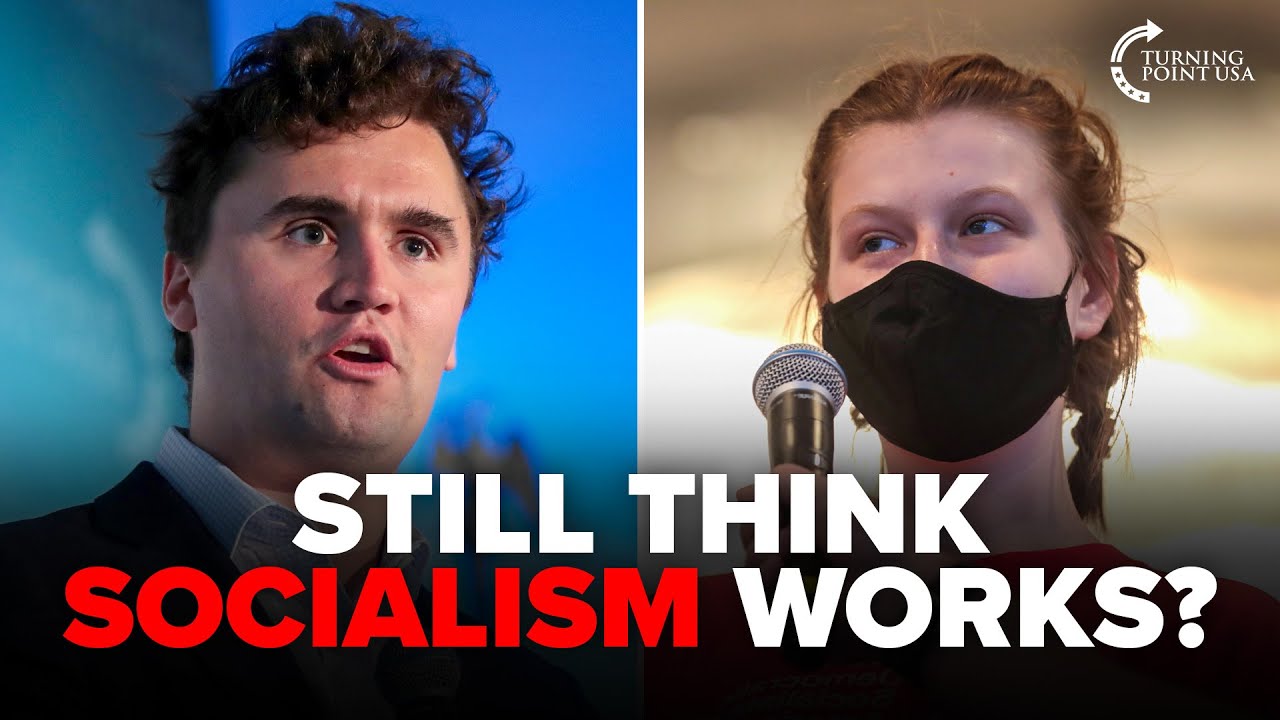
Charlie Kirk Debates Socialist Professor on Capitalism Versus Socialism and Freedom
Enjoying this? Share it with someone who needs to see it.
Up Next
Charlie Kirk Dismantles the Myth of Socialism After 100 Years of Failure Across Every Continent
1:26
Charlie Kirk Debates Marxist Student on Capitalism, Hierarchies, and Why Socialism Always Fails
6:49
Where Can Socialists And Conservatives Agree?
1:37
Charlie Kirk Debates Socialist Professor on Capitalism Versus Socialism and Freedom
Charlie Kirk engages in a heated debate with a socialist professor about the failures of socialism versus the successes of free market capitalism. The conversation covers the brutal reality of Cuba's authoritarianism, the death toll of socialist experiments across continents, and the fundamental question of whether freedom should exist only when it serves "the common good." Kirk challenges the professor's defense of socialism by pointing to the millions who died under socialist regimes and asks why people flee socialist countries if the system works so well.
The Cuba Question: If Socialism Works, Why Do People Flee?
The debate begins with a direct challenge about Cuba, one of socialism's longest-running experiments. Charlie Kirk confronts the socialist professor about the reality of Cuban socialism, noting that while Cuba has turned over authority to citizens in areas like education and healthcare, the government has banned boats and external migration to the United States. Kirk poses a simple but powerful question: if socialism is so great, why do people want to escape from it so quickly?
The professor attempts to defend Cuba's model, but Kirk's point cuts to the heart of the matter. The need to prevent citizens from leaving speaks volumes about the actual lived experience under socialist systems, regardless of theoretical promises about community ownership and worker control.
Freedom for the Common Good: A Dangerous Qualifier
When Kirk asks whether freedom is fundamentally good, the professor's response reveals a core tension in socialist ideology: "Yes, when it's for the common good." This conditional view of freedom stands in stark contrast to the principles of individual liberty that underpin free societies.
Kirk challenges this notion by asking when freedom restricted to "the common good" has ever worked in practice. The professor's answer is revealing: "It hasn't happened because the capitalist system is so oppressive." This circular reasoning attempts to blame capitalism for socialism's failures to deliver on its promises of freedom.
One Hundred Million Dead: Socialism's Bloody Track Record
Kirk doesn't let the theoretical discussion obscure the historical reality. He points to the devastating implementation of socialist ideas across more than one hundred countries over forty years. These ideas were adopted by movements and governments on every continent, from Zimbabwe to Afghanistan, from India to Bulgaria, across Eastern Europe, the Korean Peninsula, Cuba, Venezuela, and Argentina.
The results were catastrophic. Kirk notes that these ideas "ravaged cultures, communities, civilizations" and resulted in the deaths of one hundred million people. This isn't abstract economic theory—it's the documented human cost of attempting to implement the socialist model the professor defends.
Defining the Terms: Socialism Versus Free Market Capitalism
The professor offers his definition of socialism: "the transfer of ownership of private corporations and monopolies over to the community and to the society and the workers," giving workers "the authority to set policy and to run the show."
Kirk counters with his understanding of free market capitalism: "the free exchange of ideas, values and products" where people "set policy" and "decide what's good and bad for society." The crucial difference, Kirk emphasizes, is coercion. "I'm never gonna coerce people into doing something," he states, contrasting voluntary exchange with the forcible takeover of private corporations that socialism requires.
The Moral Case for Capitalism
Against claims that capitalism is failing the country, Kirk makes a moral argument for free enterprise. He describes "the free enterprise system" as "the most moral, proven and effective economic system ever discovered." This isn't merely an economic claim but an ethical one—that voluntary exchange respects human dignity and freedom in ways that coercive systems cannot.
Easy Generosity with Other People's Money
Kirk identifies a fundamental problem with socialist redistribution: "It's very easy to be generous with other people's money." The call to "redistribute the wealth" and "make it more equitable" sounds compassionate, but Kirk points out what it really accomplishes: "You get power when you do that."
The taxes required to fund such redistribution must be imposed on society. The professor's concluding words are telling: "It's gonna have to be a revolution." This admission reveals that implementing socialism requires not persuasion and voluntary cooperation, but force and upheaval.
The Enduring Questions
This exchange crystallizes the fundamental questions in the capitalism versus socialism debate. Can freedom be conditional and still be freedom? Does the promise of equality justify coercion? Can we ignore the historical evidence of socialism's failures? And ultimately, which system respects human dignity—one based on voluntary exchange or one requiring revolutionary force to implement?
Kirk's challenge remains unanswered: if socialist ideas have been tried in over one hundred countries with devastating results, why should anyone believe the next attempt will be different?