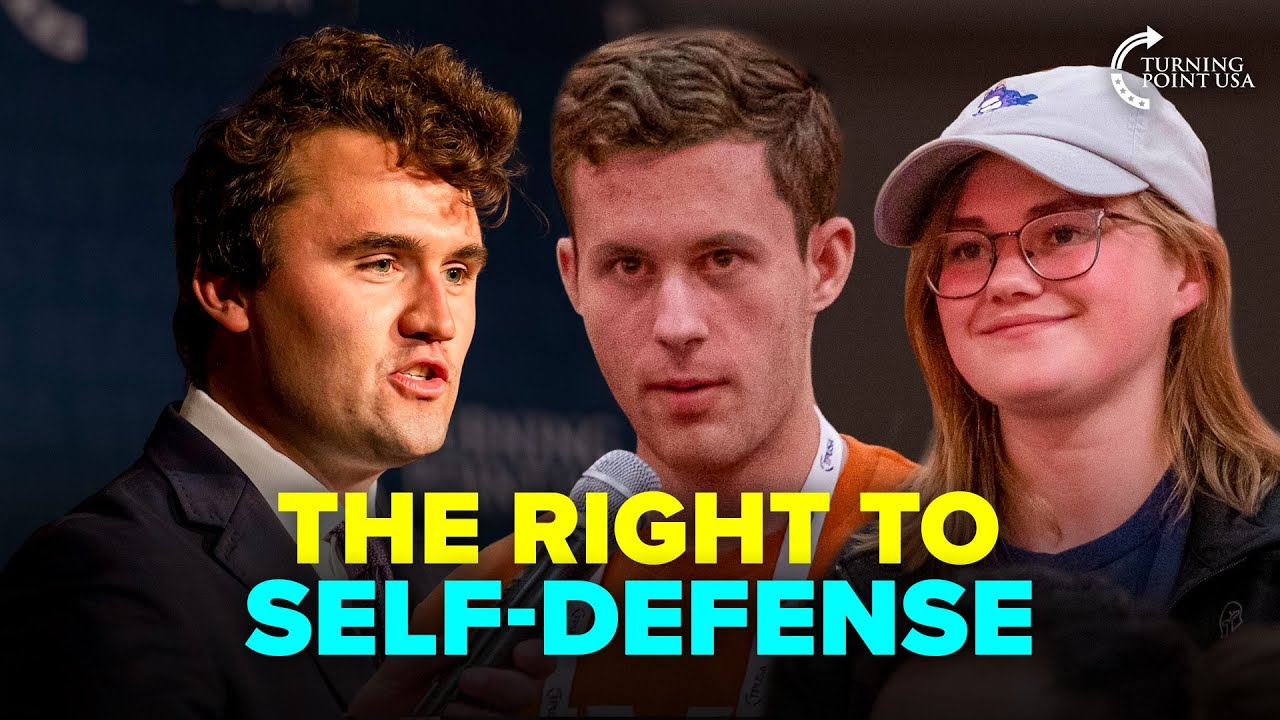
Charlie Kirk Debates Student on Gun Control, Federal Registry, and Second Amendment Rights
Enjoying this? Share it with someone who needs to see it.
Up Next
Charlie Kirk Breaks Down Gun Violence Statistics and Why Semi-Automatic Rifle Bans Miss the Point
2:39
The True Purpose of the Second Amendment: Defending Against Tyranny, Not Just Hunting or Self-Defense
2:14
Charlie Kirk Debates Gun Control and Immigration with Kansas State University Students in Manhattan
11:03
Charlie Kirk Debates Student on Gun Control, Federal Registry, and Second Amendment Rights
Charlie Kirk engages in a thoughtful debate with a student who supports gun control measures including red flag laws and a federal gun registry. The student argues these measures would protect citizens and law enforcement, while Kirk counters that gun registration leads to confiscation and that historical evidence from totalitarian regimes proves an armed citizenry protects liberty. The conversation explores the balance between rights and responsibilities, comparing gun ownership to voting rights, examining state-level gun law effectiveness, and discussing specific cases like domestic violence convictions. Kirk ultimately argues for looser gun laws, emphasizing that government intervention causes more harm than good when it comes to Second Amendment rights.
A student approached Charlie Kirk with concerns about gun control, arguing from a perspective of protecting American citizens. The student expressed support for more gun control regulations, citing school shootings and believing the Second Amendment itself qualifies the need for gun regulations. Kirk began by asking a fundamental question: whether the student viewed gun ownership as a right or a privilege.
The student responded that gun ownership is a right but comes with responsibilities, advocating for measures like red flag laws. The student specifically referenced Attorney General Pam Bondi's decision to restore Mel Gibson's gun rights despite a 2011 guilty plea to battery domestic violence charges, arguing that people who commit violent crimes should not be able to purchase guns.
Red Flag Laws and Their Implications
Kirk asked the student to describe what would constitute a red flag in their perfect world. The student suggested looking into medications that could affect someone's mental state, though acknowledging Kirk's point that this could be dangerous and potentially result in veterans losing their weapons. The student clarified the primary goal was preventing future shootings rather than broadly disarming people on medication.
The conversation then turned to the concept of a federal gun registry. The student argued this would help law enforcement officers know what guns people possess, particularly when responding to domestic calls—which the student identified as the most dangerous calls officers face. Kirk acknowledged the student was approaching the issue from a good perspective but remained skeptical of the proposal.
The Purpose of the Second Amendment
Kirk posed a critical question: what is the ultimate and final purpose of the Second Amendment? The student responded that it's self-defense against a tyrannical government, to which Kirk agreed. However, the student then argued that the Second Amendment itself implies high regulations, pointing to the phrase "well regulated militia" in the amendment's opening words.
Kirk countered that "well regulated militia" actually meant "well-armed," citing the Federalist Papers and the Heller decision—a 5-4 Supreme Court ruling that affirmed gun ownership as an individual right. The student questioned how Kirk could interpret what the Founding Fathers meant, to which Kirk responded that the founders explained their intentions in their own writings.
The Federal Registry Debate
When asked directly about his position on a federal gun registry, Kirk stated without hesitation that he disagreed with the concept. He explained that the only reason to register guns is to later confiscate them. The student pushed back, reiterating that a registry would protect law enforcement officers by informing them what weapons they might encounter on dangerous calls.
Kirk acknowledged this as a good argument but maintained that the problem with government knowing where every gun is located would lead to mass confiscation. He emphasized that a well-armed citizenry is the greatest protector of liberty and freedom in the country, even though the military possesses superior weaponry like drones and tanks.
The student conceded this was a good argument but suggested it was flawed, pointing out that in several instances citizens have been able to protect themselves. Kirk agreed that an armed population is much harder to control, reinforcing his position against a federal registry.
Comparing Gun Rights to Voting Rights
The student introduced a comparison between gun ownership and voting, both of which they agreed are rights. The student pointed out that to vote in America, citizens must first register with the government—a form of federal registration. The student asked why gun ownership shouldn't require similar registration, especially since keeping elections safe by preventing ineligible people from voting is analogous to keeping America safe by regulating gun ownership.
Kirk acknowledged this as a fair point but noted a technical difference between voter registration rolls and gun registration. He argued that guns would be targeted for confiscation much more aggressively than voter rolls. His worldview, he explained, comes from studying 20th century history, where almost every totalitarian government first confiscated guns, which then led to the erosion of freedom and liberty.
The student countered by noting that in the 20th century, the disparity between civilian and military technology was much smaller than today, making the armed citizenry argument less applicable to modern times. Kirk acknowledged this as a fair point while maintaining his position that an armed citizenry remains important, especially given the Constitution's phrase "shall not be infringed."
State-Level Evidence and Real-World Examples
Kirk shifted to discussing the relationship between gun laws and violence, using specific examples. He compared Houston and Chicago—cities with comparable populations—noting that Houston, despite having warmer weather (which potentially leads to more gang violence), has about half or fewer homicides per year than Chicago. Houston has much less strict gun laws than Chicago, which has incredibly strict gun regulations.
The student responded that surrounding areas of Chicago have more lenient gun laws, suggesting this contributes to Chicago's violence problem rather than the city's own regulations being ineffective. Kirk indicated he'd heard this argument many times before but remained unconvinced.
Violent Crime Convictions and Gun Rights
Returning to the Mel Gibson case, the student pressed Kirk on whether someone who committed domestic violence should have their gun rights restored. Kirk stated he had met Mel Gibson and believed he should be able to own a gun, questioning whether rights should be permanently taken away for something that happened 14 years ago when he didn't know all the details.
The student emphasized that Gibson literally pleaded guilty to the charge. Kirk found permanently removing rights for a past offense to be an infringement on basic rights. The conversation then moved to a broader principle: should anyone convicted of a violent crime ever be able to own guns again?
The student clarified their position—absolutely not for those committing violent crimes, emphasizing the goal of protecting Americans. Kirk questioned whether the federal government should be trusted to protect citizens from themselves regarding guns. The student clarified the goal wasn't about the government taking away guns but rather allowing government to protect citizens, noting they were a gun owner themselves who hunts and was competitive in shooting sports.
Examining State Gun Laws and Registries
Kirk asked which state had gun laws most appealing to the student's worldview. The student admitted not knowing specific state laws in detail but emphasized the value of a federal registry for protecting law enforcement officers, particularly during domestic calls—the most dangerous calls officers respond to.
Kirk pointed out that an informal registry already exists, as gun dealers are supposed to report sales. The student questioned whether dealers actually report all the time, to which Kirk agreed they obviously don't. When the student asked if a formal registry would eliminate that problem, Kirk returned to his central argument: you register in order to confiscate, and registration is a prerequisite toward confiscation.
The student characterized this as a slippery slope argument. Kirk reframed it as a historical argument, pointing to evidence throughout totalitarian dictatorships in the 20th century where governments first created registries of weapons they wanted to collect before confiscating them. Despite their disagreement, Kirk acknowledged the student was arguing in good faith.
The Case for Looser Gun Laws
Kirk revealed he tends toward a more libertarian position on this issue, even though he doesn't identify as libertarian overall. He argued that America actually needs looser gun laws, particularly in states like Illinois where very basic Second Amendment rights are restricted.
Kirk provided a specific example: in states like Rhode Island or New York, it could take a woman upwards of 30 days to get a gun. If a man threatens her and police won't intervene, Kirk argued she should be able to purchase a gun that same afternoon to protect herself. The student agreed with Kirk in that specific regard.
The Abuse of Red Flag Laws
Kirk returned to the issue of red flag laws, arguing there have been case after case of abuse. He cited examples of veterans having their weapons taken away because of false or faulty accusations claiming they were mentally unbalanced. The student asked whether investigations could examine factors like medications, noting that many anti-depressants can change brain chemistry.
Kirk's concern centered on the process: authorities take the guns away first and ask questions afterward. He described this as a difficult edge area of the law where he tends to err on the side of gun ownership being a right. Kirk expressed respect for the student's position while maintaining that government makes more mistakes than corrections in this specific area.
Final Position: Rights Over Regulation
Kirk concluded by stating his fundamental principle: the downside to having more guns in civilian hands is far better than the downside of having only the government possess guns. This encapsulated his core argument throughout the debate—that historical evidence, constitutional principles, and practical considerations all point toward protecting gun rights rather than expanding regulations, even when those regulations are proposed with good intentions of protecting citizens and law enforcement.