Charlie Kirk Defends Free Market Economics Against Stanford Student's Challenge on Economic Nationalism and Property Rights
Enjoying this? Share it with someone who needs to see it.
Up Next
Charlie Kirk Challenges College Student Who Questions His Qualifications and Accuses Him of White Supremacy
7:10
Charlie Kirk on Bill Gates Buying Idaho Farmland and the Future of Land Ownership in America
3:10
Charlie Kirk and Randy Perez Clash on Education, Race, and Economic Freedom at Arizona State University Debate
1:03:06
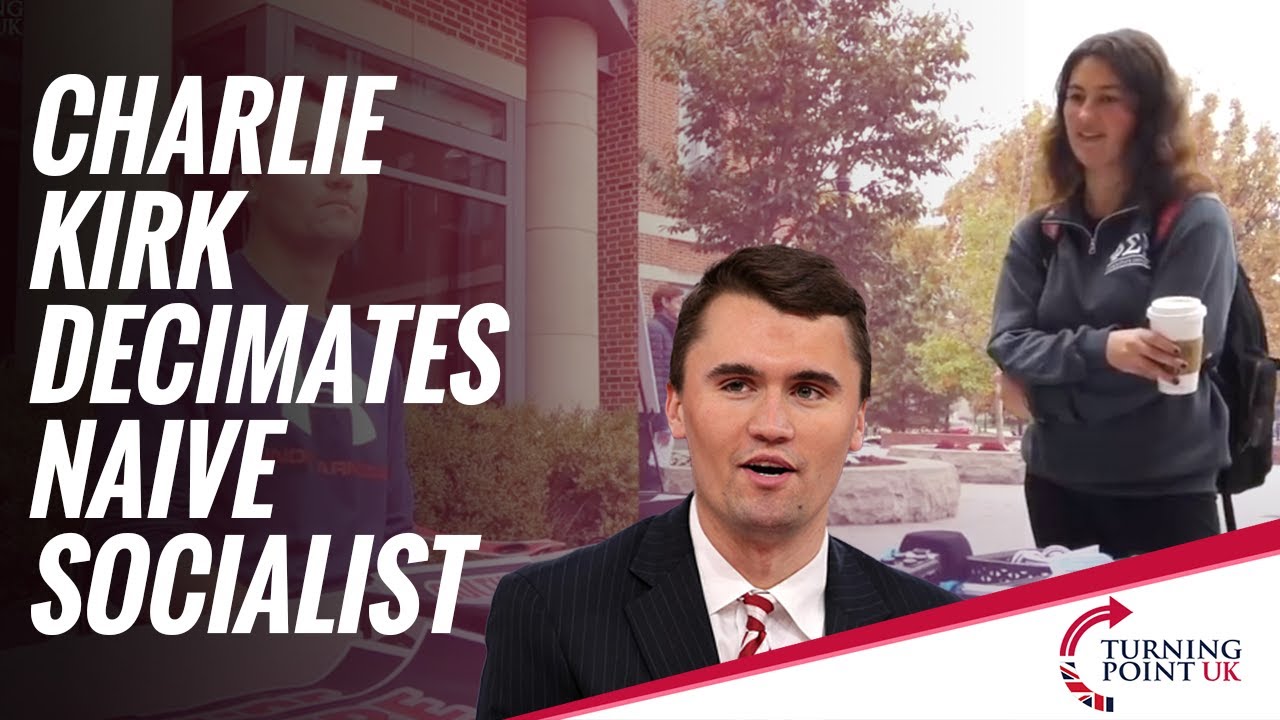
Charlie Kirk Defends Free Market Economics Against Stanford Student's Challenge on Economic Nationalism and Property Rights
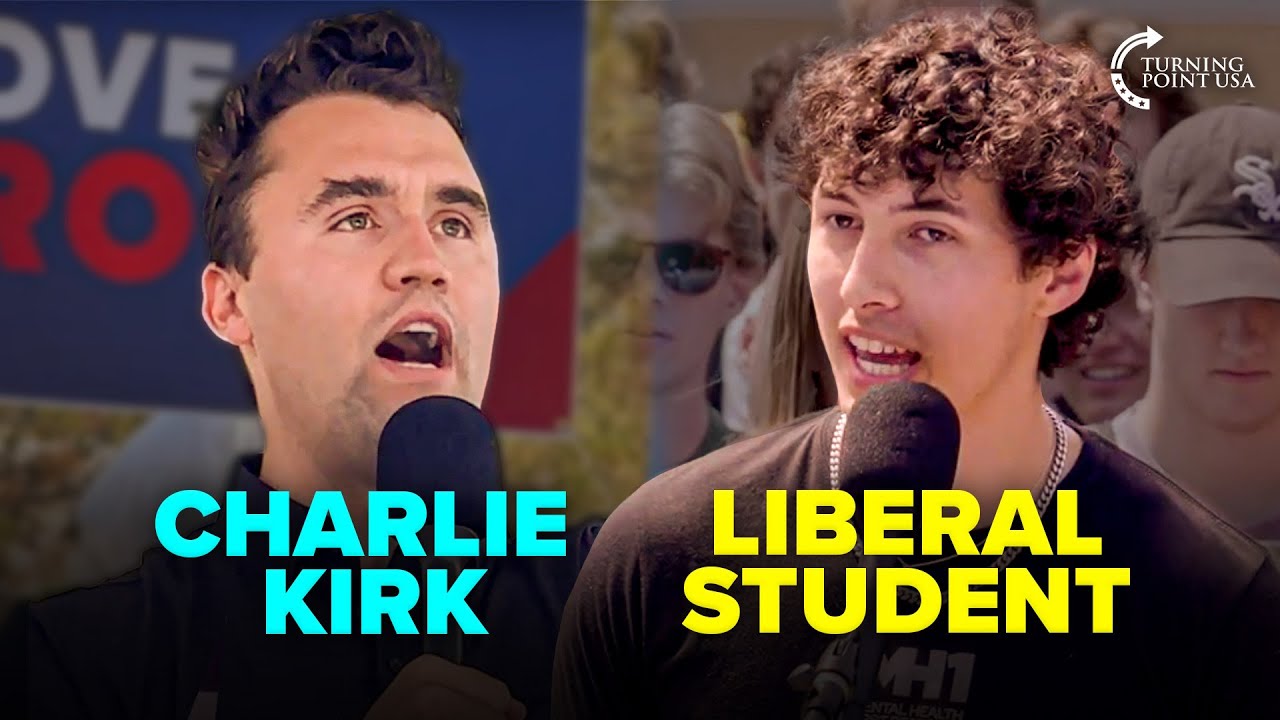
Charlie Kirk faces pointed questions from a Stanford economics major about apparent contradictions between free market principles and economic nationalism. The exchange explores whether markets truly outperform government intervention in resource allocation, with specific debates on squatter's rights and educational monopolies. Kirk argues that market-based solutions consistently deliver better outcomes across all sectors, pointing to Baltimore's failing public schools as evidence that government monopolies fail where competitive markets succeed.
The Challenge: Economic Nationalism Versus Free Markets
A Stanford economics student named Devin confronted Charlie Kirk with what he saw as a contradiction in conservative economic thinking. The student, who identifies as being on the left, questioned how economic nationalism—a concept outside orthodox economic thought—could coexist with the Milton Friedman-style free market principles that conservatives claim to support.
The student also raised a second challenge regarding property rights and resource utilization. He recounted a debate with Stanford College Republicans where he argued that according to orthodox economics, when resources like land, labor, or capital are underutilized, the government acts efficiently by redistributing those resources. The response he received suggested that free markets are acceptable only when they don't conflict with certain ideological beliefs—which, he argued, isn't true free market thinking.
Kirk's Response on Government Efficiency
Rather than directly addressing economic nationalism first, Kirk volleyed back with his own question: Does Devin truly believe that government is more efficient at using idle land, capital, and labor than the market, based on pure economics and utilitarian models?
When Devin cited squatter's rights as a specific example—where government allows people to claim unused property after six or seven years without actually seizing it—Kirk pushed back. He argued that if land is privately owned, allowing squatters to claim it because the owner isn't "using" it in a visible way constitutes a value imposition on the property owner. The owner might be storing capital or planning future use. Kirk stated he would argue strongly against squatter's rights on these grounds.
The Market Always Outperforms Government
Kirk then presented his broader economic philosophy: the market is and always will be better at utilizing labor, capital, and land than government could ever be. He argued that markets are more efficient and more widespread in their benefits.
According to Kirk, the market excels at three things:
Bringing prices down
Bringing quality up
Making accessibility expand horizontally
He claimed this pattern appears in every sector where markets are allowed to exist. Quality increases, prices decrease, and more people gain access to goods and services.
Applying Market Solutions to Structural Problems
Kirk explained that his approach involves applying market-based solutions to virtually every problem, whether in education, technology, or finance. The goal is to incorporate timeless free market principles into structural problems.
The Baltimore Schools Example
To illustrate government failure versus market success, Kirk pointed to inner-city education—a topic frequently discussed by Candace Owens. He described how government currently holds a quasi-monopoly on education, which prevents bad teachers from being fired.
Kirk cited Baltimore city schools as a stark example of government monopoly failure. It costs $24,000 per pupil to educate a student in Baltimore, yet an independent study found that in 13 Baltimore schools, not a single student could be found who was proficient in math or reading.
This, Kirk argued, represents a failed government monopoly. When conservatives look at such problems, they ask how market-based principles—which have historically improved living standards and reduced prices—can be incorporated into government-structured problems.
School Choice as Market Solution
Kirk advocated for school choice and voucher systems as the market-based solution to educational failure. These systems would allow parents to choose where their children attend school, introducing competition into communities.
He noted a striking cost differential: Catholic schools better educate students at $9,000 per year, while government schools poorly educate students at $24,000 per year. This comparison, in Kirk's view, demonstrates the superiority of market-based approaches even in traditionally government-dominated sectors.