2,279 videos 1,365,173,983 views US Joined Aug 30, 2018
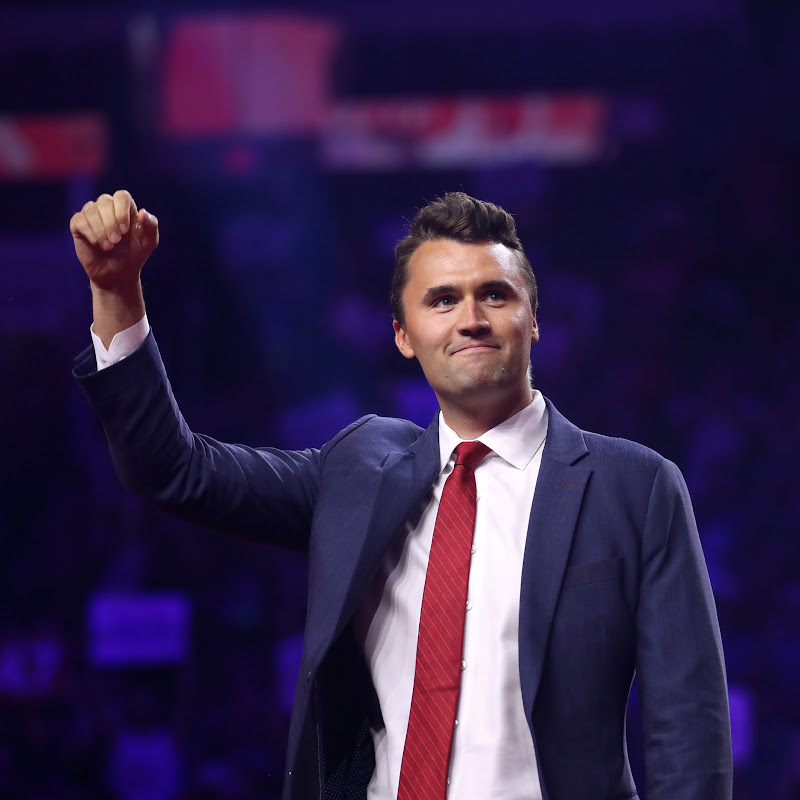
Charlie Kirk is the Founder and President of Turning Point USA, the largest and fastest growing conservative youth activist organization in the country with over 250,000 student members, over 150 full-time staff, and a presence on over 2,000 high school and college campuses nationwide. Charlie is also the Chairman of Students for Trump, which aims to activate one million new college voters on campuses in battleground states in the lead up to the 2020 presidential election. His social media reaches over 100 million people per month and according to Axios, he is one of the "top 10 most engaged" Twitter handles in the world. He is also the host of “The Charlie Kirk Show,” which regularly ranks among the top news shows on Apple podcast charts.
Charlie Kirk Defends Trump 2.0, Debates College Critics on Education, Immigration, and Conservative Values on Campus
Charlie Kirk faces tough questions from college students on a campus tour, defending President Trump's second term against claims he's abandoned his 2016 outsider status. Kirk argues Trump 2.0 is even better than the first term, pointing to border crossings dropping from 11,000 to 124 daily and the firing of 300,000 federal employees. Students challenge him on everything from Trump accepting mega-donor money to the contradiction between being pro-life and supporting the death penalty, while Kirk makes his case for abolishing the Department of Education and exposing how colleges have become left-wing indoctrination centers.
Trump Supporter Questions the Former President's Transformation
During a campus tour Q&A session, Charlie Kirk encountered a student who challenged him on President Trump's evolution from 2016 to 2024. The student pointed out that Trump famously criticized donors and special interests during the 2016 Republican primary, even tweeting that Sheldon Adelson wanted to mold Marco Rubio into his "perfect little puppet." Yet in 2024, Trump not only appointed "Little Marco" as Secretary of State but also accepted $100 million from Miriam Adelson, Sheldon's widow.
Kirk acknowledged that Trump was self-funded in 2015 but countered that candidates need to finance campaigns somehow. When pressed on whether Trump still represents the anti-establishment outsider from 2016, Kirk made a strong case that Trump 2.0 is actually superior to the first term. He cited concrete achievements: firing 300,000 federal employees, eliminating USAID, border crossings plummeting from 11,000 to 124 daily (a 95-98% decrease), and mobilizing the military to run the southern border while designating cartels as foreign terrorist organizations.
The student, who abstained from voting, continued to press on the border wall promise. Kirk explained that while the wall was blocked by federal judges during the first term, Trump has found more creative solutions in his second term, including military deployment and executive actions that have proven even more effective at stopping border crossings than physical barriers alone.
Social Work Student Navigating Conservative Values in Liberal Field
McKenzie, an aspiring social worker interested in helping foster kids and supporting the pro-life movement, asked how to make the best of her college experience when "college is a scam." Kirk acknowledged her predicament, advising students who must attend college to choose the least expensive option and graduate quickly. He noted that half of college graduates end up in jobs that don't even require their degree.
Kirk warned McKenzie that social work is an extremely left-wing field because practitioners are constantly surrounded by sad stories and people needing help. The automatic assumption becomes that bigger government is the solution. Kirk offered a conservative counter-perspective: instead of big government, we need strong families. Instead of growing the state, we need more fathers in homes. Instead of permanent government assistance programs, we need more people attending church and believing in the divine dignity of every individual.
He encouraged McKenzie to hold onto her conservative principles even when immersed in a field that assumes government intervention is always the answer. While conservatives share the compassion to help those with less—a Christian calling—they believe permanent government dependency is the wrong approach to addressing poverty and social problems.
The Economics of Women at Work and Grading Discrimination
Camden raised concerns about liberal bias on campus, specifically mentioning he's taking a required course called "Economics of Women at Work" where he's the only conservative who believes the gender pay gap is a myth. He described feeling graded differently when expressing views contrary to the assumption that a gender pay gap exists.
Kirk seized on this example as proof that "college is a scam," arguing students shouldn't be forced into debt to study things that aren't true. He explained that part of the problem is taxpayer funding—President Trump is now waging war against the college cartel by threatening to withhold federal money from schools teaching critical race theory and DEI ideology.
The other problem, according to Kirk, is that many professors have never done anything in the real world. They've lived in circles of abstractions their entire lives. When asked about tuition costs, Camden revealed he pays around $20,000 annually with in-state tuition and Bright Futures scholarship assistance. Kirk suggested that money could be better spent experiencing other cultures, getting jobs, and doing things outside academic walls rather than sitting in classrooms learning ideologically driven falsehoods.
The Changing Employment Landscape and College's Declining Value
Kirk shared insights from his experience employing a thousand people at Turning Point USA: employers don't care where you went to college. They care about whether you can do the job. He described a fundamental shift happening in the workplace—moving away from the broken, outdated college model toward something more like sports teams, where the focus is on skill and what you bring to the table, not credentials or how long you spent in school.
This emergence of a "free agent system" based on skill and merit represents a major challenge to the college cartel's business model. Kirk believes colleges will be the last institutions to adjust to this new reality, continuing to charge exorbitant fees for increasingly irrelevant credentials while the job market moves on without them.
Reconciling Pro-Life Beliefs with Support for Capital Punishment
Camden posed a theological and philosophical question: how can someone be both pro-life and support the death penalty? Kirk responded with a hypothetical scenario involving a pregnant woman and a death row inmate who murdered five people. The crucial difference is agency and innocence—the unborn baby did nothing wrong, while the murderer used his free will to take five lives.
Kirk cited biblical support, noting that the only law repeated in all five books of the Torah is that if you take a life, your life will be taken. When Camden countered with the example of Paul, who killed Christians before writing 13 books of the Bible, Kirk acknowledged that Paul repented and became an amazing disciple, but the principle of ultimate justice administration remains.
Kirk argued that society has a twisted moral equivalency problem: bleeding heart liberals feel more sorry for death row inmates than for babies in the womb who never had a chance to live. While America slaughters over 1.5 million unborn babies annually, there's excessive sympathy for those who committed heinous crimes. Kirk believes the death penalty should be used rarely and sparingly but administered quickly. He even suggested bringing back public executions for certain crimes as a statement against the worst crimes humanity can commit.
Using Luigi Mangione as an example—someone who allegedly killed a healthcare CEO in the streets of New York—Kirk argued this warrants the death penalty. The key distinction remains: the life in the womb has hurt nobody, while the person on death row definitionally has taken another person's life.
The Department of Education Debate with an Illinois Transplant
Anderson, who moved from a well-off Chicago suburb (Arlington Heights area, attended MacArthur Middle School), challenged Kirk on the Republican Party's stance on eliminating the Department of Education. Having experienced quality education in a well-funded Illinois district, Anderson argued that having a federal tool to keep schools accountable based on curriculum is more valuable than abolishing the department despite its problems.
Anderson presented the coal mining town example: shouldn't the federal government ensure that kids in a coal mining town learn more than just mining, while kids in New York City learn about markets and higher education? Without federal standards, isn't it unfair to children born into economically limited areas?
Kirk acknowledged the appeal of this argument but explained why it's both impractical and bad policy. First, anything starting in Washington DC with good intentions will be taken over by woke ideology—the "cancer" that metastasizes through institutions. He pointed to the ongoing battle to remove woke ideology from the Marines and Air Force: if we can't keep the Marines from becoming woke, there's no chance of keeping the Department of Education free from it. Education naturally attracts more left-leaning people, making this problem inevitable.
The Administrative Bloat Destroying American Education
Kirk revealed shocking statistics about education employment: of 11 million people in taxpayer-funded education jobs, only about 6.7 million are actually teachers. The remaining 4-plus million are administrators, career counselors, and paper pushers. This isn't a war on teachers—it's a war on the administrative bloat that consumes education budgets without supporting frontline educators or improving student outcomes.
Since the Department of Education was created in 1979, literacy has declined, math scores have dropped, and reading comprehension has fallen. America now ranks around 26th internationally in education despite spending $250 billion annually on the federal Department of Education. Most of that money goes to administrative paperwork, not actual instruction.
Kirk shared a stunning fact: most high school students graduate without having read an entire book cover to cover. They read snippets, chapters, and excerpts from readers, but not complete works. This represents a fundamental failure of the education system to develop well-rounded citizens.
The Constitutional and Philosophical Case Against Federal Education Control
Kirk presented two arguments against federal involvement in education. First, it's not constitutional. Article 1, Section 8 of the US Constitution enumerates 17 things the federal government can do—education is not among them. Americans have made too many exceptions for "the government should do this, the government should do that" without constitutional basis, leading to bloated federal agencies that shouldn't exist and don't perform well.
Second, federal involvement in education violates the proper purpose of learning. Kirk argued that education isn't just career preparation—it's about the growth of the soul and nurturing good citizens. In the ideal sense, education should involve reading really old good books, understanding ancient philosophy, and becoming well-rounded in what is good, true, and beautiful. The hyper-specialization of the modern education system has been dreadful.
Kirk also argued that the federal government shouldn't impose values on local communities. Inevitably, left-wing ideology gets imposed on Christian and conservative communities that have different views. The solution isn't federal mandates but state-level control, as existed in the 1950s, 60s, and 70s when America had much higher literacy rates and better math scores.
School Choice as the Free Market Solution
Anderson mentioned his sister works at a Montessori school and supports school choice but believes first-party government schools should maintain certain standards. Kirk agreed that competition in education is beneficial and pointed to Florida's robust school choice program as proof the model works.
However, Kirk redirected the conversation: the type of top-down involvement Anderson wants should happen at the state level in Tallahassee, not in Washington DC. The key is getting the federal government out of education entirely while empowering families through school choice programs that allow parents to send their children to the schools that best fit their values and educational philosophy.
Kirk emphasized that well-funded doesn't mean well-educated, pointing out that Anderson's Illinois district was heavily funded through very high property taxes. More money doesn't translate to better outcomes when the system is structurally broken and ideologically captured.











Comments
Be the first to comment on this video.