2,422 videos 1,389,747,653 views US Joined Aug 30, 2018
Charlie Kirk is the Founder and President of Turning Point USA, the largest and fastest growing conservative youth activist organization in the country with over 250,000 student members, over 150 full-time staff, and a presence on over 2,000 high school and college campuses nationwide. Charlie is also the Chairman of Students for Trump, which aims to activate one million new college voters on campuses in battleground states in the lead up to the 2020 presidential election. His social media reaches over 100 million people per month and according to Axios, he is one of the "top 10 most engaged" Twitter handles in the world. He is also the host of “The Charlie Kirk Show,” which regularly ranks among the top news shows on Apple podcast charts.
Charlie Kirk Defends Trump's Birthright Citizenship Order Against Conservative Student's Challenge on Campus
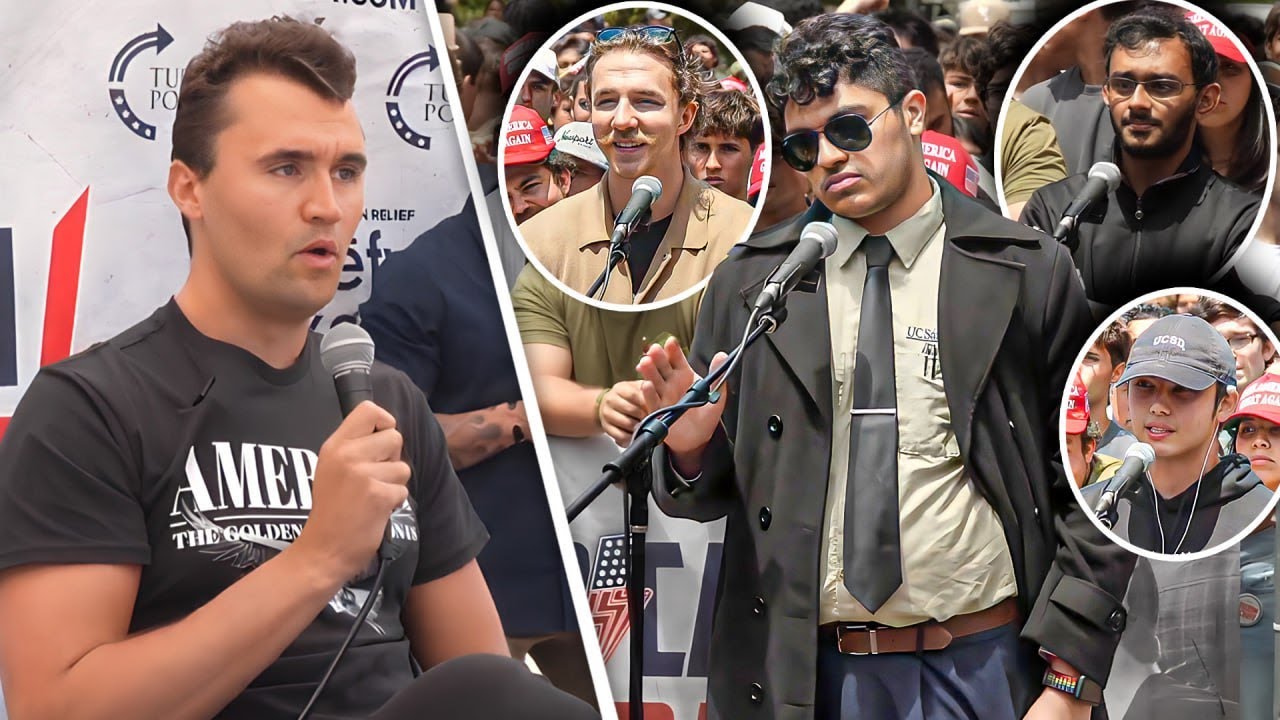
Charlie Kirk faces a passionate debate with a self-described conservative student over President Trump's executive order challenging birthright citizenship. The student argues that ending birthright citizenship contradicts 200 years of legal precedent and America's identity as a nation of immigrants. Kirk counters that America is a nation of settlers, not immigrants, and that birthright citizenship has been wrongly extended beyond its original intent in the 14th Amendment. The exchange highlights a fundamental disagreement among conservatives about what defines American citizenship and whether generosity toward immigrants has become a liability rather than a strength.
The Challenge: A Conservative Questions Birthright Citizenship Policy
During a campus visit, Charlie Kirk encountered a self-identified conservative and proud American student who came to challenge him on one specific issue: President Trump's executive order to overturn birthright citizenship. The student referenced Kirk's post on X from two months prior, claiming Kirk had stated the Supreme Court never reviewed the 14th Amendment regarding birthright citizenship. The student cited two Supreme Court cases—Wong Kim Ark and another—asserting both ruled that children of immigrants, regardless of national origin, become U.S. citizens.
Kirk clarified that his statement wasn't quite accurate as presented, acknowledging he was drawing from memory with a shallow understanding of those specific cases. However, he stood firm on his broader point: the exception for diplomats exists, but children of visitors—not just immigrants—become U.S. citizens under current interpretation. He illustrated this with a concrete example: a pregnant Chinese woman could arrive on a 90-day visitor visa at eight months pregnant, give birth in an American hospital, and her baby would automatically receive U.S. citizenship and a passport.
Settlers vs. Immigrants: Reframing America's Foundation
When the student declared pride in America being "a country of immigrants," Kirk immediately pushed back with a critical distinction. "No, we're not. We're a country of settlers, not of immigrants," he stated. Kirk explained that settlers are people who build a new country in barren territory, while immigrants come to a country already built. According to Kirk, the people who founded America went west to unconquered, barren land and built a new society from scratch. Immigrants helped enrich and grow what was built, but the foundation of America came from settlers, not immigrants.
The student countered that America lacks a unifying religion, race, or national origin, arguing that what Americans share is that anyone born on American soil has an inherent birthright to the benefits of citizenship. Kirk dismissed this as a huge mistake, challenging whether the Founding Fathers would have wanted a pregnant woman to cross the ocean and have her child automatically become a U.S. citizen simply by being born on American soil.
The 14th Amendment Debate: Original Intent vs. Current Application
The student pointed out that those who drafted the 14th Amendment in 1866 intended birthright citizenship. Kirk acknowledged this was well past the founding era and noted the 14th Amendment was largely applicable to freed slaves. The student agreed with the original purpose but noted it has been extended by the Supreme Court to others who come here. Kirk's response was direct: "Exactly. You're right. It has been wrongly extended."
Kirk drew a parallel to Roe v. Wade, pointing out the Supreme Court can get things wrong, and that wrong decision was eventually repealed. He argued that allowing anyone to fly from Paris on Delta Airlines and have their child automatically become a U.S. citizen devalues the meaning of citizenship itself.
Children Born to Illegal Immigrants: Accountability and Consequences
The student raised a moral question: Should children who did not choose to come here be held accountable for their parents' actions? Some countries, the student began to argue, don't grant citizenship based on birth. Kirk responded that if someone is already a citizen, they remain a citizen—there would be no revocation of existing citizenship. However, once the Supreme Court decision is overturned, the policy would change going forward.
The student raised concerns about creating a class of stateless children—those who wouldn't be citizens of another country either. Using India as an example, the student noted that a child born in America to Indian parents wouldn't be a citizen of India nor of America under Kirk's proposed system. Kirk disputed this, asserting that citizenship goes through the parents in India, making the child an Indian citizen who could return to India with their family.
Kirk's position was clear: children should be deported with their parents as soon as they're born. When asked if America shouldn't encourage these children to become productive members of society, Kirk responded by asking if the student believes in the American Dream. When the student said yes, Kirk clarified: "For American citizens, not for every person around the planet."
The American Dream: Who Gets Access?
Kirk emphasized it's not America's job to open borders to every sad story around the planet. The student agreed regarding adults but maintained that children who didn't choose to cross the border shouldn't be punished. Kirk's solution was straightforward: don't punish children by separating them from their parents—the entire family can return to their country of origin together.
The student protested that this isn't the current law or how things have been done. Kirk clarified they were discussing two different things: birthright citizenship and children who cross the border after they're already born. He praised President Trump's executive order as phenomenal, stating it returns to a basic question: What does it mean to be a citizen? According to Kirk, citizenship is being thrown around "like frisbees" every day, diluting its meaning. "We need to bring it back to actually say, hey, you have to earn your citizenship. You are not given your citizenship," Kirk declared.
Generosity Turned Against Us: When Virtue Becomes Vice
The student continued to argue that children don't choose their circumstances—there's no accountability for a child who didn't choose to be born to someone here illegally versus someone who is already a citizen. Kirk compared this to children in Namibia who didn't choose to be born there either, stating it's not America's concern. The student countered that the great thing about America is that by being here, the country offers opportunity.
Kirk disagreed, suggesting this generosity has been turned into a compromise of American values and used against the nation. "Generosity can turn into an overindulgence," Kirk explained. "You could become too generous where you are borrowing money that you don't have." He applied this to citizenship, arguing that America is giving citizenship where it dilutes meaning. While acknowledging America is a generous nation, Kirk warned that "our virtues have become our vices."
What Does Birthright Citizenship Actually Dilute?
When pressed on what exactly birthright citizenship dilutes, Kirk provided specific answers. First, it dilutes the experience and value for legal immigrants who are full adults and had to apply to come to America through proper channels. The student agreed illegal immigration should stop, but Kirk was making a broader point about legal immigration as well.
Second, Kirk stated he wants the idea of being a U.S. citizen to mean that you're here or born here because your parents did something to allow you to be here—not just that someone got on a non-stop flight from Seoul, South Korea, and their water broke, suddenly making their child a U.S. citizen. This devalues the entire meaning of citizenship, according to Kirk.
He emphasized that everybody in America has a unique story of what their parents or ancestors did to allow them to live in the country—that's the social compact. Some people's ancestors came in the 1700s, others in the early 1900s. But if people can gain entry and cut in line through birthright citizenship, it dilutes the sacrifices of previous generations, primarily the Greatest Generation from World War II. Kirk concluded that allowing birthright citizenship for anyone born on American soil is "an insult to them to say that we can live in a free society." The audience applauded as Kirk moved to the next question.