2,422 videos 1,389,747,653 views US Joined Aug 30, 2018
Charlie Kirk is the Founder and President of Turning Point USA, the largest and fastest growing conservative youth activist organization in the country with over 250,000 student members, over 150 full-time staff, and a presence on over 2,000 high school and college campuses nationwide. Charlie is also the Chairman of Students for Trump, which aims to activate one million new college voters on campuses in battleground states in the lead up to the 2020 presidential election. His social media reaches over 100 million people per month and according to Axios, he is one of the "top 10 most engaged" Twitter handles in the world. He is also the host of “The Charlie Kirk Show,” which regularly ranks among the top news shows on Apple podcast charts.
Charlie Kirk Defends Trump's Deportation of MS-13 Gang Member Against Due Process Claims
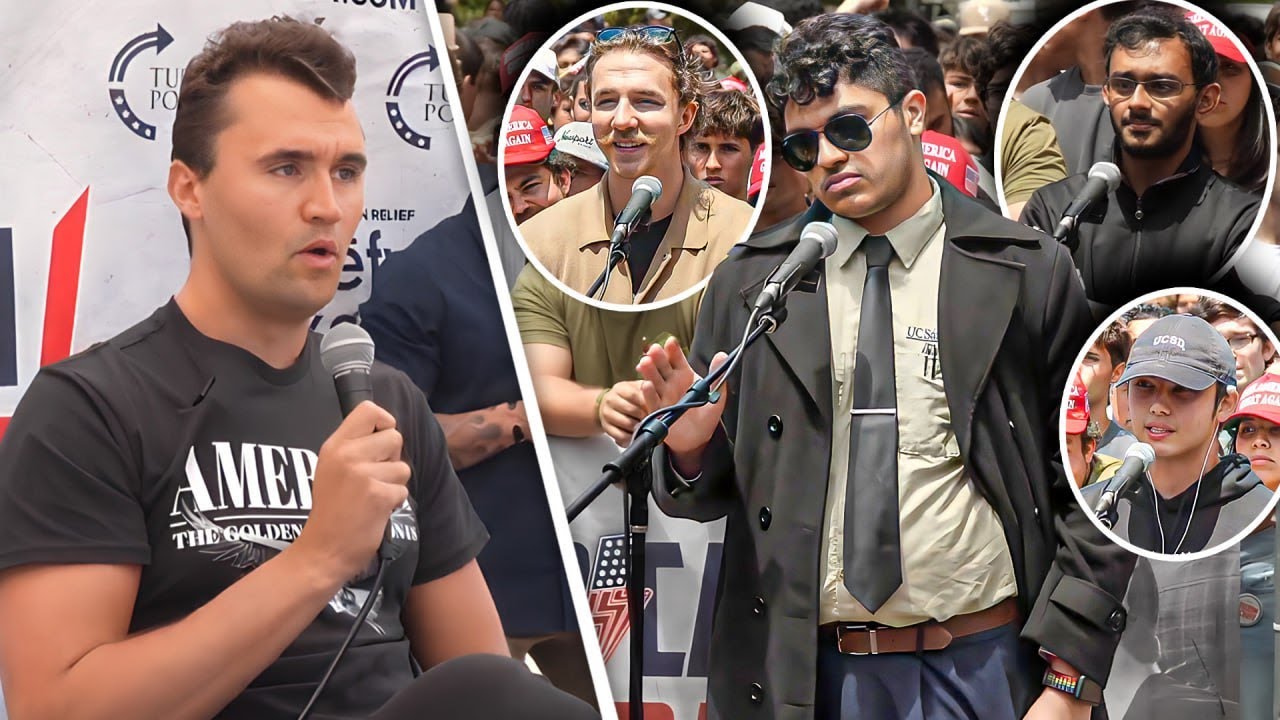
Charlie Kirk confronts a student questioning how Donald Trump can deport individuals without due process while claiming to be an American patriot. The exchange centers on the case of Abrego Garcia, an MS-13 gang member deported to El Salvador despite a Supreme Court ruling. Kirk argues the deportation was justified under the Alien Enemies Act and Expedited Removal Act, citing the invasion of MS-13 and other criminal elements into America over the past four years as grounds for executive action.
Defending Deportation Without Traditional Due Process
Charlie Kirk faced a pointed question from a student who had supported Donald Trump but expressed concern over deportations conducted without what the student believed was proper due process. The student specifically referenced the case of Abrego Garcia, an individual deported to El Salvador despite a Supreme Court ruling that allegedly ordered his return. The student asked how Kirk could call himself an American patriot when the administration deported someone the Supreme Court ruled should not have been sent to that specific country.
Kirk's response was direct and unapologetic. He questioned why an MS-13 gang member who was also accused of being a wife-beater and child abuser deserved such concern simply because of an administrative error in deportation. Kirk emphasized that American patriots should prioritize protecting American citizens over the procedural rights of foreign criminals. He challenged the student's premise by noting that the Supreme Court's 9-0 ruling did not declare the deportation itself unlawful, but rather identified an administrative error in which country Garcia was sent to.
The Supreme Court Ruling and Administrative Error
Kirk clarified the actual Supreme Court ruling, explaining that the Court did not say the deportation was illegal. Instead, the ruling stated there was an administrative error because Garcia could have been deported to any country except El Salvador. The judge had previously warned Garcia that he could be deported at any time to any country except his home country of El Salvador. Kirk pointed out the irony that if the administration had sent Garcia to the Congo, Guantanamo Bay, or North Korea, it would have been perfectly legal under the court's ruling. In that sense, sending him home to El Salvador was actually an accommodation.
The student pressed on the issue of due process guaranteed by the 14th Amendment. Kirk countered with multiple legal arguments about why traditional due process rights don't fully apply in deportation cases, especially under current circumstances.
The Alien Enemies Act and Presidential Authority
Kirk invoked the Alien Enemies Act as justification for deportations without full due process. When the student challenged this by noting the Act can only be invoked during war or invasion, Kirk argued that America has indeed been invaded over the past four years by MS-13 and other criminal organizations. He stated there is material proof of this invasion, giving the president authority to act.
Kirk further explained that the president, as commander-in-chief, has unilateral war powers to defend the country against invasion, incursion, or war. He compared this to military action, noting that a president doesn't need to go before a judge to defend America against an attack from North Korea or any other hostile force. According to Kirk, requiring court approval before acting as commander-in-chief to defend against invasion would be absurd. The president has Article 2 authority to act unilaterally in defense of the nation.
The Expedited Removal Act and Limited Due Process
Kirk cited a 2019 Supreme Court ruling under a case involving David M. Jones that established limited due process rights under the Expedited Removal Act. According to Kirk, this ruling determined that individuals within 100 miles of the border or within 14 days of entry do not receive full due process rights. This creates a legal framework where rapid deportations can occur without the lengthy trial process typically associated with due process.
Kirk then posed a practical question to the student: Should America conduct 21 million trials for all the illegal immigrants who entered during the previous administration? The implication was clear—such a process would be logistically impossible and would paralyze the immigration enforcement system.
Why El Salvador Won't Take Garcia Back
When the student insisted that the Supreme Court ruled the administration must facilitate Garcia's return, Kirk explained the practical impossibility of that order. The United States asked El Salvador to take Garcia back, and El Salvador refused. Kirk emphasized that America does not control El Salvador—it is a sovereign nation that can refuse to accept deportees.
The student seemed confused by this, asking how America could send someone to El Salvador but not bring them back. Kirk clarified that sending an El Salvadorian citizen back to El Salvador is straightforward, but forcing a sovereign nation to accept someone they don't want is beyond American jurisdiction. The Supreme Court can order the U.S. government to facilitate return, but it cannot compel El Salvador to cooperate.
Questioning the Left's Priorities
Throughout the exchange, Kirk repeatedly challenged what he called the "hyperpathological fixation" of the American left on the rights of foreign criminals while American citizens have been ignored for decades. He characterized this focus as "creepy and bizarre," questioning why a foreign gang member receives more attention and advocacy than American citizens who have suffered from illegal immigration and criminal activity.
Kirk's broader argument was that prioritizing the procedural rights of violent foreign criminals over the safety and wellbeing of American citizens represents a fundamental betrayal of patriotic duty. He framed the deportation issue not as a constitutional crisis but as a restoration of proper priorities—putting Americans first.