Charlie Kirk Dismantles White Privilege Argument Using Statistics on Race, Crime, and Asian American Success
Enjoying this? Share it with someone who needs to see it.
Up Next
Charlie Kirk Debates Critical Race Theory and Fatherhood Crisis in Black America at Campus Event
19:01
Charlie Kirk Debunks White Privilege Myth Using Crime Statistics and Two-Parent Household Data at Campus Event
7:39
Charlie Kirk Debates College Student on Socialism, Racism, and Economic Systems in America
8:20
Charlie Kirk Dismantles White Privilege Argument Using Statistics on Race, Crime, and Asian American Success
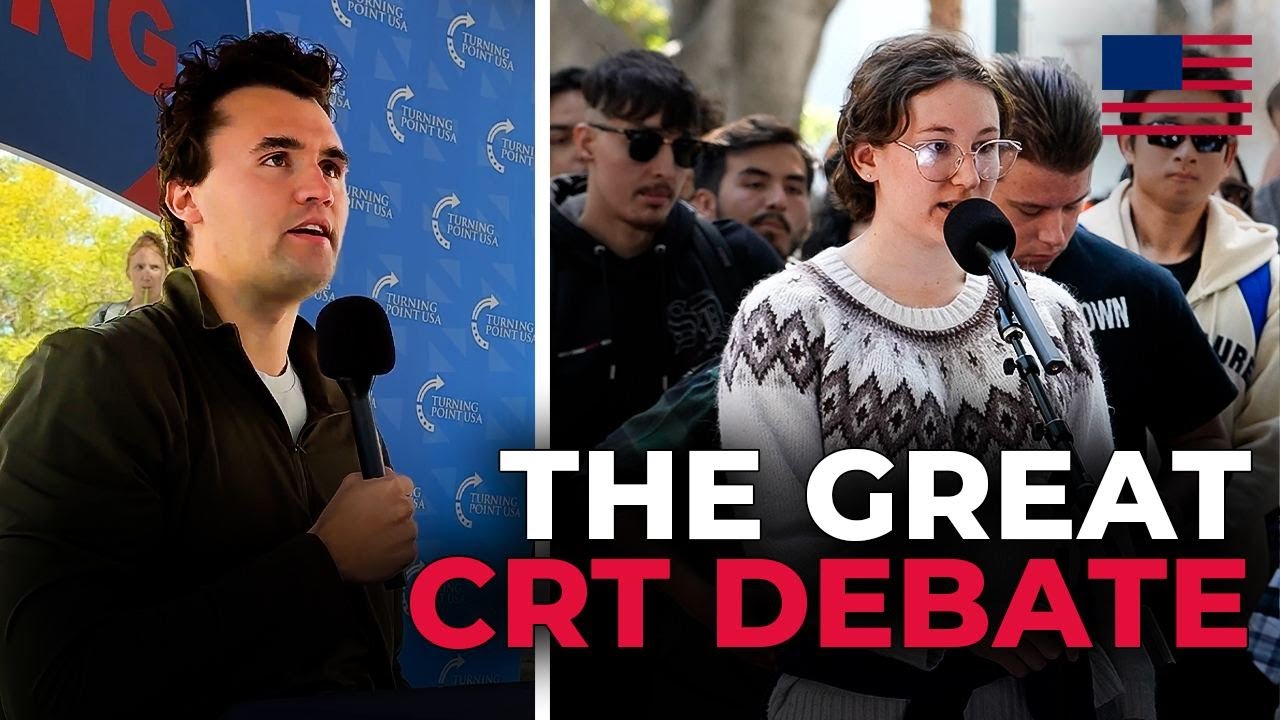
In a campus debate, Charlie Kirk challenges the concept of systemic white privilege by examining statistical realities about incarceration, crime, and economic success across racial groups. When a student argues that white privilege exists based on police brutality and discrimination, Kirk redirects the conversation to socioeconomic factors rather than race. He points to Asian Americans as the wealthiest demographic in America and references the internment camps of the 1940s to challenge the narrative of ongoing racial oppression post-Civil Rights Act. The exchange highlights a fundamental disagreement about whether economic disparities are rooted in systemic racism or other factors, with Kirk arguing that claims of a "vast white conspiracy" to oppress black Americans are unfounded.
The Opening Challenge: Does White Privilege Exist?
A student confronted Charlie Kirk with a pointed question about white privilege, asking how anyone could deny its existence given the government's history of discriminating against minorities, even after the Civil Rights era. The student requested a specific post-Civil Rights example to support Kirk's position.
Police Brutality and the Statistics Debate
The student initially offered police brutality as evidence of continuing discrimination. When Kirk asked for statistics to support this claim, the conversation shifted to incarceration rates. The student acknowledged that African Americans make up a majority of the prison population but also commit a majority of crimes and live predominantly in urban areas where crime rates are highest.
Kirk then made a critical observation: African Americans are actually under-incarcerated per capita relative to their distribution in America. The student agreed with this statistical reality.
Socioeconomic Factors Versus Racial Factors
At this point in the debate, Kirk asked the student to clarify whether the issues stem from socioeconomic conditions or race. The student initially agreed it was about economic conditions, not race. However, when Kirk pressed further, noting that the student had just admitted the issue "has nothing to do with their blacks," the student attempted to walk back the concession, claiming that race is "deeply tied" to socioeconomic status.
The Asian American Success Question
Kirk then posed a question designed to challenge the systemic racism narrative: Why are Asian Americans the richest demographic in the country if America is fundamentally racist? This question forced the conversation into new territory, as it presented a counterexample to the theory that racial minorities are systematically oppressed in America.
The student attempted to distinguish between the historical experiences of African Americans and Asian Americans, arguing that one cannot equate their histories.
Internment Camps and Historical Oppression
Kirk responded by pointing to a stark historical reality: Asian Americans were placed in internment camps in the 1940s, which he argued represented worse treatment than what African Americans experienced during that same period. He asked directly whether blacks were put in internment camps in the 1940s, to which the answer was no.
The student struggled to articulate a response, stammering through an acknowledgment that blacks have undergone oppressive conditions throughout history.
The Post-1965 Question
Kirk clarified his position: he does not deny the history of oppression against African Americans. However, he challenged the notion that this oppression continues in a systematic way after the Civil Rights Act of 1965. He rejected what he called the idea of "a vast white conspiracy to keep black people down," stating unequivocally that it "is wrong, it doesn't exist."
This exchange encapsulates a common debate on college campuses about the nature of racial disparities in America—whether they result from ongoing systemic racism or from other factors such as economic conditions, cultural differences, and historical circumstances that are no longer legally sanctioned.