Up Next
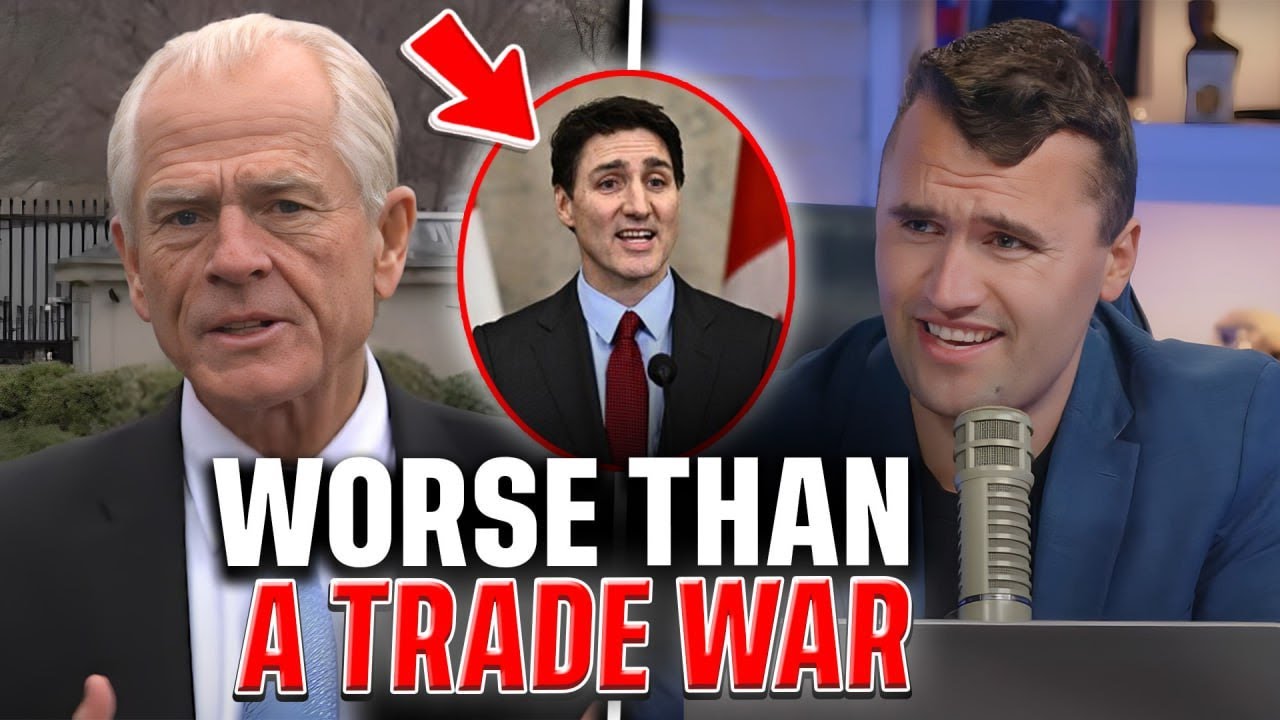
Charlie Kirk Explains Donald Trump's Strategy for Greenland and Hemispheric Dominance
5:20
Charlie Kirk and Vivek Ramaswamy Confront White Dudes for Harris and Debate Immigration at Georgia State University
44:10
Charlie Kirk Explains How Donald Trump Prevented Nuclear War Between India and Pakistan
15:17
Charlie Kirk is the Founder and President of Turning Point USA, the largest and fastest growing conservative youth activist organization in the country with over 250,000 student members, over 150 full-time staff, and a presence on over 2,000 high school and college campuses nationwide. Charlie is also the Chairman of Students for Trump, which aims to activate one million new college voters on campuses in battleground states in the lead up to the 2020 presidential election. His social media reaches over 100 million people per month and according to Axios, he is one of the "top 10 most engaged" Twitter handles in the world. He is also the host of “The Charlie Kirk Show,” which regularly ranks among the top news shows on Apple podcast charts.
Subscribe on YouTubeCharlie Kirk Explains Why President Trump's Liberation Day Tariffs Are America's Last Chance to Rebuild Manufacturing
Charlie Kirk breaks down President Trump's Liberation Day tariff strategy and why it represents America's final opportunity to reverse four decades of industrial decline. With the US trade deficit exceeding $1.2 trillion and 60,000 factories closed in just 12 years, Kirk argues that the nation faces a critical choice: endure short-term market turbulence to rebuild domestic manufacturing, or accept permanent status as a consumer colony dependent on foreign production. Kirk examines how free trade absolutism decimated the muscular class, why it now takes 62 weeks of work to support a family of four compared to 30 weeks in 1985, and how China gained superpower status while America lost 5 million manufacturing jobs.
Liberation Day: President Trump's Tariff Strategy
President Donald Trump has declared Liberation Day, announcing a comprehensive tariff strategy targeting every country that imposes tariffs on American goods. The Trump administration is planning its biggest round of tariffs yet, implementing reciprocal measures against nations that have long restricted American exports. Beyond existing tariffs on Canada and Mexico, a major wave of reciprocal tariffs is coming—tariffs imposed as retaliation for similar restrictions other countries have placed on American goods.
Examples abound: India imposes massive tariffs on Harley-Davidson motorcycles. Japan restricts big screen TV imports. The principle is simple: if America is going to be tariffed, then we will tariff back. The US trade deficit with the rest of the planet passed $1.2 trillion last year—a record high with no signs of improvement without dramatic action. America has been becoming a country that produces nothing and only buys. That trajectory ends in national bankruptcy.
A Geopolitical Restructuring on American Terms
We are witnessing a geopolitical restructuring on our terms. America faces a choice: ignore the obvious rebalancing of the international world order and continue as a consumer economy, or take action. If you are strictly a consumer economy, you are subservient and held hostage to internationalist and globalist forces. America is tired of being cheated, and President Trump has talked about this issue for decades.
As Trump has said, the messenger matters when delivering such policies. One person might say "We're going to tax you 25%" in a weak manner, while another delivers the same message with strength and conviction. We have one shot and one shot only to fix this. We have one opportunity while we are still the wealthiest nation in the world and the incumbent economic player.
The Post-World War II Consumer Economy
Post-World War II, America decided to become a consumer economy. We don't really make much in this country anymore. We make mobile apps, build homes, and have a banking sector that is robust and the best on the planet for now. But what else do we actually physically make? Some small manufacturing companies have persisted, but we signed a series of trade agreements—the North Atlantic Free Trade Agreement (NAFTA), allowed China into the WTO in the late 1990s, and decided to eliminate almost all tariffs over the last 30 to 40 years because we believed that free trade would make us richer.
While free trade has allowed us to get more stuff, has it actually made us a richer country? The political question is not just whether or not we are getting economically wealthier. It's whether or not our communities are strong, our families are staying formed, whether an average worker can afford his or her part of the American dream, and whether we have a vibrant and connected culture in our country.
The Devastation of American Manufacturing
We have lost 5 million manufacturing jobs in the last 20 years. When we lose those manufacturing jobs, when those factories are closed, there is a wage reduction for that worker by 11 to 22%. This was a bipartisan study done by Congress. When a factory worker is no longer building a dishwasher, big screen TV, or pickup truck and they find a replacement job, their wages drop significantly.
Wages for the bottom 10% have only risen 4% over the last 30 years since the World Trade Organization entrance of China and since NAFTA was passed. We have closed 60,000 factories in the last 12 years. The muscular class of this country has been completely and totally decimated, eliminated.
The American Family Economic Crisis
In 1985, it took 30 weeks of work to support a family of four—to have housing, health care, send kids to school, get a car, and save money. That meant a wife did not have to go into the workforce. She could if she wanted to, but if she wanted to be a stay-at-home mom, it made financial sense.
Now it takes 62 weeks of work for an average worker to support a family of four. This means one of two things must happen: the family has to go into debt to support a family of four, or the wife has to go into the workforce, which means the kids go to daycare. While daycare is necessary for many people, it's not ideal for many families. Many moms would prefer to be with their kids during those formative years when they're 2, 3, 4, 5, 6, 7 years old. They would prefer to be stay-at-home moms during those critical years.
Free trade absolutism has hurt our nuclear families. It has weakened our communities.
The Hardware Renaissance Window
We have one shot to fix this. There is going to be a hardware renaissance the same way we have seen a software renaissance. Advanced robotics and advanced manufacturing is going to be the new economic growth curve. Where are these tools of the future going to be built? The hardware renaissance to build the rockets, potential flying cars, and autonomous vehicles—President Trump understands that there is this window, this momentary window where we can finally rebalance and course correct the mistakes of the last 40 or 50 years.
You can only do that while you are still the incumbent economic player. As that window is starting to close, President Trump is trying to run right through it. That is what he means by Liberation Day.
The Reciprocal Tariff Question
Germany does not allow us to sell Ford vehicles in Germany without ridiculous tariffs. So why should we allow the importation of VWs, Mercedes-Benz, and BMWs? Japan is the same—why should we allow the importation of Toyota and Honda? South Korea the same—why should we allow Hyundai to dump their products into the United States?
What is about to ensue is turbulence ahead. There will be some bumps coming. But on the other side of these bumps is a recalibration of how we finance our government and how our economy is structured. If we do nothing and continue to engage in the cheap money spigot brought by unfettered free trade policies, we will have no manufacturing base. We'll be nothing but a consumerist economy where we are just a colony that buys stuff.
A country is definitionally strong based on whether or not you make stuff in your nation. If you don't, you're no longer a country. You're simply a colony that barters goods. It is a geopolitical restructuring on our terms, and President Trump has the political courage and mandate to make it happen.
The UAW and Redomiciling Manufacturing
The head of the UAW, the United Auto Workers, confirmed the power of tariffs as a forcing function to allow companies to redomicile. Companies have told the UAW point blank that they're going to have to bring product back to America if those tariffs are implemented. These companies might have to bite the bullet, say no to their McKinsey consultants, and bring manufacturing back to America.
The Johnstown, Pennsylvania Story
A 1992 Frontline report from Johnstown, Pennsylvania showed what happened when one of those 60,000 factories closed. For ages, hot molten steel had been the lifeblood of Johnstown, pumping dollars and jobs through the city's veins. But then the pulse of the community went into cardiac arrest. Bethlehem officials announced it was simply not cost-effective to run the mill any longer, citing fierce foreign competition and the national economy for their demise.
For Bethlehem employees, the news was shocking. One worker advised others: "Don't rely on a corporation that don't want you in a sense and they don't care. You're only a number." Multiply this story by 60,000, and we handed China global superpower status. We handed China the opportunity to become our greatest enemy because we wanted cheaper plastic and trinkets, and the Wall Street class wanted to make an extra couple hundred million bucks through firms like Bain Capital.
The Manufacturing-Design Connection
It used to be that you could build an automobile, computer, skyscraper, ocean liner, or fighter jet entirely with parts manufactured in the United States. The era when you could do that was the apex of American success and power. Now, the country that can build all those things on its own is China. Is it any surprise that they're now our number one rival and probably our enemy? Is it any surprise it looks like they are winning?
When you make things, you learn how to design them. When you stop making them, you forget. The brain power, design power, skills, and ability to fix things and build things—all gone, vanished. President Trump is now maximizing this opportunity we will never get again.
Senator Rick Scott on Protecting American Jobs
Senator Rick Scott of Florida, who built the largest hospital company in the world and then built manufacturing companies producing Corvette outer bodies, John Deere tractor chains, and recreational vehicle chassis, emphasized the importance of American jobs. He was competing against China, which subsidizes their companies, doesn't comply with trade deals, and often produces horrible quality products.
If we want good paying American jobs, we have to protect American manufacturers. What Trump is doing with fair trade protection policies is saying that if countries like China won't let us compete fairly in their markets, we're going to put tariffs on them to protect American jobs. If we go to war, we need to know we can build things in our own country—drugs, military equipment, everything we can built in this country to protect American jobs.
Trump is doing exactly what he said he would do on the campaign trail: protecting American jobs.
Japanese Companies Planning US Expansion
Japanese executives are already responding to the tariff strategy. A survey from a Japan-based news agency polled executives at 144 major Japanese corporations, and around 30% said they were expanding their operations in the US, with another 20% exploring options for expansion. President Trump's 25% tariffs on imported cars and car parts, expected to start soon, are already having an effect.
According to a list released by the White House based on Reuters reporting, Honda will be producing its new Civic hybrid in Indiana instead of Mexico. Hyundai Motor and Stellantis have also announced plans to set up shop in America. The way to avoid a tariff is simple: make your goods here by building a factory in Iowa, Kansas, Mississippi, or Florida.
Congressional Action to Support Manufacturing
Senator Scott outlined how Congress can empower deregulation to build factories and support manufacturing. The biggest hurdle to manufacturing in America is not wages—it's the regulatory hurdles and the cost of building. Agencies can eliminate regulations that have been put in place over the years and make it easier to get permits. Right now, dealing with the Corps of Engineers is like a black hole—you don't even know how to get a permit, and it takes forever.
Congress has passed legislation in the past that makes it harder to do business in the country. We have to recognize we're competing globally and can't have rules and regulations that don't make sense. State governments and local governments have to do the same thing. Some changes can be done by the Trump administration on their own, some through Congress. It's all hands on deck.
When Scott was governor of Florida, the state added 1.7 million jobs in eight years after losing 800,000 jobs in the four years before he became governor. The key is solving companies' problems to get more great American paying jobs.
The Two Conceits of Globalization
There were two conceits that our leadership class had when it came to globalization. The first was assuming we could separate the making of things from the design of things. The idea of globalization was that rich countries would move further up the value chain while poor countries made the simpler things. You would open an iPhone box and it would say "designed in Cupertino, California"—the implication being it would be manufactured in Shenzhen or somewhere else.
Some people might lose their jobs in manufacturing, but they could learn to design, or to use a popular phrase, "learn to code." But we got it wrong. It turns out that the geographies that do the manufacturing get awfully good at designing things. We assumed other nations would always trail us in the value chain, but as they got better at the low end, they also started catching up on the higher end. We were squeezed from both ends. Separating design and manufacturing into two completely different things was a fundamental mistake.
The Revenue Potential of Tariffs
The administration estimates the Trump tariffs will bring in $600 billion in the first year to the Treasury General Fund. The president's extra 25% tariffs on autos alone are expected to generate $100 billion on top of the reciprocal tariffs. Those tariffs on just about all countries are meant to level the trade playing field. The extra 25% tariffs on autos and other critical industries are meant to protect seven industries the president has deemed critical: autos, semiconductors, lumber, steel, aluminum, and others.
When you look at the entire picture and analysis, it's very clear that we hold the cards. We still hold all the cards. But that window is going to close. If President Trump delays this even two years, China could surpass us. This is the only window where we could do this.
Wall Street Versus Long-Term Thinking
Wall Street types are getting very jittery about potential market declines. People's 401ks and savings are important considerations, but markets will recover and will recover with strength. Wall Street has become short-term thinkers. What built the West? Christian values built the West, a belief in the divine, but also a Christian principle that is directly at odds with third world nations—a principle directly at odds with why people stay poor.
If you had to distill all the reasons why somebody stays poor, there is one major reason: instant gratification versus delayed gratification. It's one of the main reasons people stay poor. There are cycles of poverty. Third world nations consume what they grow immediately. They don't save for the future. The West was largely built on a principle of delayed gratification: I might suffer today, but my children will prosper. I might struggle today, but my children will flourish. I might have a tough day today, but my grandchildren will live in a free society.
We have now assumed the instant gratification mindset, the very same one that is at odds with our birthright. China is our chief foe. They think in terms of 50, 100, and 250 years. In order for us to compete, we need to think longer than your 3-month 401k Wall Street portfolio. We need to have the intergenerational maturity to say this is a once-in-a-lifetime opportunity.
The Stakes of Success or Failure
If we fail to rebalance, to reconfigure, to redomicile, we will never be able to bring back that domestic industrial base. We have to set right four decades of degradation—four decades of Wall Street raping 60,000 factories, of the moneyed class parachuting in and telling union labor that worked with their hands, "You're done. It's closed. It's going to mainland China, to Wuhan, to Xiaoying, to Shanghai."
We have to teach America to make things again. We have to applaud the people who shower before work and after work. We've lost those 5 million jobs in the last 20 years. We are on a precipice of a hardware renaissance. We have to make America make again.
Video Transcript
It's called liberation day. President
Donald Trump has said that there is
going to be a liberation in this
country. There will be tariffs put on
every country that has tariffs tariffs
against us. There will be reciprocity
and there will be tariffs across the
board. The Trump administration is
planning its biggest round of tariffs
yet this Wednesday. Now, do not look at
your stock portfolio. Do not do that
this week. Make a promise to yourself.
Take the app off your phone. Do not look
at your stock portfolio. Say, I this
week and maybe for a couple weeks, I am
not going to look at it because it's
going to get a little bit bumpy. We're
in for some
turbulence. Now, we already have tariffs
on Canada and Mexico. But what we're
getting now is a big wave of reciprocal
tariffs. These are tariffs that
President Trump is imposing as
retaliation for similar tariffs that
have imposed on American goods in other
countries. For
example, Indian India has a huge tariff
on Harley-Davidsons. Just stuff like
this. Uh big screen TV tariffs in Japan.
If we are going to be tariffed, then we
will tariff back. Last year, the US
trade deficit with the rest of the
planet passed $1.2 trillion. That's a
record. And there were no signs of
things getting better unless we took
dramatic action. America has been
becoming a country that produces nothing
and only buys. That ends in national
bankruptcy. We are seeing a geopolitical
restructuring on our terms. We have a
choice. We could ignore what is
obviously the rebalancing of the
international world order and continue
be a consumer economy. If you are
strictly a consumer economy, you are
subservient and held hostage
to the internationalist and globalist
forces. We are tired of being cheated.
And President Trump has talked about
this issue for
decades. And I said, somebody said,
well, what would you do? What can you
do? So easy.
I drop a 25% tax on China. And and you
know, I said to somebody that it's
really the messenger. The messenger is
important. I could have one man say,
"We're going to tax you
25%." And I could say
another, "Listen, your we're going to
tax you
25%." We have one shot and one shot only
to fix this. We have one
opportunity. While we are still the
wealthiest nation on the world in the
world and the incumbent economic player,
we have one chance to do this. You see,
post World War II and the World War II
based order, America decided to become a
consumer economy. We don't really make
much in this country anymore. We make
mobile
apps. We build
homes. And we have a banking sector that
is robust and the best on the planet for
now. What else do we actually physically
make? Now, there is some small
manufacturing companies that have still
persisted, but we signed a
series of trade agreements, the North
Atlantic Free Trade Agreement, NAFTA.
We allowed China to go into WTO in the
late
1990s. We also have decided to get rid
of almost all tariffs over the last 30
to 40 years because we believed that
free trade would make us richer. Now,
while free trade has allowed us to get
more stuff, has it actually made us a
richer country? I had this debate with a
strict libertarian on campus. He called
himself a libertarian economist. And I
said, "The political question is not
just whether or not we are getting
economically wealthier. It's whether or
not our communities are strong, our
families are staying formed. It's
whether or not an average worker can
afford to have his or her part of the
American dream. It's whether or not we
have
a vibrant and connected culture in our
country.
We have lost 5 million manufacturing
jobs in the last 20 years. 5
million. And what we have learned is
that when we lose those manufacturing
jobs, when those factories are
closed, there is a wage reduction for
that worker by 11 to 22%. This was a
bipartisan study done by Congress. So
when a factory worker is no longer
building a dishwasher or a big screen TV
or a pickup truck and they find a
replacement job, there is a wage
reduction of 11 to
22%. Wages since the World Trade
Organization entrance of China into this
compact and since NAFTA was passed,
wages for the bottom 10% have only rose
4% over the last 30 years.
We have closed
60,000 factories in the last 12 years.
60,000
factories. We call them the muscular
class on this country. And the muscular
class has been completely and totally
decimated,
eliminated. In
1985, it took 30 weeks of
work to support a family of four. 30
weeks of
work to be able to have housing, health
care, send your kids to school, get a
car, and that means you could save
money. That means your wife did not have
to go into the workforce. She could if
she wanted to, but if she wanted to be a
stay-at-home mom, it was
perfectly fin it made financial
sense. Now, it takes 62 weeks of work
for an average worker to be able to
support a family of four. 62 weeks of
work, which means that one of two things
have to happen. the family has to go
into debt to just support a family of
four or the wife has to go into the
workforce which then means the kid has
to go to daycare and if you have to do
daycare that's obviously necessary for a
lot of people but it's not ideal for
many families. Many moms would prefer to
be with their kids when they're 2 3 4 5
6 7 years old. They would prefer to be
stay-at-home moms during those formative
years. Free trade
absolutism has hurt our nuclear
families. It has weakened our
communities. So we have one shot to do
this. We have one shot. And there is
going to be a hardware renaissance the
same way that we have seen a software
renaissance. Advanced robotics and
advanced manufacturing is going to be
the new economic growth curve.
Where are these tools of the future
going to be built? The hardware
renaissance to build the rockets and the
potential flying cars and the autonomous
vehicles. President Trump understands
that there is this window. There is this
momentary window where we can finally
rebalance and course correct the
mistakes of the last 40 or 50 years. And
you can only do that while you are still
the incumbent economic player. And as
that window is starting to close,
President Trump is trying to run right
through it. And that is what he means by
liberation
day. Germany does not allow us to sell
Ford vehicles in Germany without
ridiculous tariffs. So why is it that we
should allow the importation of VWs and
MercedesBenz and
BMWs? Japan is the same. Why should we
allow the importation of Toyota and
Honda? South Korea the same. Why should
we allow Hyundai to have themselves dump
their products into the United States?
So what is about to ensue is ladies and
gentlemen, there is turbulence ahead.
There will be some bumps coming. But on
the other side of this bumps is a
recalibration of how we finance our
government and how our economy is
structured. Because if we do nothing and
we continue to engage in the cheap money
spigot brought to you by unfettered free
trade policies, we will have
no manufacturing base. We'll be nothing
but a consumerist economy where we are
just a colony that buys stuff. No, a
country is definitionally
strong based on whether or not you make
stuff in your
nation. And if you don't, you're no
longer a country. You're simply a colony
that barters goods. It is a geopolitical
restructuring on our terms. And
President Trump has the political
courage and mandate to make it happen. I
want to play this piece of tape here
first from the head of the UAW, the
United Auto Workers. What he says is
very important. Tariffs and the threat
of a tariff is a forcing function to
allow companies to make them
redomicile. We want to onshore
manufacturing. We want to see a
redomiciling
renaissance. Play cut 82.
There is plenty of opportunity and I've
had companies tell us point blank that
they're going to have to bring product
back here if those tariffs are
implemented. I thought it was a little
longer than that, but it's still very
powerful. And that's exactly right.
The president of the UAW understands
that all of the parts associated with
making a
vehicle. These companies might have to
bite the bullet and they might have to
say no to their Mckenzie consultants and
bring them back to America. I want to do
a one-two combo here. This was played on
Jesse Waters show and I have to give the
Jesse Waters production team a lot of
credit. This is a phenomenal poll. This
video has been memory hold. This is a
video before I was born in 1992 of a
frontline report in Allentown uh
John'stown,
Pennsylvania where they were talking
about one of these 60,000 factories that
were closed. Listen to this frontline
news report and then multiply this by
60,000 and we just handed
China global superpower status. What we
did throughout all of this is we handed
China global superpower status here.
China, go become our greatest enemy.
Why? Because we want cheaper plastic and
trinkets. And the Wall Street class
wants to be able to go make an extra
couple hundred million bucks. The people
like Mitt Romney and Bane Capital. Play
cut
123. For ages, hot molten steel has been
the lifeblood of John'stown, vigorously
pumping dollars and jobs through the
city's veins. But now, the pulse of the
community is in cardiac arrest.
Bethlehem officials aren't making any
more comments than what's contained in
this press release. They're sorry, but
it's simply not cost-effective to run
the mill any longer. It it does hurt and
there's a dramatic spin-off is going to
come from that and uh there's going to
be a lot of problems that have to be
solved. In part, Bethlehem cites fierce
foreign competition and the national
economy for their demise. For some
Bethlehem employees, it's hard to look
past the shocking news. Go. Don't rely
on a corporation that don't want you in
a sense and they don't care. You know,
you're only a number.
That reminds me of a scene out of the
movie Wall Street, which is a phenomenal
movie. Anakott Steel. In fact, Ryan, we
should cut up parts of that movie Wall
Street. It, as far as in drama form, it
goes to show the moneyed Wall Street
class that parachuted in and closed and
de-industrialized our country. The top
1% benefited massively from this because
they got higher
margins. It used to be where you were
able to build an automobile, a computer,
a skyscraper, an ocean liner, a fighter
jet entirely with parts manufactured in
the United States. The era where you
could do that was the apex of American
success and power. Now, the country that
can build all those things on its own is
China. Is it any surprise that they're
now our number one rival and probably
our enemy? Is it any surprise it looks
like they are winning? When you make
things, you learn how to design them.
When you stop making them, you forget
the brain power, the design power, the
skills, the ability to fix things, build
things, poof, all gone.
Vanished. And President Trump is now
maximizing this opportunity will never
get again. Look, all of our stocks are
going to go down. my stocks, your stocks
for a moment of time and then it will be
a golden era ramp up. It is a short
window. Did you know that over 140,000
family farms in the United States have
shut down since 2017? It's because a lot
of meat in the grocery stores is
imported. We need to change that. It's
time to spring into action and put
American farms first. Goodranchers.com
delivers highquality American raised
meat to your door. And right now you
could subscribe to any box of theirs and
get free bacon, ground beef, seed oil
free chicken nuggets, or salmon for a
year and $40 off. Visit goodranchers.com
the shop. Subscribe and stand with
American Ranchers. Good ranchers.
American meat delivered. Email me
freedom charliekirk.com for any feedback
or questions. Joining us now is Senator
Rick Scott from the great state of
Florida. Senator, I want to continue
this conversation about President
Trump's tariffs and liberation day. It
is time for us to reindustrialize the
country. You have a background that I
think would be interesting. You've done
a lot of venture capital. You know, a
lot of investments and things that have
actually built stuff in this country.
Talk about the need that we invest in
the backbone in the muscular class of
our
country. Number one, we want American
jobs. I built the largest hospital
company in the world. Um, and then after
that, I I built a variety of
manufacturing companies. If you have a
Corvette, I probably made your outer
body. If you have a John Deere tractor,
I probably made your chain. If you have
a toll recreational vehicle, I probably
made your chassis. I built I did I built
the biggest companies in those
industries. U and we need more American
jobs. I was competing against China. Uh
China subsidizes their companies. Uh
they don't comply with any trade deals.
Uh their quality in many cases is
horrible. Uh so if we want good paying
American jobs, we got to protect
American manufacturers. So what Trump is
trying to do with having
fair protection trade protection
policies is saying look if you are going
to protect American companies for be
able to sell into your country which
China as an example does not let us uh
compete uh fairly in their country if
you're not you're not going to be fair
then we're going to have to we're going
to put tariffs on you because we're
going to protect American jobs. If we go
to war we're going to want to have know
that we can build things in our own
country. We want to buy our drugs built
in our country. We want to buy our our
military equipment built in our country.
We want to buy everything we can built
in this country and protect American
jobs. So what he's doing is he's doing
exactly what he said he's going to do on
the on the campaign trail. He's
protecting American jobs. I want to play
this piece of tape here. This is cut
124. This
is Japanese
executives now admitting and
acknowledging they're planning US
expansion. You see, that's the thing.
How do you avoid a tariff? You avoid a
tariff by just making your good here. By
building a factory in Iowa or Kansas,
Mississippi, or in the great state of
Florida. Let's play cut 124, please.
Based on your research, it sounds like
President Trump's tariffs are one of the
factors here. Yeah, DD, they definitely
play a part. A new survey from a
Japan-based news agency pulled
executives at 144 major Japanese
corporations, and around 30% said they
were expanding their operations in the
US, and another 20% said they were
exploring options for expansion. So,
President Trump's 25% tariffs on
imported cars and car parts, that is
expected to start next week. So tell us
about though the changes that we're
actually already seeing uh with regards
to foreign automakers making ahead of
this. Yeah, so according to a list
released by the White House which they
got from reporting by Reuters, Honda
will be producing its new Civic hybrid
in Indiana instead of Mexico. Also,
Hyundai Motor and Stalantis have
announced their plans to set up shop
here, too.
Senator, your reaction to that very
powerful clip. Good job, guys, getting
that clip. Senator
Senator is muted right now. Uh, sorry. I
don't know. I think someone muted you
really quickly. One sec. I don't know if
it's on your side or our side.
Um, while we get that sorted out, we're
going to do a we're going to do a double
clip for you, Senator. While we get the
tech sorted out, let's play cut 121.
There were two conceits that our
leadership class had when it came to
globalization.
The first is assuming that we can
separate the making of things from the
design of things. The idea of
globalization was that rich countries
would move further up the value chain
while the poor countries made the
simpler things. You would open an iPhone
box and it would say designed in
Certino, California. Now the implication
of course is that it would be
manufactured in Shenzhen or somewhere
else. And yeah, some people might lose
their jobs in manufacturing, but they
could learn to design, or to use a very
popular phrase, learn to code. But I
think we got it wrong. It turns out that
the geographies that do the
manufacturing get awfully good at the
designing of things. Now, we assume that
other nations would always trail us in
the value chain, but it turns out that
as they got better at the low end of the
value chain, they also started catching
up on the higher end. We were squeezed
from both ends. Separating the design
and the
manufacturing is two completely
different things. Senator, your reaction
to both clips. Well, the the most
important thing is we've got to figure
out how do you build American jobs?
Here's how you do it. I mean, I built
companies all over the United States. I
did business probably in 40 states. Is
you one, you make sure that you know you
got their best employees. You make sure
you don't have regulations that your
competition doesn't have. You don't you
make it easy to get a permit. You don't
have taxes and fees that your
competition doesn't have. And if you do,
American Ninja is always going to win.
But when other countries subsidize their
industries, then we've got to do what
Donald Trump is doing. He's going to say
that's not fair. Then we're going to do
the same thing in ours. And the way he's
going to do it is through tariffs. So
I'm glad that the president is standing
up for American jobs. I'm excited. I
think people are I think these companies
worldwide are going to come back to
America. We're going to see a a
renaissance of new jobs. You already saw
it, I think, in the February numbers.
And under the B administration, we've
been losing about 9,000 manufacturing
jobs a month. His first month, February,
we added 10,000 manufacturing jobs. So,
I think that's going to continue. So,
Senator, how do we empower Congress to
deregulate the ability
to build
factories and to have manufacturing
here? The biggest hurdle to
manufacturing in America is not wages.
It's actually the regulatory hurdles and
the cost of building. Are there any ways
that Congress or the Trump
administration can lower those barriers?
Well, part of it is the agencies can do
on their own. It's regulations that have
been been put in place over the years.
They can eliminate those regulations.
They can make it easier to get a permit.
Right now, if you're dealing with the
core of engineers, it's like like it's a
black hole. You don't even know how to
get a permit. uh it takes forever to get
a permit. So then the Congress can do
some things. We Congress has passed
legislation in the past that makes it
harder to do business in the country. We
have to say look we're at a global we're
competing globally. We got to compete
globally. If we're going to compete
globally that mean we can't have rules
and regulations that don't make any
sense. Uh next our state governments
have to do the same thing and our local
governments have to do the same thing.
Some of it's local, some of it's state,
some of it's federal. Some can be done
by the Trump administration on their
own. Some has to be done through
Congress. So, it's got to be all hands
on deck. And what businesses have to do
is they have to be very clear. I tell
people I tell them all the time, tell me
where your problem is. If I have to call
a governor, I'll call them. If I have to
call a mayor, I'll call them. If I have
to call a secretary uh that works for
Trump, I'll call them. Tell me what your
problems are because I want more jobs in
America. I did the same thing when I was
governor of Florida. We added 1.7
million jobs uh in my eight years as
governor. And the state had lost 800,000
jobs the four years before I became
governor. So that's what we have to do.
We have to go solve companies problems
and we'll get more great American paying
jobs. And you can go buy American. Stop
buying anything made in China. They want
to destroy your way of life. Look at if
Amazon doesn't tell you where it's made,
don't buy it. Uh if you get online
anywhere they don't tell you where it's
made, assume the worst. Don't buy it.
So, Senator, shifting gears here for a
second. There is a fair amount of
constrnation around the special election
in Florida. I'm told that we are
surging. What's the latest that you've
learned?
Well, what I what look, the election's
not over until tomorrow night when the
election is close. We got two elections.
We've got Jimmy Pnis taking Matt Gates
seat and we got Randy Fine taking Mike
Walt's seat. Uh, so we've got to get our
vote out. And these special elections
are always scary because the turnout is
so much slower. Uh, in Randy Fine's
case, his opponent raised over $10
million. Uh, because with that blue,
they were all in. So, here's why I tell
everybody. Get out and vote. If you're
in in uh in Randy Fine's area, you've
got to get out and vote. If you're in
Jim Petronis, go vote. Don't take a
chance. Make sure you know we have a big
win. I think we're going to win, but
it's all vote on B. It's turnout today
and tomorrow.
And so, Senator, more broadly, why is it
that we are struggling at least on the
surface on special elections and how do
we change the Republican party's
approach to some of these off-year and
spring elections? We ju we just have to
understand that the every election every
election matters and we got to stay
active. U so it's your you know, you as
a candidates got to do their job. Now,
let me tell you, Donald Trump is doing
his job. He's done telephone town halls
for both Jimmy Patronis and Randy Fine.
He's done tweets. He's done everything
he can. He endorsed them. He's doing
everything he can to get the votes out.
I've endorsed them. I've done telephone
town halls. I'm going to do everything I
can to continue to help them get their
get the vote out. But all of us have to,
you know, we have to volunteer. We have
to, and you don't have to be in that
district to volunteer. You can make
phone calls. Uh you can send texts on
behalf of Randy Fine or Jimmy Petronis,
but that's true in the Wisconsin uh
Supreme Court race. anywhere where we
have an election, we nationwide have to
be all on board to help make sure we
win. Senator, thank you for your
leadership on all this. Uh just really
quickly, anything happening in front of
the US Senate this week that our
audience should be aware of?
Reconciliation, I think our first vote
on reconciliation is going to happen
this week. We've been working our tail
off. Uh by the way, I saw President
Trump Friday night uh down in Mara Lago.
He is absolutely on board to figuring
out how to balance this budget. So, what
we've got to do is we got to go back to
prepandemic spending uh because we can't
be running these $2 trillion deficits.
We've got to give the president the
money he needs for the border, the money
we need to make sure we plus up our
military, and we we've got to make sure
we keep the Trump tax cuts in place so
we keep this economy going. I'm I'm very
optimistic all those things are going to
happen. Senator, thank you so much.
Really appreciate it. Thank you. I want
to play more piece of tape here. Here is
how much money that could be raised
through tariffs. Now mind you this is
only taking imports then dividing the
percentage that could come in as
revenue. I actually hope it's not this
much because I want the manufacturing
base to then onshore into the United
States of America. But just look at the
enormity of money that we've been
leaving on the table. Play cut 118.
administration estimates the Trump
tariffs will bring in $600 billion in
the first year to the Treasury General
Fund. The president's extra 25% tariffs
on autos alone expected to generate $100
billion on top of the reciprocal
tariffs. So those tariffs on just about
all countries is meant to level the
trade playing field. The extra 25%
tariffs on autos and others meant to
protect seven industries the president
has deemed critical. You see those
industries there, autos on the list
along with semiconductors, labor, steel,
aluminum, and the others.
And when you look at the entire picture,
the entire
analysis, it's very clear that we hold
the
cards. We still hold all the cards. Now,
that window is going to close. If
President Trump delays this even two
years, China could surpass us. This is
the only window where we could do this.
And look, all the Wall Street types I
have CNBC on, they're getting very
jittery.
Oo, the market might go down a little
bit. Look, I don't want to discount
that. That's people's 401ks. It's their
savings. It will recover and will
recover with
gusto. But Wall Street has become
short-term
thinkers. What built the West? Many
things. Christian values built the West,
a belief in the divine, but also a
Christian principle that is directly at
odds with third world nations, a
Christian principle that is directly at
odds with why people stay
poor. If you had to distill all the
reasons why somebody stays poor, there
is one major reason. Instant
gratification versus delayed
gratification. It's one of the main
reasons why people stay poor. There are
cycles of
poverty. If you look at third world
nations, they consume what they grow
immediately. They don't save for the
future. The West was largely built on a
principle of delayed gratification. I
might suffer today, but my children will
prosper. I might struggle today, but my
children will flourish. I might have a
tough day today, but my grandchildren
will live in a free society. And we have
now assumed the instant gratification
mindset. The very same one that is at
odds with our birthright. China is our
chief foe. They think in terms of 50,
100, and 250 years. In order for us to
compete, we need to think longer than
your 3month 401k Wall Street portfolio.
We need to have the intergenerational
maturity to say, "My goodness, this is a
once- ina-lifetime
opportunity." And if we fail to do it,
if we fail to rebalance, to reconfigure,
to
redicile, we will never be able to bring
back that domestic industrial base. We
have to set right four decades of
degradation. Four decades of Wall Street
going in and
raping 60,000
factories of the moneyed class
parachuting in and telling union labor
that worked at their hands, "You're
done. It's closed. It's going to
mainland China. It's going to Wuhan.
It's going to Xiaoing. It's going
to
Shanghai. We have to teach America to
make things
again. We have to applaud the people who
shower before work and after work. And
we've lost those 5 million jobs in the
last 20 years. We are on a precipice of
a hardware renaissance.
Let me summarize by saying we have to
make America make
Comments
Be the first to comment on this video.