Charlie Kirk Explains Why the Constitution Is the Greatest Political Document Ever Written Despite Its Flawed Founders
Enjoying this? Share it with someone who needs to see it.
Up Next
Charlie Kirk Confronts UT Austin Students on America's Greatness, Lockdowns, and Abortion Rights in Live Debate
1:37:59
Charlie Kirk on America's Founding Choice: Victimhood Ideology Versus E Pluribus Unum Unity
2:10
Charlie Kirk Debates Young Turks Contributor Ben Carollo on Marxism in America and Communism's Historical Record
52:52
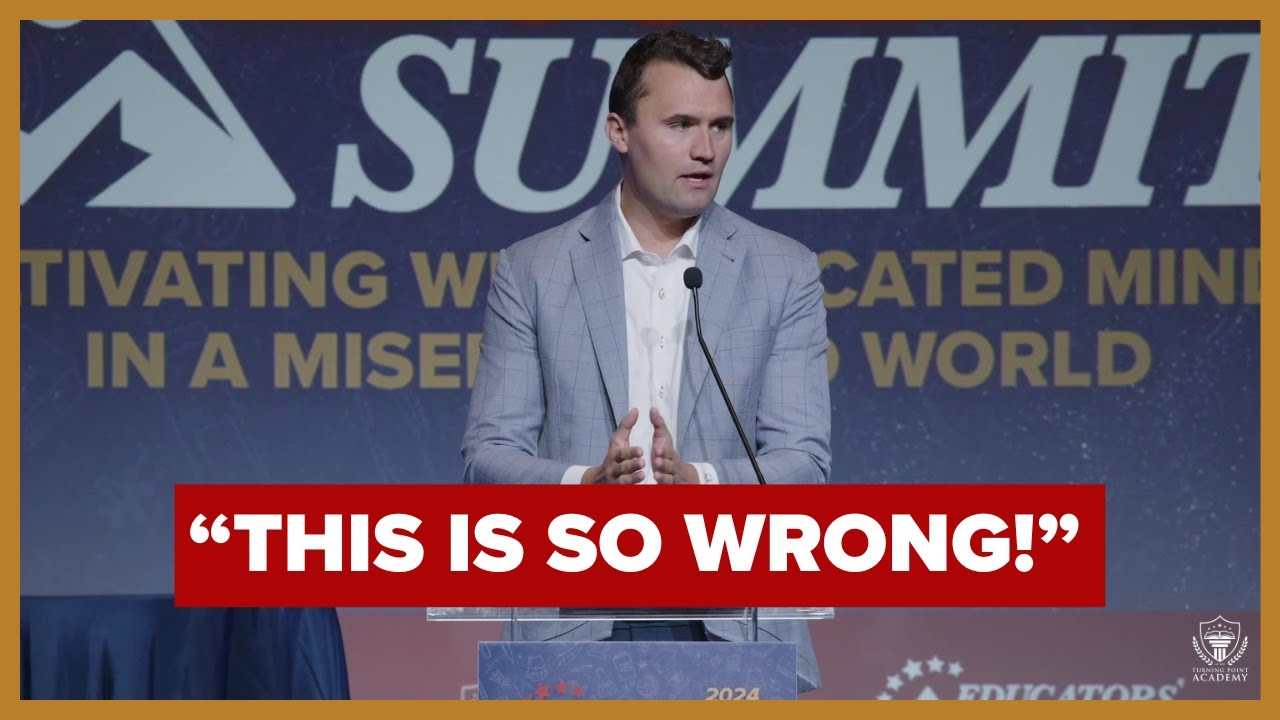
Charlie Kirk Explains Why the Constitution Is the Greatest Political Document Ever Written Despite Its Flawed Founders
Charlie Kirk identifies as a conservatarian who believes people should be free to do what they want as long as it doesn't harm others. When confronted with the argument that the Constitution was written by slave owners, Kirk doesn't shy away from the uncomfortable truth. Instead, he makes a compelling case for why the moral failures of the Founding Fathers don't diminish the revolutionary ideas they codified. Kirk explains how America's founders became the first successful political rebels to decentralize power rather than consolidate it for themselves, creating a system of checks and balances that recognized natural rights from God, not government. His defense of the Constitution focuses on its timeless understanding of human nature and its unique framework that limits what government can do to citizens.
Charlie Kirk defines his political philosophy as conservatarian, a belief system centered on individual liberty. His core principle is simple: people should be able to do whatever they want to do as long as it doesn't harm someone else. This worldview forms the foundation of his deep appreciation for America and its founding documents.
Kirk believes America is the greatest country in the history of the world and that the Constitution stands as the greatest political document ever written. These aren't just patriotic platitudes for Kirk, but convictions grounded in what he sees as the revolutionary nature of America's founding principles.
Addressing the Slave Owner Argument
Kirk directly confronts one of the most common criticisms leveled against the Constitution: that it was written by slave owners. He doesn't deny this uncomfortable historical reality. Instead, he acknowledges it openly while arguing that the truth of the ideas contained in the Constitution remains valid regardless of the personal sins of those who wrote it.
Kirk characterizes attacks on the Constitution based solely on the moral failures of its authors as a strong man red herring argument. He contends that judging the document, its text, and its ideas purely based on the sins of the people who wrote it is intellectually dishonest. Some of the Founding Fathers, Kirk notes, came to regret their involvement in slavery and released their slaves toward the end of their lives, though he emphasizes this point is ultimately irrelevant to evaluating the merit of the ideas themselves.
Why the Constitution Stands Above All Others
What makes the Constitution the greatest political document ever written, according to Kirk, is that the Founding Fathers were the first successful political rebels ever to give power back to the people instead of keeping it for themselves. This was unprecedented in human history.
The founders could have easily created a monarchy for themselves—a Jefferson, Washington, or Hamiltonian dynasty that would have kept tremendous amounts of people under perpetual power essentially forever. Instead, they made a fundamentally different choice: they decentralized that power and gave it back to the people.
Learning from Human History
The Founding Fathers' approach was grounded in a deep study of human history. They examined what happens when human beings accumulate power, observing that typically a dangerous person accumulates far too much power far too quickly, leading civilizations through a traditional arc of rise and fall.
They studied the Roman Empire, the Greek Empire, the Chinese Empire, and the British Empire. From these historical examples, they decided to try something fundamentally different. They created a system of checks and balances and recognized natural rights. This led to the creation of the Electoral College, the House of Representatives, and the U.S. Senate.
Built for Imperfection and Adaptation
The founders also understood they didn't necessarily get everything right, which is why Kirk loves the Tenth Amendment. The capacity for states' rights and the ability to amend the Constitution demonstrates the flexibility built into the system.
The Bill of Rights is particularly significant because it recognizes that rights come from God, not from government. Government's role is to protect rights, not to encroach upon them. This represents the first political document ever written that specifies what government cannot do, rather than what government gives out.
The Amendments That Protect Freedom
Kirk walks through several key amendments that illustrate the Constitution's protective framework. The First Amendment provides the right to consciousness—essentially allowing people to say what they want to say, how they want to say it, without government interference.
The Second Amendment is Kirk's favorite, as he believes you need this amendment to protect all the others. The Fourth Amendment establishes the right to privacy, and so on through the Bill of Rights.
Timeless Principles for Unchanging Human Nature
The Constitution was not written for the times it was written in, Kirk argues, but rather to stand the test of time. This is because despite how technology continues to advance, human beings stay exactly the same. We are self-centered, broken by nature, envious, and narcissistic individuals who will always try to serve our self-interest.
The Founding Fathers recognized this pattern in human nature. In response, they developed a system of government that would decentralize evil as far as possible and provide the most representation imaginable.
A Model Copied Worldwide
The proof of the Constitution's greatness, according to Kirk, can be seen in how it has been copied across the world. Civilizations that have copied the U.S. Constitution, even in its smallest sense, have seen an unbelievable advancement of political, economic, and human freedom beyond any comprehension.
This stands in stark contrast, Kirk contends, to any neo-Marxist or post-modernist utopia that has tried to be created. The Constitution's framework, grounded in a realistic understanding of human nature and a commitment to limiting government power, has proven itself as a superior model for human flourishing and freedom.