2,422 videos 1,389,747,653 views US Joined Aug 30, 2018
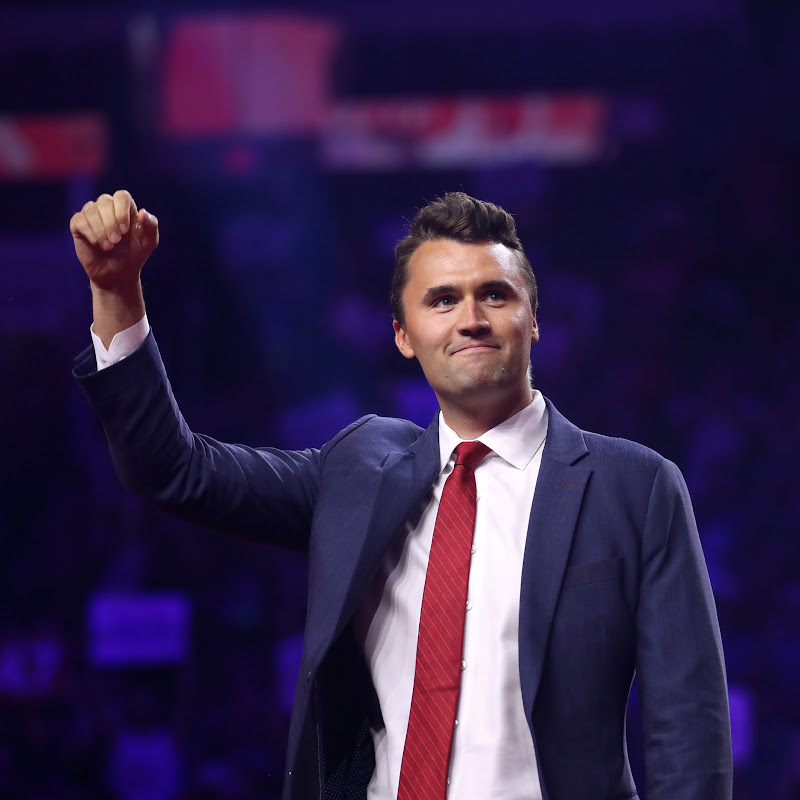
Charlie Kirk is the Founder and President of Turning Point USA, the largest and fastest growing conservative youth activist organization in the country with over 250,000 student members, over 150 full-time staff, and a presence on over 2,000 high school and college campuses nationwide. Charlie is also the Chairman of Students for Trump, which aims to activate one million new college voters on campuses in battleground states in the lead up to the 2020 presidential election. His social media reaches over 100 million people per month and according to Axios, he is one of the "top 10 most engaged" Twitter handles in the world. He is also the host of “The Charlie Kirk Show,” which regularly ranks among the top news shows on Apple podcast charts.
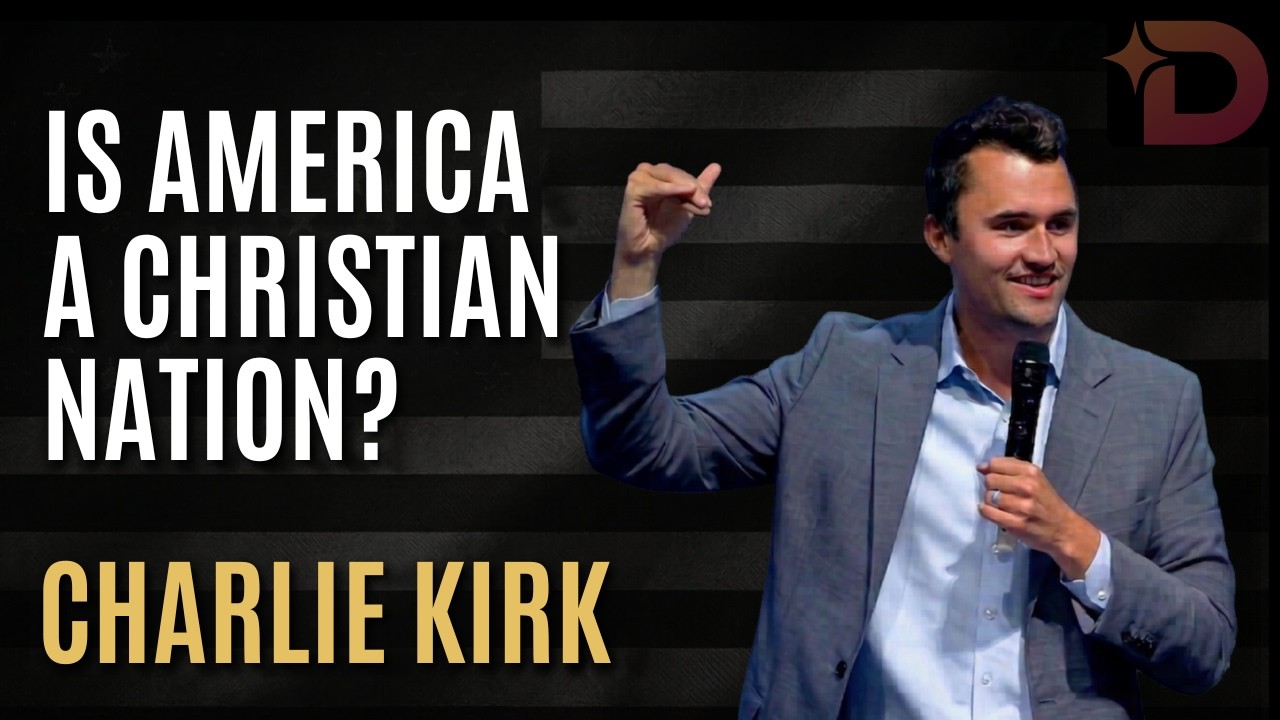
Charlie Kirk Exposes How Biblical Principles Formed America's Constitutional Foundation and Why That Matters Today
Charlie Kirk delivers a powerful breakdown of America's Christian roots, revealing how all 13 original state constitutions required declarations of faith, and 55 out of 56 Declaration signers were Bible-believing Christians. He explains how common law stems from Christian principles found in Leviticus and how the Declaration of Independence references God four times, including a prayer to Christ as the supreme judge. Kirk argues that America's constitutional crisis exists because the nation has abandoned its Christian foundation while maintaining a government designed for a Christian people. Dr. Jerry Newcombe joins to discuss why religion and morality remain indispensable to political prosperity and freedom.
Charlie Kirk begins by emphasizing a crucial historical reality that many Americans don't understand: the United States was originally a collection of states and colonies with explicitly Christian foundations. To truly understand American governance, Kirk insists we must read the state constitutions before anything else.
The statistics are striking. All 13 of the original state constitutions required a declaration of faith. Nine out of 13 required you to be a Protestant, with Maryland being the exception as a Catholic state, though it still required a declaration of faith. Every single one of the original state constitutions, including Pennsylvania, contained language such as "I profess Lord and Jesus Christ as my Lord and Savior."
Furthermore, 55 out of 56 of the original signers of the Declaration of Independence were Bible-believing, church-attending Christians. This wasn't incidental to their political philosophy—it was foundational.
Common Law's Biblical Origins
Kirk addresses the question of common law and its relationship to Christianity. Common law, he explains, is inherited from Blackstone, who was Christian. Common law is an outgrowth of the scriptures themselves.
Kirk identifies three principles of common law that are directly biblical:
Due process
Jury of your peers
The ultimate biblical principle that you shall not favor justice if you are rich or poor
This last principle comes from Leviticus 19, right before the most famous part of that chapter which instructs that you should love your neighbor as yourself. Before that command comes the instruction that in the administration of justice, you shall not favor the rich or the poor. This is the idea of blind justice that the West inherited, Kirk explains.
This concept is also incorporated in the New Testament ideal of "neither slave nor Greek nor Jew. You're all one in Jesus Christ." From this we get the idea of human equality. These are biblical ideas, not Enlightenment ideas, though they are often conflated at that time in history.
God in the Declaration of Independence
Critics often minimize the role of God in America's founding documents, noting that God was only mentioned four times in the Declaration of Independence. Kirk's response: that's a big deal.
The Declaration references "laws of nature and nature's God." More significantly, the last paragraph of the Declaration reads as a prayer. It states, "We appeal to the supreme judge of the universe." Kirk asks pointedly: Who's the judge of the universe? Jesus Christ. As it says in Revelation, Jesus will judge the earth on his throne. In the Declaration, the founders were praying to Christ our Lord as a prayer, very specifically.
Kirk also notes that Deuteronomy was by far the most quoted book—religious or non-religious—in the time of the founding when they were putting together the Constitution. It was quoted more than John Locke, more than Montesquieu, more than Blackstone. The book of Deuteronomy, which talked about laws, customs, and traditions, was Moses's farewell address as he prepared to say goodbye, instructing: "Hey, good luck in Canaan, guys. Here's how you should set up your form of government."
What the Founders Actually Said
Most importantly, Kirk directs attention to what the founders themselves actually said about the relationship between Christianity and American government. John Adams stated unambiguously: "The Constitution was only written for a moral and religious people. It was wholly inadequate for the people of any other."
Kirk explains the profound implications of this statement: The body politic of America was so Christian and was so Protestant that our form and structure of government was built for the people that believed in Christ our Lord.
This leads Kirk to a sobering diagnosis of America's current condition: One of the reasons we're living through a constitutional crisis is that we no longer have a Christian nation, but we have a Christian form of government, and they're incompatible. His conclusion is stark: You cannot have liberty if you do not have a Christian population.
Dr. Jerry Newcombe's Response
Dr. Jerry Newcombe responds enthusiastically to Kirk's presentation, affirming that he is totally right. He emphasizes that America has a foundation based on biblical principles and returns to that crucial quote from John Adams: "Our constitution was made only for a moral and religious people. It is wholly inadequate to the government of any other."
Newcombe points to George Washington's farewell address, where he said: "Of all the dispositions and habits which lead to political prosperity, religion and morality are indispensable supports."
Yet modern Americans today are saying that religion and morality have no place in the public arena. Newcombe finds this absurd. It was religion and morality, specifically Christianity, that gave Americans the freedoms they enjoyed. Those freedoms cannot be maintained for long if the nation undercuts that Christian foundation.
The Foundation Still Stands
Newcombe acknowledges that the foundation is still there, though it is attacked and people bring out all kinds of different ways to try and cut Americans off from that foundation. This is why history is so important, he explains, and why organizations like Providence Forum and Turning Point work to create videos and programs to educate people about America's Christian roots.
Newcombe highlights another John Adams quote in a different context: "Facts are stubborn things." The fact of the matter is that human beings are sinful, and that is a very important doctrine that the founding fathers fully understood.
The Constitution Reflects Biblical Anthropology
When you read the Constitution, Newcombe explains, you see the separation of power. The founders did not want to give too much power to too many people. When you read the Declaration of Independence, you see the consent of the governed, and this is because Americans have their rights from God.
The fact that human beings are made in the image of God is enshrined in the Declaration of Independence. The fact that human beings are fallen and sinful is enshrined in the Constitution. These principles have governed America very well.
The Atheistic Alternative
Newcombe draws a sharp contrast with countries like the communist countries of the 20th and 21st centuries. When you look at these nations, you see how they begin with an atheistic foundation: there is no God. When there is no God in that belief system, then there are no rights.
Even some liberal-type founders of America, such as Thomas Jefferson, weren't as unchristian as they're sometimes made out to be. Jefferson was not a lifelong skeptic. In fact, the year after he wrote the Declaration of Independence, he helped found as a layman the Calvinistical Reformed Church of Charlottesville. He even wrote up the agreement for the subscription for this church, and they called an evangelical minister, the Reverend Charles Clay, for this church, saying they were "desirous of gospel knowledge."
Even later, when Jefferson had some doubts about some of the doctrines, he still said that American rights come from God. He wrote that if Americans ever forget that, "I tremble for my country," because how can the nation maintain its freedoms if it ever loses sight of God?
Nations Soaked in Blood
Newcombe concludes with a sobering historical observation: The 20th century and the beginning of the 21st century saw many nations soaked in blood because they began with the premise that there is no God, no higher authority than the state. The state becomes god in such systems.
"Good luck with that," Newcombe says sarcastically, noting that Mao slayed his millions and tens of millions, and Stalin too. Kirk responds that the "soaked in blood" line really hits, and Americans must be on guard about that reality.