Charlie Kirk Faces Tough Questions on Immigration, Birthright Citizenship, and Gun Rights in Oklahoma
Enjoying this? Share it with someone who needs to see it.
Up Next
Charlie Kirk on Iran, Islam, Immigration, and the Problem with Western Assimilation in America
6:34
Charlie Kirk Debates Student on Trump Economy Versus Biden-Harris: Why Seventy Percent of Americans Reject Expert Claims
10:26
Charlie Kirk Dismantles Illegal Immigration Myths and Debates Abortion With UC San Diego Students
30:01
Charlie Kirk Faces Tough Questions on Immigration, Birthright Citizenship, and Gun Rights in Oklahoma
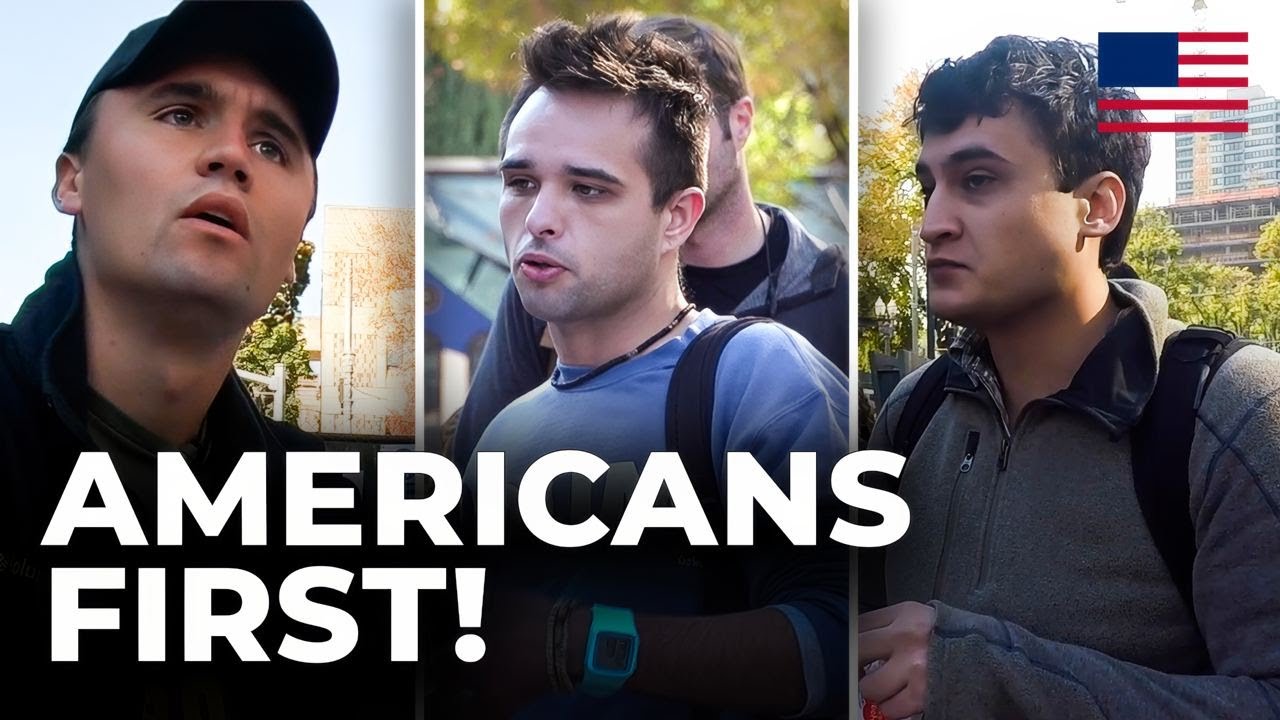
Charlie Kirk took questions from students and community members in Oklahoma, addressing controversial topics ranging from the 14th Amendment and birthright citizenship to America's drug cartel crisis and Second Amendment rights. Kirk defended his stance against accusations of racism, explained his opposition to anchor babies, and advocated for targeted military strikes against Mexican drug cartels. The exchange revealed sharp generational and ideological divides, with Kirk challenging questioners on the meaning of citizenship, the nature of rights versus privileges, and the proper role of government in a free society.
The conversation began with a question about President Trump's recent renaming initiatives, including the Gulf of America and Mount McKinley. Kirk responded that names should reflect meaning, not just serve as arbitrary labels. He explained that historically, names carried significant weight—ancestors' surnames often reflected their profession or tribal affiliation.
Kirk drew on biblical examples to illustrate his point: Abraham means "father of nations," Moses means "out of the water" or "redeemer," Jacob means "by the heel" because he was born holding his brother's heel, and Isaac means "laugh" because Sarah laughed at the idea of bearing him. Kirk emphasized that semantics literally means meaning in its original Greek, making the debate about naming far more substantial than simple word choice.
Birthright Citizenship and the 14th Amendment
A high school junior named Jacob Norwood raised questions about the 14th Amendment and birthright citizenship, noting that he has many friends born to illegal immigrants. Kirk stated he supports abolishing birthright citizenship for anchor babies, though he acknowledged it likely won't hold up legally. He argued the 14th Amendment was not intended to grant automatic citizenship to children of people who break into the country.
When challenged about the amendment's original purpose regarding children of formerly enslaved people, Kirk clarified that slaves were granted citizenship, so their children were already citizens' children. He distinguished between the moral category of enslaved people brought here forcibly and those who voluntarily break immigration laws.
Kirk highlighted that America is one of the only industrialized countries with birthright citizenship. He described a practice where tens of thousands of pregnant women from countries like China and Vietnam fly to America at seven months pregnant specifically to give birth and secure U.S. citizenship for their children. Kirk called this practice "insane" and argued it dilutes the meaning of American citizenship and allows people to cut in line ahead of those following legal immigration processes.
Confronting False Accusations of Racism
The exchange grew heated when Jacob revealed his father had called Kirk a white supremacist and questioned whether Kirk would still hold such views if he worked in a more diverse field. Kirk forcefully rejected the accusation, pointing to his leadership of Blexit, an organization that employs 40 black Americans working in Atlanta, Chicago, and Philadelphia to improve conditions in inner-city black communities.
Kirk challenged Jacob to define what a white supremacist actually is. When Jacob defined it as someone who takes advantage and believes they are higher than everyone else, Kirk asked if there was any evidence he held such beliefs. He condemned the casual use of such serious accusations, calling it destructive to national dialogue and unity. Kirk told Jacob he should be ashamed of his father for peddling such lies without evidence.
Advice for an Aspiring Christian Journalist
A college student preparing to graduate with a degree in political journalism shared that mentors and peers at her news station internship had told her she probably wouldn't succeed because she's a Christian young woman. She asked Kirk how he maintains motivation despite constant criticism and attacks.
Kirk offered practical and encouraging advice. First, he told her she will succeed in journalism if she simply outworks other people. Second, he noted that many current journalists won't have jobs in five to ten years as the media landscape transforms. He suggested exploring communication director positions for senators and congressmen, as well as local news stations with more conservative ownership.
Kirk emphasized the importance of silencing the noise, knowing your strengths, and following your skills regardless of what people say. He urged her to say yes to every opportunity and promised that if she outworks everyone as an intern, that dedication will be noticed and rewarded regardless of political affiliation. He concluded by telling her that all the opposition should make her want to fight harder, will make her stronger, and will ultimately make her a better person and professional.
Military Action Against Mexican Drug Cartels
A University of Central Oklahoma student with a liberal family asked about policies to help Mexico that would benefit America. Kirk gave what he acknowledged as a controversial answer: the best way to help Mexico would be to eliminate the drug cartels, which would require military action. He noted President Trump has considered this idea but it remains unclear what action will be taken.
Kirk explained that Mexico is essentially controlled by nine families, most importantly the Sinaloa drug cartel. He connected this to the audience's lived experience, noting that almost everyone present has probably lost a friend to fentanyl or knows someone dealing with hard drug use. Almost all of these drugs are produced by the Sinaloa drug cartel and trafficked into communities throughout Oklahoma.
Rather than sending hundreds of billions of dollars in aid as the U.S. has done over the past 30 years, Kirk advocated for targeted military strikes against the Sinaloa drug cartel to liberate Mexico from its current captivity. He argued that America is in an active hostile conflict with the cartel, pointing to 100,000 annual American deaths from drug overdoses involving foreign-made drugs intentionally pumped into U.S. communities.
Kirk emphasized that many overdose victims believe they're taking lower-level recreational drugs that have been laced with fentanyl. While acknowledging people have agency in their choices, he described the drug epidemic as an intentional destruction of the country, disproportionately targeting working-age young men in America.
Gun Rights: Privilege or God-Given Right?
The final questioner stated she was totally against guns but understood why some people need them. She asked what laws Kirk would support to prevent the wrong people from getting guns, noting that some states don't require background checks for certain firearms.
Kirk began by asking whether she viewed gun ownership as a right or a privilege. When she answered "privilege," Kirk explained he views it as a right—specifically, a right given by the Creator, not by government. He argued that the right of free people to defend their families from threats and potentially from government overreach is fundamental to a free society. A society cannot be truly free if it is not an armed society.
Kirk then flipped the question: if she's against guns, why does it make sense to guard sports stadiums, banks, and airports with guns? He asked whether she's against guns as a technology or against people who use guns for evil. When she clarified she's against people who use guns for evil, Kirk suggested this indicates more of a "brokenness of humanity problem or a sin problem, not the actual tool itself."
Regarding gun laws, Kirk stated that federal laws and background checks already exist but aren't always enforced. Controversially, he argued for fewer gun laws, not more, because gun ownership is a right and people should be able to protect themselves as they see fit. He pointed to cities like Houston where more guns correlate with lower violent crime, though gang-related gun deaths still occur.
Kirk broke down the statistics on gun deaths in America: of 30,000 annual gun deaths, two-thirds are suicides. Of the remainder, the vast majority involve gang violence in inner cities. When the questioner maintained that it's too easy for anyone to get a gun, Kirk simply disagreed, reiterating that people should be able to own firearms and protect themselves. He warned that excessive government involvement in determining who can own guns threatens freedom itself, stating emphatically: "We will cease to be a free people if we are not an armed citizenry."