Up Next

Charlie Kirk Defends Pro-Life Stance in Passionate Exchange with Split-Ticket Voter on Abortion Morality
10:59

Charlie Kirk Debates Abortion with College Students: When Does Life Begin and Why It Matters
1:15:33

Charlie Kirk Defends Absolute Right to Life Against Oxford Student's Violinist Thought Experiment Challenge
6:50


Charlie Kirk is the Founder and President of Turning Point USA, the largest and fastest growing conservative youth activist organization in the country with over 250,000 student members, over 150 full-time staff, and a presence on over 2,000 high school and college campuses nationwide. Charlie is also the Chairman of Students for Trump, which aims to activate one million new college voters on campuses in battleground states in the lead up to the 2020 presidential election. His social media reaches over 100 million people per month and according to Axios, he is one of the "top 10 most engaged" Twitter handles in the world. He is also the host of “The Charlie Kirk Show,” which regularly ranks among the top news shows on Apple podcast charts.
Subscribe on YouTubeCharlie Kirk Faces UC Riverside Students on Abortion, Immigration, College Costs, and DEI in California Showdown
Charlie Kirk brought his debate tour to UC Riverside in California, confronting hundreds of students and community members on the most contentious issues facing America. From defending life at conception using ultrasound images to challenging the economic value of college degrees in the age of artificial intelligence, Kirk sparred with students over abortion in cases of rape, the morality of illegal immigration, the validity of reparations for black Americans, and whether DEI policies represent fairness or discrimination. One particularly tense exchange saw a biology student argue that human life at six months old isn't worthy of protection if the child cannot speak. Kirk also addressed military presence in Afghanistan, mass incarceration in the black community, and California's intentionally high gas prices under Governor Gavin Newsom. The event showcased the deep ideological divide on American campuses while demonstrating Kirk's willingness to engage directly with opposing viewpoints
Charlie Kirk Takes California by Storm
Charlie Kirk arrived at UC Riverside to thunderous cheers and chants of "USA" from a packed crowd eager to engage with one of conservative America's most prominent voices. Despite the scorching heat that threatened to sideline attendees, Kirk dove into hours of debate with students on everything from abortion and immigration to the value of college education and diversity policies. The event represented a microcosm of the cultural battles defining modern America, with Kirk defending traditional conservative positions against students representing the progressive values dominant in California's educational institutions.
Kirk opened by acknowledging the challenging conditions and urging attendees to stay hydrated, even joking that people shouldn't faint just to get a signed hat. The atmosphere was electric, with Kirk demonstrating his signature blend of humor, confrontation, and theological reasoning as he fielded questions from a diverse array of students.
Defending Life After Rape: The Ultrasound Argument
One of the first substantive exchanges came from a young father who had recently welcomed a seven-week-old daughter and was reconsidering his pro-choice position. He asked Kirk to defend the pro-life position specifically in cases of rape, acknowledging the trauma such circumstances create for victims.
Kirk responded with a prepared visual demonstration, presenting two ultrasound images and asking the questioner to identify which baby was conceived through rape. When the student couldn't distinguish between them, Kirk made his point: "They're both human beings. Regardless of the method of conception, they're both human beings. The process of conception does not give you more or less rights."
Kirk argued that performing an evil action after an evil action is never the right moral course. He shared that he has met hundreds of people across the country who were conceived in rape, and their mothers courageously brought them to term, allowing them to live fulfilling lives. "We must be consistent that human beings are made in the image of God, they have a soul, and just because of the method of your conception, you don't get to have your life taken away from you," Kirk stated.
When pressed about the trauma abortion might prevent for the mother, Kirk countered that abortion itself can be highly traumatic and is never "just like getting a haircut." He emphasized that trauma is never an excuse for taking a life, comparing it to someone with mental health issues claiming that justifies harming another person.
Immigration: Distinguishing Legal from Illegal Entry
A student whose parents immigrated legally to the United States challenged Kirk on immigration policy, citing the biblical account of Jesus fleeing to Egypt to escape King Herod's massacre. She argued that many people must leave everything behind out of necessity, and questioned Kirk's stance given this biblical precedent.
Kirk corrected a common misconception, noting that Jesus didn't actually immigrate in the modern sense because Egypt was under Roman jurisdiction at the time, meaning he stayed within the same political empire. More substantively, Kirk argued that immigration should always benefit the home country and made a crucial distinction between legal and illegal immigration.
When the student mentioned that illegal immigrants pay into social security without receiving benefits, Kirk challenged her: "If they have a social security number, how'd they get that?" When she acknowledged they stole it, Kirk pointed out that this constitutes identity theft that drives down wages and opportunity costs for American workers.
Kirk emphasized that illegal immigrants "were not invited to come to this country. They broke in line. They cut in line. And we should not reward line cutters or border jumpers. We should reward people like your parents that actually came here legally to this country." The crowd erupted in applause.
The student pressed Kirk on the humanitarian aspects, noting that her grandmother has been waiting ten years just to visit as a tourist despite having sufficient financial means. She described Trump's zero tolerance policy as "cruel" and "inhumane." Kirk responded by asking what would happen if he went to Mexico without permission and took a job. When she couldn't answer, he stated that Mexico would deport him back to America, and asked why that same standard shouldn't apply to the United States.
Kirk rejected the notion that difficult circumstances justify breaking immigration law, comparing it to robbing a bank because you want more money. He argued for empowering people to improve their home countries rather than encouraging mass migration, which he said harms both America and the countries people are fleeing from. He concluded by advocating for a complete pause on immigration for ten years, arguing that California's hospitals and schools are already overrun and the state needs time to "metaphorically digest the major meal that we just ate."
Reparations: Historical Precedent and Present Reality
A thoughtful student raised the issue of reparations for black Americans, acknowledging that no living black American has been enslaved but pointing out that other groups have received reparations. He cited compensation given to Asian Americans for World War II internment, Native Hawaiians, and even former slave owners in the North who were compensated when required to free their slaves. He asked why there seems to be such pushback against reparations for black Americans.
Kirk made an important distinction: "For any of those examples, was there intergenerational reparations given?" He noted that in the cases cited, the actual people wronged received compensation, whereas current reparations proposals would go to people 150 years removed from slavery. He also pointed out that not every black person is a descendant of slaves, with some having mixed ancestry or more recent immigration.
Kirk then reframed the question: "Have we spent a lot of money on the black community the last 50 years? And if so, has it worked?" He argued that America has spent trillions of dollars trying to improve the well-being of black Americans since the 1960s, yet black America is actually poorer per capita relative to other groups than it was in the 1960s.
"I would argue it's actually not a resource or a money thing. It's a values thing. And the values, unfortunately, that are predominantly in the black community right now are quasi suicidal," Kirk stated bluntly. When the student mentioned two Tulsa Race Massacre survivors over 100 years old who were denied reparations for lost property in Oklahoma courts, Kirk said he would research that specific case but maintained his broader argument about values over resources.
College as a Scam: The Debt and AI Revolution
Kirk faced his most prepared opponent when a student systematically argued that college is not a scam. The student defined scam as fraud, noting that colleges don't promise guaranteed success but rather access to resources, which they do deliver. He cited statistics showing college graduates earn higher incomes on average and have lower unemployment rates.
Kirk turned the tables by asking the student to define a scam, then getting him to agree that forcing customers to buy something against their will would constitute a scam. Kirk then asked the audience: "How many of you have to take classes against your will that waste their time?" Nearly every hand went up. "You just agreed a scam would make people buy something against their will, and every hand went up in the audience saying they have to take classes against their will. You just now agreed using Aristotelian logic that that's a scam."
Kirk challenged the statistics about college graduates earning more, calling them "deceiving" because they include high earners like doctors, lawyers, and engineers that skew the average upward. He argued that humanities graduates, who make up a large portion of college students, typically earn only $50,000 to $60,000 annually. In contrast, Kirk cited Wall Street Journal reporting that hundreds of thousands of high school juniors are receiving $70,000 annual job offers to become plumbers, welders, and electricians without any college degree or student debt.
Kirk introduced a particularly provocative argument: "Almost everybody in this audience is studying something that will be irrelevant because of artificial intelligence." He questioned whether every course and degree at UC Riverside is truly prepared for the AI revolution. When the student tried to deflect, Kirk pressed: "Almost every one of your careers will be rendered obsolete by AI in the next 10 years."
Kirk also noted that four out of ten students who start college do not graduate, citing a 59% national graduation rate. He acknowledged that for specialized fields like engineering, medicine, and nursing, college makes sense, but argued that "the vast majority of kids that go to college are studying the humanities, soft social sciences, psychology or communications" that don't require a degree.
Military Service and Afghanistan Withdrawal
A military veteran who served during Operation Allies Welcome, the Afghan refugee resettlement operation, presented a unique argument. He shared his firsthand experience dealing with Afghan refugees in 2021 when President Biden withdrew from Afghanistan, noting that many were "known or suspected of terrorism." He argued that America should maintain a military presence in Afghanistan, similar to other countries, because al-Qaeda is rebuilding and potential terrorists entered America both through Afghanistan and the southern border.
Kirk thanked him for his service and acknowledged receiving "an argument I've never heard" before getting to his response. He fundamentally reframed the issue: "9/11 was not a 'we did not occupy enough countries' problem. 9/11 was an intelligence and most importantly an immigration problem. We allowed people into our country that were not American to come into our country."
Kirk asked whether Trump was elected on a platform of more foreign wars or fewer. When the veteran acknowledged "less," Kirk pressed further, agreeing that Biden's withdrawal was executed disgracefully with the deaths of 13 service members at Abbey Gate, whom Biden never called. However, Kirk maintained that the principle of withdrawal was correct.
"We need to protect our own borders a lot more than the borders of a foreign country," Kirk argued. He advocated for finding and removing terrorists already in America through strict immigration enforcement rather than sending military personnel into another "no-win war in a foreign country where you might have to lose your life where the objective is very unclear."
The veteran raised the question of what America gained from two decades in Afghanistan if the withdrawal was so catastrophic. Kirk called it "one of the most disappointing and disgusting days in American history" but maintained that the solution is immigration enforcement, not reoccupation.
Biblical Defense of Pro-Choice Position Falls Short
A Christian student attempted to use Scripture to defend abortion rights, citing Exodus 21:22-25, which discusses penalties when men fighting accidentally cause a pregnant woman to miscarry. She argued this passage shows that causing a miscarriage results in a fine determined by judges and the husband, not divine judgment, and that harm to the woman herself carries stricter penalties. She concluded this meant humans, not God, should determine abortion policy.
Kirk immediately identified a flaw in her interpretation: "Didn't you say it was a miscarriage, not an abortion?" He pointed out that the passage describes an accidental injury with no intent to kill the baby, which is categorically different from deliberate abortion. He also noted the passage doesn't clarify whether there was intent to harm the baby.
When the student argued that if a woman needs an abortion for healthcare reasons and is denied, leading to her death, the doctor should be liable under God, Kirk corrected a common misconception: "Those instances don't happen." He explained that in the rare cases where a mother's life is genuinely threatened, the baby is already dead, and removing a deceased baby is "not an abortion. That's a removal of a carcass of a baby. Those are two technically different things."
The exchange took a turn when Kirk asked if the student believed Christians are bound to all 613 Levitical laws. When she said yes, he asked if she eats kosher. She admitted she doesn't, to which Kirk pointed out the contradiction. He explained that Christians recognize three types of Old Testament law: ceremonial, civil, and moral. Ceremonial laws like kosher restrictions are not binding under the new covenant, as Paul wrote in Colossians that "the ordinances of Moses are nailed to the cross."
Kirk then challenged her with Scripture supporting the pro-life position. He cited Luke 1, where John the Baptist leaped in Elizabeth's womb when Mary, pregnant with Jesus, came near, using the Greek word "brephos" which means baby. He referenced Jeremiah's "I knew you before you were in the womb" and Psalm 139's detailed description of human formation in the womb. "Because of science, because of biology, we know that human life begins at that spark of new DNA. And God says do not murder. And it's incumbent on Christians to therefore protect that life."
When she pressed on cases where a living baby must be aborted to save the mother, Kirk introduced the option of Caesarean section: "You could take the baby out of the environment and try to save its life as a C-section." He argued this is safer and quicker than abortion and that every hospital is equipped for C-sections while abortions require specialized facilities. Kirk distinguished between "no more" and "not yet" situations: when medical intervention can no longer improve life (no more), different moral considerations apply than when a life simply hasn't developed yet (not yet). In "not yet" situations, like pregnancy, everything must be done to preserve life.
The Most Shocking Exchange: A Biology Student's Moral Framework
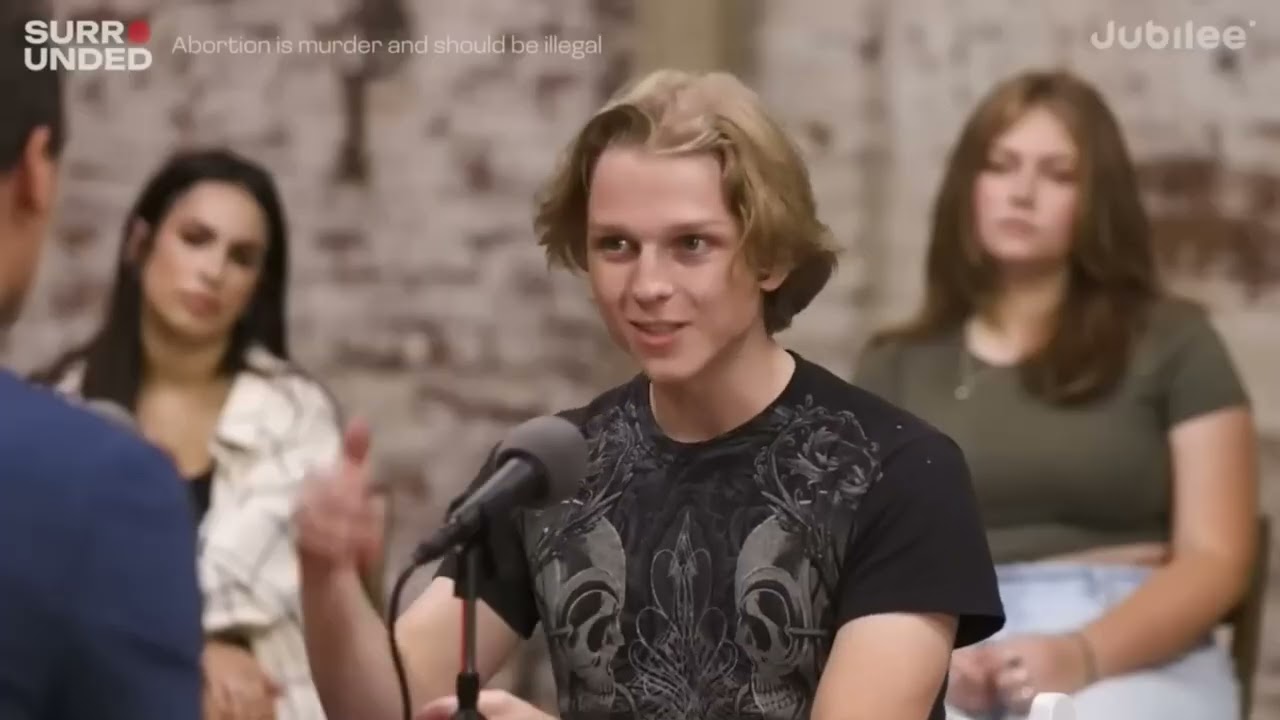
Perhaps the most disturbing moment came when a UC Riverside biology student challenged Kirk's pro-life position from a scientific materialist perspective. The student dismissed the concept of the soul as "founded in nothing" and argued that a zygote isn't capable of the higher functions that define human life.
Kirk asked a simple question: "When did your life become worthy of protection?" The student's answer shocked the crowd: "When I became actually conscious and able to speak." When Kirk clarified that babies typically don't speak until 12-18 months old and asked if murdering a six-month-old would therefore be acceptable, the biology student calmly replied: "Yes."
The audience erupted in disbelief. Kirk pressed further: "What about babies that never speak? Can I murder them?" The student tried to walk back slightly, saying physical speech isn't necessarily the qualifier but rather "some actual nervous activity," noting that even pigs are capable of such activity.
Kirk maintained that animals will never reach the level of human reason or consciousness, and that humans are valued simply because they are human beings, not snakes, lizards, or leopards. When Kirk asked whether the student would save a hundred dog lives or one human life, the student said it depends on the human, adding: "I would save one dog over your life."
Kirk concluded this exchange by noting: "The fact that he's a bio student at this university shows the horrifying moral rot happening in higher education and Trump should defund all these schools as evidence." The crowd's reaction suggested widespread agreement that the student's position represented an alarming ethical breakdown.
DEI: Opening Doors or Lowering Standards?
The final substantive debate addressed Diversity, Equity, and Inclusion policies, with a student arguing that Kirk's "Didn't Earn It" characterization misses the point. She cited Harvard analysis showing students from the wealthiest 1% of families are 13 times more likely to score 1300+ on the SAT than students from the poorest families, attributing this to access to better schools, tutors, and test prep rather than inherent intelligence.
She also noted that legacy applicants, children of donors, and recruited athletes at elite schools are significantly more likely to be admitted than other students with the same academic credentials. At Harvard, roughly 43% of white students admitted from 2010-2015 fell into these privileged categories, and 75% of these admits would not have been accepted based solely on academic qualifications. She argued DEI could mean "diversity of abilities" and that holistic review considers more than just test scores.
Kirk redirected to the Students for Fair Admissions Supreme Court case against Harvard, which found that Asian and white students effectively had 200-400 points knocked off their scores compared to black and Hispanic students. "It was disenfranchising white and Asian students," Kirk stated. He then posed a direct question: "Do you think that we should have all test scores be weighed the same or do you think that certain ethnic groups should get certain points because of their race?"
The student tried to avoid the question by saying she believes "we should acknowledge the fact that certain students have a different starting point." Kirk pressed: "How many points should a black student get over a white student in admissions?" When she responded that SAT scores and points shouldn't be the only thing considered, Kirk insisted: "You have to answer the question because the status quo" requires making these determinations.
The exchange was cut short as the event concluded, but Kirk had successfully forced the student to confront the reality that DEI policies in practice require assigning different values to students based on race, which was precisely why the Supreme Court struck down affirmative action.
California's Future and National Implications
Throughout the event, Kirk repeatedly referenced California's governance failures under Democrats, particularly Governor Gavin Newsom. When asked about high gas prices and food costs five months into Trump's presidency, Kirk explained that gas prices are declining nationally but remain high in California due to deliberate policy choices. "You guys have made a decision here in this state to have intentionally high gas prices," he said, referencing refinery restrictions that make it nearly impossible to own petroleum-based vehicles affordably.
Kirk expressed hope that California would elect a Republican governor in 2026, with the crowd enthusiastically chanting for candidate Brian Dahle. He argued that California is a "cluttered state with social services that are being strained" and needs "a pause on all immigration" to address assimilation, cultural cohesion, and infrastructure problems.
The UC Riverside event demonstrated Kirk's ability to engage hostile audiences while maintaining his positions under pressure. Whether discussing the sanctity of life, the rule of law in immigration, the practical value of higher education, or the implementation of DEI policies, Kirk consistently appealed to logic, data, and moral first principles. The exchanges revealed the stark ideological divide on American campuses while showcasing genuine intellectual engagement across that divide—something increasingly rare in modern political discourse.
Video Transcript
[cheering] That's a lot of people. How we doing, California? [cheering] >> Is California ready for a Republican governor? Are you guys ready for one? [cheering] There's something happening here in California. We're going to have a lot of fun. Uh it's very hot. Uh don't be a hero. Make sure you drink water. Seek shade. Unfortunately, at some of these events, uh people faint and pass out. We do not want to see that happen. Um you already passed out. You want me to sign your hat? >> I'll sign your hat. [cheering] Don't start fating just to get a signed hat. We're going to have a lot of fun. Um, you guys know the rules and it's a great day to be here. We're going to start. We love you guys, too. And God bless California. God bless America. Let's get started. [cheering] >> Hello. Hello. What's up, Charlie? Hey, dude. So, uh, first out, welcome to California, uh, Riverside. What's up, Riverside? How's everyone doing so far? Yeah. All right, [cheering] cool. So, um I'm just going to get started. Typically, um I agree on a lot of stuff that you state. So, um literally in everything, the only reason I came up to debate was um about abortions and um rape abortions. And so, uh recently I was kind of for abortions, pro-choice. Um I recently had a daughter. She's 7 weeks old. And, uh I can't imagine living without her. So, I appreciate it. And um my only concern as I was thinking about it um it's just hard for girls that do happen to get raped, you know, whether they're unconscious and drugged or just whatever happens, incest or whatever. Um would you be able to just defend uh just any abortion or um non-abortions on rape and uh if I could just hear a point of view on that? >> Yeah, for sure. Thank you for the good faith question and uh praise God that you welcome the daughter into this world. That's the be that's the best thing you said. [cheering] Um, look, OB, needless to say, rape is a tragic thing and it's terrible. We believe that abortion is the taking of a life, which would be murder. Can Can I do a thought exercise with you? Is that okay? Yeah, of course. >> Um, okay. So, I actually have a picture. I brought it here cuz I do this so many times. So, I have two ultrasounds here. You know what ultrasound is? >> Yeah. This isn't the dolphin, is it? >> No, these are two human beings. >> Okay. No. >> All right. >> Um, one of these two ultrasounds is a baby conceived in rape. Which one is it? I'm assuming the one on the left. >> Uh, no. >> No. Okay. Oh, you know what? I don't know. >> You get the point. >> Yes. Yes. >> They're both human beings. >> Okay. >> Regardless of the method of conception, they're both human beings. [cheering] >> Awesome. Okay. >> And it's not a gotcha. I just want you to think about cuz these are both human beings made in the image of God. >> The process of conception does not give you more or less rights. >> Of course. And so we also do not believe that an evil action after an evil action is the right course. And so we believe that a human being must be protected. We must be consistent in that. >> And I've met thousands of people now across the country, hundreds, I'll say, of people that were conceived in rape >> and the mom was courageous enough to bring that baby to term and now they're able to live amazing lives. And so we must be consistent that human beings are made in the image of God. they have a soul and that just because of the method of your conception, you don't get to have your life taken away from you. >> Yes, sir. Now, um what about the trauma that it may or may not bring the mother? Um just kind of living on a like her own self. Uh maybe can't defend having the baby just because she wasn't ready in the first place and um you know now her whole life just got switched around. If you can explain that for me, please. >> Yeah. So, it's a little bit of a false choice because an abortion can also be very traumatic as well. To say that there's that abortion is just like getting a haircut, it's nonsensical. It's not just a cosmetic procedure. >> Yeah, I agree. >> And so, we acknowledge, of course, that there can be trauma, but trauma is never an excuse for taking a life. >> If you say, "I have a mental health issue." Are you allowed to take somebody else's life? Of course not. That's never morally defensible. Under no moral framework are we able to say that that is true or correct. >> Cool. I appreciate it. Also, I have a second question real fast. Yeah, I'm sorry. So, um we're 5 months into the President Trump's presidency and a lot of uh Democrats will state, you know, like, "Oh, he's doing this wrong and this this this." Um the gas prices are still up. The food is still up. When do you think we will see change? >> Well, gas prices in California are up. Actually, across the country, they're going down dramatically. One of the reasons is that Gavin Newsome and Democrats have intentionally done this. >> You should boo them. >> The way that you again, it's a little wonky, but it's a refinery issue. You guys have made a decision here in this state to have intentionally high gas prices. And because of that, your leaders here in California, they basically almost wanted to make it impossible to own a uh petroleumbased, petroleum fired vehicle. Um, and we want to try to bring gas prices down for all Americans. One of the reasons why I hope that you guys get a new governor in 2026. >> Biano, baby. [cheering] Awesome. Would you mind? Can I come shake? >> Yeah, sure. Of course. You would like a hat, too. Yeah. God bless you, man. Thank you. Here's your hat. Thank you. >> Next question. Great. Thank you. >> All right. Well, good afternoon. Uh been a longtime fan, but >> thank you. Just talk right into the mic if you can, please. >> Okay. Um the topic I want to discuss with you today is um it's sorry, it's on reparations, but more so why there's a bias towards black Americans when it comes to reparations. Now, I understand that no, no black American alive has ever been a slave. I acknowledge that. However, >> sorry. Um, my the point I wanted to make is that um, reparations have been given to other ethnic groups, Asian-Americans for their incarceration during World War II, Native Hawaiians, um, sorry I wrote it all down, but uh, even former slave owners uh, specifically the ones in the north that had to give up their slaves, they were compensated for former slaves. However, why is it that uh when it comes to black people receiving reparations, there seems to be a lot of push back to the point where now, you know, there's, you know, now it's almost laughable to even think about black people getting reparations for something in the past. >> Well, for any of those examples, was there intergenerational reparations given? >> No. I >> So, they're not necessarily applicable, right? So, those were the actual people that received it because a wrong was done to them. We're talking about something 150 years removed. And also we not every black person is a descendant of slave slaves. Some are some are mixed race. Some are able to prove that. But I think more importantly we should ask the question, have we spent a lot of money on the black community the last 50 years? And if so, has it worked? It's a good question because I mean obviously there are [laughter] certain communities in black America that are not so great. You know, some of them some of the traumas and problems they have are of their own making. I acknowledge that. Thankfully, I was raised away from all that. Two loving parents. Um but >> and that's the greatest thing that you are one of the if not the greatest. And that's my hope for every child, black, white, or Asian to have two parents. That is a ticket to success. Please continue. >> But um the example I wanted to use was the two Tulsa survivors. Um they tried, you know, they're aged, you know, over 100 years old. They've tried to sue the Oklahoma government for reparations for their lost property and they were actually denied reparations. And to me, when when I read about that, because that to me that was kind of the test to see like, okay, they say reparations shouldn't go to people who weren't directly affected. Well, here we have two people who were directly affected, who were there, and they were still denied reparations. So, to me, that kind of confirmed that it was never about who was directly affected or not. To me, it just sounds like there's a bias towards black Americans. >> Okay. I don't know about that instance. I'll look into it. Um, but more broadly, I do want to just repeat the point and something to think about. You don't have to answer it. that we've spent trillions of dollars on trying to improve the well-being of black Americans since the 1960s. And actually, black America is poorer per capita and on average in relation to other groups than it was in the 1960s. >> So, I would argue it's actually not a resource or a money thing. It's a values thing. And the values, unfortunately, that are predominantly in the black community right now are quasi suicidal. >> Fair point. But yeah, bas basically I just wanted you to I didn't know if I was going to change your mind, but it's something I wanted you to think about. >> I'll research the example that you gave and uh thank you for watching our content and being a supporter. >> Definitely. >> Would you like a hat? >> Thank you. Yes, sir. Thank you. [applause] >> Thank you, man. It's great. Thank you, friends. The Charlie Kirk show team here. America's debt bomb has [music] blown past $ 37 trillion, and it's climbing every second. President Trump is fighting for fair trade and strong borders to slow the train wreck. But the numbers don't lie. When debt grows this fast, it [music] can threaten your savings and your family's future. That's why more Americans are turning to [music] real assets like gold and silver. I work with and recommend Preserve Gold. They make it simple to own physical gold and silver, even inside your retirement accounts, like an IRA or 401k. [music] Text USA to505 for their free wealth protection guide. With a qualified purchase, you could get up to $20,000 in free gold [music] or silver [cheering and applause] >> right here. >> Hi, good afternoon. Um, so my sense today is honestly on immigration. So I think Is that does that sound better? >> Okay. >> Okay. So, my stance today is on immigration. I think that immigration contributes a lot to America. So, my parents did come here legally and they right now are in the process again and it takes a long time. >> No, they came here legally. Like they came with their visa and now they're renewing it and it's a different process right now. But um so I'm really religious. I'm Catholic. My parents grew me up that way. And in Matthew 2:13-15, it talks about how Jesus had to flee Nazareth or no, Bethlehem, sorry. He had to flee because someone was going to die and they were looking to kill him and he had to flee his own country and leave everything behind because an angel spoke to Mary and Joseph that they should leave. So, a lot of people do that. That's why they immigrate to the United States. A lot of people have to leave everything behind because not everyone just wants to pack up all their things and leave. I right now I personally would hate if I had to sell my car, my house, leave my parents, leave my friends and leave everyone. So I just want to know what your stance is on that just because in the Bible it talks about that. >> Right. So first of all, Jesus actually didn't immigrate. He stayed within the confines of the Roman Empire because Egypt was actually other under Roman jurisdiction. That's a separate point. But there are plenty of verses that says you should welcome the stranger. And so I I will grant you that. I I guess the first po the first point I would have to ask is should immigration always benefit the home country? >> I think so. Yes. And that is one thing that I looked into. So there are immigrants right now working here. Correct. And they get some of their paycheck cut off, right? Because of social security and all those benefits, but they don't get those benefits because they're illegal. >> So do you mean legal or illegal immigrants? That distinction is very important. >> Illegal. They don't get those benefits. >> So let's just be clear. If they have a social security number, how'd they get that? the right way. >> They stole it. >> You don't get a you don't get a social security number as an illegal period. It does not happen. >> They stole it. Okay. >> So, that's an act of theft. >> And >> so, they stole an American social security number to be able to work here, which drives down wages, which drives down opportunity cost. But even beyond that, we just have to look at their action. They were not invited to come to this country. They broke in line. They cut in line. And we should not reward line cutters or border jumpers. We should reward people like your parents that actually came here legally to this country. [cheering] >> Yeah, I understand that point. I really do. But sometimes people generally need to leave their country because in like my mother's case for instance, there was like a terrorist attack on my family and that's the reason my mom had to come and thankfully she did get it immediately. But now I've heard of so many stories where people have to wait like 10 years, 20 years, even 30 years. Like my grandma right now is trying to get the process and thankfully she is now but it's taken her about 10 years now and she makes enough money in her country and she just wants to come here as a tourist. That's the main reason and I do understand that. I think that my main point is that how we should implement more money into the immigration system cuz Trump's zero tolerance policy that just felt cruel because there's a lot of people here that are doing well and zero tolerance. They just have to leave the country. I feel like that was inhumane of him. >> Yeah. But it's not their country though. And that's the So let me just here's if I went to Mexico without being invited or allowed and I took a job and the Mexican government found out, what would the Mexican government do to me? >> I'm not sure. >> They would send me back to America. >> And why was the reason you left the US first? >> Well, again, so the Okay, as far as the audio guys, we're going as loud as the university allows us. There's a decibel count, so we're going to keep pushing the amount as much as we can. Okay. So, we got in trouble. I'll blame all of you. Um, so reason, that's an interesting thing. Is there ever a legitimate reason in your opinion to commit a crime? >> No. >> Well, then the reason doesn't matter because under that say, so let's can you rob a bank because you wish you had more money? >> No. You work harder. >> Then why doesn't that moral standard apply to immigration? >> Because the system is it isn't doing its job. That's why I think we should implement more money because there is some people like I do get it. You know, some people come here and then I do admit some of them commit crime but not all of them. >> No, no, but they're all criminals if they came illegally. That's the distinction. By definition, they're breaking federal law 8 USC 1312. Just their presence here is against the law. >> And let's say you're here in the US. Okay. You have um from what I think I've heard, I think you have two daughters, correct? >> A daughter and a son. >> Daughter and a son. Okay. You have a daughter and a son. Let's say someone is attacking your family, like targeting you guys. You You love your children. I'm assuming. >> Hold on. I actually someone every day we get death threats. So, this is not an abstraction. And I'm not leaving America. >> That makes sense. But cuz the United States, the co [cheering] >> I mean, so it's actually very real. Every day someone says they want to murder me and kill my family. I'm staying. >> But has anyone genuinely ever like driven to your house, done like a drive by? Not going to get into the details, but plenty of people have been arrested trying to kill me. >> Okay. >> So, I mean, but here's the here's the idea. And by the way, if we apply this if we apply that logic that if somebody is in danger, they're allowed to come to America, would you be okay welcoming in 500 million people into America? >> That's why we should implement the system to understand each case. Do you think 500 million people would be too many people? >> 500 million? I don't even think that would fit the United States. >> I agree. And that's the point is that if everyone all of a sudden declared that their life was in danger, we'd have to let in like all of Nicaragua, all of Honduras, almost all of Venezuela, the standard all of a sudden starts falling apart. And we find that people lie about this. They deceive it. Here's my perspective. Why don't we try to empower those people to make the countries they're coming from greater and stronger, else this problem will actually never be fixed at the root level. [cheering] Does that make sense? >> It does make sense and I wish it was that easy. So for instance, I am part Peruvian and in Peru, so they were having a presidential um election and the president who was going to win was better for the country and would help out a lot more. But since it's corrupt, they made the other president win. They sent him death threats, nearly almost killed him. He had to fake his death and leave and they jailed her. They jailed her completely and they let the guy win. That is why it's corrupt. It's hard to fix a country when there's no help towards it. So Peru was they were rooting for the good president. They were rooting to build their system back up. But the other president, it was rigged. It was completely rigged. >> So does it make it better or worse if millions of people leave that country for Peru? >> Can you like What do you mean by? >> Three million people left Peru. Does Peru get greater or weaker? Stronger or weaker? >> Neither. I mean it's in a weak state right now, >> right? I mean it's pretty obvious. You I'm trying to even say that mass immigration is bad for everybody. It's bad for America and it's bad for the country that people are leaving from. The only difference is that they send back American money through remittances that actually subsidize this entire thing. Let me ask one final question. If somebody comes into America without invitation and they are illegal, what do you think the penalty should be? >> I think it's humane to look at their case and why they had to leave everything they've ever known. We believe that we should send them back to their country of origin. [cheering] >> I just want to make one more final point. So I do understand that. But my final point is that do you agree that we should implement more money to the immigration system? >> No. I I think we should have no immigrants in the country for the next 10 years. We have way too many people in this country. And I'll prove it to you here in California. Your hospitals are overrun. Your schools are overrun. Do you guys agree that you have a crowded state right now? >> [cheering] >> We we we are a California is a cluttered state with social services that are being strained and we need a pause on all immigration in my opinion to metaphorically digest the major meal that we just ate or else we are going to have a major major assimilation problem, cultural problem, cohesion problem, all sorts of issues and I know this is a provocative thing to say but immigration is something that you use as a way to benefit the homeland. You don't have to have immigration. >> But just as an example, my parents came here, like I said, legally zero dollars and they have benefited so much the country. They have made so much like hundreds and thousands of dollars. >> Praise God. That's the American dream. >> It is. And it's just like a hard thing to do. >> And I I want Americanborn young people from UC Riverside to also have that American dream and not have to compete against foreigners for that. Thank you for your time. >> Can I say one thing? >> We have a long line. Thank you. really quick though. >> Okay. Again, what is it? >> Sorry. Sorry. Okay. I understand the American dream is hard. My parents, my mom was pregnant, working two jobs one day and she sacrificed everything and now she has more money than the average American. >> Praise God. That is the American dream. Thank you very much. It's hard work. Thank you. >> Thank you. Thank [applause and cheering] you. >> And I'm glad she came here legally. That deserves to be applauded very much so. Thank you. >> Hey, Charlie. Hey, everyone. How are you? [cheering and applause] >> So, today I'll be honest. >> Yeah. Good to meet you. I'm not a very political person. I'm here for the love of the game only and I want to see your views, you know. Uh so my topic of discussion is going to be that college is not a scam. And please hear me out till the end before I ask my question. So it kind of makes sense. So um I understand all the all everything you say. You said college is a scam and the issue is because there's a lot of student loans. There's people who drop out of college every year. There is a lot of people who can't find jobs. government's funding it and why should taxpayers pay for it. Right? I understand it's a concern. It's valid. But at the same time, scam means fraud and fraud is not what college is because colleges don't promise guaranteed success. Colleges promise access to resources which they do deliver. And it's up to the people to actually be accountable and use those resources correctly. But what happens a lot of times is that a lot of people don't use it correctly and fail. I do agree that there needs to be reforms. I think especially the funding of colleges should be reformed. How the government funds may be limited maybe more structured and more with more oversight but at the end of the day colleges do provide a lot of value to the society and also people who do go to colleges on average statistically earn higher income on average have half the unemployment rate and they have more opportunities. So my question to you is are you denying the data? >> Okay. So let's define a scam. What is a scam? Well, I just defined it fraud, right? >> Yes. So, would you agree in a scam you force a customer to buy something against their will? >> Here's the thing. No one. >> Yes or no? I let you talk. Yes or no? >> Yes. But here. >> Okay. How many of you have to take classes against your will that are waste their time? Look around. Hold on. >> Hold on. Look. Look around. I let you talk. Look around. Every >> You haven't looked around yet. >> I've taken classes myself. >> Every hand is up. Hold on. You just agreed a scam would make people buy something against their will, and every hand went up in the audience saying they have to take classes against their will. You just now agreed using arisatilian logic that that's a scam. >> Hold on. Don't people choose to go to college? >> Not always. That's a very Well, of course they have the right to go to college. >> A lot are pressured by parents. Time out. Of course, they have the agency to do that. But there's a cultural expectation to get that piece of paper. Secondly, to your point about earning more money. Do you know half of the kids in this audience if they get a job, they'll get a job that does not require a college degree. >> I've actually fact checked your data. It's from the Department of Education. >> Yeah, that's true. The reality is that's true only for entry level roles. Later in the career, that's not the case. Average college graduate earns 80% higher income compared to high school graduates if they graduate. The median see that's a that's a deceiving stat. I wrote a whole book on this. It's very deceiving. Let me tell you why. Because you're taking the top income earners of doctors and lawyers and engineers and it brings the average up even more. When in reality, no, you look at people who study the humanities. You have a big humanities school at here. You see Riverside, they will on average earn maybe 50 or 60,000 a year. Secondly, >> even liberal arts graduates earn 15 to 40,000 more than high school graduates. >> Incorrect. That's old data. Correct. How many here? That's correct. How many people here would be thrilled earning $70,000 a year right now? >> That's higher than the average. >> Wrong. According to the Wall Street Journal, hundreds of thousands of high school juniors, high school juniors getting $70,000 a year job offers for not going to college to become plumbers, welders, and electricians. They don't have to go to college. They don't have to get student loan debt. Let me I let you talk. Let me talk. >> So, they don't have to go into debt. They don't have to get any degree. I'm sure almost everyone in this audience would be like, "Boy, I would kill to earn 70 grand a year." And yet, how many people in this audience were told a fair hearing, "Hey, you don't need to go to four-year college. You could earn 70 grand as a high school junior to become a welder." >> That is not a truth. of labor statistics says that on average the college graduates earn about 30% higher than trade school graduates and >> I agree there's alternatives college is not for everyone I totally agree with you people could go to trade school they could start a business but everything comes with risk we got to look at what is college promising the students college is promising access to resources and it provides >> incorrect colleges implicitly and explicitly through their website and their promotional material tell parents that if you come here you will have a better life instead. That is that is the sales pitch. >> I I guarantee you if someone >> Can you show me one website? I've looked all over the place. I haven't seen a single university that guarantees success or happiness. >> Hold on a second. >> They promise resources. >> I just said implicitly and explicitly almost every single college has on their website preparing leaders for a better tomorrow. Preparing leaders for an everchanging world. And if you go through that, they have all these deceiving statistics that if you come to this college for 4 years, allow me to finish talking. Okay. Again, >> for 4 years. Yep. Someone, we're going to keep going. Don't stare. We tried to warn about that. Get them some water, too. >> Um, hat. >> Yeah. And you get a signed hat. Don't faint just for the signed hat. Of course, I acknowledge that some college graduates do better. That window is increasingly closing. Now, let me ask you another argument that you might not be prepared for. Almost everybody in this audience is studying something that will be irrelevant because of artificial intelligence. Yeah. >> Do you think at this school, every single course and every degree is really prepared for the AI revolution that is coming next? >> Now, let me ask you a question. >> You have to answer, you have to answer mine. >> What are your alternatives? >> Oh, I have plenty. So, actually work, you know, there's 11 million job openings right now that pay you more than $75,000 a year that don't require a college degree right now. But did you know that 95 over 95% of US employers still require a college degree from mid to high roles and about 40% require again you didn't even answer my question you're dodging it but that again that number is coming down at secondly 11 million jobs that pay more than $75,000 a year that don't require a college degree. My alternative also is this. If you want to get something specialized of course go to college. The vast majority of kids that go to college are studying the humanities, soft social sciences, psychology or communications. They're not studying to become engineers or doctors or nurses. All of which I totally understand. And what you're basically saying, your argument, which is true, but it's fraudulent. Come here to get a piece of paper because once you get the piece of paper, then you'll get a job. >> That's not true. No one is promising that college promises access to resources. Access to preparation to leadership doesn't mean guarantee. It only gives access. You are the one responsible. There are plenty of examples based and people should take accountability for their actions. If they come to college and be late classes, they are going to have do they have job preparedness at this school? >> Yes, there is a career guidance center. I went to it. >> Hold on. Wait, they have a whole center about career preparedness? So, they're selling career preparedness. >> Yes. And you got to point. Wait, hold on. So, they're selling time out. You keep interrupting me, man. Again, do they teach you to interrupt in college this much? It's like you got to let the other person talk. Okay. >> Let me let me be honest. I respect you, but no one interrupts more than you. >> At career preparedness centers, >> career preparedness centers are implicitly and explicitly telling you you're getting something of value. And again, half the people in this audience, if they get a job, they'll get a job that doesn't require a college degree. They'll be burdened with debt. It's four years of wasted time, talent, and treasure. And finally, and most importantly, almost every one of your careers will be rendered obsolete by AI in the next 10 years. >> Hold on. Are you denying the data that $1.2 2 million higher earnings in median for college graduates. >> I've already explained that. >> That's not the mean. You were talking about the average. What about the median? >> I've already explained it's not degree specific. Also, one other stat. Do you know that four out of 10 kids that go to college do not graduate? Four out of 10 kids that go to college do not graduate. >> That's not true. >> It is 59% is the national graduation rate. >> Okay. Again, I can't have a conversation if you deal in different, you know, factual reality. >> I was trying to say the same degree. If you're talking about dropout rates, I totally agree with you. There is a lot of people dropping out. That's an issue. We should find ways to fix that. >> Let me get my nerves down a little bit. Uh not to be repetitive. Uh the water. Oh, I can. Let me >> So, I have a similar question, but uh my question my question is uh thing. It's right here. Good. Oh, not touch it. All right. All right. So, via this is via your turning point USC uh USA website. In March 2025, President Donald Trump appointed Charlie Kirk to United States Air Force Academy Board of Visitors uh advisory panel that oversees various aspects of the academy, including morale, curriculum, and discipline. This appointment indicates a level and trust in Kirk's commitment to the military's well-being. So, I know that you're very you're an advocate for military well-being. My my question is you say that college is a scam but there's been multiple data that the post 911 GI bill a lot of people enlist via the post 911 GI GI bill uh so that they can get free college education. So my my uh question is what do you have to say on regarding that tape? >> I don't think I should spend too much time on this topic. I think I thoroughly did the prior. So >> but I'm uh I'm speaking more when it comes to uh military enlistment when it comes to college. >> Yeah. I mean for some people college is a good idea. For some people it's a bad idea and most people are being scammed when they go to college. My st my stance remains. >> But as someone as someone who's a supporter of the military, wouldn't you support college considering it creates more enlistment via the Syracuse University >> people? Yeah. I mean >> via the Syracuse University, it's it's a high uh 53% of when they took 8,000 uh supporters. They found that 53% wanted to list because of the post 911 GI bill and over 80 80% of enlist uh new enlisted uh enlistments were uh motivated by post 911 GI bill. >> Okay. What's the question though? >> My question is is do you support do you support college? Yeah, my question is do you support college? >> I think have I not answered this guys sufficiently? Yeah, you're okay. For some people, yes, it is a racket for a lot of people. Thank you. >> How you doing Charlie? Uh first off, I want to start off by saying thank you to everyone in the crowd who has served our country and served our military. [cheering] So, my belief is that the United States should have a presence back into Afghanistan. And I know um firsthand experience how it is with um Afghan refugees during 2021 when President Biden pulled out of Afghanistan. My unit was the one that had to deal with the Afghan refugee refugees when they came into the United States. Uh Operation Allies Welcome. And a lot of the stuff that I seen right there was not pretty. And a lot of the uh refugees that came over, a lot of them were either known or suspected of terrorism. Not to mention also during uh the Biden administration when millions of people came over through the border. Everyone's focus is really on people from Latin America. But people are forgetting that a lot of the that that came in were from the Middle East and were also known and unknown terrorists on the FBI watch list. So my thing is we should have a more presence in Afghanistan because there's a lot of al-Qaeda that's still building up their numbers and a lot of other members that are here in the country because of what happened there. And so my sorry my question is also what will pre President Trump do in his administration do to prevent the next 911? I've seen a lot of Are you familiar with Sean Ryan with his um interview with Sarah Adams, CIA targeter? She stated that the next 911 is bound to happen in the tens of thousands. So, what can we do to prevent that happen? And and we do need another um a more presence in Afghanistan again. >> Okay. First of all, thank you for your service. I I mean that and thank you. Um I have to give you a compliment. Uh you have an argument I've never heard. Uh >> yeah, that was the whole point cuz I know everyone argues the same thing and I really believe I'm giving you credit. So, uh to be clear, you would like to see a reinvasion of Afghanistan. >> Not reinvasion, but more presence like how we do in a lot of other countries. reinvasion, right? Got it. Okay. Uh, that's fine. So, so while I acknowledge all the things you say, let's first make sure we interpret what happened on 911 correctly. 9/11 was not a we did not occupy enough countries problem. 9/11 was an intelligence and most importantly an immigration problem. We allowed people into our country that were not American >> to come into our country. >> Mhm. >> That one. >> I'm sorry. >> Inside. Yeah. Well, we can have a we can have a question on that if you'd like, but we're not on that one now. But I would ask the question, >> what do you believe that President Trump was elected on more foreign wars and more conflicts or less? >> Less foreign wars, but okay. Do you believe it was a a great idea to pull out Afghanistan? >> Not the way Biden did it, but yes, I actually do agree with it. I think the way he did it was disgraceful. I think >> the service members died. >> No, of course. I I met I met some of the Abbey Gate family. It's terrible. It's like saying you got to get rid of your appendix and you take out a you know a switch you know a switchblade and just start doing I mean it was the most terrible gruesome way to do it. We should have protected Bram Air Base. We never should have left a hundred billion dollars of military equipment in Afghanistan. >> But just to talk more morally clear we need to protect our own borders a lot more than the borders of a foreign country. >> Correct. So I know everyone's is really distracted with the war in in um Israel. Um the war in Ukraine um Pakistan and and um India are heating up now. So a lot of the focus is not really on what's going on in the Middle East and what is going to happen. Not saying you know >> the best way to prevent it is don't let them into our country. >> Correct. >> It's an immigration problem. >> Correct. And President um President Trump has closed our borders and they're not coming in as Trump. But the damage is already done. There's a lot of them that are already here >> and we need to find them and we need to root them out and kick them out of our country. But that doesn't mean we should send more of our I for one I don't want to see people like you and friends like you have to go into another no- win war in a foreign country where you might have to lose your life where the objective is very unclear. I would rather have you be able to live a prosperous life here in this country, close our borders and have very strict immigration. >> And I'm grateful for my time in my service. I'm using my GI bill right now is doing great. >> Some people should go to college and I'm glad you're benefiting. >> A lot of my NCOs's while I was still in um when we did pull out Afghanistan did argue that this should have never happened and that's someone as as NCOs's who were there fighting in Afghanistan. So they do feel like as also kind of a question what about now we we went to Afghanistan a lot of a lot a lot of soldiers died a lot of our service members died. What are we what are we taking out of that? That was one of the most disappointing and disgusting days in American history with the withdrawal of Afghanistan and those 13 Marines that unnecessarily died who Joe Biden to this day never called those Marines for their sacrifice at the Abbey Gate. Thank you for my for your service, sir. >> Would you like to meet Jesus? >> I'm sorry. Jesus. >> Thank you very much. Yes. God bless you, man. Thank you. Yes. [cheering] >> Everyone should give Jesus as your Lord and Savior, right? [cheering] [applause] Thank you. >> Hello. Hello. Um, I just want to say first, thank you for debating and coming to UCR. And my main question is all of us I want I I don't want to speak for everybody, but most of us here believe in the American dream and one of the core aspects of the American dream is a meritocracy. Is that is that am I right in saying that? And so one of the true fundamental points of a true meritocracy is equal opportunity for people. Is there aspect of >> No, it's not. >> Why do you say that? >> Well, because that will never be achieved. It could be a goal, but it will never be reality. >> For example, do I have do you and I have equal opportunity to to play in the NBA as LeBron James? >> No. >> Okay. So, that's what I'm saying is it's never going to happen. >> Uh I'm talking about some people who have the abilities. Like for example, I'm going to use the SAT as a example. Like let's say two people took the SAT at the same um a practice SAT at the same day. One person scored 100 points higher than the other person, but that same person who scored 100 points higher doesn't have the same resources to maintain studying while the other person has the resources. Is there any way you propose that both people have the equal opportunity? Because in theoretical a meritocracy says the person with 100 points higher at the start will eventually be at a higher position. The only solution would be an IQ test. And the left hates IQ tests. >> I IQ tests are a great way to bring back true meritocracy because IQ tests are study and preparation agnostic. >> Are you familiar with an intelligent quotient test? >> Yeah. Yeah. And the >> but but they don't like it because the left says they're racist because I mean you can read Charles Murray's bell curve why they don't like it. >> Yeah. And >> but would you agree we should bring back IQ tests? I I believe in the the IQ test have validity but I don't think it should be the defining factor. >> Okay. I mean then you don't believe in a meritocracy >> but the thing is an IQ test has specific types of intelligence which is being tested. People have different types of intelligence which are more suited for different professions. >> Yes, I agree. And certain companies should again what what companies got away from IQ tests like 20 years ago because they were all called racist. But fair enough. I think IQ tests are a great way to cut through preparation. And I will even acknowledge that if you could pay for a really good tutor and get a higher we we took the ACT where I'm from the Midwest. We didn't take the SAT, but you could get a higher ACT score with proper preparation and if you spend money on I totally acknowledge that. >> Yeah. So, um I'm the thing is I've always been brought up with the idea that a meritocracy will bring me my American dream. And outside of an IQ test, if the left is so against it, would you propose or would you suggest any other ways that we can theoretically do it without without still being true to the meritocracy that brings the American dream what it is? >> I can't think of one. I I'm looking for it, but I mean again, I think an IQ test is a great colorblind preparation agnostic way to find out people that have the acumen to be able to do the task. >> And when we go to the IQ test, would you suggest that there's different types of IQ test for different per uh >> Sure. I mean, of course, there's variety, but the generally agreed upon IQ test that was developed in the late 80s is pretty good. >> Okay, that that was my question. >> Great question. Thank you very much. Yes, thank you. >> Yeah, I'll sign it. >> Hello. >> Hello. Great to see you, Charlie. So, maybe I really am just Uncle Tom's favorite nephew, but I do have a quick question. What is so wrong with mass incarceration if the only way to be incarcerated is to commit a crime? >> There there's nothing wrong with mass incarceration. In fact, we need more prisoners in this country, not less prisoners. And we let prisoners out of jail way too quickly in America. But isn't it racist to have mass incarceration? >> You know what? I don't think it's racist because I've been black for 28 years and I've yet to go to jail or prison. [cheering] >> But come on, the justice system is rigged against black people. That's You're a white supremacist. >> You know what? I still don't know how white supremacy would benefit me, but I love it here in America. >> Amen. God bless you, man. Thank you. >> Hello. So, I want to talk about the debate of abortion. So, I know that it's something very controversial. Some people are pro-choice, some people are pro-life. Um, before I start, I want to make sure that I understand your opinion fully so I don't take, you know, what I've heard online. What is your stance on abortion? Life begins at conception. >> Okay. So where do you So conception so is that when sperm enters the egg? Is that during >> when new DNA is formed? >> Okay. When new DNA is formed. So the egg by itself you don't think is anything. >> Sorry. >> The egg of a woman by itself do you think it's anything? >> It's something but it's not a life. Correct. >> Okay. That's okay. So my question is when you talk about abortion and why you think you s why you support it? Why you don't support it? Sorry. [laughter] Why you don't support it? What do you use as your evidence? Do you use scientific evidence? Do you talk about the Bible? Do you use both? >> Mainly self scientific and self-evident reason. >> Okay. So, are you someone who's a follower of the Bible? >> I am, but that's not relevant to this discussion, but we could talk about it if you'd like. >> I find it relevant because when I'm going to talk about abortion, there's there's quotes in the Bible that I think support pro-choice in my opinion. >> Bible Exodus. Exodus 21:22-2. When men strive together and hit a pregnant woman so that her child come out, so miscarriage, but there is no harm to the woman, the one who hit her shall surely be fined. As the woman's husband shall impose on him, and he shall pay as a judges determined. But if there is harm to the woman, you shall pay life for life, foot for foot, burn for burn, wound for wound, stripe for stripe. So I know that that can be interpreted different ways. The Bible is interpreted in many ways different there's different types different um interpretations but this says if a person causes a miscarriage through a woman that they will pay for the abortion. So they they will pay another one will punish them. >> That is not what this law says. But let me just ask are you a Christian? >> Yes. >> Okay then continue. So >> so if >> do you believe in the inherent word of God? >> Yes. >> Okay. Good. >> Yes. Um, so it says that as the woman's husband shall impose on him and he shall pay as the judge is determined. So the judge is determined and it's talking about the husband. So therefore it's talking about a person, not God himself, not his judgment. So it's saying if someone has an abortion, we have the right to choose what to do to them, right? >> But didn't you say it was a miscarriage, not an abortion? >> It says when man strive together and hit a pregnant woman, so that's causing her to lose the baby. That's a outside cause. outside cause. Therefore, it could mean abortion because some people find that aggressive abortion is through violence some such as hitting because not everyone has access to medical. >> Was it the intent for them to kill the baby? >> It's unclarified. So, that I cannot tell you. >> It's unclarified. However, what I will say is that it says that it's the judges determine, the husband determines. So [gasps] God's not making the choice for us what to do with a person who does that to someone's child, does that to their own child, but it does say that if the woman is harmed, her herself, not the child, then they are liable by God, their life for her life, their foot for her foot. So what I'm saying is if somebody needs an abortion for healthcare, let's say a woman's baby is not going to make it and if the baby stays in her womb, she will die and they refuse her an abortion. They refuse her that healthcare and she dies. Should the doctor be liable under God? >> First of all, this those instances don't happen. So let's just be clear. No, see, you guys are so propagandized by this. That only happens in a very rare case of the breaking of the uterine wall. It does happen. >> But no, but where the baby is already dead. And that's the point is that the baby is already dead. That's a removal of a carcass of a baby. >> It's also still medically. >> No, it's not. That's incorrect. No, it's not. A No, it's not. A removal of a carcass of a baby is not an abortion. Those are two technically different things. It is not a DNA. It is not. A DNA is something completely different. But then, if you want to talk about scripture, do you think we are bound to all 613 Levitical laws? >> Yes. Yes. If you're a follower of the Bible, you cannot pick and choose what you follow. >> Oh, so so do you eat kosher? >> You cannot pick kosher. >> No. >> Well, I thought you were bound to all 613 laws. >> I'm not perfect. I'm sinner. Everyone here is a sinner. But if >> are we bound to it? Do you think Christians should eat kosher? >> If you choose to follow the Bible, you cannot pick and choose what you follow. >> Of course, but we do believe in a new new covenant, old covenant. So there's three types of Old Testament laws, right? There's ceremonial, there's civil and moral. So ceremonial laws we do not honor. Civil, we consider moral, we absolutely do. >> Why do humans decide what to follow in God's word? >> Because Christ, it's not us. It's not humans. So Paul actually authored in the book of Colossians, >> that's a human, >> right? Inspired by the Holy Spirit, which wrote the Bible, the ordinances of Moses are nailed to the cross. Secondly, Christ our Lord repeated nine out of 10 of the nine out of 10 of the ten commandments. And he said, "All the laws of the prophet hang upon the two teachings of Leviticus 19 and Deuteronomy 6." But now I equally have to challenge you with scripture. In Luke 1, when Elizabeth came in contact with Mary and both were babies, >> what did it say that John the Baptist did? >> I cannot tell you that >> he leapt. >> Okay. >> Do non-babies leap? Um, I don't understand the question. I'm going to be honest. >> Is it if it isn't it a baby then worthy of protection if they're leaping? >> I suppose, but I might. >> And it was the Greek word brephos, which literally means baby. Intentionally used throughout. Hold on. In Jeremiah, it says, "I knew you before you were in the womb." In Psalm, I think 139, it's one of the most intricate verses about the detail of our formation process as human beings. And finally, because of science, because of biology, we know that human life begins at that spark of new DNA. And God says do not murder. And it's incumbent on Christians to therefore protect that life. >> Okay. So my my biggest question is I'm not saying that all abortion is valid. I feel like that's up for everyone to decide. But in the most even if it's very small percentage in the very small percentage that a baby is alive but it has to be aborted for the sake of the mother. What do you thinkction? What is a C-section? >> A C-section is when you cut a mother's >> Why don't they do that instead of the abortion? >> Uh because it could be equally as dangerous. >> Wrong. It's much safer than an abortion and quicker. >> Do you have evidence? >> I mean yes. It's it's it's self-evident. >> Can you tell me? >> I mean again I I you there's plenty of people >> evidence. He has plenty of people that are in medicine can tell you, but like to be very clear, think about it. Every hospital is equipped to do C-sections. You have to go to a specific place for an abortion. And a C-section, onethird out of everyone in this audience was born by C-section. C-sections save lives. They do not terminate lives. And so when they say we must abort the baby, thanks to modern technology, that's actually a false choice. You could take the baby out of the environment and try to save its life as a cacaian section. What if when the C-section happens, the baby's not able to survive on its own no matter what? >> Okay. Well, then that's a separate circumstance. It's like saying if the baby has a heart attack after the C-section, that's not a reason not to terminate it. >> What do you mean? >> If you have to give everybody a chance at life, you don't kill the baby in the womb just because you think that it's going to well, it could hurt the mother. You take it out of that environment. >> Okay? But what I'm saying is if they take the baby out and they know it's not going to survive regardless. >> How do they know that post 22 weeks? You don't know that. >> There's miracles that happen every day in the neonatal in the neo Hold on. In the neonatal intensive care unit, there's miracles that happen every day in NICU. >> And I agree. There's definitely they don't know 100% for sure, but there's definitely probability through science, through biology that they know, hey, this is more likely going to happen. >> We don't do morals on probability. We don't >> I'm not saying it's morality. I'm saying probability of a baby's going to survive or not. >> Doesn't matter. You don't terminate a life based on a probability of survival. >> Oh, you do? >> Interesting. You guys You guys murder people based on probability of survival? >> Interesting. So, somebody on a ventilator should just be murdered. I mean, it's such an incredible morality. >> Would you keep someone on a ventilator for the entire of everything else? Then >> it depends. There's two different things. There's no more and not yet. Once you reach the level of no more human human interventions can improve this person's life or bring them back to a full life, that is a separate moral decision than not yet. When a human being is at not yet, which they are in the womb, you must do everything you can to make sure they get life. When a human being is at no more, it's a completely separate moral dimension and decision to make. No more and not yet are are the ways to look at pro-life decision. That make sense? >> Yes, that makes sense. Well, thank you for debating with me. You know, agree to disagree. >> Okay. Thank you. Next question. Thank you. Okay. I didn't think I'd make it here, but um Okay. Politics are meant to separate us. What do you think of that? >> Wrong. >> Why? >> Politics is the highest form of community because it blends sociality, sociability, and morality. We are political beings naturally. Politics actually is meant to bring us together. Look how everyone is brought together here in defense of the country and liberty and freedom. [cheering] >> This is actually a unifying event, not a dividing one. >> Okay? But we've survived for millions of years without politics or thousands. I'm sorry. >> Wrong. Every civilization, every custom has always had some political structure. They've had kings. They've had pharaohs. They've had zars. They've had some sort of governing structure is political by nature. >> But those weren't debating. You know, you didn't debate to have those kings. >> Of course you did. You had you have debates all the time. Even in Jesus's time, the Sadducees debated the Pharisees and debated the Romans and they debated the Samaria and they debated the Judeans. We are political beings by nature. Man is a political animal. >> Okay, but why hasn't there been some sort of middle ground in between the two? >> Oh, I mean, I'm sorry, what? >> Why hasn't there been a sort of middle ground in between the two? >> I mean, I don't know. Ask the left. We'd love I mean, we found middle ground with some of these questioners. We brought a liberal up and he was protrans and we found middle ground on very important issues. No men and female sports and no castration of kids. We did find middle ground here. >> All right. Thank you. >> Thank you very much. USA. USA. >> Were you rolling your eyes cuz they were saying USA? >> Yeah, actually. >> Oh, come on. You're destroying America. You are actively contributing more to the binary American empire than every communist in history. >> Let let literally every every leftwing anti-war anti-American activist I'm I'm giving you space. Allow allow him or her I'm sorry. Sorry, I don't mean to misgender you to talk. So, >> wow. Wow. So, first of all, I just want to congratulate you on like uh I don't know like the organizational strategy. I mean, just like uh figuring out like realizing like none of the f you would not get like a tenth of this crowd if you actually just talked to students. So, you had to bust in people from the retirement homes. I think that's I think that's really smart actually. It's a it's a sign of great intelligence that you decided to do that. >> No one was busted, my friend. >> Yeah. [cheering] Then >> Wow. So, would you explain all the people with silver hair and like wrinkled skin? >> Yes. They they have cars and they drove to see us. Yeah. Wow. And these are UCR students. [cheering] Like you do know that boomers drive, too. >> Yeah, I do. Now, I just want to congrat again. I I I feel it's really admirable that you're just getting like people. >> By the way, can you find one older person right here? I'm starting to look at it. Can you like >> Okay. Yeah. Wow. You found one. And by the way, >> there's an entire crowd over there, man. By the way, what what is the criticism? We represent Americans of all ages from young to old. Why is that a bad campus, dude? [cheering] >> I've seen your tactics before, man. I I know my school district uh I I've been to like school district protests before. The people you send in to manufacture the belief that you're actually popular with the American citizenship. You import people from all over, man. None of these people. No one is imported. They all came by thems You know what this is? This is the left refusing to believe we're very popular on a liberal college campus in California. >> He just he can't believe he's like he must be busting people in. He must be there's no way that people actually want to make America great again. Carter, my friend, co-arter because we're very very popular. What's your question? >> So I just I don't really have a question. I just want to say nothing you said so far has been even remotely accurate. Not a single argument you made from the census. The one that Trump illegally stopped to miscount California's population in order to uh deny us seats in the legislature. That's Um I don't know the environmental like oh yeah we should build more homes in Joshua tree. We should bulldo like endangered uh like Joshua trees and like uh get rid of wildlife reservations so we can build more like single family suburban homes. That'll solve the housing crisis. Yeah. because it's like it's definitely nature reserves that are like holding up all of this usable land which is right next to like major cities and it's not every other word. Can you have a little bit more respect? >> I don't know. Maybe I could have a bit more respect if you actually debated instead of just bringing on people who come here to >> like I don't >> Hold on. I mean would you would you like to debate or do you want to swear every other word? >> I mean I don't know man. uh like would you like to debate or would you like to just like get college students who agree with you on ca uh in front of you uh just to like uh I don't know I mean obviously there are better places you could be doing this but I'm not I'm not going to go into that what I am going to tackle for instance is I don't know your abortion thing you mentioned you think abortion is a scientific thing like what like life starts at conception that's scientifically proven how when does your DNA start DNA start man your DNA >> when when is your DNA a form. >> Are you seriously arguing that the seat of the soul is DNA? >> But no, it's the beginning of the process of human development. When did your development begin as a human? >> I mean, yes. I'm I'm a bio student. I am aware of the process of gameamt fusion, man. I know what a zygote is. That's not a qualif that's not a moral qualifier. That's when Wait, hold on. So, it's a human and human development begins at conception. Therefore, human life begins at conception. >> Human life be Oh my god. So, I'm sorry. What do you think the actual mortal significance of a human is compared to any other kind of animal? Well, first of all, we are the only beings that can blush, can show love, show empathy, compassion, and have a soul. A dog can feel pleasure and pain. We can do good from evil and right from wrong, and just from unjust. We in human beings are above the animals and below the angels, made in the image of our creator, God Almighty. >> Okay, one, that's not [cheering] okay. One, there's like [applause] Okay, one, that's founded in nothing. Like, literally nothing. There is no soul. Uh, but two, I mean, okay, was zygot are not capable of any of that. Like literally none of that. >> Well, but why not? >> I'm sorry. Do do you seriously have a soul? >> Do you seriously expect me >> regardless of whether or not I can win you over on the soul? That's still a process of human development. There's a process where a zygote then becomes what you would call a fetus or a baby and then it forms all the way in to an infant. Human development starts at a moment. We believe that very the earliest moment in human development is worthy of protection. So I would ask you when does human life begin? >> Well, I mean, so if you're What do you mean like are you talking about like >> when did your life begin? >> So my life in what sense? Do you mean like literally define life like right now? >> When when did your life become worthy of protection? >> In what sense? Are you talking about the metab? >> I just did. When did your life become worthy of protection? >> When I became actually conscious and able to speak. >> So like able to speak. So like 2 years old. >> I think I was a bit earlier than that. Yeah. No, babies usually don't speak till about year, year and a half. So if I murdered you at six months, that's okay. >> Yes. [cheering] >> And you're a bio student at UC Riverside? >> Yes. >> What about babies that never speak? Can I murder them? >> Oh my god. [cheering] So disabled babies and people without that sort of intelligence. I'm not saying that like physical speech is a qualifier necessarily for like uh morality or whatever or like moral significance but some actual nervous activity and I don't mean just like the whatever like the fetus like thing in the womb that's not a qualifier for like human like pigs are capable of that much like are you a vegetarian or do you eat meat >> no but again animals will never reach the level of human reason or consciousness a human is valued because it is a human being >> and a disabled person also would >> correct And they're still valuable because they're a person. They're a human being. They're not a snake. They're not a lizard. They're not a toad. They're not a leopard. They're a human being. Therefore, worthy of protection. >> Okay. So, let me ask you a question. Would you save a hundred dogs lives or one human life? >> One human life. >> Why? >> Well, I mean, it depends on the human. Obviously, would I would save a trillion? So, I would save one dog over your life. But >> no, tell me why a human. >> I want And we'll close with this. The fact that he's a bio student at this university shows the horrifying moral rot happening in higher education and Trump should defund all these schools as evidence. [cheering] Thank you very much. >> So, you're ending this right now? Okay, we have a long line and we're running out of time. Thank you. >> I've heard a lot of things, but terminating a 9-month old baby, that's something else. >> [cheering] >> Just for context, um I am open to learning and being informed, but I do believe we have a disagreement when it comes to DEI. You think it stands for didn't earn it. Um essentially that colleges are dropping the bar, but I think they're just opening the door. Um, so for example, a recent Harvard analysis by Top Economics found that students from the wealthiest 1% of families are 13 times more likely to score in the 1300 plus range for the SAT, SAT than students from the poorest families. And I don't think that's because rich kids are 13 times smarter, but it's because they have access to better schools, private tutors, test prep, everything, right? And according to the University of California, they show that family background accounts for 40% of the variance in AC SAT/ACT scores among UC applicants. Um I would also like to mention that the uh diversity in society's leaders the casual effects of admissions at highly selective private colleges a study shown by the national bureau of economic research that I think that if you're if you think it's based on race at times I think it's based on wealth. So legacy applicants, children's of donors, and recruited athletes were significantly more likely to be admitted than other students with the same academic credentials. So yeah, lead schools like Harvard legacy students are about five to six times more likely to be admitted than non legacy non-leggy non legacy students with similar SAT scores. Roughly 43% of white students admitted to Harvard from 20 to 2015 uh fell into one of the four categories, right? legacy athletes, things interest list or children of faculty or staff. Threearters of these ALDC admits, 75% would not have been admitted if evaluated only on academic projections. My question is, I guess, um, do you believe that DEI could possibly not stand for diversity, equity, and didn't earn it, but can stand for actual diversity, that diversity of abilities? When you go into a job or to a school, they don't just ask for your SAT score. They ask what kind of clubs you were into. They ask you to submit an essay. They look at they are a holistic academic review. So why why do you think it doesn't did it means didn't earn it? If maybe they got a less SAT SAT score, but them as a person are just more well-rounded than the person who had all these tutors but did nothing outside of it. What? Yeah. Tell me about Do you know anything about the Students for Fair Admission case? The Supreme Court case at Harvard? >> I would love to hear about it. >> Yeah. So, basically at Harvard, Asian and white students, they basically got 2 to 400 points knocked off of their score versus black and Hispanic students. So, it was disenfranchising white and Asian students. So, if you support DEI, let's say you're in char you're in charge. Uh, do you think that we should have all test scores be weighed the same >> or do you think that certain ethnic groups should get certain points because of their race? >> I believe that we should acknowledge the fact that certain students have a different starting point and I would love to give everybody the opportunity to get >> So, how many points should a black student get over a white student in admissions? >> I think that SAT scores and points shouldn't be the only thing rep. You have to answer the question because the status quo >> but it's not that black and white. >> It is. So it is because that's that's why affirmative action was struck down by the Supreme Court. >> We're not talking about affirmative action. We're talking about DEI. >> DEI is an outgrowth. Affirmativ
Related Books
Browse Conservative Books