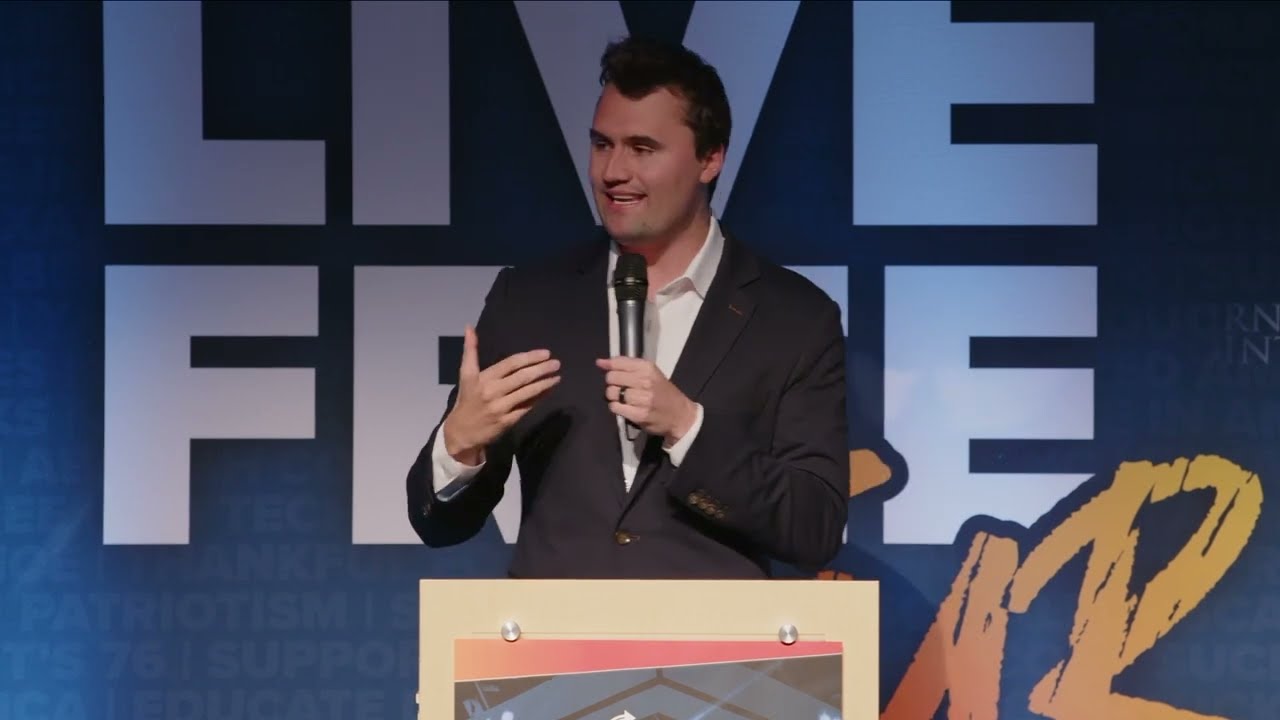
Charlie Kirk on Bill Maher Interview: What Happens When Society Loses Its Christian Foundation
Enjoying this? Share it with someone who needs to see it.
Up Next
Charlie Kirk Sits Down with Bill Maher on Club Random: Discussing Faith, Politics, and Cultural Battles
1:10:43
Charlie Kirk Exposes the Greatest Failure of Modern Education and How Christians Can Fix It
19:52
Charlie Kirk on America's Founding Documents, Christian Courage, and Why July Fourth Matters to Believers Today
1:37:01
Charlie Kirk on Bill Maher Interview: What Happens When Society Loses Its Christian Foundation
Charlie Kirk reflects on his recent conversation with atheist Bill Maher, exploring how the decline of Christianity in America creates a moral vacuum that wokeism rushes to fill. Kirk argues that without an agreed-upon moral structure rooted in biblical truth, society descends into confusion, from men competing in women's sports to the worship of alternative ideologies. He challenges the notion that America can maintain principles like universal human equality without acknowledging their divine foundation, warning that Gen Z's departure from traditional religion doesn't mean they're non-religious, they're simply worshiping something else. Kirk contends that the Constitution itself emerged from biblical truths, and that preserving Western civilization requires reconnecting with the Christian worldview that built it.
Charlie Kirk recently sat down with Bill Maher for what turned into a revealing conversation about faith, culture, and the foundations of American society. Maher, an outspoken atheist who was smoking marijuana throughout the interview, treated Kirk respectfully despite their fundamental disagreements. Kirk joked about the potential effects of secondhand marijuana smoke, emphasizing that he's never used the drug himself and continues to warn against its cognitive effects.
While they covered various topics including Christianity—particularly relevant given the conversation's timing after Easter—Kirk wished they had spent more time discussing something he considers even more fundamental: the importance of an agreed-upon moral structure for any functioning society.
The Moral Vacuum and What Fills It
Kirk's central argument is straightforward but profound: if a society doesn't have a religious basis, specifically a Christian one, something else will inevitably replace it. This is where the political intersects with the spiritual and religious. As people become less religious—and Gen Z is demonstrably less religious than previous generations—a gaping hole opens in the human heart that demands to be filled.
According to Kirk, wokeism emerges directly from this lack of Christianity. While it's easy to mock the absurdities of woke ideology—the claim that men can give birth, for instance—Kirk argues we need to understand its deeper origins. The question isn't whether there should be some separation between church and state (Kirk acknowledges there should be some distinction), but whether there can be separation between morality and state.
The Consequences of Moral Confusion
Without a bedrock moral structure that society agrees upon, Kirk warns, people fall into moral confusion. This confusion manifests in policies and cultural movements that would have seemed unthinkable just years ago. Kirk points to the transgender movement as a prime example, particularly the issue of biological men competing in women's sports. He notes that 890 medals have been stolen from women because biological males decided to compete in female sports categories, and society has chosen to accommodate this rather than reject it based on any coherent moral principle.
This isn't just an isolated cultural oddity, Kirk argues—it's a massive problem that represents the death of Christianity's influence on Western civilization. The implications extend far beyond sports into every area of life, affecting everyone's children and grandchildren.
The Lie of Being Non-Religious
Kirk challenges the claim that many in the younger generation make when they say they have no religious affiliation. He insists they're lying—or at least being imprecise. What they really mean is they have no traditional religious affiliation. But everyone worships something, Kirk contends, because worship is simply what you aim at in life.
When people say they're not religious and just want to aim at whatever they want, Kirk sees danger. Does that mean worshiping the flesh? Pursuing drunkenness? He warns that this is a miserable way to live, and most people know someone trapped in that endless downward spiral of doing whatever the flesh demands whenever it demands it.
A Better Way: Glorifying God in Everything
Conservatives and Christians offer a better alternative, Kirk argues: a life dedicated to glorifying God in everything we do—including political matters. The Western tradition that conservatives fight to preserve is fundamentally rooted in Christian principles, starting with the recognition of universal human equality.
This point is crucial to Kirk's argument: you cannot arrive at the idea that all humans are created equal without belief in the divine. If you rely only on reason and embrace atheism, you cannot definitively and objectively say that murder is wrong. You might say murder hurts people or doesn't feel good, but you can't call it wrong because doing so requires appealing to a moral standard above yourself.
Wokeism as Religious Substitute
Kirk sees the consequences of secularism playing out across multiple dimensions of Western society. At first, it manifests as wokeism and secularism with their outlandish ideas. But the woke movement, whatever it eventually calls itself, mimics religious structures and maxims. It creates new objects of worship:
Nature or earth worship
The cult of anti-racism
The religion of scientism (the demand to "trust the experts" and "trust the scientists" at all times)
At some level, Kirk observes, human beings desire connection to something greater than themselves. His contention is that nothing is greater than being connected to what built Western civilization in the first place—the God of the Bible.
The Challenge to Non-Believers
Kirk issues a challenge to liberals, leftists, and atheists: tell us what the ultimate authority should be. Politically, conservatives believe the Constitution should be the ultimate authority. But Kirk argues that the Constitution itself is built on biblical truths—concepts found throughout the Bible.
These foundational American principles include:
All men being created equal
The right to free expression
The right to worship your creator
The principle that faith cannot be imposed by force but must be embraced through personal agency
All these ideas, Kirk maintains, grew out of the biblical worldview that too many people now take for granted. The principles that make America exceptional and that protect our freedoms didn't emerge from a vacuum or from pure reason—they came from a specific understanding of human nature and human dignity rooted in Scripture.
The Stakes for Western Civilization
Kirk's message to Christians, conservatives, and center-right Americans is clear: understand the consequences of where secularization leads. It begins with seemingly abstract ideological battles but eventually touches every aspect of society. The loss of Christianity as society's moral foundation doesn't result in neutral secularism—it results in the worship of false gods and the adoption of incoherent moral frameworks that harm real people.
Preserving the Western tradition requires acknowledging and defending its Christian roots. The alternative isn't a peaceful, rational secular society but rather a chaotic landscape of competing pseudo-religious movements, each offering its own answer to humanity's fundamental questions about meaning, purpose, and morality—answers that Kirk believes will always fall short of the truth that built Western civilization in the first place.