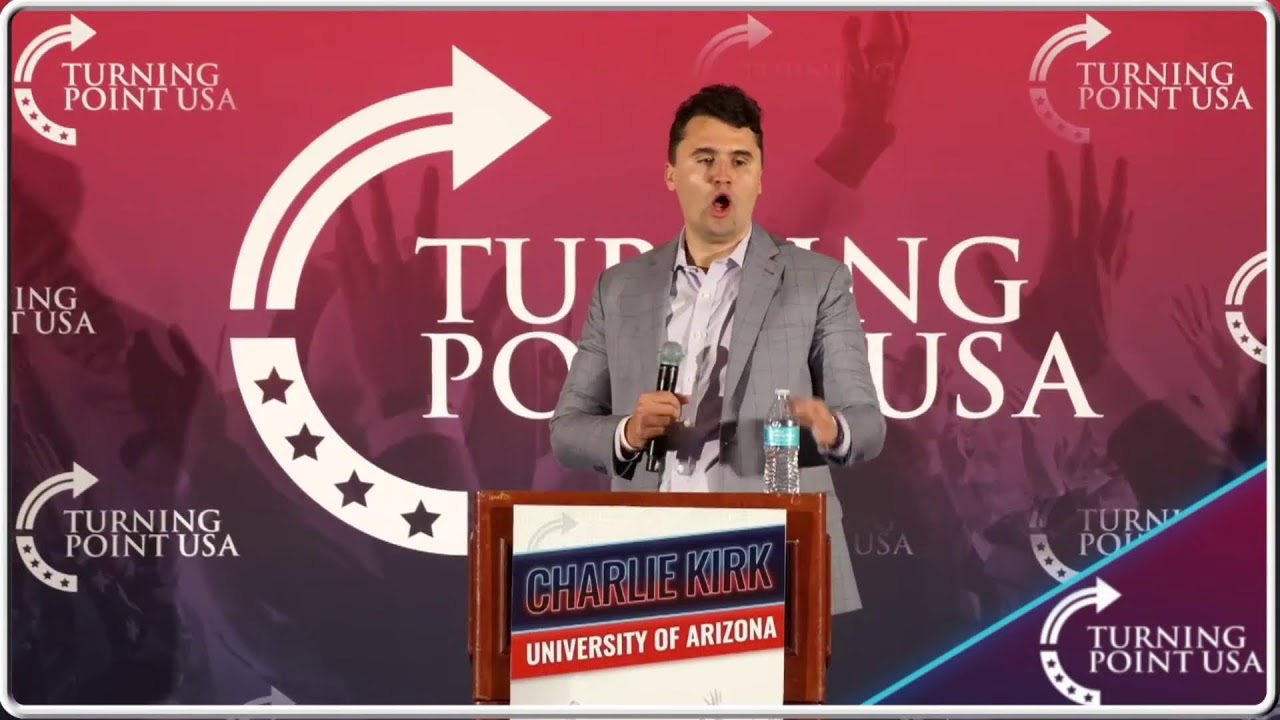
Charlie Kirk on the Crisis of Courage: Why Self-Censorship Is America's Biggest Threat
Enjoying this? Share it with someone who needs to see it.
Up Next
Charlie Kirk Confronts FBI Overreach, Vaccine Mandates, and the Battle for Arizona's Future at University of Arizona
1:11:10
Charlie Kirk Exposes the Greatest Failure of Modern Education and How Christians Can Fix It
19:52
Charlie Kirk on the Crisis of Courage and Self-Censorship Destroying America
17:28
Charlie Kirk on the Crisis of Courage: Why Self-Censorship Is America's Biggest Threat
Charlie Kirk addresses what he calls a crisis of courage in America, arguing that self-censorship, not big tech or government overreach, is the number one form of censorship facing the country. Drawing on quotes from George S. Patton and Aristotle, Kirk challenges audiences to stop shutting themselves up out of fear of losing jobs, friends, or social standing. He connects the decline of courage to the erosion of shared language, culture, and religious foundations, warning that when societies lose their moral structure, chaos and totalitarianism follow. Kirk calls for an end to spectator conservatism and urges people to become the same person in public that they are in private, no matter the cost.
There is a crisis of courage in our country. The number one form of censorship in America is not big tech censorship. It's self-censorship. It's shutting yourself up. People say they won't talk about politics at meals because they don't want to lose friends. They won't tell their neighbors what they think. Many live good lives and understand that what people say about them matters, that Instagram likes feel incredibly important. But you can be a lot of things—smart, creative, funny, successful, charming—yet if you are not courageous, they're all very brittle.
George S. Patton, one of the greatest men ever to live, famously said that moral courage is the most necessary yet absent characteristic in men. Aristotle famously said that without courage, there is no other virtue—that it is the virtue that holds all the other ones in place.
What Is Courage?
What is courage? When asked, younger audiences often stumble around by using the word in the definition. That's okay. It's not their fault. We don't teach children what courage is. Courage, simply defined, is doing the right thing or the good thing when the outcome is uncertain. It's that simple. When there's an unknown after the action. If you know how things are going to work out, that's not very courageous. Buying a cheeseburger at McDonald's is not exactly courage—you know how it's going to work, you're going to get it and you're going to gain weight.
Living on the Coattails of the Greatest Generation
We are living on the coattails of the greatest generation's courage. Let me say that again. We are living on the coattails of the greatest generation's courage. And that gift that the greatest generation gave us—my grandfather who served in World War II, Erika's grandfather who served in World War II—who stepped up and gave everything for a good beyond anything imaginable to save the planet from unspeakable evil and tyranny on two fronts, sacrificing our own manufacturing base, metal, might, all of it. Sending our own sons across the world, many of whom never to return again. We are living on their coattails, and that time is running out.
And it wasn't just the war effort. It's what they did after. They made a decision that they were going to commit to getting married and having children. They made a decision that they were going to build strong communities and reinvest in America.
How Does One Become Courageous?
How does one become courageous? It's a really interesting question. I've realized that there is a courage crisis in our country largely because we have a lot to lose. You see, revolutions tend to work with people that don't have a lot—material stuff, friends, relationships, connections. So you just have to ask yourself, does that matter more than pursuing the truth with courage? And if so, so be it.
Some people say they're going to lose their job. You might. You're right. You might lose your job. Make a decision. That's it. Maybe it's the right decision. Maybe it's the wrong decision. You might lose your friends. Yes, you will. But you'll make new ones. A lot of them. If you're really wrestling with this and this is speaking to you, just list the courageous people that you've seen in your life that you see in history and you write them down and you ask yourself the question, do I want to be more like them?
Shared Language, Culture, and History
If a country does not have a shared language, culture, or history, it's going to stop being a country and it will just be a temporary colony where you make a bunch of money and you lose any sense of congruency and any sense of familiarity with your fellow countrymen. We love free speech in the conservative movement. But if you don't share a language with your fellow countrymen, how can you express and share ideas?
Let's talk about the moral imperative of speech. Why do we like freedom of speech? We like freedom of speech because it's the best way that we can govern ourselves without actually having to get to physical conflict. Dialogue, which comes from the Greek word through reason, through thinking, is what makes us different in the West than almost any other country around the world. Our capacity to say, you know what, debate me. Come up and tell me why your ideas are better.
The Tyranny of Self-Censorship
But all of a sudden, if speech is disappearing, which it is in our country, then all of a sudden you're more likely to self-segregate from a certain conversation or shut yourself up. We talk about censorship a lot in the conservative movement. Do you know what the number one form of censorship is in the country? It's not from Google. It's not from social media. It's self-censorship. How many people self-censor their views because they're afraid of losing a job, getting kicked out of a fraternity, getting kicked out of a sorority, or having their friends call them the r-word? The answer is almost every single person, whether your hands go up or not.
That form of self-censorship is such an unbelievably dangerous trend that's happening in our country. And what does that result in? That results in half the country voluntarily saying that they don't even want to care about what we think, that they care nothing more than a power struggle of controlling our entire country.
The Problem With Unlimited Truths
Somebody said different cultures have different truths. Are there different customs? Of course, be respectful of them and all things. But you look at that question: there's an unlimited amount of truths? There could be lots of different shared experiences, but for example, if you have a car crash and there are five witnesses, everyone says what happened. Eventually, you want to get to the truth of what ended up happening. You want to be able to get to the consensus of the matter.
When you design a government or you have a society and you raise a generation that says anyone can believe whatever they want to believe about anything at any time, how on earth are you going to have a stable and civil society from that point? If everybody had a definition of what north is, good luck trying to orient everybody. So no, there's not an unlimited amount of truths. I believe there's one truth, but I think that truth is rather broad. It's a road that is not too narrow and not too wide, as C.S. Lewis would say in The Abolition of Man. It's the Dao.
From Chaos to Totalitarianism
The consequence of this will end up being two things. First, you get chaos, and that's bad. But we never talk about what happens after that, which is then you get totalitarianism. You see, as soon as you confuse everybody—there is no truth, you have your own truth, and you have all these different bickering tribes—eventually people are going to want order. And that's when you get someone like Joseph Stalin that comes along. And all they care about is power, and they're good at it. And then all of a sudden, you could throw out all the stuff I've talked about: consent to the governed, separation of powers. Chaos is a strategy towards totalitarianism.
Not everyone who's participating even recognizes or realizes it. They say they're liberating groups to be able to have whatever truth they want to have under any circumstance. Now, you can have your own opinions. But do you notice how quickly it goes from this is my truth to all of a sudden if you don't accept your truth, you're going to be penalized? Happens very quickly. So it's not just your truth. It's that I must now adopt that.
Self-Love Versus Self-Respect
The fascination with loving yourself is gnostic narcissism. You should have respect for yourself, not love for yourself. I read these self-help phrases sometimes where they say my imperfections make me perfect. If you actually go through Pinterest and read some of this stuff, instead it should be: I'm not all who I could possibly be. Maybe it should be a challenge to oneself, not a non-stop romantic love campaign with yourself. In fact, I think it creates more misery and more depression the more people think that they're in a romantic relationship with themselves.
You should have respect for yourself, but you should have respect enough to say that I could be more than I am today and I'm going to delay my own immediate gratification. There's a lot of good people that are into the self-help, self-love thing. I hope it works for you. I have seen it do great damage to a lot of young people. When I was in seventh grade, I saw a sign that was posted all throughout our school and it said, "You are perfect the way you are." And I asked my teacher then, "Then why am I in school?"
Why would you go to school if you are perfect the way you are? Instead, it should be: you have great potential. It's a much better message to tell a young person because as soon as you say you're perfect the way they are, they know they're not. They put more pressure on themselves. They're harder on themselves. Instead, it should be a pursuit and a journey towards development that I am not there, but I'm going to keep on trying to either lose weight or improve my diet, stop lying, get better friends, and then maybe I can be a better version of myself. The West was built on that. The West was not built by a bunch of people on the Mayflower Compact saying they're in deep love with themselves. The Declaration of Independence was not signed by 56 people that were into self-love. It was signed by people who love their family and love their country.
Conversation With Bill Maher: The Need for Shared Moral Structure
I just sat down with Bill Maher. If you guys saw it or not, if not, I encourage you to look at it. It's a good conversation. Bill Maher is not a Christian—he's very much not a Christian. He is an atheist. And remember, without God, there would be no atheist. I sat down with him, and it was kind of interesting. He treated me very well to his credit. We just dialogued a lot. He was smoking pot the whole time, which may or may not have impacted me. Don't do marijuana, by the way. I've never done marijuana in my life. I encourage you not to do it. I've talked against marijuana my whole life about how it makes you not as sharp as you could be. Totally true. Be very careful if you go on a podcast with Bill Maher. I actually didn't do it, but the secondhand high might be a real thing.
We talked a lot about Christianity, which again, this is coming after Easter. But what I wish we would have spent more time on is the importance for a society to have an agreed upon moral structure. If you do not have a religious basis, specifically a Christian one, for your society, something else is going to replace it. And this is where the political meets the spiritual and the political meets the religious.
The Death of Christianity and Rise of Wokeism
When you become less religious, which this generation is—Gen Z is becoming less and less religious than their parents' generation—then you have a gaping sized hole in your heart and something must fill it. And out of the lack of Christianity is where we get wokeism. Understand that it's easy to attack wokeism, this idea that men can give birth and all this nonsense. It's easy to say, well, separation of church and state, we could talk about that. Of course, there should be some separation, some distinction. But do we have separation of morality and state?
When you no longer have a bedrock upon agreed moral structure for your society, then people are going to be in moral confusion. And that is when you start to see widespread transgenderism for our youth or men in female sports. Because if you do not have an agreed upon thing of what is right, what is wrong, what is good, what is evil, what is just, what is unjust, what is holy, what is profane—when you see something as asinine as this idea that biological men should be able to compete in female sports, 890 medals by the way have been stolen from women because biological men decided to play in that sport and we have to accommodate that. This is a massive problem that is an outgrowth of the death of Christianity.
What Happens When Society Gets Too Secular?
What happens when a society gets too secular? Why does that matter to everyone? It should break you out of your comfort zone to know that it actually does impact you and your children and your grandchildren. If a society becomes less religious, if a society becomes less Christian, if a society becomes less grounded to our foundational roots, be very careful what will actually replace it. As we start to see many in the younger generation say they have no religious affiliation, they're actually lying to you. They're saying that they have no traditional religious affiliation. Something is their god. They are worshiping something, and to worship is what you are aiming at.
But if you say you're not religious and you just want to aim at whatever you want to aim at, be very careful. What does that mean? Does that mean you're going to be the god of the flesh? The god of trying to get as drunk as I possibly can? And just a little bit of a warning: that is a miserable way to live. You know plenty of people probably that are in that cycle, that endless downturn, that down spiral of I'm just going to do whatever the flesh tells me to do whenever I want to do it. Be very cautious with that.
The Western Tradition and Biblical Worldview
We believe a better way to live as conservatives and Christians is one that we want to glorify God in everything that we do in all that we do. And that includes political matters. The Western tradition is what we are trying to fight for. The Western tradition is one that recognizes universal human equality. Think about how fundamental this is. You cannot get to this idea that all humans are created equal without a belief in a divine.
If you just have reason and you believe in atheism, you cannot resolutely and objectively say that murder is wrong. You could say murder might hurt people. You could say murder might not feel good, but you can't say murder is wrong because you have to eventually appeal to a moral standard above you. And so we see this playing out in so many different dimensions of the West. My call to all of you that are Christians or center-right or conservatives: understand the consequence of where this leads. At first it will just be wokeism and secularism. It will be the craziest ideas imaginable because the woke movement, whatever it ends up calling itself in the future, mimics religious maxims. It will have whether it be the worship of nature or earth worshiping or the cult of anti-racism or this idea that the religion of scientism. Remember we went through that entire thing that you must trust the experts and trust the scientists at all points.
At some level, we as human beings desire to be connected to something greater. My contention is there's nothing greater than actually being connected to what built this place in the first place. We open it up for liberals or leftists or atheists: you tell us what ultimate authority should be. Politically, we believe the Constitution should be ultimate authority. But out of the Constitution are all biblical truths. These are things that we find in the Bible: all men being created equal, that you have a right to free expression, that you have a right to be able to worship your creator, that we're not going to do it by force, but you have to do it with your own agency. These ideas were grown out of the biblical worldview that many people take for granted.
Institutions Have Failed—Now It's On Us
Every major institution you have trusted to self-correct the trajectory of America has largely failed us. The media, academia, corporations. So now it's like, all right, every organization that was supposed to be doing what they were supposed to be doing while I was building my business and while I was building my family has basically betrayed us. It's now on us. I'm going to show up to the school board meeting. And this is the sort of mindset that needs to start to set in, which is no more spectator conservatism. No more watching from afar and just hoping it gets better.
Fighting Cancel Culture: Be the Same Person in Public and Private
I'll give you a great example of this. People say, "Well, Charlie, what's one way that one thing that we can improve upon?" I can't stand the term cancel culture. I don't know about you. It drives me nuts. But it's true. It's a real thing. But all of us participate in cancel culture, whether we know it or not, in two ways. We shut ourselves up or we're okay when all of a sudden someone we know or someone in our circle gets canceled because of a racist text message that gets resurrected and we all sit idly by because we don't want the sword of Damocles to be dropped on us.
Let's start with the first thing. Every single person needs to be the same person in public that they are in private starting tonight. Every single person here tonight can no longer shut themselves up because of the tyranny, the mockery, the threats, or the ridicule that might come your way because you might get discovered to be a conservative. We need to say, you know what, you might fire me. You might no longer be my friend. I don't care. This is what I believe. It's that simple. I don't care.
We allow our decency to turn into apathy and silence. We don't want to be disorderly. We don't want to offend people. Well, I could tell you right now that the tyranny of self-censorship is a much bigger threat than even the censorship of tech companies and other people shutting us up. The threat of people shutting themselves up—I'm going to shut up me—big problem and it's happening a lot.