Charlie Kirk on Canada's Decline and What He Would Do as Prime Minister
Enjoying this? Share it with someone who needs to see it.
Up Next
Charlie Kirk Rallies Arizona Crowd After RFK Jr Endorsement of Donald Trump
17:45
Charlie Kirk Debates Gun Control and Immigration with Kansas State University Students in Manhattan
11:03
Charlie Kirk Responds to Free Speech Question About Banning Critical Race Theory in Schools
1:06
Charlie Kirk on Canada's Decline and What He Would Do as Prime Minister
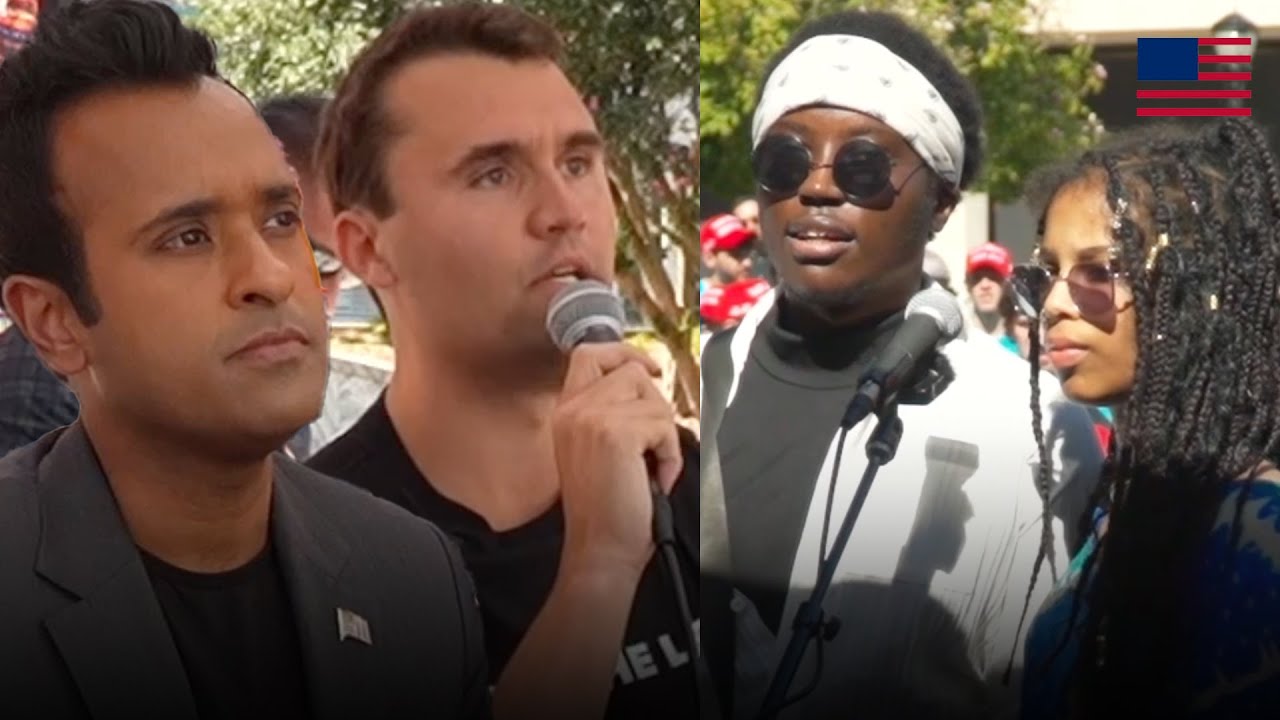
Charlie Kirk responds to a former Canadian resident who moved to America, sharing his stark assessment of Canada's current state. Kirk discusses Canada's self-destructive politeness, lack of constitutional protections, and unsustainable immigration policies. He addresses what he would do if he were Prime Minister, why Alberta should consider independence, and how Canada's liberal cities in Ottawa, Toronto, and Vancouver are driving the country's decline. Kirk warns that a Kamala Harris presidency could turn America into "Canada 2.0" and explains why Canada's lack of First and Second Amendment equivalents allows government overreach.
Charlie Kirk engaged with an audience member who recently moved from Canada to the United States, sparking a conversation about the fundamental differences between the two countries and Canada's accelerating decline. The former Canadian resident expressed gratitude for making the move to America while raising concerns that a Kamala Harris presidency could transform the United States into "Canada 2.0."
Kirk didn't mince words in his assessment of Canada's current trajectory, calling it "a real problem" and expressing relief that the questioner had successfully obtained American citizenship. The conversation highlighted deep concerns about governance, constitutional protections, and the future of both nations.
What Charlie Kirk Would Do as Prime Minister
When asked what he would do if he were Prime Minister of Canada, Kirk's first response was characteristically direct: "I would deport Justin Trudeau the first day. That guy sucks." Beyond this opening salvo, Kirk outlined a more substantive policy proposal that would fundamentally reshape the Canadian federation.
Kirk stated he would "basically allow Alberta to become its own country," acknowledging the unique character of Canada's western province. He praised Edmonton and Calgary as "the two best parts of Canada," noting the region's beautiful landscape and distinct political culture that sets it apart from the rest of the country.
The Problem with Politeness: How Good Traits Become Weaknesses
Kirk identified what he sees as a core problem in Canadian political culture: the country's defining characteristic of politeness has become its Achilles heel. He described Canada as "a self-hating country" that "prides itself on being polite," but argued this trait has been weaponized against the country's own interests.
"This is a great lesson for those of us in the west," Kirk explained, "that your favorable characteristics of being polite, nice and welcoming can also be your downfall." He illustrated this point by describing how Canadian politeness translates into policy: "Super polite, okay, we're just going to allow a bunch of foreigners to overrun our country. Super polite, we're not going to allow anyone, we're not going to have free speech."
Kirk's argument suggests that cultural virtues, when taken to extremes or exploited by bad actors, can transform from strengths into vulnerabilities that threaten a nation's sovereignty and character.
Constitutional Deficiencies: The Absence of American-Style Protections
A central theme in Kirk's critique of Canada was the country's lack of constitutional protections equivalent to America's First and Second Amendments. "Canada's got a big problem," Kirk stated. "It does not have the Constitution, so you do not have robust free speech protections, you do not have Second Amendment protections, so the government is able to do whatever they want."
This constitutional gap, according to Kirk, fundamentally changes the relationship between citizen and state. Without explicit protections for speech and self-defense enshrined in foundational documents, the Canadian government operates with far fewer constraints on its power than the American government faces.
Kirk acknowledged that even if he were to become Prime Minister with reformist intentions, he "wouldn't last very long" given the entrenched political culture and lack of constitutional framework to support fundamental rights.
The Liberal Urban Axis: Ottawa, Toronto, and Vancouver
Kirk identified three Canadian cities as the driving force behind the country's leftward trajectory: Ottawa, Toronto, and Vancouver. He described these urban centers as "some of those liberal cities on the planet," suggesting they form a political and cultural axis that dominates Canadian politics despite representing a relatively small geographic portion of the country.
This urban-rural divide mirrors similar dynamics in the United States, where coastal cities and political capitals often pursue policies at odds with rural and suburban populations. The concentration of political, economic, and media power in these three cities gives them outsized influence over national policy.
Immigration at Unsustainable Levels
Beyond cultural and constitutional issues, Kirk raised alarm about Canada's immigration policies, claiming that "Canada I think is bringing in like half of its population in the next decade in immigrants. It's just not sustainable."
While Kirk's specific numerical claim would require verification, his broader point addresses concerns about rapid demographic change and its impact on social cohesion, infrastructure, housing, and labor markets. The sustainability of immigration levels has become a contentious political issue not just in Canada but throughout the Western world.
From Great to Fallen: Canada's Trajectory
Kirk concluded his assessment with a somber epitaph: "It's too bad. It was a once great country. Canada has fallen." This framing positions Canada not as a country facing temporary challenges but as one that has fundamentally lost its way, transitioning from greatness to decline.
The conversation ended on a positive note for the individual questioner, with Kirk congratulating him on his citizenship and his journey from California, through Canada, and back to America. "You won the lottery," Kirk told him, welcoming him home to the United States.
The exchange encapsulated broader concerns among American conservatives about the direction of Western democracies and the importance of constitutional protections, controlled immigration, and cultural confidence in maintaining a free society.