Charlie Kirk Reveals His Right-Wing Revolution Strategy to Beat the Woke and Save Western Civilization
Enjoying this? Share it with someone who needs to see it.
Up Next
Andrew Kolvet and Mikey McCoy Share Charlie Kirk's Final Asia Trip and Turning Point's Future Vision
1:58:02
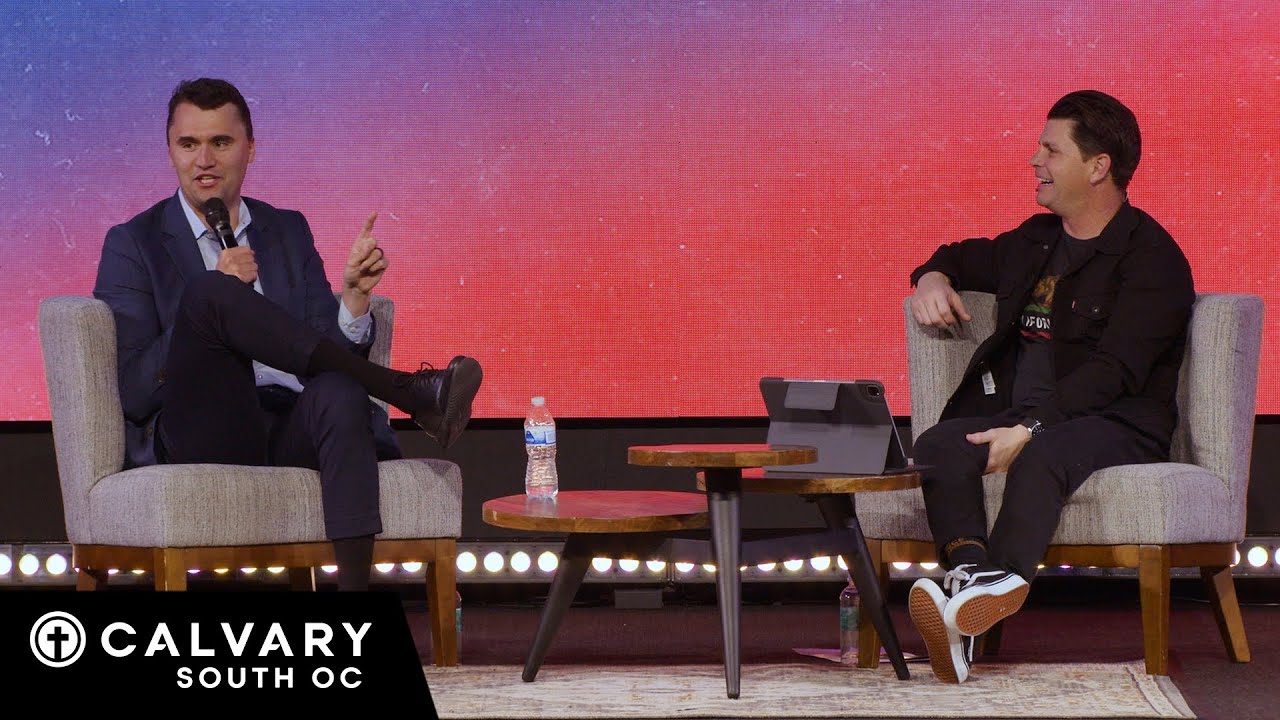
Charlie Kirk on Fatherhood, Faith, and Fighting for the Next Generation at Calvary Chapel South OC
1:07:33
Charlie Kirk and Candace Owens on Building the Conservative Movement Through Dialogue and Youth Engagement
7:30
Charlie Kirk Reveals His Right-Wing Revolution Strategy to Beat the Woke and Save Western Civilization
Charlie Kirk joins Dr. Gad Saad to discuss his latest book, Right-Wing Revolution, and his journey from a 19-year-old entrepreneur to leading one of the most influential conservative organizations in America. Kirk shares the genetic traits that drove his success, including an unusual ability to ignore criticism and work 330 days a year for a decade straight. He explains why 90% of his new book focuses on actionable solutions rather than diagnosing woke ideology, offers predictions for the Trump-Biden debate, and addresses the puzzling inability of many American Jews to change their political allegiance despite evidence that might suggest otherwise. Kirk also discusses Turning Point USA's ambitious ballot-chasing operation and his upcoming 20-campus tour across America.
From West Point Dreams to Conservative Movement Builder
Charlie Kirk never intended to become a political entrepreneur. He wanted to attend West Point, but when that didn't work out, he told his parents he was taking a gap year to "save civilization." That gap year has now lasted twelve years, during which Kirk built Turning Point USA from 80 students in a Holiday Inn Express in West Palm Beach to a 600-person organization hosting events with 15,000 enthusiastic attendees in stadium-like venues.
Kirk attributes his success to several key factors. First, he realized early that high performers in professional life are far rarer than in high school. While many students will stay up late studying for good grades, few adults maintain that work ethic in their careers. Kirk traveled 330 days a year for ten years straight—3,300 days total. His promise to himself was simple: he might not have the most credentials, but he would outwork everyone.
Second, Kirk possesses what he calls a "genetic deformity"—he genuinely doesn't care what people say about him. When Congressman Thomas Massie mentioned having the same trait, Kirk recognized a kindred spirit. This psychological resilience allowed him to ignore critics who said he would fail without a college degree.
Third, the 2008 financial crisis inadvertently liberated him. His parents couldn't afford to pay for college, meaning Kirk would have to take on debt himself. This made him think carefully about whether borrowing $100,000 to study something he wasn't passionate about made financial sense. He chose a different path.
The Traits That Predict Success
Kirk cites research showing that intelligence plus self-control are the top two predictors of success. From a young age, he prided himself on self-control. He was the "weird kid" in high school who didn't do drugs or drink, following a regimented, rule-based trajectory. He describes his superpower as the ability to work on things that might seem unenjoyable for long periods, knowing they would bear fruit eventually.
Dr. Gad Saad adds another dimension: delayed gratification. Kirk's choice to skip the typical college party experience and work relentlessly, combined with Saad's own decision to stay in university until age 29 pursuing his PhD, both exemplify the willingness to sacrifice immediate pleasures for long-term gains. This trait also correlates with better financial habits, such as saving for the future rather than spending every paycheck immediately.
Kirk applies this long-term thinking to Turning Point USA's mission. The organization works toward goals that are years or decades down the horizon. He notes that Western society has regressed toward immediate gratification, creating problems in both culture and economics. The fear of any recession leads policymakers to immediately "turn the money printer on," flooding the economy with cheap money rather than accepting short-term pain for long-term stability.
Right-Wing Revolution: A Blueprint for Action
Kirk's latest book, published by Winning Team Publishing (co-founded by Donald Trump Jr.), takes a different approach than most anti-woke literature. Only about 10% of the book diagnoses the problem—explaining how woke ideology emerges from nihilism, postmodernism, post-structuralism, and deconstructionism. Kirk describes woke as "a group of people that complain until they control," primarily a means of destabilization and control.
The remaining 90% focuses on what can actually be done, both at the micro and macro levels. This includes building new institutions, improving yourself, getting off social media, and what Kirk calls the "honey badger element"—caring less about what others call you. A significant portion examines why non-woke individuals, despite having more political and economic power than they realize, fail to use it effectively. Kirk believes the answer is not lack of numbers but lack of will.
Westerners have prioritized comfort and the ease of modern life over the necessity of conserving what is good, true, and beautiful. The book includes Kirk's personal story and challenges readers to get off the couch and take action. He receives countless questions from people who agree that woke ideology is destructive but don't know what to do about it. The book provides answers.
Specific proposals include founding a hundred new colleges in the next five years, modeled after the University of Austin and Hillsdale College. Kirk details legislative strategies for defunding major woke institutions at the taxpayer level, identifying states like Oklahoma, Missouri, and Kansas where lawmakers are receptive. His contribution focuses on activism and entrepreneurship rather than academic scholarship, filling a gap in the anti-woke resistance.
Turning Point USA: Where Aesthetics Meet Ideology
Kirk couldn't stand traditional conservative events—boring gatherings in old Hiltons with mediocre audiovisual setups. He asked a fundamental question: if conservatives believe their value system is superior, why are their aesthetics so bad? He insisted that aesthetics must also be beautiful and excellent because humans have five senses. Winning isn't just about arguments; it requires a whole-of-being approach that creates excitement, depth, and spiritual movement.
The transformation didn't happen overnight. The first Turning Point event hosted 80 kids in a Holiday Inn Express in West Palm Beach with barely enough money to pay for it, featuring a slideshow and two speakers. But Kirk promised himself to wait ten years and see where those events would be. Today, they are the biggest, boldest, and most impactful conservative events in the country, the envy of the entire movement. Dr. Saad, who spoke at AmericaFest in December, compared the experience to being Mick Jagger performing for 12,000 to 15,000 enthusiastic fans in a stadium setting.
Predictions for the Trump-Biden Debate
Kirk acknowledges his bias—he's very close to President Trump, who has been a friend and supporter throughout the years. That said, he offers several observations about the unprecedented early summer debate. Debates typically happen in the fall, making this timing highly unusual. Trump, doing what Trump does, posted on social media that he would debate Biden anytime, anywhere, not expecting Biden to call the bluff.
Biden's campaign, seeing negative poll numbers and realizing that Trump's conviction (which Kirk calls "ridiculous," "sinister," "unprecedented," and "evil") actually increased Trump's poll numbers in certain states, views the debate as a desperate attempt to tighten the race and get within the margin of error. Kirk believes that if Biden gets through all 90 minutes, "it'll be one of the greatest accomplishments in American chemistry in the modern era." He wants to know the recipe and meet the person who deserves a prize for creating that pharmaceutical cocktail.
Kirk's advice to Trump, both publicly and privately, is that a tie is a win. Trump is already doing very well in the polls. Biden's team will try to create a caricature of Trump as someone who interrupts constantly and appears unstable. Kirk believes Biden has more to lose than Trump, and Trump will surprise people with his ability to navigate adversarial moderators and Biden's responses.
Trump will be at his best if he emphasizes that for the first time since 1892, Americans can judge two independent presidential terms back-to-back. In that historical election, Grover Cleveland (who won in 1884) was displaced by Benjamin Harrison (who won in 1888), then ran again and won, becoming the only president to serve non-consecutive terms. Kirk hopes Trump will follow the same pattern.
The key message: remind voters how good things were under Trump, how bad they've become under Biden, and what the path forward looks like. Crucially, Trump should remind swing voters and independents how Biden has embraced what Kirk and Saad call the woke agenda—a radical anti-reality, anti-truth ideology now running the federal government.
The Puzzling Case of American Jewish Voters
Dr. Saad presents a perplexing statistic: in 2020, American Jews voted 68-30 for Biden, a 38-point differential. A recent poll shows 61-23 for Biden—still a 38-point differential. Despite four years of events, including October 7th and the resulting surge in antisemitism that Biden's policies facilitated, the needle hasn't moved by even one percent among American Jews. Meanwhile, Latino and Black voting patterns have shifted.
Saad identifies this as the most surprising human phenomenon in his 30-plus year career as a professor and behavioral scientist: the inability of people to change their minds in light of incoming evidence. Kirk offers an explanation that he stresses is not a criticism, given his strong pro-Israel and pro-Jewish stance: most American Jews take social justice more seriously than their religion. Their religion has become social justice.
The pattern is clear: the more liberal someone is in their Judaism, or the less seriously they take their Judaism, the more likely they are to remain attached to the Democrat Party no matter what. Conversely, the more seriously someone takes their Judaism—Orthodox Jews, for example—the more likely they are to support Donald Trump. This explains the recurring "Donald Trump is a fascist" narrative. Many Jewish Americans want nothing to do with what they perceive as the fascist party.
Kirk cites Dennis Prager, a committed Jew, who observed that some of the most destructive worldviews introduced to the West—from Marxism to parts of nihilism and deconstruction—often came from Jewish intellectuals or philosophers. There has been a yearning in Jewish circles to improve the world by all means necessary, often through state power. It's remarkable that even after the slaughter of 1,000-plus Israelis, campus protests, and open hunting season against American Jews, many liberal Jews still prioritize their liberalism over their Judaism.
Addressing Right-Wing Antisemitism
Saad raises another troubling issue. He frequently posts evidence that Islam poses the greatest danger to Christian life throughout the world, including persecution in the Middle East. Inevitably, some Christians respond not by acknowledging this threat but by blaming Jews. When Saad shows that grooming gangs in Britain consist entirely of men named Muhammad, thousands descend on his social media claiming it's not Islam's fault but the Jews who promoted open-door immigration policies. In their view, when three Muhammads commit a crime, Moshe is really to blame.
These critics aren't Muslims—they're right-wing Christians. Saad asks Kirk whether there's any way to reach these people or whether they're irretrievable. Kirk believes they can be reached and insists they don't represent the majority of the Western conservative movement. Most conservatives are very pro-Israel and pro-Jewish life. However, these critics conflate liberalism with Judaism, which are not the same thing.
There are many liberal Jews, but Judaism itself is not necessarily liberal. Blaming "the Jews" for all problems is "incredibly sloppy intellectual thinking," Kirk argues. Who exactly implemented open-door policies in the United Kingdom? Mostly secular former Episcopalians, not Jews. It is tempting but evil to blame a small group for society's suffering. It's a copout.
Kirk points out the selective processing involved: Stephen Miller, arguably the biggest opponent of open immigration in the United States, is Jewish. Dr. Gad Saad opposes open-door policies and is Jewish. But critics focus only on George Soros (an acolyte of Karl Popper, who started the Open Society movement) because both are Jewish. They look for Jews who support problematic ideologies while ignoring Jews who fight against them—a perfect manifestation of confirmation bias supporting innate bigotry.
The solution, Kirk suggests, is focusing on values and publicly stated beliefs rather than tribal or ethnic groups. The Islamic example works precisely because there are publicly stated beliefs and actions that pose an existential threat to the West. The same applies to woke ideology. One of the key criticisms of the woke is that they view the world through a tribal group lens. Team reality must resist that same temptation.
As Saad notes, he probably shares more values with Kirk than with an ultra-progressive Jew from Oberlin. He has more in common with Imam Tawhidi, a reformist Muslim cleric, than he might with some Orthodox Jews. The measure should be character and values, not ethnicity or religion.
Current Projects and Future Plans
Beyond promoting Right-Wing Revolution, Kirk is working on several major initiatives. The most significant is Turning Point Action's ballot-chasing operation. Kirk believes the Democrat Party has invested more money, time, and focus on the election process than on winning policy debates. His response is a serious project requiring tens of millions of dollars and hiring hundreds of full-time people to engage in ballot chasing, ballot harvesting (where legal), and registering voters.
American elections are a "totally disorganized mess," varying state by state and county by county, while Democrats have built a multi-billion dollar infrastructure. More information is available at TPAction.com. Kirk is also planning his most ambitious campus tour ever this fall, visiting nearly 20 campuses across the country in about 30 days. People can watch live streams and clips online. His podcast continues to grow, along with his daily radio program.
When asked if he might enter politics himself—perhaps even becoming president someday—Kirk demurs. He's very happy and grateful for what he has and rarely meets a happy politician. Saad jokes that Kirk has all the necessary talents plus one crucial advantage: height. As a shorter man, Saad knows he could never be prime minister or president, but Kirk has everything including the physical stature. Kirk laughs and says he has no plans to run for office, but if it happens, Dr. Saad could be a senior adviser.