Could Charlie Kirk's Pendant Have Caused His Neck Wound? Medical Expert Analyzes Ballistics and Physics
Enjoying this? Share it with someone who needs to see it.
Up Next
Was There a Conspiracy? Investigating the Suspicious Circumstances Around Charlie Kirk's Assassination
23:57
Investigator Jon Aaron Bray Replicates Charlie Kirk Assassination Wound Using Ballistic Gel and Bacteria Cellulose
1:13
Stephen Gardner Backs Official FBI Narrative on Charlie Kirk While Trigger Matt Questions the 306 Bullet Theory
34:42
Could Charlie Kirk's Pendant Have Caused His Neck Wound? Medical Expert Analyzes Ballistics and Physics
TriggerSmart's detailed forensic analysis examines whether Charlie Kirk's pendant could have penetrated his neck during the shooting incident. Medical expert Kalikukul presents calculations on bullet trajectories, neck cavitation physics, and the whipping effect of the necklace chain. The analysis estimates the pendant could have reached 45 meters per second, right at the threshold needed to pierce human skin (40-50 m/s). This investigation also explores the internal jugular vein injury, decorticate posturing survival rates, and whether mysterious dots caught on video represent additional bullets from multiple shooters.
Medical analyst Kalikukul has provided an in-depth examination of Charlie Kirk's neck wound, addressing viewer requests for more detailed analysis. The bullet damaged the cervical vein rather than an artery, evidenced by the color of the blood and the way it flowed out instead of squirting. The limited blood at the scene further supports this assessment.
Kalikukul identifies the injury as most likely affecting the internal jugular vein (IJV). The human neck contains multiple jugular veins that function as an interconnected system. Medical literature indicates that all IJV injuries should be repaired when possible, but doctors commonly ligate (tie off) the vein if repair proves impossible, demonstrating the body's high tolerance regarding this venous network.
An article on neck injuries cited by Kalikukul documents two cases of internal jugular vein damage where both venous injuries were ligated. At follow-up appointments 12 and 21 days later, both patients were doing well with no complications. The main risks include immediate bleeding before stopping it and the danger of the vein sucking in air. While still dangerous, a cut vein is far less dangerous than a cut artery.
Immediate Response and Survival Prospects
Based on video evidence, there appears to be significant blood flow initially—a substantial first spurt. Charlie Kirk's wound received attention within seconds by his trained security staff, providing nearly immediate medical response. Kalikukul assesses that Charlie's wound was definitely serious, but most likely wasn't instantly fatal from bleeding alone, contrary to some suggestions that he would be "dead before he touched the ground."
However, there was the concerning factor of decorticate posturing, which indicates severe brain damage. This posturing occurs when specific parts of the brain and motor pathways are damaged while others remain functional. Kalikukul proposes this might have happened if the bullet hit the occipital bone at the back of the head, causing trauma underneath it, then traveling along the spine.
The injury was severe but might not have been immediately fatal. Statistically, there's a 37% survival rate associated with decorticate posturing. Medical literature states that following a head injury, only 37% of patients displaying decorticate posture and 10% of those displaying decerebrate posture survive. Kalikukul's overall assessment is that Charlie's condition was severe, but there was potentially some chance of survival, contrary to many who suggested there wasn't.
The Bullet Caught on Video Theory
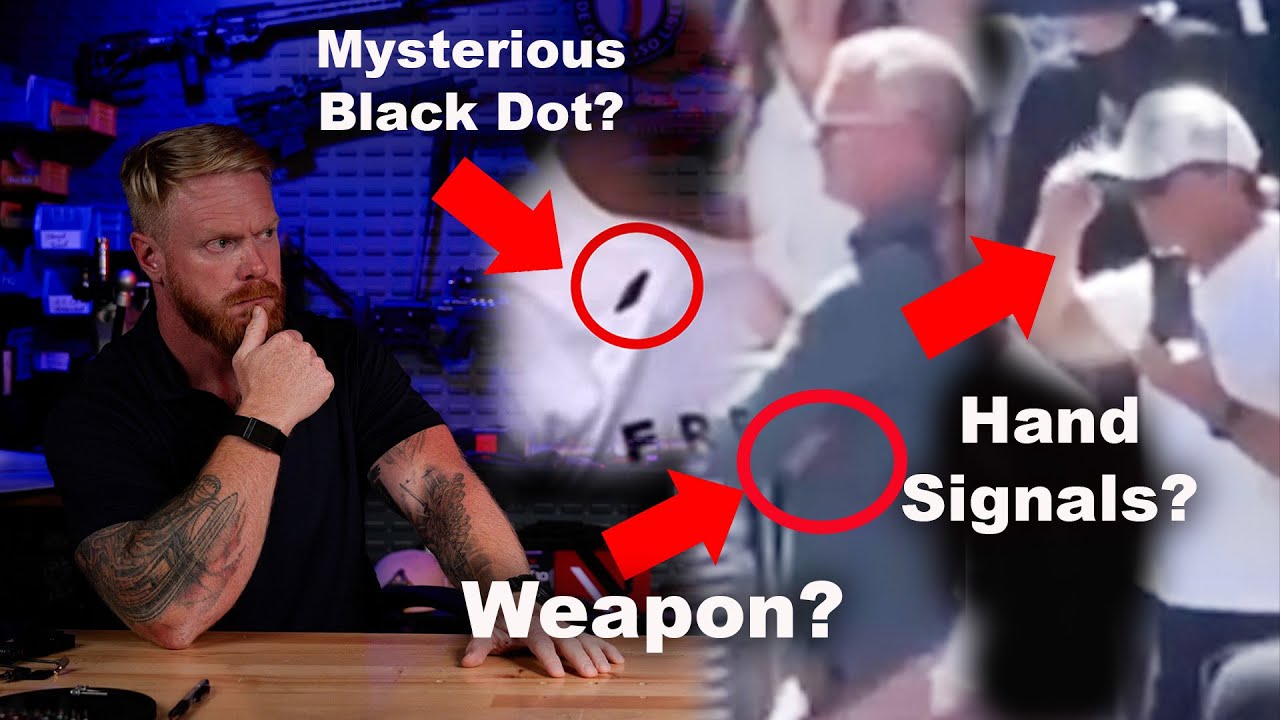
Kalikukul addresses Jason Goodman's theory about a bullet being caught on video. Goodman merged parts of images from 20 fps and 30 fps versions of the same footage to show three dots in an almost perfect line around the moment Charlie was shot. Although this coincides with one of the very possible trajectories, Kalikukul expresses doubt that it shows the bullet that hit Charlie.
One frame before the middle dot appears in the 20 fps version with two dots visible, there's no effect on Charlie yet. When the middle dot appears, there's still no visible impact on Charlie. Then the dot moves to the upper right. In subsequent frames, Charlie's shirt is going up and it appears he may have been hit, or it could be his microphone moving.
There's something happening at this point, but there's also what appears to be a projectile or bullet in a different location. Kalikukul and some other analysts theorize that the bullet Jason Goodman identified might not be the one that hit Charlie, but rather one flying past. This would support the theory of multiple shooters from different positions.
Questions About Bullet Speed and Direction
Kalikukul notes that the dot moves quite slowly for a bullet. Estimating the distance from Charlie to the edge of the tent at 12 feet, with the right dot near the tent edge and the left dot at his head, the distance between every two dots could be 6 feet. The 20 fps video captures a snapshot every 50 milliseconds, meaning the dot moves 120 feet per second. Typical rifle bullet speeds range from 2,300 to 3,500 feet per second. Low velocity PCP air guns seem to start around 300 feet per second.
The bullet appears to move away from Charlie, which contradicts the expected trajectory. Jason Goodman suggested this could be caused by technical reasons related to video encoding mixing up the order of some portions of the image, proposing the dots actually went toward Charlie. Kalikukul admits not having observed such phenomenon in compressed videos with small flying objects like bugs, which typically jump around instead of flying in a straight line. While acknowledging it might be possible, Kalikukul considers it uncommon.
The dots aren't in a straight line, which Goodman attributed to difficulty aligning the two video versions. Kalikukul questions what would make it difficult to align two versions of the same video, even if one is cropped differently. The process should simply involve stopping both videos at the same anchoring moment and shifting one on top of the other until the scene overlaps perfectly.
The Pendant Penetration Theory
Kalikukul addresses criticism from Valhalla VFT and other experienced ballistics experts who found most of the pendant theory plausible except for one crucial element: whether the pendant could actually penetrate the neck. These experts, some with wartime experience, couldn't accept this aspect as theoretically possible based on what they'd seen.
Kalikukul provides calculations involving cavitation size and duration. An important clarification: some YouTubers misunderstood the theory, thinking the expanding chest was supposed to whip up the pendant. This is not the case at all. Kalikukul doesn't believe the chest expanded from any cavitation—just the neck.
According to ballistics research from Banaras Hindu University, the minimum velocity required to penetrate skin is about 40 to 50 meters per second. This is known as threshold velocity. For bone penetration, the value is about 60 m/s. The wounding effect depends on several factors including target site (front or back of body, neck location), velocity of the projectile, constructional features, and range of firing.
The Physics of Pendant Acceleration
Mathematically describing a pendant accelerated by an expanding circle is quite difficult. Kalikukul identifies two accelerating factors working together:
The expanding circle: It has an increasingly greater effect as the necklace gets more in contact with the circle
The whipping effect: Due to the law of conservation of momentum, as the portion of free necklace out of contact with the circle decreases, the speed of the remaining out-of-contact portion increases
These two effects combine, with the whipping effect multiplying the speed received by the pendant through the necklace from the expanding circle. This is similar to how two cars colliding head-on at 60 mph each create a 120 mph collision impact.
The shape of the object also matters. The cross was pretty pointy and hung by its top arm, so it would travel with the top point first. Some observers have noted what appears to be damage on one side of the cross, with a piece possibly broken off and reattached, or perhaps missing diamonds or stones. This raises the question of whether a broken piece could have penetrated.
Detailed Velocity Calculations
To better understand the acceleration sources, consider how the necklace wraps increasingly tighter around the expanding neck circle, with the length of the free part decreasing. As cavitation of the neck occurs, forces on the outside of the chain would increase, pulling the pendant closer and faster into the tissue.
Using realistic parameters for neck size, cavitation duration, and necklace length close to Charlie's actual measurements, Kalikukul initially calculated a possible final velocity of 59 m/s. However, after finding numerical errors in the original calculation, a revised analysis was provided.
The corrected calculations use the following parameters:
Cavitation duration: approximately 2.5 milliseconds for the expansion phase
Necklace length: 57 cm
Neck circumference: 40 cm (leaving 12.7 cm neck diameter)
Distance traveled: approximately 6.85 cm
Velocity from cavitation: 27.4 m/s
Strengthened by whipping effect: approximately 45 m/s
This final velocity of 45 meters per second (148 feet per second) falls within the 40-50 m/s range needed to break skin. Kalikukul argues this is in the ballpark of being possible and shouldn't be discarded as absolutely impossible.
Why This Injury Pattern Is Rare
A common question arises: why doesn't this happen all the time to people shot in the neck while wearing a necklace with a pendant? Kalikukul explains that it's rare for bullets to travel vertically, making the neck cavitation in the horizontal plane efficient and prominent. In most cases, bullets travel straight in, causing cavitation perpendicular to the bullet path. If a bullet enters horizontally, expansion goes up and down (toward the brain and into the body).
In this theory from both Kalikukul and Jason Goodman, if there was a shot from the back hitting the occipital lobe and traveling down the spine, that vertical downward motion would cause horizontal expansion of the neck. This trajectory is unusual—most bullets travel into the body rather than down the body.
Understanding the Whipping Effect
Some may question why the chain would create a whipping effect at all. Kalikukul explains using the physics of an actual whip. A whip is thick at the handle and gets thinner throughout its length. When you swing the grip in a slow movement of a heavy mass, that energy passes to lighter and lighter parts of the whip. For momentum to stay the same (momentum equals weight times velocity), the lighter parts must move faster and faster. Thanks to this principle, the speed at the end of a whip can reach up to twice the speed of sound.
Additional Considerations
The calculations and chosen parameters might differ slightly from reality, affecting results in both directions—lowering or increasing the velocity. For instance, if the necklace was slightly longer, it would decrease the velocity. If it was slightly shorter, it would increase velocity. Shortening the necklace would increase speed quite rapidly.
Another possibility is that the pendant didn't fully penetrate the skin but merely nicked it. All it would need to do is cut open the surface of the vein, and it would burst open with all the internal pressure. This would require even less force than full penetration.
The range given (40-50 m/s) is approximate, and it wouldn't be accurate to say anything under 40 m/s cannot pierce skin. The calculations suggest the pendant theory remains plausible when combined with Jason Goodman's shot-from-the-back trajectory theory. The estimated 45 m/s velocity falls right at the threshold needed to break open or nick the skin.