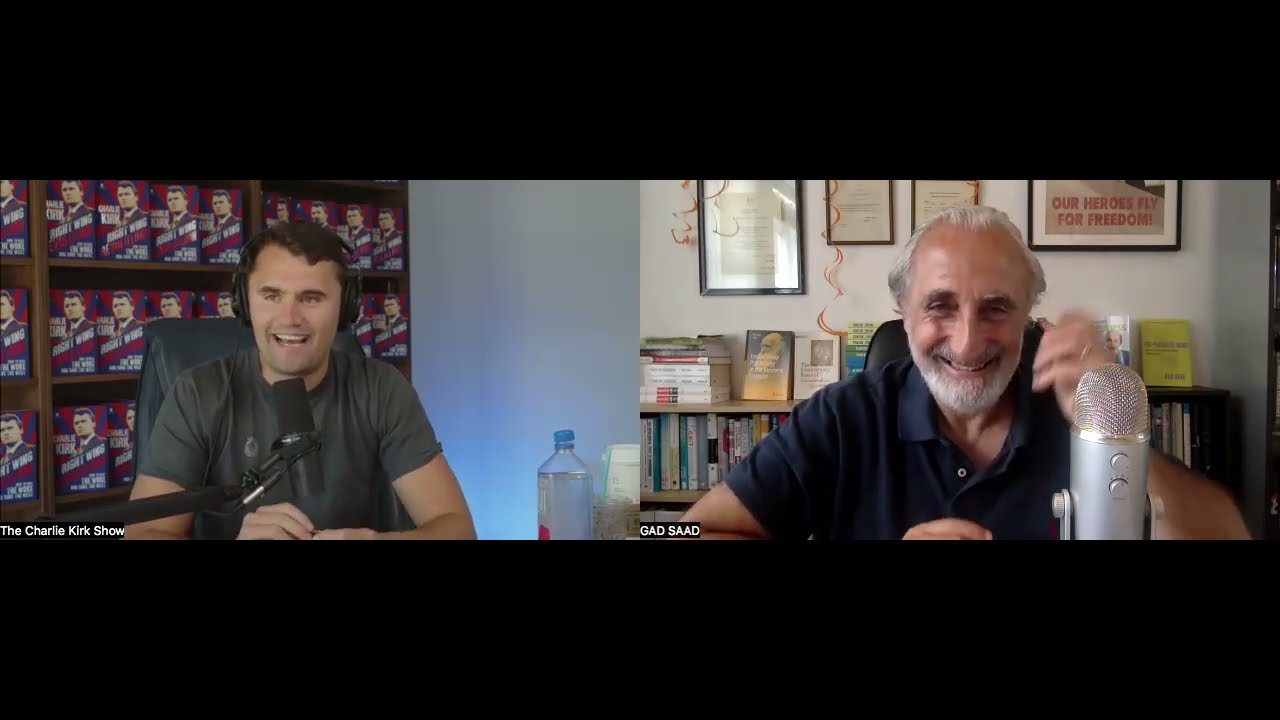
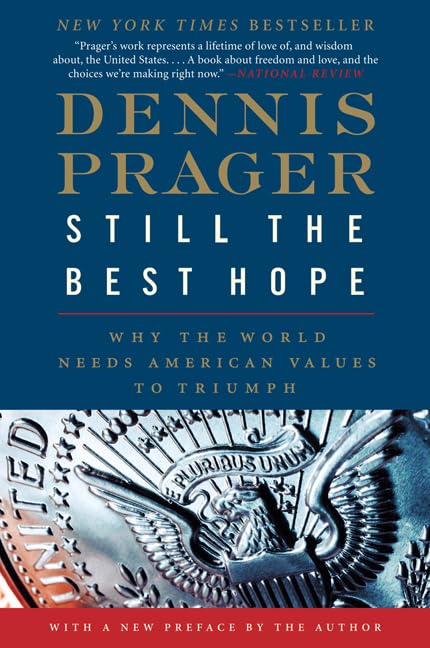
Hi everybody. I'm Dennis Prager and this is my home. As you probably know by now, unless this is your first time watching, this is completely unscripted. It's called my fireside chat. Very very rarely I have a guest. So if I have a guest, it's pretty pretty special. And he is pretty special. Charlie Kirk, who is known to many of you, but not to all of you, but you will know him as a result of today, is my guest. Charlie, it is a joy, a privilege, and all the good things like honor to have you. Well, it's an honor to be here, Dennis. I listen to you almost daily and have for years and a big impact on my life. That means a lot to me. Actually, let me let me tell you, let me give my way of introducing Charlie Kirk. Charlie Kirk founded Turning Point USA. Turning Point USA is enormous. It is actually one of the handful of reasons for optimism about America. Uh I'm known for not engaging in hyperbole, so you'll have to take me for my word. He has out of nothing created this thing called Turning Point USA, TPUSA. Thousands and thousands, we'll find out the specific numbers in a moment, of young people. It's a college, correct? It it doesn't start in high school. Oh, you do. So like Prager force you also. Yeah. Yes. So the they organize events. He organizes events. For example, I just spoke in Florida for his group to 4,000 people. 3,000 of them were uh college and high school students. And uh it's uh it's very moving because we're worried about the next generation of Americans. Look, the truth is you should be worried about my generation of Americans. So this is not new worrying about the young generation. I was worried about my generation when I was 20 years old. That's another story. I I don't talk about that one time. Anyway, uh so you he is combating this terrible mealism, this this this destructive force that is permeating our society, not of liberalism, which we could all live with, uh but of of leftism, which is truly nealistic. And these kids, you know, you know what? You know what I love which verifies what I believe in? This is when I go to your conferences. I meet a lot of these kids. Obviously, not all 3,000, but I meet so many of them and they radiate good cheer. They're simply happy kids. Yes. I would love for an honest, this is asking a lot, an honest Washington Post, New York Times reporter to go to a a left-wing conference of thousands of kids and a conservative conference of thousands of kids and just compare the happiness. Well, and so I I think I know why that is and it it's perfectly consistent with what you talk about. Our students are thankful to live in America. When you come from a position of gratitude, that's great. You're happier. The left is angry they live in America. They're unthankful. They're unsettled. And so, you're right. They're of good cheer because they wake up and they say, "My existence in this country is a blessing." Well, that that's I think you hit it on the nose. Anyway, look, there are and there are other issues like I believe happy people don't gravitate to the left. No. So, it it and then it feeds on it. You're unhappy and the reason you're unhappy is because of sexism and homophobia and transphobia and and xenophobia, etc. Whereas, you're right, our side, oh, am I lucky to be here? Yes. And and that comes from typically a belief that God is sovereign, that there's a sovereign God, that you you must have some form of a fear of God, that he is almighty, omnisient, omnipotent, all powerful, and that thank goodness I'm even able to live another day. Right. And then from there, the other But I want to say I'll bet I don't believe all those 3,000 are religious kids. No, but not necessarily religious. I'd find very few that are atheist. Oh, that Oh, that's a good point. That's fair. That I agree with that. But I I don't want people to think that TPUSA is like a church organization. No, no, not not at all. No, I want I just want on your behalf. I want to make it clear. Not that there would be anything wrong with it. Sure. But you you get a very varied group of people. Oh, totally. Yes. And and we had many Orthodox Jews there and evangelical Christians, people that are more secular, colors, and everything. So So I want I want people to know you since they get plenty you get plenty of philosophy from me every week. So, I wanted people to know you cuz you're simply you you uh you represent to me uh something that I realize is not explicable, but for which I'm very thankful. Every generation seems to produce unique types that just lead. And this is not meant as a compliment, so you don't, you know, you don't have to be embarrassed, but it's true. Look, how old are you? 25. Okay. 25. When did you start Turning Point? When I was 18. 18. Okay. So, what are most 18y olds doing? It's a rhetorical question. They're not founding organizations to celebrate America and and being wildly successful. You created this from nothing. Is that correct? Relatively. Yes. Out of my parents' garage. Yeah. When I was Yes. Well, everything comes from parents garage. Yeah. You know, that's no no money, no connection, and no idea what I was doing, right? And and then you you made where where did it begin? Well, I I I first want to say the story that you're asking about only in America is this possible. And what what gives me joy is I get to fight for that which I have benefited from. I just that's a beautiful way to put it. You could not start Turning Point Italy. just maybe as a branch eventually. But no, no, no. It's true. There's something so special about this country and my or France or Germany. This was not an anti-Italian comment for the sensitive or or Indonesia. We can go the whole United Nations or the world. Right. Exactly. The United States. So, look, as far back as I can remember, I've always enjoyed debate and discussion. I've always tried to be a contrarian in my way of thinking. Um I initially when I was in kindergarten, first and second grade, my parents put me into what I hate this term, but it's the term used a gifted school. Um and that laid a foundation of rigorous um academic, you know, try to be in the pursuit of academic excellence. Um then my parents made a decision to put me into Christian Bible- based school when I was in third, fourth, and fifth grade, which was really where I learned um a lot about the Bible. By fifth grade, I knew more about the Bible than most self-p profofessed adult Christians would. And then my parents made the decision to put me into public school uh in sixth grade. And as soon as I hit sixth grade, um this was in the fall of 2005 and the spring of 2006, I was immediately hit with ideology from my sixth grade teachers that was not consistent with the values I was brought up in. Some of it very subtle that I caught up with, some not so subtle, such as this country is not a good place. If you work hard and play by the rules, you don't you won't really be successful. The American dream is a lie. Now, most of that will go over the heads of sixth graders. for me just because for whatever reason I had I was more in tune with what they were saying. I found myself challenging um some of my teachers in sixth grade and seventh grade. And I remember going home and I asked my parents, "Are we Republicans or are we Democrats?" And my parents said, "Well, we're pretty much Republicans because we believe in God and we work hard." That's how they explain politics to me. And by the way, that's the way a lot of Americans look at politics. That simple. And then I always was entrepreneurial and thought of I wanted to be very successful and I just couldn't ever find myself believing that bigger government less freedom would ever allow my own personal ambitions to be fulfilled and therefore my own dreams were consistent with political ideology and philosophy and I grew I then started to read Milton Friedman and you know the great books that really built western society and I became I loved politics from a very very young So you went then to a regular high school after that that public high school. Yes. So did you did you have any close friends? Oh yes. Yes. People So but I I don't only mean you know buddies to to hang out with. I'm sure you had. But uh did did were there any who who agreed with your outlook on life? Very few. If any I'll tell you I have want to think about before I say this almost none. now that I still talk to. In fact, I'm mislabeled and disowned by every quote unquote friend I had from high school with a couple exceptions, maybe one or two that will still talk to me, but these people you consider yourself to be very close with in high school all of a sudden, you know, aren't quite friend, but never did I have much commonality around. So, one day you had an idea, listen, this this my my generation is in trouble. What what happened? I mean, what sparked it? I wanted to go to West Point. That was my lifelong ambition since I was 12 years old. Um, I always tried to do difficult things in my life. And so I remember asking my teacher, "What's the hardest school to get into?" And they said, "Well, besides Harvard, it's West Point." I said, "Oh, well that's interesting." And I always loved the idea of military service and patriotism um and just trying to be part of something bigger than yourself. And so then I wanted to go to West Point and became an Eagle Scout. did very well in school, football captain, basketball captain, um, and got my congressional nomination, but I did not get appointed. It's a two-step process, and at first I was crushed, but it ended up being the best thing that never happened to me and to America. Well, it God God had a plan for me, if you will, and um and it was all right. So, I but I want to understand because I have no idea what the answer is. What did you do on day one? I I mean how do you organize people when you don't have access to people? It's very well so this is this was I starting something from nothing from zero to one is is it teaches a lot about yourself first and foremost it teaches you a lot about yourself of how hard are you willing to push yourself and for how long and how much grit do you actually have how much perseverance do you have so on June 5th of 2012 when I started the organization I said well you know it's one member turning and I had the name turning point USA and so I remember being on Facebook and on Twitter hearing and seeing other young conservatives across the country. Uhhuh. That were discontented with Obama. I said, "Well, what if I create a Facebook group?" Which they were kind of new back in 2012. For those people watching these videos, you probably laugh at how many Facebook groups you're now members of, but it was almost a new concept where this essentially Dennis, it's like a comm almost like a blog post page you can have within Facebook where you can network. And I created one called the young conservatives and I just added young conservatives from across the country of thousands of students where there could be a forum almost. And that was the basis of Turning Point USA. And and then you went to donors obviously. Correct. And I said, "Look at this enthusiasm. Look, there's Marta from Seattle. There's Matthew from Miami. If we only had $600, we could get a website going." And you Is that what you started with? $600 that that that with the first big check we got was for $10,000. Um cuz I went down and I borrowed money to go to the Republican National Convention in August of 2012. Um and I met a guy named Foster Freeze in a stairwell and I gave him a stairwell pitch but not an elevator pitch. And he was he wrote us our first $10,000 check. And from there I was able to have a website, network people together, build a very small team. By the way, there's a saying this is a this is a how does the saying go? Uh uh success has innumerable fathers and failure is an orphan. That's correct. That's exact. So you have no idea how many people have said to me I was the first one to fund Charlie Kirk. But you know someone else gave me a wise piece of p piece of advice. Never disagree with them. Oh totally. I I'm saying it with a smile. I I and I certainly have no basis to disagree with them. I go that's very impressive. No meaning me. I should never do that. No, I know that and I'm saying but I certainly if there someone the seven people who've said that to me I said you know six other people told me that I don't do that. I I'm I I I'm with you. And anyway, they mean well and and they were were the there were people who were in the beginning. That's right. Yes. There's no question. Obviously, they get the credit. And so then it began. Now, how many So, what is it? One joins turning point if one is in college. Did if you graduate college, you are no longer in turning point. That's not necessarily. We and we're developing an alumni network of you an extension outside of the high school and campus university um infrastructure we've built, but we have chapters on these campuses. We have activism events. I go and speak at over 45 colleges a year just as part of what I do. Um and you actually spoke at some of our Turning Point USA groups at Colorado State University and University of Wyoming. Two excellent speeches you gave. And we we love the partnership between Prager and Turning Point USA. I I just don't compliment other groups if you follow what I do. Um cuz most of them don't deserve it. But Prager University is helping change. Well, that's how we feel. No, no, no. You have a very Was it your line or Alan Estrin's line about the Air Force and the Army? I think I said I think it's yours. Yes. So, tell everybody. Well, the analogy is if to use a military analogy is uh Prager University is the Air Force and Turning Point USA is the army or the infantry, right? Which I like that. Exactly. But you need both. And you need the air reconnaissance. Yeah. Yes. And you need the Marines, you know. That's correct. You know, so now we have to find a navy. Sure. We're lacking a navy. So And a Coast Guard. And a Coast Guard. Right. I mean, it could go on forever. A border patrol, highway patrol, all of it. Exactly. How many members? Um, well, we have hundreds of thousands of members that that Yeah. that we that have that have let's just put it this way that have been crewed on recruited on campus. Now whether all of them are active or not, we go through that. Well, you uh you're here in LA in part to make a video, two videos for Prager University. Uh in in your uh in the script, you noted unfortunately correctly, whatever our numbers, let's remember how many millions Yes. we haven't touched. That's right. So, I'm going to ask you a question, and I'm asked this all the time, and I don't think I ever give the answer people want to hear. I'll explain that in a moment, but I'm more interested in you. Are you are you optimistic for America? I have to be or else I would be crazy doing what I'm doing. So the the so if I if I traveled 340 days a year which I do and I dedicated my life to this and I take many redeye flights you know a month and you know which red eyes to me dedication throw off my body clock and of course they're terrible but if if I did all of this and I keep pushing myself and I was pessimistic about the future that's a very twisted existence in my opinion right because I and and if I was putting my credibility and my vision and my ambition behind all of this all Right. So other than your psychological desire, which I totally relate to and understand, to be optimistic, give me two reasons to be optimistic. Sure. Prager University's view count would be one of them. If these ideas had no resonance, the electoral college video would not have had 31 million views in 48 hours or less. I if if there was no reason to be optimistic, we wouldn't have had 3,000 students in Palm Beach right before Christmas from all 50 states and six member countries. It just wouldn't be happening. Um that that stuff that stuff is unique. That stuff did not happen in 1996. Okay? You know, that stuff did not happen in 2006. This is a new twist in American political culture. And and the second thing for optimism and Dennis I can say this from my travels. Students are not opposed to our ideas. They're just not exposed to them at all in the first place. Exactly correct. I would be so pessimistic if I came on a college campus. So I went to Stanford, UC Berkeley, and UCLA last spring. And I know you did UCLA and UC Berkeley. I would be pessimistic if they went up to the question line and they had a thoughtful well wellressearched response of why I was wrong. Instead, they are curious and flumxed. My ideas exist in the first place. Therefore, they have not they've never gone through the the rational or critical thinking process of what do these ideas actually mean? Therefore, we just have to go to more territory. We just have to bring our more me our message to more universities and more colleges and more young people. And I I know that's also the charter mission. Let me say this to you folks who are watching. The reason that the left uses six herbs, sexist, intolerant, xenophobic, homophobic, islamophobic, racist, bigoted, to label all, not some, all those they differ with is that they don't have arguments. This is critical. I tell people all the time, I the reason we win debates is not necessarily because we're better debaters. It's that we know all their arguments and they know none of ours. That's right. We read them, study under them, know them, hear them, watch them, but they don't know anything we stand for. Why read a racist? Why read a bigot? That's right. That's exactly. So that's the inoculation against taking us seriously, right? And so we we say at Turning Point USA, if our ideas were so bad, then the left should allow us to come on campus and nobody would show up or just we would be refuted. That's exactly right. You I I suspect you do this. I I know I do that and I'm sure I I'm sure you do this. If you differ with me first. Yes. Go to the front to the microphone. It's policy at every one of my speeches. I want the disagreement. Yes, I pursue it. Yes. And it gives us credibility. It gives us credibility. But this is why I do what I do. I do it because maybe I'll learn something or maybe they'll learn something or maybe millions of other people will learn something new. And the collision of ideas is what made Western society. When you have a monolithic train of thought, it deteriorates the an individual's ability to think and to process information. So you mentioned hundreds of thousands of students been in in TPUSA. For every one of those, I suspect there are five who are afraid to join. No doubt. Without without a doubt. Or um are not as aware as they should be. That certainly. But I but the fear part is you want to focus on the fear. Yes. So, so the and and the left makes it so culturally impermissible to be a conservative. Yes. And and being anti-American is more fashionable than being patriotic. You saw Ammy Horowitz wave the American flag at uh was it Berkeley or Stanford? Was it Berkeley? Berkeley. So he Did you ever see this video? I I I'm I'm familiar with the one where he went to UC Davis, not the Berkeley. Okay. where he where he waved the American flag for, you know, a half hour and he waved the ISIS flag for a half hour and he got all the hate for waving the US flag. Oh, I mean, look, it I wish it surprised me, but and and but here's the other piece of optimism, Dennis, is that the I and you agree with this and your solution at Prager University is so brilliant because the the the cancer is being inputed into the next generation in very specific places, college, universities. So, we know where this is happening. It's not like it would be I would be pessimistic if it was a mystery. Oh, I wonder where all this stuff is coming from. No, no, no. We know exactly where it's coming from. It's coming at the gender studies department at the University of Texas. Okay? So, if you if you map out a simple map of how you solve problems in business or in life or in family, you identify where the cancer is metastasizing, you cut it off, neutralize the problem, and offer solutions and alternatives like you have at PragerU there. That so I'm optimistic because we know where the problem is. Well, and and as you pointed out, when they hear it, if they have at all an open mind, and many do, they go, "Wow, that makes sense." To which I always respond, conservatism is common sense. You don't have to believe anything. Just ask what what is logical. Is it is it the is a minimum wage going to suppress employment or increase employment? That's all the the issue isn't uh isn't ideological. It's it's it's a common sense empirically based question. The uh this I'm going to ask you something very sensitive here. Um because and I I don't have an answer but I have a suspicion otherwise I wouldn't ask this. Do you you mentioned gender studies? Would you say that the vast majority of the professors and the students are female? I I because I Well, I I'll I'll answer it in a different way. A mass majority are feminine. Okay, that was a good one. Uh well, well, no. I wish that were true because a lot of the females who are in it are not particularly feminine. This is not to insult them. I I don't have enough data to Okay, fine. Fair enough. So, I that's why I asked. I don't I I never check the data, but it's so rare that I come across a male professor of gender studies. Uh the reason that I asked it is I I think that the there are a lot of young women who have uh who have been made sad. I know the depression rates on college with college girls is very high and there's got to be a reason. This was not true in my parents' generation in college. Uh something has happened. Something certainly happened with males. Everybody knows there's a big male issue, but I think something has happened with females. Yes. Do you have a thought on that? Sure. And I'm going to Yes. So the the the the myth of the patriarchy is just that it's one of the great lies of our time that somehow we live in a in a patriarchal society where a vast majority of incoming college freshmen are women almost 56% vast majority of college graduates master's degree recipients doctorate degree recipients women live much longer women are far less likely to have heart disease die of depression suicide all these sorts of things but you are seeing a problem in the college university amongst depression rates amongst young women and the solution of the feminist and the gender studies uh professors are it's because of men this is happening right so that that that's their conclusion which it's incorrect the the the the my observation is that some women not all women are being forced into very linear a very linear focus on a career pursuit when that's not what they always want if they're forcing themselves here would be it just occurred to me now and I I may do a radio show on this. It just occurred to me I would like to see statistics and if they're available what percentage of depressed women in college have a a a significant other in their life. Yes. And I I think that's exactly correct. And so the the the things that built western society to function and to grow, monogous relationships, um committing yourself to another person, um not overdrinking, you know, not participating in binge drinking culture, all those things are frowned upon in college. In fact, the opposite is glorified where it's hookup culture, where it is binge drinking, you know, drink till you're drunk, where it's almost unlimited amount, I hate this word, but a limited amount of freedom, but no responsibility. And that that will only create unhappy people and unproductive people. That's that that look that and you and I resonate to this that and secularism without know that that's the number one thing. I I I mean look every poll by totally secular organizations Pew, Gallup, religious people are happier than secular people. Sure. And it it so when you combine the complete lack of of of religious foundation, a godless life and told career is everything. uh uh you you the last thing you need is a man in your life. It's it's no wonder that I think a lot of young women are unhappy. Sure. And and and the the secular side of it um is is is put forth by by by people that first they themselves are unhappy and they almost proitize the secularization more than religious people put forth their religious beliefs. Oh god. Is that ever true? when they say that this this mantra it is so wrong and I'm saying this as a Jew oh it's so wrong if Christians try to proitize I'm a Jew I don't care why is it wrong why is it okay for the left to proitize but Christians shouldn't proitize the atheists proitize everybody proit if you believe in something you proitize you can do it obnoxiously or you can do it nicely but what is wrong this is what I believe I'd like you to hear about it I would love to hear about it well and I joke around with atheist. Why does it matter to you? I mean, that's right. I mean, why are you wasting your limited amount of time on this planet? Cuz you got 42 years left and 17 days and you know, for me, there's a whole afterlife for us. We're we're good. I mean, so if you want to have this conversation, I actually see some benefit in getting you to But I apply this to everything. I remember if you know, on the rare occasion, say a Mormon would come to my door, I would invite him in. Of course. Well, you got to also, you know, appreciate the the commitment they have, too. And you want to I totally do. Look, I'm a big fan of and so so this was one the one and I I've done so much thinking about this when I when I was younger. What were some of the themes that was taught to me and just beat like a drum and one of them is the world is a worse place because of Jews and Christians. That was one of the things that I was taught. So and it would be much better if we were in a post religious age. That's right. So it was it's the the lies about the crusades and the evils of you know Christianity. Well, you know what I say cuz I and I in this sense I I I can say it more easily than you because I'm not Christian. So I you know I say well so wait a minute uh and I wrote a book on anti-semitism which has a big chapter on Christian anti-semitism. I know all about it all. I I taught courses on Jewish history at college on the college level. Nevertheless, the fact that you have to go back to the 15th century, you know, uh hello. Uh that's a long time ago. That's correct. The sp Oh, the Spanish Inquisition. That was in 1492. Okay. So, the Christian record since 1500 isn't so bad. That's right. If you have to go back to 1492 and and and and wait a minute. And who abolished slavery? Atheists who formed America? Yes. religious refugees from Europe that wanted to form their own colonies around specific forms of Christianity. That is correct. And and so here's the question that I ask with Isra about Israel, about America, about religion. Is the world a better place because of America? Is the better a better is the world a better place because of Israel? I asked Howard Zinn that question. Howard Zinn is the is the he's now passed away. Howard is the most committed anti-American. Well, he he wrote the standard tragically the standard history text, the untold history or something. No, the popular history I think it's of the United States and and what I call it is it's a practist's view of America. That's what I that's how I describe his book. But I had him on my show and I never I never dump on guests no matter how much I can't stand their views and I treated him perfectly kindly. All I wanted was to get his view. I asked him that question. Would the world have been better had there never been a United States? And he was agnostic. He he it's it's stunning to me. It's stunning. It is stunning. And but it's also it takes effort to come to that conclusion. And it takes an unsettled an unsettled soul to come to that conclusion. He he in order to say that so and I don't want a virtue signal to him, but he must have been in a very unhappy place in his life. When you go to college campuses, are you are you almost always greeted by protesters? Initially, yes, but I'm seeing a change. Dennis, you are. Yes. That's great. More curiosity and open-mindedness. Um, look, there's still the protesters that that sit up, right? But you know what? I believe you because I think a lot of students are thinking, "What's so bad about these people? Let me find out." That That's right. That's correct. Let me see it for for myself. And and there's a hilarious video of one of these street journalists that did we spoke at Cal State Long Beach and if you want to lose hope for America, spend time in California universities. Let me just put it that way. Um you want to gain hope for America, spend time anywhere else. Um so they they they Candace Owens and I and Candace is a total superstar as you well know. She we were speaking at Cal State Long Beach and we had a soldout crowd and the university refused to give us a bigger auditorium. Of course, we had 400 people inside and they had this protest outside and saying that, you know, the white supremacists are inside. And one of these street journalists went around, they said, "Hey, so you think Candace Owens is a white supremacist?" Absolutely. 100%. Candace Owens is black, just for the record. And but but then they said, "And Charlie Kirk's a white supremacist?" Yes. What does he say that's white rooted in white supremacy? Just all of it. You know, they and they Well, to show You'll love this. I don't know if you know this one. when I was at I think it was was it University of Wyoming. That's correct. Yes. That was that was a turning point USA event. Why socialism makes people selfish. Yes. And there were,200 people and and 400 in another room. It it was it was a great success. And by the way, you could folks should watch that. It's a great it's a wonderful speech. Thank you. So the usual every campus I go to, there are attacks on me prior to my coming from left-wing professors or students. So, this one uh included the usual uh uh how could we spend uh student funds or whatever it is? Oh, that was Colorado State. Uh why are we bringing in Dennis Prager, you know, who is a homophobic, islamophobic, uh all the phobias. Okay. And anti-semitic. Well, that one's that one. Did you see that one? Of course. Yes. That was worth everything. You wrote a book that's been published multiple times in anti on anti not only that I'm Jewish. Yes. And I'm pro-Jewish Jewish, which is not always the case. I'm Jewish. I'm a practicing Jew. I I I I fought anti-semitism my whole life. And so why So then why did the this woman write anti-semitic? Because they get away with it. Yes. And because they just have a list. Then the I am as homophobic and Islamophobic and racist and that and all that as I am anti-Semitic. All of it is a lie. It's the whole thing is a lie. That's right. But it doesn't matter if you throw it out enough. The assumption it will stick without a doubt. And and and it's it's it's corrosive. And the the university teaches students and they weaponize them to become activists that attack people's character, right? Not challenges ideas. Yes. And so the academy was originally built to actually culture people away from the the the more tribal type thinking that the academy was built originally in to first of all to teach religion. That's actually the original charter of the American college. But secondly, it was if you actually look at the reason why Harvard and Princeton and Yale, the original universities of America's founding, John Hopkins were formed and advanced, it was people need to learn deeper think ways to think and to be able to communicate. Now it's done the exact opposite. That's correct. Isn't that the It's gone absolutely full circle back to tribalism. And the assumption was that you are here to learn truth irrespective of where the the chips may fall. Yes, you are here to learn the best music, the best ideas, the best literature, but not now. I love I love what you say about Bach and the Tokyo Philarmonic and the Indonesian music. And for the people that know what you're talking about, it's the New York Times music critic. And this is someone should write a book on this and Jordan Peterson talked about it a little bit but is the left hates anyone could be better at anything than anyone else. And if anyone is it's because they exploited themselves to get there. How is Bach who did he exploit by becoming the best composer of all time like well I mean as you well know I mean the the look it's all backwards. I'm reading Steven Pinker because I always like to read people I differ with. He's the the psychologist at at Harvard who's an atheist, but he's a good he also attacks the left. He's he's rare. He because he's a liberal. He's not a leftist. Uh but of course he he uh he so he has a whole chapter on don't be pessimistic. Things are getting better. And then he has a list of all of the diseases that we've conquered in the last hundred years. And when he went through the list, I realized every single one is a European or American name. Every single disease that has been conquered is has been in Europe. Now, does that mean white supremacy? That's idiotic. Hitler was white and he was he was the garbage of humanity. Stalin was white. He was garbage. It has nothing to do with white. It has to do with values. Yes. Values produced Bach. values produced uh insulin and and and uh and and a sulk vaccine and and that's what matters. Well, and values created the peanut by George Washington Carver. I mean, it had nothing to do with had nothing to do with race. It has everything to do with ideas and values and character. So, so we're attacked for saying what we're saying now. Of course, that is what is so amazing. It's the anti-intellectual center, the university. Oh, without a doubt. Yes. And they're they they they've become a place and I say this commonly where they want everyone to look different but think the same. Yes. That's right. Right. Diversity is only looks only racial diversity. Yes. Like it matters. That that's right. And and and that that should be a point of optimism. You asked me earlier, why are you optimistic? That brings me optimism. If the the left trying to stop us from talking shows us that when we do talk, we win. So all we have to do is just talk more to talk to more people. Well, that's what TPUSA and that that's that gives me optimism. Okay, that's good. I'm happy to hear this. By the way, how's our timing here? Cuz this is too much fun. 36 minutes. Sorry. 36. Oh, we've already gone over. You're fun. We can keep going. I I know we can't, but we could. I know what you mean. Why not? Well, because it's better that they should want more. If you want more Charlie Kirk, tell tell everybody. I I I was blown away and that's a reason for optimism. You're the third most tweeted uh thinker type in in the country. How what is the order? The president uh Alexandria Kaziocortez. Well, hold on. That's that's a little tough to hear, I have to say. And then and then and then me. But um so but if so the president so here's the optimism is that you got a Kaziocortez who's a sitting member of Congress with unlimited amount of positive media coverage and then me just a couple varial points within her with nothing but negative media coverage and not a sitting member of Congress and 5 years younger. Um that should give you optimism. Um I mean she has received billions of dollars of earned media of course and she I'm still within a couple margin points of Twitter engagement. So Axios did an objective analysis of who has the most engaged Twitter in American politics and so the president was way up there than Accaziocortez and I was right there even above the New York Times and people like even Don Jr. and Sean Hannity were mentioned there were much much bigger and so I'm happy to hear that it shows that Aaziocortez and your success is America's success same to you and Prager University God bless you thank you Dennis Charlie Kirk he's special every generation throws out these special people he's one of them I'm Dennis Prager this is a special edition as it were of my fireside chat I'll see you next week I'm guessing you've heard of the acclaimed TV show Game of Thrones. Seven kingdoms vying for power. Plots within plots. Watch your back or lose your head. It's great. But you've probably never heard of the real life drama that I call the game of loans. That's a game Washington politicians play on young people, that is college students, every day. Just like Game of Thrones, the Game of Plots within plots, big winners and big losers. The winners are politicians and colleges. They fool students into thinking that by generously providing ever larger college loans to cover ever larger tuition costs, they have earned students votes at election time. Why do I say students are fooled? Because it is thanks to the very politicians who promised students more and more aid in league with the colleges that college tuition became so expensive in the first place. Here's how the game works. According to Bloomberg News, since 1978, the cost of a college education has gone up by over 1,000%. Way past the rate of inflation. Tuition alone at many colleges is 20, 40, even $50,000 a year. So, how do you pay for it? Answer: student loans. Loans the government is happy to give you since they collect the interest. You don't have to be a finance major to figure out that all these student loans give colleges no incentive to cut costs. Instead, it gives them every incentive to raise costs. Higher tuition obviously means more money for the college. Now, if students were going to college in record numbers to study engineering or computer science or biology, professions with high employment rates, maybe these crazy sums would make some sense. Maybe. But the most common majors are in the social sciences and communications in subjects like sociology, cinema history, and gender studies. Not surprisingly, these majors have very high unemployment rates, as in they don't prepare you for a job. And these majors are mainstream. You can get a degree in storytelling, bag piping, and puppet arts for your 50,000 a year. But here's the point. Colleges are no longer primarily about preparing you for a career. Today's higher education is about teaching you what a terrible country America is, social activism and binge drinking. Hey, if college in costs so much, the parties might be worth it. But it does. The average student loan debt in America is $28,400 per borrower. Note that is per borrower, not graduate. Big difference. A large chunk of the $1.3 trillion student loan liability is held by ex students who never graduated. For every 100 students who enter a 4-year college, only 59 exit with a degree. But maybe you're one of the lucky ones. You got a business degree and you found a decent job. Chances are you're paying off your student loans and will be for the next 10, 20, or even 30 years. Good luck saving money for a down payment on a house or just about anything else. Mike Row from the TV show Dirty Jobs nicely summarized the issue this way. We are lending money we don't have to kids who can't pay it back to train them for jobs that no longer exist. So am I saying college is always a waste of time and money? Of course not. But I am saying this one. Remember that if you take out a student loan, it's not free money. You actually have to pay it back. I know this sounds ridiculously basic, but it's also ridiculously important. And since you owe this money to the federal government, you can't get out of it even if you declare bankruptcy. Two, whenever you hear politicians say they want to make college more affordable, what they're really saying is they want to get the youth vote while making it easier for you to dig yourself into a deep hole. These politicians don't have your best interest at heart. They have their own best interests at heart. namely getting elected. You don't owe them anything. The game of loans is rigged and not in your favor, but if you're smart about your choices, you can beat the odds. I'm Charlie Kirk of Turning Point USA for Prager University. Hey, I've got a great investment idea for you. You give me $100,000 and four years of your life, and I give you Hm. pretty much nothing. No, I'm not the devil. I'm Mr. College and I'm here to help you finance this wonderful opportunity. I have a whole package of government loans and impressive sounding scholarships to make it all possible. Of course, you'll have to pay interest on the loans which will double the cost over time, but that's a problem for future you and need not concern us now. Do we have a deal? Yes, of course we do. You want to succeed in life, don't you? How can you do that without a college degree? But that doesn't mean you can't have a good time. Are you a movie fan? We've got a degree for that. How about criminal justice? Be like one of the cool people on the TV detective shows. And we offer a whole selection of minority and gender studies programs. Learn why you're a victim and deserve to be angry all the time. What are you waiting for? Sign on the dotted line. Classes begin in the fall. Don't miss orientation, especially if you're male. You don't want to be parading your toxic masculinity around the campus. Definitely not cool. Sound crazy? I don't know why it should. Millions of college students make that deal every year, usually with their parents' encouragement and financial support. Now, don't get me wrong. I have nothing against going to college. I sincerely believe it can be a worthwhile pursuit under the right circumstances. If you want to be a doctor or an architect, for example, it's obviously a necessity. But look through the typical college syllabus and it's clear that most of the majors, not to mention classes, are a waste of time and money. So why do responsible adults who only want the best for their children and are usually cautious with their hard-earned money squander it on such a bad investment? Worse, why would they send their son or daughter to a school to learn to reject the values they the parents hold dear? On what planet does that make sense? It doesn't. It's an old paradigm and we need to break it before it breaks us. How do we do that? Here are two solutions that would go a long way to solving the problem. One, ask yourself if you really need to go to college. Most of us go to college because it's simply expected that we do so. Our parents expect it. Our friends expect it. Plus, it sounds like fun, a right of passage, an escape from mom and dad and all their rules. But none of that actually has anything to do with getting an education or earning a living after you leave college. Maybe you're not the academic type. What's wrong with that? Nothing. According to a Georgetown University study, there are 30 million jobs paying over $55,000 a year that don't require a college degree. Learn a skill like welding or plumbing or a dozen other trades and you'll never be looking for a job. The jobs will be looking for you. We're talking $50 an hour or more, six figure income after 5 years, and no debt. Consider the military. you learn essential skills and again no debt or go into sales. You don't need a sociology degree for that. If you are going to college then have a goal and a plan to achieve it. Your college journey will cost you and or your parents a boatload of money. What are you going to get in return? Choose your courses with a practical mindset. Stay away from the silly stuff. And if you really don't know why you're going to college, consider answer two. Delay college for a year or longer. If more graduating high school seniors would do this, not jump into college immediately after high school, college curriculums would improve and nonsense like safe spaces would disappear. Why? Because students who had spent a year or longer in the real world wouldn't put up with it. Get a job, any job, for a year before starting college. What's the big rush anyway? One year isn't going to make a difference as to whether or not you succeed in life. But waiting tables or stacking boxes or whatever you do for a year will almost certainly change your attitude about a lot of things, like how hard it is to earn a dollar and how easy it is for the government to take that dollar away. You will also develop a new appreciation for the privilege of going to college and you'll be much more likely to be immune to the BS. Don't be a passive investor as a student or a parent. Your education is too expensive and too important to be left to Mr. College. He might have your money. Don't give him your mind. I'm Charlie Kirk, founder and president of Turning Point USA for Prager University. Year after year, Americans pour billions of dollars into colleges and universities. I'm not talking about the outrageous tuition costs, living expenses, and fees, the debt pit students fall into. And I'm not talking about the tax money, our money colleges and universities get from federal and state governments. I'm talking about the money Americans are handing over to these institutions of their own free will. In 2017, that number was $44 billion. $44 billion in donations in one year from alumni and other donors. And for what? To enhance the education of America's youth. Do you really think our college graduates are better educated, more literate, more versed in classical philosophy and American history than they were 10, 20, or 50 years ago? If your child goes to college and spends four years partying, skipping class, and playing video games, consider yourself lucky. It's when they actually listen to their radical professors that you're in trouble. So, what have our institutions been doing with all this money? Well, the University of Michigan's vice provost of equity and inclusion makes $400,000 a year. The university spends close to 11 million annually on diversity and inclusion staff and programs according to a recent report. What do you think vice provosts of equity and inclusion and almost all schools have one now do all day? They and the small armies they supervise spend all day every day looking for racism, sexism, classism, islamophobia, homophobia, transphobia, and any other phobias they can dream up. If they don't find some bias somewhere, they're out of a job. So guess what? They find it even where it doesn't exist. The University of California at Santa Cruz now has an quote activist in residence. His job is to mint new leftist activists as if we have a shortage. Why are we voluntarily giving billions and billions of dollars to hopelessly corrupt institutions that overcharge, underdel, and undermine the most basic values of Western civilization? We should be starving this beast. Instead, we're feeding it. Are there exceptions to this rule? colleges that are actually dedicated to the pursuit of knowledge and wisdom. Of course, there are, and they are worthy of your financial support, but you can count them on two hands. The rest have a different mission, and they have more than enough coin to carry it out. The affforementioned University of Michigan has an endowment of 12 billion, but that's small potatoes compared to Yale's 30 billion or Harvard's 40 billion. And donors keep giving them more. it's time to stop. You'd be better throwing your money into a bonfire. That's just a waste. But when you donate to your average university, you're actually hurting your society. You're the reason kids, maybe your kids, are coming home loving socialism and hating free market capitalism, believing male and female don't objectively exist, excusing rockets being shot into Israel, then blaming Israel for defending itself, romanticizing Che Guavara and reviling George Washington, and dismissing America, arguably the most decent country ever created, as racist, genocidal, imperialist, white supremacist, hate-filled, and misogynistic. Your children are being fed a steady diet of this nihilism in grade school, middle school, and high school. But they have to come home for dinner every night. College is where the leftist deal is sealed. They're free of your influence and under the sway of their leftist professors and leftist peers. Stop supporting institutions that don't support your values, that in fact despise your values. And believe me, they despise you when your back is turned. The only thing they love about you is your money. Oh, you might say, "I would never give money for all that diversity, equity, and inclusion nonsense. I designate my donations to the business school or the medical center." If you think that, you're fooling yourself. Money is funible. You can designate it for anything you want, but you can't control what the university does with it. I travel around the country every week trying to rescue kids from the leftist cult that is college. It's bad enough that I have to battle administrators, professors, and leftist student body. I shouldn't have to fight you, too. College has become a big business. Most indoctrinate rather than educate. The best way to force them to change is to take away their cash. Your cash. Start today. I'm Charlie Kirk, founder and president of Turning Point USA for Prager University. It's appalling that in the 21st century, there is still so little diversity on American college campuses. This cannot stand. It's not who we are. It's intolerable. It's time we demand a change. It's time to stage a protest, to storm the dean's office. We will not be ignored. Diversity is our strength. I'm not talking about diversity of skin color. Been there, done that. Today's campuses are more racially integrated than at any time in history. And I'm not talking about gender diversity. Women already make up the majority of college graduates. And if your concern is non-binary gender, there is no place on earth more accepting of him, hers, zims, and zers than a college campus. I'm not even talking about sexual diversity. You can pretty much experiment with anyone you want in any way you want as long as you get a consent form signed and notorized in advance. No, the diversity I'm talking about is diversity of thought. Let me say it again in case you missed it. Diversity of thought. That's right. People expressing different points of view on an issue. At most colleges today, that's a dangerous revolutionary idea. If that different point of view is not on the left, the moment you enter college, you enter an indoctrination center. Remember orientation week? It starts there and never stops. They tell you to be open-minded, but they don't really mean it. Almost all your professors are on the left, nearly 12 to1, left to right. According to a recent study by Econo Journal Watch, there are many departments at many colleges that don't have a single conservative voice. The administration invariably supports leftist positions. And all those diversity administrators, they depend for their livelihood, that means their paycheck, on creating victims. diversity of race or gender or sexuality or any of the other distinctions dour that universities glorify are at best superficial and at worst just plain destructive. It's destructive to any real learning. If you don't study Shakespeare because he was a white male, you have been deprived of learning from the most brilliant playwright who ever lived. And it's destructive of a peaceful campus environment because it pits racial, ethnic, and gender groups against one another. In other words, diversity as practiced on your typical college campus divides, not unites people. And diversity of thought, the free exchange of ideas, you know what college is actually supposed to be about? Not happening. If you've been in college for a few years, ask yourself this. When was the last time you heard a professor or a TA make the argument that capitalism has lifted more people out of poverty than any other economic system? Or that socialism always leads to poverty? Or that the postworld war II order created by America has been the freest and most prosperous time in human history. Or that the cause of high crime rates in black communities has very little to do with historic racism. And God forbid if a conservative speaker should show up on campus and dare say any of these things. If the ideas of the people on the right have so little merit, why bother to protest? Shouldn't their bad ideas just die on their own? Isn't the purpose of a liberal education to expose students to differing points of view? Turns out that the liberal in liberal education means leftist. Here's how the University of California at Berkeley, the pinnacle of political correctness, describes itself. Our goal is to transform UC Berkeley into an equitable and inclusive academy of the highest caliber, one that fully honors the diversity of our students, faculty, and staff. Give me a break. Berkeley needs to be transformed. It's not diverse enough after all these years of expanding equity and inclusion. Bull crap. It positively reeks of cis sexist heteropatriarchy. Say that three times. I don't know what it means, but it sure sounds bad. Walk around the Berkeley campus or almost any campus and you'll see plenty of blacks, Hispanics, gays, lesbians, even a straight white guy or two. College is a place where they want everyone to look different but think exactly the same. It's like a freaking cult. At some point, you have to stand up, separate yourself from the crowd, and say enough. It's time to diversify thought on campus. It's time to demand a real education. God knows you're paying for it. I'm Charlie Kirk, president of Turning Point USA for Prager University.