2,422 videos 1,389,747,653 views US Joined Aug 30, 2018
Charlie Kirk is the Founder and President of Turning Point USA, the largest and fastest growing conservative youth activist organization in the country with over 250,000 student members, over 150 full-time staff, and a presence on over 2,000 high school and college campuses nationwide. Charlie is also the Chairman of Students for Trump, which aims to activate one million new college voters on campuses in battleground states in the lead up to the 2020 presidential election. His social media reaches over 100 million people per month and according to Axios, he is one of the "top 10 most engaged" Twitter handles in the world. He is also the host of “The Charlie Kirk Show,” which regularly ranks among the top news shows on Apple podcast charts.
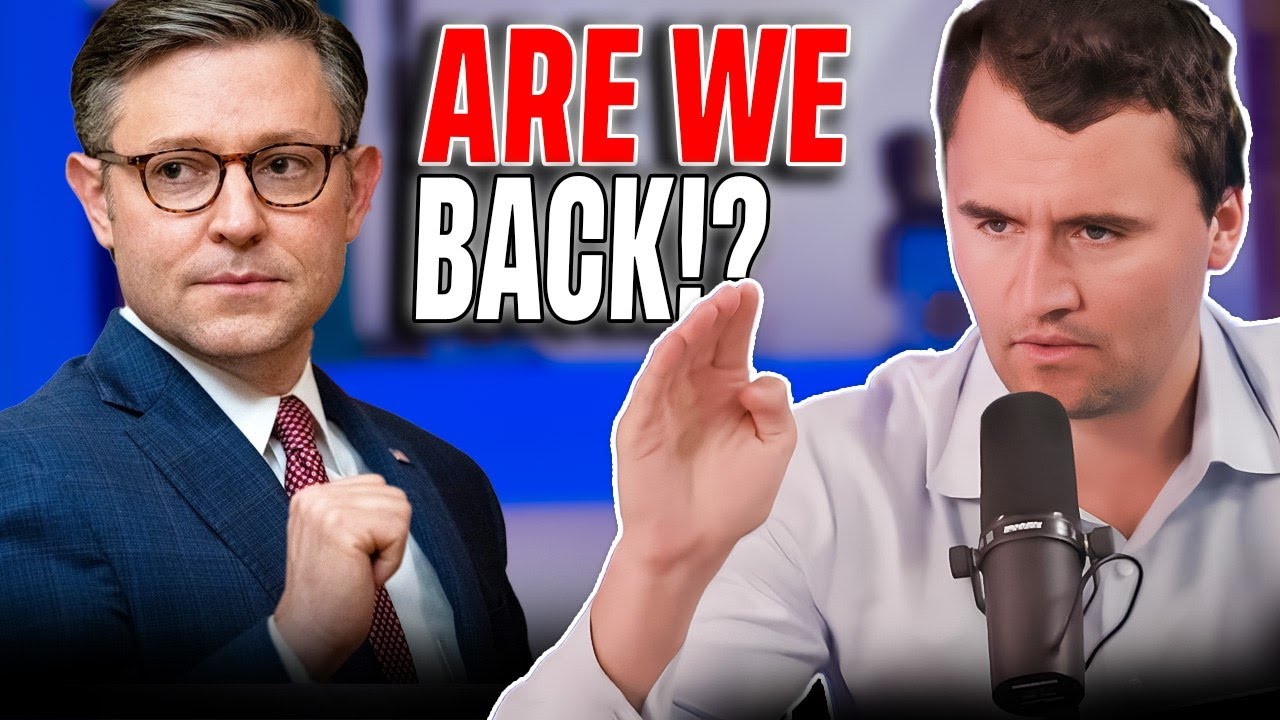
Glenn Greenwald Exposes How Mike Johnson Betrayed Free Speech and Constitutional Principles for Power
Glenn Greenwald joins Charlie Kirk to dissect the dangerous expansion of anti-discrimination law through the Anti-Semitism Awareness Act, which criminalizes criticism of Israel while protecting no other nation. Greenwald reveals how Speaker Mike Johnson abandoned his constitutional principles on FISA, warrantless spying, and FBI accountability within months of gaining power. The conversation explores how intelligence agencies manipulate newly elected officials through classified briefings in secure facilities, creating a pattern of capitulation that extends from Obama's broken promises to close Guantanamo to Johnson's reversal on Fourth Amendment protections.
The Anti-Semitism Awareness Act: A Direct Assault on Free Speech
Glenn Greenwald, independent journalist and host of System Update on Rumble, explains the fundamental problems with the Anti-Semitism Awareness Act that recently passed the House of Representatives. While no one disputes that anti-Semitism is reprehensible, Greenwald argues that defending free speech necessarily means protecting even repellent views from government censorship.
The legislation takes existing federal anti-discrimination law and incorporates a massively expansive definition of anti-Semitism previously advocated by Israel and adopted in some European countries. The House didn't just adopt the definition, but explicitly incorporated the examples themselves into federal law.
According to Greenwald, these examples now prohibit Americans from:
Suggesting that a particular Jewish individual has more loyalty to Israel than the United States
Criticizing Israel in ways that impose double standards compared to other democratic states
Saying that Jewish people are responsible for the death of Jesus
Comparing the behavior of the Israeli state to war crimes or crimes against humanity committed by Nazis
Greenwald emphasizes that while many of these views might be repellent, they are absolutely within the realm of protected free speech. The most disturbing aspect is the selective nature of these restrictions. Americans can express similar opinions about any other group—suggesting evangelicals prioritize Israeli interests over American interests is perfectly fine, and citizens can criticize other countries in any way they want, including with double standards. The one thing now prohibited is expressing these opinions about Jewish individuals or the state of Israel specifically.
Speaker Johnson Bypasses Committee Process During Campus Protests
Charlie Kirk highlights that Speaker Mike Johnson bypassed the standard committee process to rush this legislation to the floor, violating his promise that members would have 72 hours to read bills before voting. This maneuver occurred amid campus protests, the vast majority of which constitute constitutionally protected speech.
Greenwald traces this pattern back to the concessions Kevin McCarthy was forced to make before becoming Speaker. Members who successfully removed McCarthy had demanded necessary reforms because House leadership had consolidated so much power that the rest of Congress had become merely decorative. These reforms were designed to ensure the Speaker couldn't unilaterally control everything—members needed the right to read legislation, pass things through committee, and control what reaches the House floor.
Despite watching McCarthy get deposed for violating these promises, Mike Johnson made the same commitments and is now systematically violating almost every one. Greenwald explains that Johnson can operate with impunity because Republicans cannot remove him—Democrats have promised protection as long as he serves their agenda, which he has done faithfully.
Mike Johnson's Complete Reversal on Constitutional Principles
Greenwald reveals a stunning fact: Mike Johnson appeared on System Update just three months before becoming Speaker, where he passionately defended constitutional principles as a self-described constitutional law professor. These weren't throwaway talking points but elaborated convictions about:
Opposition to funding for the war in Ukraine
The evils of warrantless eavesdropping and a promise never to renew FISA without reforms
Strong criticism of the FBI and opposition to spending $9 billion on a new FBI headquarters
After becoming Speaker, Johnson reversed every single position. He led the way to continue funding the war in Ukraine, renewed FISA without reforms at the behest of the CIA and Biden White House, and oversaw the appropriation of funds for the FBI headquarters he had previously condemned.
The Anti-Semitism Awareness Act passed with overwhelming bipartisan support—only 21 Republicans and 70 Democrats voted against it. Both parties saw a political opportunity to claim rampant anti-Semitism endangers Jewish students, creating a moral panic similar to previous campaigns around racial minorities or transgender individuals that justified controlling speech to prevent violence or genocide.
What Happens Inside the SCIF: The Intelligence Community's Manipulation Tactics
When asked what motivates such dramatic reversals, Greenwald addresses the popular theory that officials are blackmailed. While acknowledging that political blackmail has been used by U.S. Security State agencies historically—J. Edgar Hoover maintained dossiers on political officials for six decades, which allowed him to run the FBI through fear—Greenwald resists making blackmail accusations without evidence.
Instead, he points to Johnson's own explanation. When asked why he changed his mind, Johnson said he went to briefings. Intelligence agencies bring newly powerful officials into the bowels of American power—the Situation Room, secure NSA facilities—where people with medals on their chests and tremendous authority treat them like dignitaries, explaining the supposed necessity of spying on Americans without warrants.
Greenwald explains that officials quickly learn their newfound power, prestige, and access to the inner circle depends upon serving an agenda they previously opposed. Human nature craves power, and people are willing to make compromises to maintain it.
The Theater of Classified Briefings
Greenwald provides insight from his Snowden reporting, which spanned two and a half years and revealed that the NSA had secretly converted the internet into a system of mass domestic warrantless surveillance directed not just at foreign populations but at Americans themselves. This occurred unbeknownst to most members of Congress.
A few months after these revelations began, the NSA invited 60 Minutes into secret parts of the facility. The broadcast crew was visibly excited, showing cameras capturing codes being entered on doors, enamored with the toys and futuristic atmosphere. Yet as Greenwald notes with amusement, these were just conference rooms with nothing particularly special in them. But because they were presented as secret spaces where super-important activities occur—similar to how the Situation Room is portrayed—people feel important and grateful to be granted access.
Speaker Mike Johnson now sits third in line to the presidency. The question becomes: does he want to return to the back benches of Congress? The answer is obviously no, and he's willing to do anything to maintain his position.
Greenwald acknowledges that even critics of Security State agencies have been conditioned to believe that what happens in the CIA, NSA, and FBI is super sophisticated, highly secretive, and genuinely important—sometimes actually catching criminals or terrorists or protecting the country. Even people critical of these agencies can become hypnotized once they're embraced, welcomed in, and presented with top-secret documents.
The Obama Precedent: Constitutional Scholar Turned Drone Enthusiast
Greenwald draws a parallel to Barack Obama's transformation. Obama ran for president in 2008 presenting himself as a constitutional lawyer. Americans had turned against the excesses of the War on Terror, and Obama promised to uproot all the neoconservative and Bush-Cheney domestic abridgments of civil liberties undertaken in the name of fighting terrorism.
Within two months of taking office, Obama fell in love with David Petraeus and his Harvard and Princeton-educated generals. He became enamored with Special Forces and drones. Not only did he fail to uproot any of the programs he campaigned against, but he continued and in many ways expanded them—the very programs he swore repeatedly to eliminate, including closing Guantanamo, ending interrogation programs, and reforming surveillance.
Greenwald attributes this to Obama being enamored with the secret briefings and access. The intelligence officials who conduct these briefings have been around for decades and know exactly how to manipulate newly elected presidents or newly elected House speakers.
The 2008 Obama Wave and Broken Promises
Charlie Kirk reflects that Obama's support in 2007-2008 came significantly from promises to close Guantanamo and give people time to read bills, positioning himself against Bush-Cheney excesses. While John McCain would likely have lost regardless—it was an Obama wave year—the margins of power came partly from cultural libertarians, privacy-focused voters, and people concerned about civil liberties who believed Obama's rhetoric.
Obama not only failed to deliver on any of these promises but became worse in some ways for domestic spying and civil rights abuses than anything seen in recent memory. Kirk credits Greenwald's reporting, particularly around the Snowden revelations, with fundamentally shaping his own views on domestic spying, while lamenting the lack of legislative reform despite these revelations.
The Lobby Complex in Washington
Greenwald notes it's not controversial to say Washington runs on well-organized, well-financed lobbies—Planned Parenthood, the NRA, Big Tech, Wall Street, pharmaceutical companies. The pro-Israel lobby is a major force in this landscape. Additionally, members of Congress have various motivations for supporting Israel: some have religious or cultural reasons to love the state of Israel, others believe it's an important component of national security.
All these positions are legitimate to hold, but they don't justify assaults on the free speech rights of Americans to protect a foreign country. They certainly don't support attempting to characterize criticism of the Anti-Semitism Awareness Act as being in favor of anti-Semitism—a rhetorical tactic designed to silence dissent.
Kirk observes that Washington seems capable of agreeing on only a few things: spying on Americans, borrowing money the country doesn't have, restricting speech, and financing wars that don't serve American interests. The rapid, bipartisan passage of the Anti-Semitism Awareness Act during campus protests exemplifies all these tendencies converging at once.