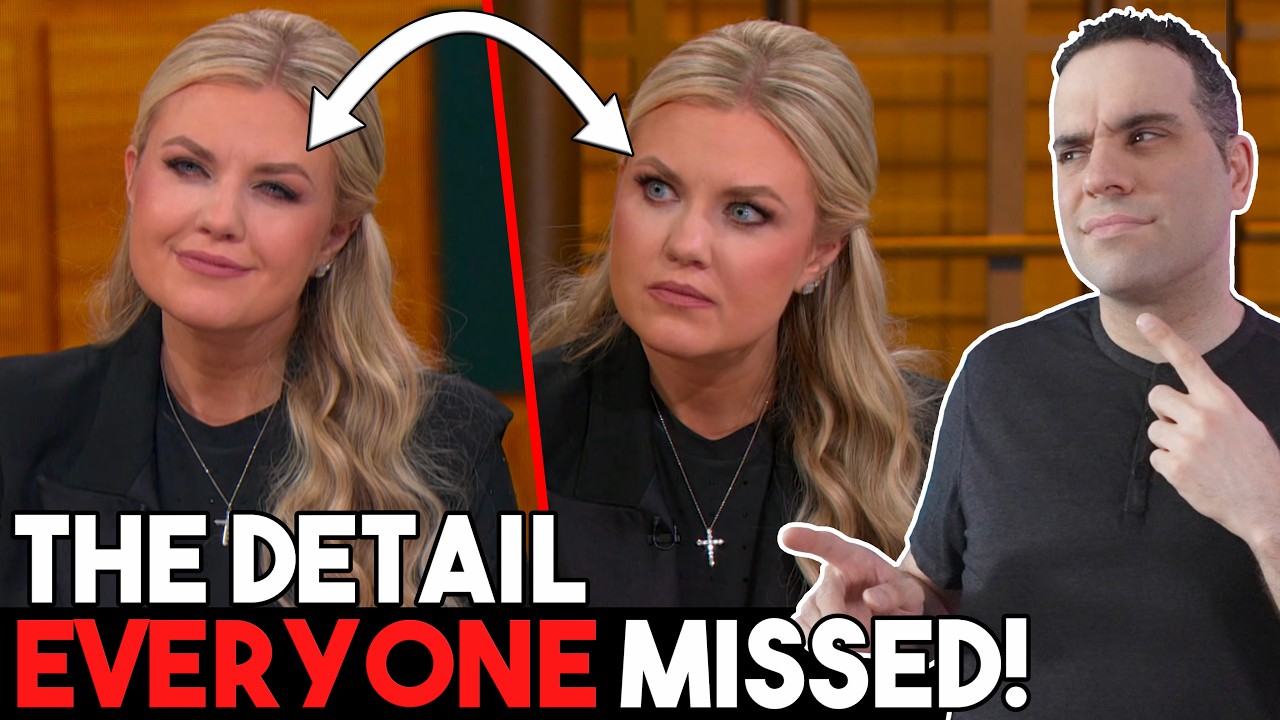
No one will ever replace my husband. No. But I do see some similarities of my husband in JD and vice president JD Vance. I do. >> What's going on everyone? Welcome to the behavioral arts. My name is Spidey and I use my degree in sociology and psychology, my certifications in criminal interrogation and body language analysis, [music] and my experience as an award-winning mentalist to teach people behavioral analysis and practical psychology on stage and television shows all over the world. Last week at the University of Mississippi during a Turning Point USA event, Erica Kirk, Charlie Kirk's widow, introduced Vice President JD Vance to the stage. And what followed has become one of the most viral moments of the year. The two shared a look and a hug that has the internet going crazy with opinions. But here's the thing, the placement of her hand during the hug, which is what everyone online is talking about, was not the only gesture that spoke volumes. In this video, we're going to take a look at her introduction speech, the now famous hug, and JD Vance's viral response to a student's question about his marriage. What do their body language, facial expressions, and word choice actually reveal? Let's dive in. All right. So, for the purposes of this analysis, we're going to do this a little bit out of order because in chronological order, she introduced him. Then he came out, they shared this hug, and then he gave his speech and answered this question from a student about his marriage that a lot of people are talking about. But for the analysis, we're going to start with the hug, and then we're going to go to her introduction of him and then we're going to end with his response to that student. Okay. So, the reason I'm really excited to cover this moment is because there's so much more going on with the non-verbal communication than just this hand on the back of the head, both with her body language and his. There are a couple of really, really important other things that we can easily see. The first thing that anyone in my line of work would notice is that at the moment that she goes to hug him, we see her right shoulder move upwards like this into the hug. In his best-selling book, What Everybody Is Saying, former FBI agent and worldrenowned interrogation and body language expert Joe Navaro, who's been on the channel before, talks a lot about gravitydefying gestures. This is any time where we see gestures in the body that move upwards while someone's communicating. And these are a very good sign of positive feelings. When we're feeling good, we go upwards with our body language. It's even in the language, right? I'm jumping for joy. I'm in heaven. I'm on cloud nine. Whereas with negative feelings, the opposite applies as well. And it's in the language once again. I'm feeling down. I'm feeling low. Things close in downwards. And the research supports this as well. Universally, when we see gestures that are expansive and upwards, we associate this to positive emotion. This is something that we very often see in the shoulders in moments of affection and embrace. In fact, it's so universally recognized that it's often used in cartoons. When people hug each other, those shoulders come up to show just how close and affectionate that hug is. Think about the difference if you were watching a cartoon between a character holding something in their hands and doing this versus doing this. When those shoulders come up, it indicates that they're fully immersed in this positive experience and they're fully taking it in. And that's exactly what's happening here with Erica Kirk and JD Vans. As she hugs him, we see that shoulder come up as she fully immerses herself in this positive moment. And by the way, really important note, especially if you're new to the channel. This is neither critique nor judgment. This is behavioral analysis. I'm not saying what should be. I'm not saying what shouldn't be. I'm saying what is. And after we objectively observe all these behaviors, we could start putting them together to see what story they tell. But for now, it's just observation of what's happening. So, following this upwards shoulder gesture from her, we see two other gestures that suggest how she's feeling in this moment. and we see quite a few things from him that also let us know what's going on in his head. But before we talk about those, here's a word about this week's sponsor. As you know, I don't do a lot of sponsored ads. That's because for me to talk to you about a product or service, I personally really have to believe in it. Otherwise, what's the point? But I'm really excited to talk to you guys about this week's sponsor, Ground News, because they're a perfect fit with the mission of the channel. Ground News is a website and app that compiles hundreds of news stories given any topic in one place and shows context about the publication, political leaning, reliability, and ownership. So, for example, with this week's topic, when I go search this on ground news, it compiles dozens of news stories and I could scroll down and I can choose if I want to see stories from publications that lean left, right, or as you know my preference, right down the middle. give me the facts and I don't want to be persuaded in either direction. And for every single article, you will see who owns it and you see how reliable that source tends to be all checked by third parties. They even have a great tool called bias comparison where they sum up what the left is saying, what the right is saying, and what they have in common, which I find so useful to cut through biased opinions and stick to objective facts. Now, Ground News is offering my viewers an amazing discount on their unlimited access Vantage plan, which is the plan that I use. And by using the QR code on your screen or the link ground.news/tba, which I will also leave in the description and the top comment, you can get a 40% discount on that plan. This has been a huge help for me to navigate through the bias on media and sometimes even keep my own bias in check. And I know that a lot of viewers are really going to appreciate a great way to do that. So use the QR code on your screen or the link in the description and top comment to get 40% off your membership to Ground News so they can help you navigate through the bias and manipulation of today's media. Okay, back to the famous hug. So, we see the shoulder go up and then we go right into the moment that everyone online is talking about where her hand moves up and goes right up into his hair/ head on the side over here with this open palm gripping of his head. So, in the beginning of every video, I tell you guys that I've got a certification in criminal interrogation and body language analysis. And I very distinctly remember when I was doing my certification course for body language analysis, one of the first things that we learned and there was a lot of emphasis on this is when people touch in a social setting, how much of the palm makes contact with the other person? And not just that, where on the body are these touches happening? So the arm and the hands is pretty much a free-for-all zone. When you're greeting someone with a handshake, we do palmtom contact as we greet them. We might even touch their arm with the other palm like this. And that's fine. That happens in very professional settings. Aside from that, however, in professional settings, when somebody does touch someone else, it's usually a brushing and very often with the fingers. So, somebody might say something funny. You might give them a little tap on the shoulder like this or a little nudge on the shoulder like this. But it's rarely a grasp and it's rarely with the full palm of the hand. Now as we observe people who are more familiar with each other like friends we notice two things increase. One is how much of the hand is making contact and where on the body. So we see those touches moving a little bit away from the arms. It could be like on the chest or it could be on the back. And we start to see a little bit more contact area with the rest of the hand. And when we move into very close relationships, like very close friends or family or intimate relationships, we start to touch areas that are a little bit more offlimits, usually socially, like the neck, the face, the small of the back, the waist, and we use a lot more of that palm. However, there is a caveat. In moments where we're providing or requesting emotional comfort, those touches go up on that scale regardless of the relationship. So, with a colleague that we usually just kind of shake hands professionally, if they announce sad news and they're feeling low, we might give a more comforting, you know, touch on the shoulder like it's going to be okay. If I have a friend that typically I fist bump, if something tragic happens and they need comfort, I might give them a hug that's a little bit more intimate, a little bit more hold them with the hand up here or around the face. We elevate that relationship pretty much all over the board. What that means is that if I saw this hug out in public and you told me that these two are strangers or don't like each other, I wouldn't believe you. I would say the behaviors don't support that. What they do support, however, is a very wide range of things. And in order to narrow down on what's likely going on, we have to look at more information. What are his behaviors? What are their word choice when they speak about each other? And so we're going to look at those things in order to arrive at a more informed, objective conclusion as opposed to using bias to instantly make up our minds with enormous certainty. But before we do, do me a huge favor. Hit that subscribe button, turn those notifications on, and take a quick second to like this video because it really helps with the growth of the channel. I do want to throw this in because baseline is very important with behavioral analysis. There's a picture that's been circulating online. I saw it in a couple of different posts where it compares the way Erica hugged JD to the way she's hugging a woman. It's interesting to note that that in moments of comfort, her hand might have the reflex of going up there to fully embrace someone. All the while, I also do want to mention this. Not everyone will agree that the way women behave with female friends is acceptable for women to behave with male friends or acquaintances. And so I think it's really interesting to say, okay, that's part of her baseline. That's a great note, but I also wouldn't invalidate if someone responded in saying, okay, it's fine if she hugs women that way, but with a married man, it has different implications. That's a valid counter argument. Okay, so let's look at JD Vance's non-verbal communication when he comes in for this hug. So the first thing you'll notice is that his hands that are down by his side open up like this, which is him getting ready for an embrace. But at the very same time, you'll notice that he leads with his head. His head leans forward. And this could suggest a couple of things. First of all, he's significantly taller than her. And if he wants to give her a warm hug, he does need to bring his head down. So, this could be him getting ready for that. The second thing is, you'll notice as soon as they do hug, he whispers something to her. He says something to her. So, this could be him getting ready to get close to her ear and say that. But it also has this latent function, this subtle function. And it's the fact that usually if you want to know how close to people are, especially with a hug, look at the pelvic area. Usually with very close friends or people that we're very close to, we see the pelvis come close to each other as we hug someone. Even in pictures side by side, we see that pelvis approach. But in relationships that are more professional or distant, we see what we call pelvic distancing. You might see people hug like this with the upper body, but the pelvis is far from each other. And even in pictures, even if they're leaning in like this with a smile, that midsection and lower is pushed away from the person. We're just approaching like this with the upper body. And if we look at this hug, you'll notice there's a slight discrepancy between the two because with Erica, her body is more straight, whereas him with this head leaning forward, it's kind of forced his lower body to move away a little bit. It's not one of these like this, you know, but it is a little bit more distanced than her. Now, if it was just this, I'd proceed with caution because again, he's significantly taller than her. So, in order to hug her, there naturally has to be this little bit of a bend. But that's not the only thing we're seeing. Notice how the moment the hug happens and she raises her shoulder into him like this, as she's moving her hand up, we see something with him. We see his right hand kind of tapping her like this on the back. It's not a rubbing, it's not a squeezing, it's just tapping. So tapping in almost any scenario suggests more of a friendly relationship between two individuals. Think I don't even need to tell you this. Think about any hug where instead of holding the person like this, you're just kind of tapping. This is a very friendly kind of gesture. It does contrast in this case with the fact that his left hand is flat against her lower back. And I think what's happening here is he's noticing the way this hug might come off. JD Vance is quite aware of public opinion and what people think of him. He pays attention to it and he kind of responds in subtle ways. For example, just this Halloween, he chose to dress up as a meme of his that's circulating out there as a joke. And this kind of lets me know that although he can laugh about it, he's aware of the public and what they think of it. So, I think what's happening here is he felt in this embrace, you know, she's moving into it. He's got his hand on her lower back and I think he immediately just taps her like this to kind of bring that level of like closeness and what it suggests down just a little bit like tap tap we're friends here type thing. He's also the one to break away from the hug first and to look away first. These are huge indications. So you'll notice he leans out like this first. His hand makes a pit stop on her waist over here which does suggest closeness, a close bond. But as he backs away, he almost instantly breaks eye contact as he looks up getting ready to address the audience while she breaks away second and looks at him. So at the very least, there are a few little details coming from him that suggest that he's trying to manage a little bit the way this hug comes off. And as a politician, he's constantly aware of what the public perceives. And we're seeing signs of that here. And again, this is just analysis. Please try to not get ahead of me and defend or attack any of this because this isn't judgment. I'm just saying behaviorally what's happening. And both these things, what they're both doing, depending on how you think about it, could suggest the same thing. So, more on this later once we've seen more things. I am tremendously blessed and honored tonight to be able to introduce to you a very very dear friend and his wife. They are incredible. And I see no one will ever replace my husband. No, but I do see some similarities of my husband in JD and vice president JD Vance. I do. >> Okay. So, the famous introduction and the way she spoke about JD Vance and his wife Usha. So, as she's introducing JD Vance, she says, "A very, very dear friend." And we see a smile on her face and an eye block. And there's a lot of research on eye blocking. And they've observed that even children who are born blind do this the same way that everyone else does it, which is huge because it lets us know that it's not a learned behavior. They didn't observe it and copy it. It's innate to all humans. And it happens when we're trying to hold on to a thought or trying to move away from a thought. So think about your eyes as the garage doors to your thoughts and either we're trying to hold something in or out. So in moments of great victory or celebration, we might close our eyes to really savor the moment. But if you get bad news about something, you might also close your eyes because you don't want to face that image. The rest of the behaviors, both verbally and non-verbally, allow us to know which of the two it is. So in this case, as she's saying a very dear friend of mine with that eye block, it's likely that this is positive. She's trying to hold on or emphasize how dear this relationship is, how positive it is, how lucky she is to have this friend in her life. Then after this moment, she says and his wife as the expression changes, the smile goes away. She looks up like this and we see this kind of jittery no with her head with a very serious look on her face. Now, it's very important to note that with behavioral analysis, we focus a lot on baseline. We're looking for deviations of that baseline that come in clusters. These things are very, very important. So, for Erica Kirk, this whole no gesture with a very serious face, especially when she's talking about something either emotional or serious, is very much part of her baseline. Here are a few examples. They don't all look exactly the same, but they have that commonality where there's this jitter of the head like this with a neutral or serious expression. >> Remember, being the courageous generation that you are, stand up for the truth. Love your family fearlessly. Love your spouse fearlessly. Love this country. defend her. You're worried about losing a friend? You might. I lost my friend. I lost my best friend. It is so easy to be afraid, but we are commanded to not be afraid. So, we see it in all kinds of scenarios like there when she said, "I lost my friend. I lost my best friend." We see it there. And obviously in that case, there's some kind of a negative emotion associated to losing a best friend. But earlier when she's talking about fighting for the country, even if this is a positive message, we're still seeing that same gesture like this because of how serious it is in tone, what it means for her, that message. So, if we go back to the idea of JD Vance and his wife, that shift in demeanor absolutely does suggest that there's a shift in thought, right? Because we don't go from this to this without a shift in what's going on in our head. Now, again, this is such a great example of why I stay away from bias. Because if I've already come into this with confirmation bias, I've already decided that she's madly in love with JD Vance and she wants Usha out of the picture, which is a possibility, but not a certainty. I look at it and go, "Oh my god, she hates the wife." And that might be what this is. Of course, it might be what it is, but we should also consider the fact that it could be something else. We know that there's a shift and an interrogation room, we see that shift and we ask questions about it. Hey, what what what are you thinking about right now? talk to me about your relationship with Usha uh Vance. What you know and and we try to figure out why this shift happened because what if the shift in this case is because she's thinking about their marriage and she's thinking about how she lost her partner. Maybe that's what's causing this shift. I'm not defending it. I'm not attacking it. I'm just saying behaviors are clues, not conclusions. Now the next part I can cover with a lot of certainty because I'm very familiar with this principle given what I do for a living. So she says nobody can replace my husband. No, but I see a lot of similarities with JD. So, the response to this speech, whether it's the hug, whether it's her introduction all over the internet, has been that either there is an ongoing affair or that she wants an ongoing affair or there's some interest. That's been a major part of the response to this. And although we can look at it and say that's a very unfair conclusion, she has something to do with that narrative because what she just said right there in psychology is known as a suggestion. And it's a very powerful thing. Look, words have a lot of power. I'm a mentalist. I get on stage and I entertain people with psychological demonstrations. And although a lot of it is relying on trickery, we also use a lot of suggestion to guide people's decisions. Her word choice here is creating a very powerful suggestion. When she says, "Nobody can replace my husband, but I see a lot of similarities with JD." First of all, the brain doesn't really register negations the way we think. For example, if I say, "Do not think of a green apple." Most of us are thinking of a green apple. Because the brain has to go, "Okay, wait. What is it? I'm not supposed to think of a green apple. Okay, don't think of that." It's the exact same thing as if I say, "I will not be going skiing this weekend." Most of us build an image of me skiing to go, okay, this is the thing that he will not be doing. This does not apply to about 5% of the population who have something called aphantasia, which is the inability to build images in your mind. But for everyone else, we're thinking of that green apple and we're picturing the person skiing. Second, her word choice really contributes to this suggestion as well because she's saying nobody can replace my husband, not nobody can replace Charlie. There is a ton of research that shows that the descriptive words that we use to talk about someone affects the image that the listeners have about that person, the image that they build in their head. So if she had said nobody can replace Charlie, the image we would have had in our heads may have been Charlie the speaker, Charlie the social media influencer. That's the thing that nobody can replace. But JD Vance has some similarities when it comes to that. But she said, "Nobody can replace my husband." So the image that we have in our heads now is not Charlie the influencer, Charlie the speaker. It's Charlie Erica's husband. This isn't something that she's doing on purpose to try to have this malicious message out there. It's just that in her choice of words, she's enacting these powerful psychological principles that we've seen again and again in the research. And it's creating this image of JD replacing her husband, not Charlie Kirk, the speaker. >> There's too many people who want to come to the United States of America. And my job as vice president is not to look out for the interest of the whole world. It's to look out for the people of the United States. Now, Now you you you you asked you asked a personal question about about our interfaith household and yes my wife did not grow up Christian. I think it's fair to say that she grew up in a Hindu family but not a particularly religious family in either direction. In fact when I met my wife we were both I would consider myself an agnostic or an atheist and that's what I think she would have considered herself as well. You know, everybody has to come to their own arrangement here. The way that we've come to our arrangement is she's my best friend. We talk to each other about this stuff. So, we've decided to raise our kids Christian. You just got to talk to your The only advice I can give is you just got to talk to the person that God has put you with and you've got to make those decisions as a family unit. For us, it works out. As I've told her and I've said publicly and I'll say now in front of 10,000 of my closest friends, do I hope eventually that she is somehow moved by the same thing that I was moved in by church? Yeah, I honestly I do wish that because I believe in the Christian gospel and I hope eventually my wife comes to see it the same way. But if she doesn't, then God says everybody has free will and so that doesn't cause a problem for me. That's something you work out with your friends, with your family, with the person that you love. Again, the most one of the most important Christian principles is that you respect free will. >> Okay. So, a lot going on with JD Vance and this question. So, first of all, this student who asked him the question about his interfaith marriage had a very long question and it had it was compound. There are multiple elements and one of the things the two focuses were this interfaith marriage thing and also she had some questions and frustrations about immigration policy. So those were the two focuses and what I really found interesting is that he started with addressing the immigration thing. So very often in interview or interrogation we ask compounded questions a question that has numerous questions in it because we want to see what the person is going to prioritize. Typically, we start with questions that we're more confident in our response, whether it's confident in our information or confident in the agreement that we're going to get because we start with building that rapport and then we go towards the more sensitive one or the one that we're trying to avoid. What I found really fascinating with JD Vance is that he would prefer talking about immigration policy, which is a really sensitive political topic, before talking about his interfaith relationship. And my guess as to why that is is because in the room that he's at, he knows at this point that he has a lot of supporters and when it comes to immigration, he's going to have a high level of support. It's also an answer that he's prepared a lot because it's something he's probably asked about a lot. So, it's something that he can more confidently address. Whereas the interfaith question is probably going to be a little bit harder to navigate. And as such, when he started answering it, I had a couple of questions. So when he was talking about how his wife grew up, he said that she grew up in a Hindu family but not a particular religious one. And as he was saying that we see him kind of looked down and his eyes start to flutter. We get this rapid succession of blinks. And in the research it shows that when we get this succession of blinks like this, it happens in processing whether it's processing a thought or an emotion. And throughout his speech, we do see him do these flutters a lot as he's thinking about an answer, as he's trying to process something. we do see quite a bit. But here, as I saw that with this look down and this blinking, it kind of caught my attention. It wasn't a huge red flag, but I was like, okay, what's going on here? Then when he spoke about his own faith and said he would consider himself agnostic, we saw his illustrators come up here. Illustrators are the gestures we use as we're speaking to drive those points home. They were up here, but when he talks about her, there are a couple of very important things. One, those illustrators anchor down as he holds on to the podium. Then he says, "And I think she would consider herself agnostic as well." But what do you mean you think? I mean, usually these are conversations you have with your partner, especially when you're going to get married, you're going to have children. So, he would know exactly what her faith was when they met. >> When I met my wife, we were both I would consider myself an agnostic or an atheist, and that's what I think she would have considered herself as well. >> The other huge thing is that he separates it. He says, "When we met, I would consider myself an agnostic." And I think she would have considered herself that as well. Well, if that's what you believe, why wouldn't you say, "When we met, we were both agnostic." That's the easy way to say that. Clearly, in the way that he's delivering this, there's some kind of separation between the two. Otherwise, the mind immediately groups them together. The best example I give of this in my seminars is that in a deck of cards, there are even cards and odd cards. So, if I hold up these two cards, the uh eight of hearts and the four of clubs, and I ask anyone, are these odd cards or even cards? Every single time I've asked this, the person said, "Those are both even cards." Nobody goes, "Well, let's see here. That one's an even one, and then that one I think is also an even one." Nobody says that. Our brain compartmentalizes. So, it doesn't make sense if they're the same thing for him to say, "When we met, I was agnostic and she was also, I think, agnostic." So all these behaviors, this kind of fluttering, this looking down, this kind of separating something that should be put together, the I think she was agnostic when most people would know exactly what faith their spouse was when they met had me asking a lot of questions. So I dug up this interview that they once did on Fox News and Usha herself said this. >> Usa, why were you so supportive? >> There are a few different reasons. Um, one is that I did grow up in a a religious household. My parents are Hindu and that was one of the things that made them such good parents that that make them really very good people. >> And so I think I've seen that the power of that in my own life. >> Okay. So first of all for context she is saying that the reason she's happy that JD has found faith is because she grew up in a household with faith and that she saw the positive impact that it had on her upbringing. So there isn't this big Hindu versus Christian thing in her speech, but at the very least, we're getting from her own mouth that she did grow up in a religious Hindu household, which if we go back and listen to what he said isn't quite the way he represented her upbringing. >> I think it's fair to say that she grew up in a Hindu family, but not a particularly religious family in either direction. >> Now, of course, this doesn't speak to her life as an adult. It's very possible that she grew up in a Hindu household and in her adult life went a little bit more towards being agnostic which would also explain why she married someone who is not Hindu. So obviously it's not this super important thing for her to keep the household Hindu. And she's also very accepting here of the fact that his faith regardless of what it is is a positive thing. So it is very conceivable that she's very accepting of other faiths. She's definitely suggesting that in the way that she's speaking in the Fox News interview. But there's still a misrepresentation when he says that she did not grow up in a religious household. She herself said otherwise. Now let's move on to the second part of what JD said. So he said, I've said this before, I'll say it again here in front of everyone. I'd say this in front of my best friends. Do I hope that she's moved by the same thing that I was, you know, towards the church? Yes, I do hope that. And what I don't like, again, I've complained about this a lot on the channel, is that a lot of people on social media cut that and just put that part that he's saying that he would want her to move towards the church and cut out the second part, the rest of what he said. But to be complete, to be fair, he goes on to say that if that doesn't happen, he believes that God has put free will in everyone. And that's something you work out with your friends, with your family, with the person that you love. So, I know a lot of people who are in interfaith relationships. I live in a very multicultural part of the world in French-speaking Canada, Quebec, Montreal, we have all kinds of cultures, all kinds of faiths. And anytime that I've asked someone who's in an interfaith relationship, if they hope that their partner will see it their way, this is more or less the answer that I get. I get, look, in an ideal world, yes, they would see things my way. But if they don't, that's fine. You know, I I chose to be in this relationship and I respect everyone, so I'm okay with it. So ideally, yes, but forcefully no. And again, let's keep in mind that JD Vance is very aware of his audience. All politicians are. They have to be very careful with the words that they say. He knows that he's in a room with not just Republicans, but big supporters of Turning Point USA. So if he was asked that question, he said, "Nah, I don't care if she's Christian or not. Doesn't make a difference to me." Remember this is also someone who in his own words was agnostic for a long time in his adult life and recently has converted to Christianity and and follows that belief system. So if he were to say nah it doesn't matter to me he might lose the favor of a lot of people in that room who are heavily Christians. So he has to really walk that line very very carefully. If he goes too much to one side it's a problem. If he goes too much to the other side it's also a problem. So let's do it. Let's put it all together. Let's look at all these behaviors and talk about likelihoods. So, do we have enough behaviors here to know for a fact that a a relationship is taking place that there there's there's some kind of affair happening here? We don't have enough to conclude that that is for sure already happening. And the reason for that is this. Whatever you throw at me, I could play devil's advocate because the research has shown and observation has shown that there isn't a specific way that people are having an affair behave. You might see proximity between two people and go, they're for sure having an affair. But there are a lot of examples where people are having an affair actually have more distance because they don't want you to know that something's going on. Think about how when Bill Clinton was asked about his affair with Monica Lewinsky, he said the most famous line associated to affairs. >> I did not have sexual relations with that woman. Miss Lewinsky >> with that woman. Then he specified Miss Lewinsky. at first that woman. That's distancing language. We studied that in behavioral analysis. His mind went to that woman to create some distance there. So, could I look at Erica and say, "Oh my god, look at this intimacy. Look at where her hand is. Look at her moving into this hug. There's for sure something going on there." Yeah, you could say that. But could I also look at Jade Vents and go, "Oh my god, look at that. He's patting her on the back. There's some pelvic distancing. He's cutting away. He doesn't want us to know that there's something going on." See, that's how confirmation bias works. If we've already made a decision, we only look for evidence to support that decision, that conclusion. A lot of the discussion online is about how appropriate these behaviors are. Everything we talked about in this video. And I've said it once and I'll say it again. That is not my job. My job as a behavioral analyst is to look at the behaviors and tell you what's going on, how the person is feeling or thinking. So yes, here we are behaviorally seeing a closeness, a proximity. All these things are behaviorally undeniable and suggest a certain closeness there in emotion and in thought. Now, what that suggests and how appropriate that is, that's none of my business. A lot of people are going to look at it and focus on the negative and say, "That's very inappropriate for a recent widow and a married man." A lot of people are going to look at it and focus on the grieving process of two people who have lost someone and are sharing in grief. And it's totally fine in those moments to show that bond, to get through this together. And that's fine as well. Those are both subjective opinions based on objective behaviors. But behaviorally, can it paint the picture of some kind of interest here, some kind of connection? Yes, it can. But to jump to the worst conclusions immediately, that's confirmation bias, and I'm not about that, which is why I'm so happy to work with ground news on this video. Speaking of ground news, before we go, I want to give you a very, very strong tool that I often use to keep my biases in check. This is a personal mental exercise that I do and a lot of the time you guys ask me how do you keep bias out of analysis. So here's a huge tip that I encourage you all to try. So this is for anyone who's aware of any bias that they might have towards Erica Kirk. And I don't care what the bias is whether you are generally favorable and positive towards her or generally unfavorable and negative towards her. Try this exercise. So step one, think about how you feel about this hug. Do you feel like it suggests something really bad about them or is it this innocent positive thing? That's step one. Just kind of be clear about your opinion of it. Step two, replace Erica Kirk by somebody that you feel the complete opposite about. What I mean by this is if you usually very much dislike her for whatever reason, doesn't matter, replace her by someone that you really like and have positive attitudes towards. And then vice versa. If you typically are very positive towards her and you really like her for whatever reason, replace her by someone that you genuinely dislike, someone that you have very negative opinions of and imagine that person having this same hug, doing the exact same thing. Step three, re-evaluate. So ask yourself genuinely if you would feel the exact same way about this person if they did a hug that looked exactly like that. If you notice that there's a change in your opinion, it could be that who the person is was influencing your read on this. And if it's the exact same, it's likely that you objectively only stuck to the behaviors and formed an opinion regardless of who the person is. And you have to be honest with yourself. You know, I know it's very tempting for people to say, "No, it changed nothing. This is horrible." Or, "No, it changed nothing. There's nothing wrong with this." It's easy to go down that path, but be honest with yourself to try to see if there's a shift. As for me, there are certainly some interesting behaviors both with the word choice and non-verbally that make me want to ask some questions to try to figure out exactly what's going on. But that does not mean that right now I'm making a massive decision at either extreme based on these behaviors. So, let me know in the comments what you think and please let's try to stay respectful because at the end of the day, nobody knows and behaviors aren't absolute. We can't look at this and go, "It's for sure this or for sure that." So, let's try to keep it respectful, but let me know in the comments what you think of all this.