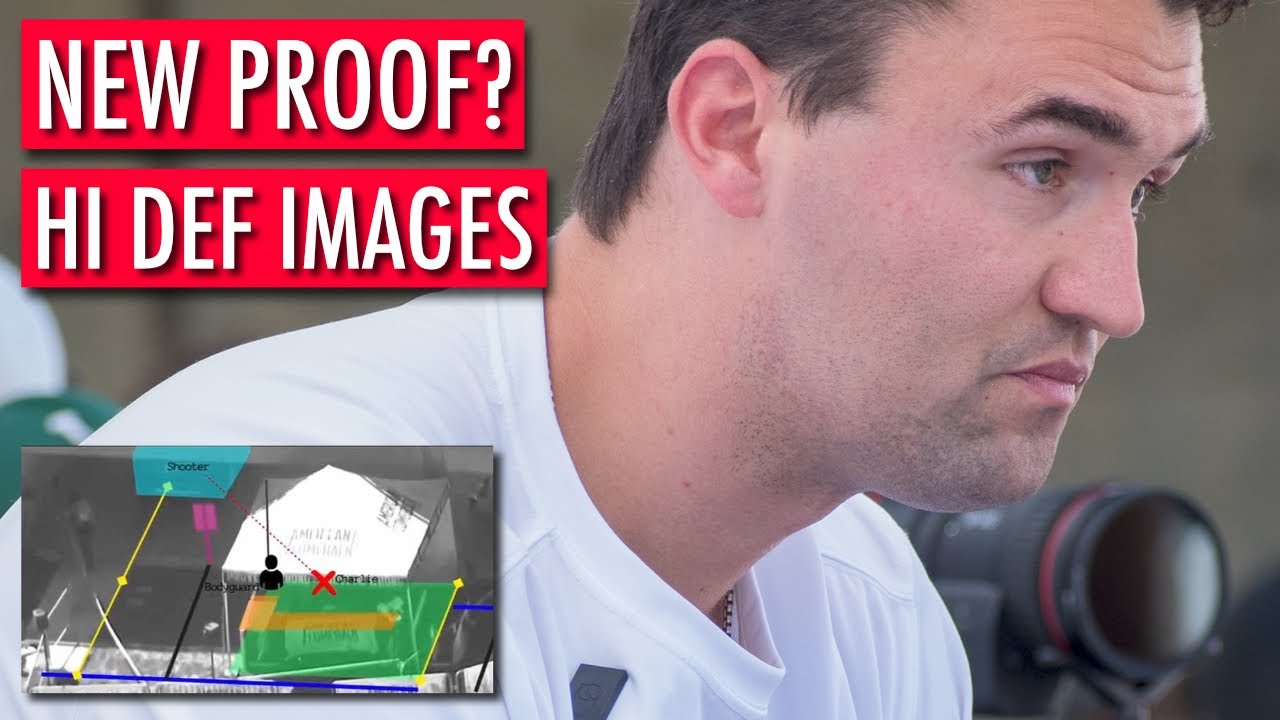
I'm here today with Jason Goodman, seen on many channels, including his own, as well as Redacted, telling his interpretation of what happened to Charlie Kirk. Now, his narrative does go against the mainstream, and it's causing a lot of people to question what they think they know about the assassination. He has a contest going, which I'll tell you about, until November, challenging anyone to refute his theory. And if you get it correct, maybe you could win some money. Jason, welcome. And can you tell us your background and experience and what made you first start looking into all of this? >> Absolutely, Matthew. Thanks for having me on first of all. And just to clarify and to keep me out of legal trouble, it is not a contest. It is not a sweep stakes. It is not gambling. I am offering a bounty for someone who can bring superior evidence in the same way that Jay Jonah Jameson would offer $500 for a photograph of Spider-Man. If someone has a better solution as a news agency, I will pay. It's almost like freelance research or freelance journalist. So I just want to make sure that's clear. My background is for many years, decades in fact, I have been in the motion picture industry. I was there at the outset of digital film making and I've been doing uh photo retouching in Photoshop for since version 1.07. And I got to make sure I get my dates correctly. But since it was new, I've been using it. So, I'm very familiar with video encoding and image manipulation and all these kinds of things. And one of the biggest problems we're having with this Charlie Kirk assassination is that all of the evidence that people are evaluating is digital video and digital images. And I want to make sure that people understand the types of artifacts that are involved in these things. Particularly when things are uploaded to one platform like Tik Tok, downloaded somewhere else. Now people are watching us on YouTube or X or wherever it might be. Each of these platforms transcode the files, compress the images. And so one of the things I saw you evaluating was did Charlie have a necklace or a headset or something? And when he's sitting there, we don't see the headset. But one of the things that video compression does is it's making averages of groups of pixels, macro blocks of pixels. And so if he's got a clear or mostly clear headset, and particularly if we're far away and it's been recompressed, the computer might not see the difference in color between the headset and his skin in such a way that it doesn't record it at all. So when you're looking at the computer image, if we don't see the headset while it's on his ear, but then something flies off and now the headset is showing contrast with a dark background, maybe the computer is picking it up. So I want to make sure people aren't making conclusions based on deceptive elements of evidence. >> Yeah. So artifacts and it could be the same as like colored audio, right? People can manipulate audio. In this case, just think of it as the computer or the camera manipulating the visual signal that you're actually seeing. So, the only true way to get what happened would be to see it with your own eyes. But we're getting the next best thing, which is by camera. >> Exactly. And I don't mean to suggest that anyone Well, we might get into that, but I don't want to presume that anyone has deliberately manipulated the footage. I'm just talking about the normal process of how these digital recording mechanisms work because this is the first issue I want to cover on your show. A lot of people saw I did a debate with Dr. Chris Martinson on Owen Shroyer's show and subsequent to that debate, Dr. Martinson has accused me of manipulating evidence, which I absolutely did not do. Now, the email that you were reviewing included a composite photograph that I had created. Part of my evidence bounty is that it is my position that Charlie Kirk was uh shot from behind by a projectile moving at approximately 500 ft per second. >> Let's talk about that really quick. So, I don't mean to cut you off, but a lot of people do know that you've had um a good amount of air time telling your story. So, a lot of people are very familiar with your position. So, I have a few questions for you. Um in this particular case with those three items that you're showing there, so obviously they were asking questions. Well, they're not in a straight line, and I get that they can jump around a little bit based on the frames and things like that and camera position. And I know that you edit it from different frames per second. So that can cause the different size issues and things that people are seeing. But overall, yes, it is basically a straight line, right? Um heading towards the back of his head. Now, the question I have for you is in that case, if it's coming from that angle, you didn't specifically say this, but I said this. If it's that vehicle that's behind him to his right and it's shooting up or even straight across, does that bullet or does that projectile align properly from that position based on what you're showing? It almost looks like it's coming from above at a slightly raised angle. >> Yeah, I'm glad you're bringing this up. So, I have another image for us to look at here. I don't know if you want to go full screen on this, but but uh >> go for it. >> Yep. I am also a my area of expertise when I worked in Hollywood I was a visual effects cinematographer specialized in stereoscopic 3D. So I've worked on 3D movies like Amazing Spider-Man, X-Men, Metallica Through the Never. I spent years developing stereoscopic camera systems and optical systems and it's extremely difficult for us to evaluate this three-dimensional scene from looking at individual two-dimensional photographs of it. So, what we've got right here is this side view of Charlie where I agree with you. It looks like this thing is coming in on a downward diagonal. But look at this guy over here with his arms crossed. Do you see him there? It looks like he's standing basically right next to Charlie's tent. But then a few days ago, I got this sort of more frontward view where we can see here's that same guy with his arms crossed. And look at how far away he is from the tent. So there's all this space. And also we can gauge the top of his head. This is where what I allege is a projectile. It's right there at the top of his head. And in this front view, we can see the top of his head is pretty much in line with this van. Now, a lot of people still say I'm saying it seems to me extremely suspicious that the door of this van, the rear door of this van or this SUV, whatever it is, it opens like 5 seconds before Charlie is shot, then he's shot and it closes. I mean, that's at least suspicious. And it does suggest that perhaps someone inside that van could have shot at him. Now, this is still only two two-dimensional photographs of a three-dimensional scene, and it might be insufficient for us to get a proper sense of how the whole thing is oriented. Because if the person taking this more head-on photo is lower down than the van, we don't know the slope of the land or whatever, but it does look like it's pretty aligned with Charlie. So, if someone's in the back of this van shooting a pneumatic rifle or a pneumatic handgun at the back of Charlie's head, that's pretty close range. And some of these current uh PCP guns, as I'm sure you know much better than I do, I never heard of a PCP gun before this. I've gone shooting like three or four times in my life. I'm a very, very inexperienced shooter. I'm not claiming to have any expertise in that. I'm just talking about the digital evidence that we're looking at. And it looks to me like someone inside the back of that van could have shot at the back of Charlie's head. And I'll tell you exactly how I arrived at the 500 ft per second if and when you're ready to hear about that. >> Yeah. But real quick before we touch on that, let me show you a few things based on what you just said because >> Yeah. Again, I'm getting these emails, but and of course, you know, I'm not associated with anyone with any of this stuff at all. This is just information being sent to me that I find interesting. So, um I have no dog in the fight, uh from that perspective, but All right. So, what are your thoughts on this? So, someone sent me this after they saw my video, which was basically your information, right? >> So, here you can see this yellow. Can you see that? >> Yes. >> Okay. So that would be the trunk open for this Pacifica is what everyone says. This is the Chrysler Pacifica. >> So if that's open, that's blocking this gentleman who's way back here. But even with your theory, that's still in about the same line, right? Going to Charlie Kirk if they were to shoot from there. Now, here's the second image. >> You see this person up here? >> Yeah. >> Looks like they have a phone, maybe. >> Here's the Pacifica. So that also that's just another just a side note um that someone saw this and I thought that was pretty interesting as well. >> Yeah. I mean again that guy standing up there I mean we we got to get the timing down cuz things are moving back there and certainly after Charlie was shot. It's chaotic. Somebody has another video where somebody is moving around that Chrysler Pacifica van. So maybe they moved it. I mean would anybody notice if a car moved there? People running for their lives. It was chaos after the fact. But I mean, again, I'm not saying for sure what happened with that van. I'm just saying I'll explain to you in a moment how I arrived at 500 ft per second. We see the door of the van open. Gun experts like yourself all agree that this injury is not an entry wound from a high-powered rifle from in front of him. It can't be. It just can't be. His neck would be explo I mean, I'm not a gun expert, but I can watch hunting channels. I can watch people shooting ballistic gel. The kinetic energy and the size and the and just the power of those rounds, the cavitation that they create. His whole neck would have exploded if he had been shot with that from the front or the back. This is a low velocity, relatively low kinetic energy round. So, here's how I arrived at 500 ft per second. I believe that this video, this image comes from a video that I originally got from Zeb Zeb Boyin. I don't know Zeb beyond interacting with him on YouTube and Twitter and all that. And you know, he seemed like a nice guy. He and I have subsequently stopped talking over all this, but set that aside. He provided this video. He went on to Owen Shroyer's show and he showed this video and I said, "Wow, that's a high quality video." And he shared it with me. And what I noticed when he shared it with me was that, you know, when you shoot a video on your phone and you download it to the computer, whether it's Mac, PC, whatever, you double click the video, it automatically opens in the video player, right? >> Yep. >> This video didn't do that. So I said, "Gee, that's weird." Well, it was just transcoded into an odd format. Now, I was able to open it in VLC and I went through and I checked out uh certain details of the file and what that showed me this this kind of detailed interrogation of the file was that this was not as I had been previously led to believe a video straight out of somebody's phone. And you know, I'm looking at my early interviews with Zeb now and I keep referring to it as an original video from somebody's phone. He doesn't stop me and say, "No, no, it's not an original video from somebody's phone." He doesn't say anything. This is some metadata on the video that I looked at in F meg. >> Yeah. And it says it's encoded in the high 10 profile, which is an HDR profile. And even more interesting, 20 frames per second. >> Now, the iPhone can shoot HDR, but it uses the normal 10 profile. No, this is a software transcode, and 20 frames per second is a very unusual frame rate. If you're using Adobe Premiere or Adobe After Effects or Adobe Media Encoder, it won't even do an H.264 MPEG file at 20 frames per second. You need to use something like FFmpeg. So, it's somebody pretty sophisticated who transcoded this file, and we don't know what frame rate it was transcoded from. And when I started talking to Zeb about this, he and I did another show, and mysteriously a 30 frames per second version of the file showed up, but at much lower bit rate. This first 20 frames per second file, it looked very clear and sharp. And that was something that Owen Schroyer noticed, something that I noticed. That's why I thought it was the original file from somebody's phone. So when this 30 frame per second file showed up, I said, "Wait a minute. Both of these files, they play very smoothly. When you transcode a 30 frame per second file to an odd frame rate like 20 frames per second, there would normally be really unusual motion artifacts and things that would make it look weird. But neither of these videos were showing those artifacts. So, it occurred to me that the original file must have been evenly divisible by both 20 and 30. That's how we were able to get smooth playing videos from it. So, that's either going to be a 60 frame per second file, a 120 frame per second file, or a 240 frames per second file. And I have surmised that it was a 240 frames per second file. The reason I think that is that is a frame rate that the uh iPhone can shoot since iPhone 8. It's been able to do 240 frames per second. And these two projectiles came from the original. These two dots that I believe are projectiles came from the original 20 frame per second video. This second one that you rightly point out is a different size and slightly not perfectly aligned with them. that came from the 30 frame per second video which was transcoded to a much lower data rate. So even though the first video had only 20 frames per second fewer frames it was about a 60 megabyte file 65 something like that the 30 frame per second file which at the same duration should have more data in it was less than 30 megabytes. So somebody compressed it even more and we lose more spatial information, resolution, sharpness, etc. And that likely accounts for the difference in size. This thing is just not represented with the same resolution and contrast as these other two are. And there could be other changes made to it as well. But people ask me, well, how do you know somebody didn't add these dots? I just don't think they would have. It doesn't make sense to add these dots and then spend all this energy and time saying that Jason is lying and Jason is manipulating footage and blah blah blah. I did not manipulate this footage. Now, obviously, I added these arrows. I added this scale. This is a photo illustration that I'm using to instruct people as to exactly what I'm talking about. I never said these came out of the video one, two, three. This is what Chris Martinson is accusing me of. I never said that. I've been saying since the first day that these things showed up that this dot appears out of time. Now I want to switch to another application here. Here's Adobe After Effects and this is this 20 frame per second file. We can see in this file we've got that dot up here by the guy's hair that I think is the first frame of the projectile. But at the same time that that's on screen >> now really quick. So, I I know um I know you've showed this on redacted in a few other uh episodes as well, but if you go back to that original bullet or well, alleged bullet, right? If you go back to that spec that is right by the tent, the first one >> right >> now. If we look at the height of that, like you said, from this angle, it's kind of hard to tell, but if that came from that van area, that person would have to be standing and holding a gun higher than chest level to shoot at that height. So, now here's another question for you. So, so the question I have is could it be possible that that person that was standing further in the back that was kind of when the when the gate popped if they came from back there maybe that could be that height. The other question is you were talking about remote triggers and things like that. Could it be possible that that tailgate a lot of people have asked this on the video that tailgate when it pops up could it be possible that a PCP or some other device is in the tailgate and shooting from the height of the tailgate? >> Absolutely. People have spoken about the possibility that somebody hid a gun in the camera. I mean, certainly that's possible, but I just don't think the evidence supports that. I don't think the trajectory matches, but certainly it would be easier to build a PCP gun into a car than it would a camera. That trunk is gigantic. I mean, you could hide I mean, if you're sitting there in a workshop, pimp my ride with a PCP gun in the back of the trunk. I mean, anything is possible. And you could really pump up that velocity, too, because you could have a much bigger compression chamber. So, yeah. I mean, >> well, let me get to the velocity. Sorry to interrupt, Matthew, but let me tell you how I calculated the velocity. So, the other thing that's interesting about these dots, sorry, I'm getting ahead of myself. Let's first explain this. Here's the frame that shows the first dot. And the thing that has got Chris Martinson hung up, is that we also see the first frame of Charlie hit I'm going to step back in this video here for a second just so I can explain what I'm saying. I'm going in reverse now, one frame at a time. Now, you see this? That's the second position of the projectile, I allege. But Charlie is not hit. When I move forward, he's hit. And as we continue forward, he's about to start bleeding. I don't want to get you a uh but you can see he's been hit. So when we move back, it doesn't make sense to people that position one of the projectile shows up one frame late. And so this is where we go to MEG encoding. And this is I don't mean to get technical, but it's important for people to understand this. Meg is a type of video encoding that is designed to deal with video on the internet. And the way it works is it has different types of frames. They're called I, P, and B frames. The I frame, basically what people need to know about it is it breaks the image down into these little macro blocks, little squares. And in this image, for instance, the building is stationary. So there's significant areas that just don't change from frame to frame. You know, when you're looking at a highdeinition video, it's 1,920 pixels by 1,080 pixels 30 times a second. It's 2 million pixels 30 times a second coming to your phone, coming to your computer over the internet. It's so much data. It absolutely cannot be transmitted. So to reduce the amount of data being transmitted, mathematical algorithms are applied to the image to say, well, okay, this block of images is approximately the same. So instead of remembering every single one, we've got a little math equation, and it's like a it's like a recipe. And when they encode the image, it's a much smaller piece of data that's sent that when you decode it on your phone or your computer or whatever, it's coming back to what looks essentially like the image, but takes up much less space. So these I frames then are used to create what's called a P frame, which the best way to remember this is that the P frame is just based on the previous frame. If nothing changes, like you're sitting against a black wall, you're barely moving. There's many, many P frames based on the previous frame where the computer just says, "Well, wait, this is the same. Oh, Matthew just blinked. So, we're just going to remember his eyes are moving. He's moving his head." If you were to totally move the camera now, there'd be a lot of eye frames because every single frame would change and nothing could be based on the previous frame. >> So, are you saying that the P frame is what you're seeing in the im with the bullet that's sitting there? Well, the other thing that it does is it has these B frames which are bidirectional. It uses bidirectional temporal prediction to look backwards and forwards to determine what was there. And like if we had that scene with the building and a plane flies by, the previous frame might not accurately represent what's happening in the video. So it looks at the previous frame, the next frame. It's doing all this kind of mathematical stuff to the image. And what happens is when we have a very high contrast item like this lightly colored dot moving against this guy's dark hair and it's moving very rapidly, it can confuse these algorithms and be presented out of order. the birectional the previous the these things get confused by these rare you know it's not every video where you have a bullet moving 500 ft per second and so it confuses the thing additionally >> okay so so let's let's touch on that really quick so 500 ft per second so you know well I'm not sure if you know you said you don't do a lot of shooting and stuff so a typical rifle is anywhere from you know 1500 ft per second to well over 3,000 right and typically when you have cavitation um like many people are agreeing has has probably happened, right? Whether it was a front shot, side shot, back shot, doesn't matter. There's some kind of cavitation happening and that's supposed to explain the shirt and the necklace and everything flying off, right? Um, in theory, so let's say there is cavitation in this case. Um, cavitation obviously like even even in your videos and things showing the back of his head deforming and stuff like that. Um, for that to happen, you have to have a certain feet per second, a certain amount of power. There has to be a certain amount of footbs that are transferred to that tissue to cause the fluids and things to expand and move around and and that kind of thing. So, the question is, can 500 can a 500 ft per second projectile cause cavitation? And I've been looking around and doing some research and everything I've seen so far says it typically has to break the sound barrier. So, it typically has to be over,00 ft per second. So, I'm just kind of curious. What would you say if everyone's like, "Well, to to actually have cavitation, you have to be f much faster than 500 feet per second." >> I don't think there was cavitation. I think that people again are being fooled. That cavitation theory originated with Dr. Martinson and he was looking at a different camera in the cavitation theory where that camera was the school not the newspaper but the school media outlet the uh UVU review and we can see that camera in other people's cell phone videos. It's got a long lens. It's like an ESPN or a news kind of camera. That's called an ENG style camera. That's a broadcast camera, not the camera in your cell phone. And that's got a long telephoto lens on it. It's zoomed in on Charlie. Those lenses have mechanical iris in there that lets you stop down the iris opening, the aperture of the lens, and reduce the amount of light coming in. >> Those cameras typically will also have what's called a neutral density filter, which is like sunglasses that you put on the camera to reduce the amount of light coming in. Right? and they're going to be shooting with a normal shutter speed of about 160th of a second. Now, back to our image of this alleged projectile. This is shot, I'm saying, with an iPhone outdoors on a bright sunny day. It was like bluebird day there in Utah, high altitude. This is probably a shutter speed of 115,000th or 120,000th of a second. That's why even at 240 frames per second, we're freezing the action of this bullet. It's the same exposure time as if you had a 20,000 frame per second camera, but we're only getting approximately onetenth of those frames recorded. With the camera angle that Dr. Martinson incorrectly presumes is showing cavitation, we're seeing so much motion happening in 160th of a second that it's creating this motion blur. That's a lot of agitation of the shirt. If we go back to this After Effects angle, you can see this is the same camera with the higher shutter speed and we can see that we don't see any cavitation of the neck. We see the shirt ruffling around a lot, but there's no cavitation of his neck. His neck's not going to relax from that cavitation so quickly. And I also just don't believe we don't even know that he's wearing a necklace. I do think this was a uh earpiece from his security people. Like maybe the security people gave it to him 5 minutes before he went out there and nobody else knew he was wearing it. >> All right. So, real quick on that um just because we're kind of talking about uh variations of your theory and and other things that people are saying that you're refuting. I just want to show this really quick here. Now, this is from the same person that took your theory and added some to it, right? >> Exactly. And we should say this person was invited to appear today and decided to be anonymous. So I want to touch on that after you show us. >> Correct. Which now there's two sides of that, right? Do they want to appear anonymous because their information was taken from somewhere else and they're being disingenuous or do they want to be anonymous because they're not comfortable in this kind of light? It could be either. But um in all fairness, yes, they they are not here and they were invited. Correct. Now, in this case, they basically are saying a bunch of things about how their theory about the necklace going in the neck could be true. So, I just want to cover this really quick. I don't believe it or not believe it. It's it's interesting, but the point I'm going to show you is where he actually shows the necklace itself in his frames. And I'm interested to see your theory on that as well. So, what he's saying is cavitation happens. Again, now you're saying there was no cavitation. So cavitation happens, neck swells, and the pendant or cross, whatever it may be, is pulled up into the neck and then this the necklace breaks off, whips around, and he shows all these different, you know, his exact interpretation basically of how it happened and how it got ripped out as it went off the side, and you know, it's about 2 ft long. So now we go into the actual photos. Now it's showing each of these frames. So he's saying the pin is whipped up. That's what he's saying this is. And you come over here. Now, this is where he starts showing the chain, right? So, I initially heard from everyone else, Paramount Tactical and all these other channels that it was a earpiece. And some uh someone even said that it rang Bro, I think said it was blood or something, right? So, so really that goes back to what you're saying with no one can really tell what the hell this is based on artifacts and things, but if you look at this, you can see what looks like at a chain or maybe the earpiece, but then he follows it. You can see he's right there. There's a very long object. Could be an earpiece possibly. And then he just keeps following it. So, as you go down all these frames, you can clearly see this long what looks to be chain that keeps going. And now it's down here. And as he goes, he goes frame by frame. And now you can see how long it is. That's like that whole necklace that was wrapped around his neck earlier that we saw. >> And then it falls off to the side. Now here, this is the interesting part. We're not showing this because obviously there's some gore, but >> right, >> the chain for some reason is still holding in this spot and it's hanging off of his shoulder and you can see it clearly right there. Clearly as you know as far as this video's resolution and stuff is, right? And then you come down here and then you see finally it starts to fall off and pops out and that's when you see theoretically that blood squirt out that initial blood that comes out and then it falls to the ground. So, so that's the theory from that point of view and that kind of shows the chain. Now, could it be an earpiece? Yes. >> I I don't think that this person's research is valid at all. And I'll tell you why. I invited him to come on here. He could have come on or she could have come on by voice only. Could have done all kinds of things. But here's the thing, Matthew. You're showing your face. People know your name, your business, where to find you. I'm showing my face. Who is this person that they need to be anonymous? Why do they want to inject themselves to this level, but not to stand behind what they're saying? Um, >> well, and how anonymous are they? Because they they sent the emails to you. I was told by this person they've sent this email to over 20 or 30 different YouTube channels. >> Had shown this Proton Mail email address. When I saw that, I said, "Oh my god, Matthew's doxing the guy." I communicated with him by email after that, and he didn't say, "I'm angry with this person and don't want to go on his YouTube channel because he showed my email address." He was >> I got his permission to >> Well, then that's even crazier. Why does he want his email address out there for everybody, but he he wants to be anonymous? That's a contradiction. And so >> proton masks >> your email. It's a kind of like a think of it like a VPN for emails. Yeah. So So he's that either >> because here's the thing. I know you're running a firearms channel and a gun training channel and we're now dipping toes into the conspiracy theory world as it is called. >> I like to call it analytics. Yeah, >> I agree. It's analytics. I'm I'm just trying to speak in a language that people understand. I don't mean to disparage what I do. I'm very fascinated by these unsolved crimes, suspicious things that happened in Butler, Pennsylvania. suspicious things that happened here in Utah, suspicious things that happened on 9/11. This is what my show, Crowdsource the Truth, investigates all the time. And the thing is, I approach it in a very analytic and scientific method. And I have come to learn over the nine years that I've been doing this that the people who are involved in criminal conspiracies who want to hide them don't like it when people like me do what I'm doing. Because if I am correct and this video was shot at 240 frames per second, that means whoever was recording it knew that Charlie Kirk was going to be shot and that this was a reconnaissance video. So, let me explain how I came to 245 uh 240 frames per second and why I think this is a projectile traveling at 500 ft per second. Whether it was fired from some custom installation in the van or this is a optical deception based on our angle or whatever. This projectile is moving approximately 500 feet per second because this scale that I've added, it doesn't matter if this is inches, feet, whatever. We know that Charlie Kirk is approximately 6'4 and he's seated here from the top of his head to the bottom of his seat. We're looking at about 3 feet approximately of Charlie Kirk. And the distance between each of these dots if it's traveling 500 feet per second and photographed at 240 frames per second calculated by chat GPT would be 2.08 ft. And this is these are nearly equidistant. These three dots. So I mean again when you shoot on an iPhone at 240 frames per second it could be 242 frames per second, 241 frames per second. This could be 506 feet per second, but I'm saying it's in that range. And this looks to be about two or 2 and 1/2 ft between each of these. Now, back to the frames appearing out of order. Again, that's got to do with the birectional temporal prediction of meg encoding and the fact that if this originated at 240 frames per second and someone who doesn't quite exactly know what they're doing transcoded it to a 20 frame per second video, there is a lot of room for errors to happen. Now, another problem that I ran ran into is that these, you know, armchair meg encoding geniuses said, "No, because if you drop out one out of every 12 or you take one out of every 12 frames, this thing would be, you know, moving hundreds of feet." Well, the point is it doesn't work that way. An MPEG file doesn't have discrete frames in the way that a 35mm strip of film that you would hold up to the light and see 24 pictures for every second. Remember, it's computed frames based on, you know, when you say take this 240 frame per second thing and now make new P frames and B frames and I frames based on this stream of data. So, the thing goes through there and it says, "Well, we've got this white dot and it doesn't appear once." Maybe if it appeared once, it would think it's noise or it's dust or it's some unimportant element of the image. It would forget it. But it doesn't appear once, it doesn't appear twice, it appears three times. And I didn't write this software, but three times moving in a line strikes me as something that would trigger the algorithm into thinking this is a component of the image, but it's moving so quickly and it's so high contrast and it's been transcoded in this totally unusual way that it appearing out of order, it frankly doesn't surprise me. I've seen that happen in other meg videos. birds moving against the sky and you get a black dot of the bird behind it where it's not supposed to be. So again, I'm not a software developer. I It's like people watching this need to think about me like a like a test pilot. I don't know how to build the airplane, but I can tell you what it does when you fly it. And I don't care what the engineers say. When I'm in the cockpit, it does this. It's not supposed to do that. I get it. But it does. I've seen it. >> I do have a question for you. >> Yeah. So, so a lot of people have seen your your theory and a lot of people do agree with it. Um, according to the video that I have out right now, um, a lot of people believe that that's probably the most sound theory at the moment. Now, I have one question and this may be easily refuted on your side. If he got shot from the back and you know, say that's you say you say it's an exit wound, correct? I just want to make sure. I don't want to put words in your mouth, but So, that's an exit wound. Okay. So, if that's an exit wound in the front, um, and all conspiracies aside, all manufactured autopsy results aside, and all that kind of stuff, how do you explain the bullet still being in the body or the projectile still being in the body? >> I have not seen an officially released medical examiner's report. I have heard people say that they've spoken to people who have seen that, who have said that, that surgeons have said that, that somebody told somebody who said they saw that. I haven't seen even a medical examiner's report released. However, even if I did, and again, I get it that you're focused on firearms training and that kind of stuff, but if you go back, you might remember Bill Clinton when he was the governor of Arkansas. There was a coroner by the name of Fam Malik. People should look this guy up. People who were shot twice, had their heads cut off, and jumped out of a window got listed as suicide. So, a coroner is a person. And I'm not saying that all coroners are corrupt. >> They can be paid off just like anyone else. >> Absolutely. Or threatened just like anyone else. Yeah. >> Threatened. Paid off. And by the way, look, I'm not trying to disparage coroners, but I don't know. I think it might be. It's not like the guy's a gastroentererologist. You know who goes into being a coroner? I don't even know. I don't mean to disparrage them. I'm just saying it's a human being who could be paid, who could be coerced, who could be whatever. I don't care about what an allegation about a report that nobody has seen yet says. I'm talking about the evidence that we see. Now, back to this email that this pseudo anonymous person sent to you and to me, what I have observed over the years is when I or anyone is getting close to the truth of something that they don't want out, there is a technique called a limited hangout. And and this language comes from Richard Nixon. When Watergate was happening and there were all these tapes, it was revealed of Nixon talking. Nixon became very worried about all this information hanging out. So whether it was John Dean or Halderman, he had all of his, you know, cabinet guys and lawyers who were trying to come up with strategies and they said, "Well, you know, if we focus on this piece of information, maybe we can, you know, deny this super terrible thing over here and we'll have sort of a limited amount of information hanging out." And that's the limited hangout. So, as it starts to become less and less possible for them to refute what I'm saying because I've provided so much empirical evidence and when non-experts like Chris Martinson say that Jason has deceptively presented frames out of order and I can go back and say, "No, the first time I saw that video on September 18th when Zeb showed it to me, the first thing I noticed, the first thing I pointed out to my audience was, "Wait a minute, how could this thing be back here if it's just hit Charlie and within seconds I said this strikes me as an MPEG encoding error now Chris Martinson didn't it makes sense and by the way if I'm wrong let's get an MEG data scientists over here to tell me how I'm wrong because they won't they'll say Jason is right this is how the encoding process works and it's certainly possible particularly when we have we've got a broken chain of custody on this evidence. There's more I want to tell you about that video. That video that I say was shot at 240 frames per second was published in ABC News on their website and they gave a credit to a guy named Samir MSI. Samir Masi is a student at UVU and he works for UVU Review and he was separately interviewed by ABC News Australia where he said that he he gave this whole story about how he was they were having a pizza party and he had his uh free pizza and he uh went outside and he had such a good view of Charlie Kirk that he decided to start recording and he recorded this video. Can I play you actually my phone call with Samir Mossi? Would that be interesting? >> Yeah, give me just one. We We'll do that for sure. Um but I do want to show you something really quick. This is interesting to me because like you said as as the gun guy, we're we're really focused on the entry and exit wounds, right? >> Um entry wound doesn't necessarily show anything because it kind of selfseals, right? >> Right. um as it passes through there might not there might be no blood and or very little damage and of course if it hits the hair area you might not see anything but the interesting thing I found is I was doing some research so if the bullet was found near C7 this assumes this assumes the autopsy is correct and legit right we don't know there wasn't like an official release I haven't seen the documents but just in that theory that the bullet was near the C7 and it destroyed C2 to C7 right there was damage through all those they said the thing that's interesting is this says The bullet entered from the rear posterior lateral angle, which is what you're saying as well, traveled forward and down. Um, the temporary cavity and bone fragmentation would create multiple secondary wounds. But here's the interesting part. The pressure could eject material through weaker structures in front like the jugular area, which means it doesn't have to necessarily be a bullet exiting to have that kind of wound. Could be, right? I mean, again, I'm not a doctor. I'm just saying he was shot from behind. And what it looks like to me is that the bullet comes out the front of his neck. Now we The other thing that we see in this after effects clip is this is such an acute I mean people are saying this is his necklace. So you're telling me all this activity happens and it the cross comes up. That's a lot of transfer of energy. It's a lot of transfer of energy. What that looks like to me and people have said, "Oh, that's ridiculous." But it looks to me like the projectile from the PCB gun comes through the back of his head, hits, we saw it in the other video where I did a uh 500% blow up. And thank you for also using that. You showcase this video where we see it hit the back of his head here and it's clear that his hair becomes agitated sort of first thing, right? And again, this is a cell phone camera shooting this. So, I mean, we have different This is another thing that's going to have a very fast shutter speed. So, we see all this activity on this shirt in great detail here. We don't have high frame rate, but we have this sort of pressure event. This is not a good app for stepping frame by frame, but we have this pressure event at the back of his head where it's almost like clapping your hand on a pool of water where it's, you know, the air that gets ejected from just the nape of his neck there. This this to me looks like the shirt getting inflated in a very small area. There's air pressure here. His hair goes up here. The bullets just hit him right here. His hair is agitated. The shirt is agitated. The thing goes in the back of his neck. This explains the immediate brain injury. And then I think it deflects downward either off his vertebrae or his skull or something hard. Deflects downward and the bullet the projectile comes out the front of his neck. Now when you do shoot a bullet into ballistic gel, it doesn't go on forever. Eventually it runs out of energy and it stops and it stays there in the ballistic gel. So, if it had enough energy to go like let's say it stops right before the end of the ballistic gel. If it had a little more energy and it went just out of the ballistic gel and you had a t-shirt on the ballistic gel and it has almost no energy left. The t-shirt catches it. It stretches out a little and then that's it. It flops down. That's what it looks like is happening to me. The bullet is coming out the front of his neck and getting caught in the t-shirt with so little remaining kinetic energy cuz it started out with so little kinetic energy compared to a rifle round. It's a 500 foot per second, maybe 50 cal, maybe less. But these air PCP guns, they go up to, I think, 75 caliber. Pretty common to get a 50 caliber, 45 caliber PCP gun that shoots 500 ft per second. And there are some that I've seen that they say generate like 400 foot-p pounds. That's gonna do a lot of damage from that kind of close range. And again, maybe I'm wrong about the shirt. >> Now, I do have a question. So, say it goes through, say it's 4 or 500 footbs and say it's moving around 500 ft per second based on your calculations. It in it hits the back of the head causes the seizing and other things we see. It comes out of the front and it causes the exit wound. Okay. So, what I saw in the the full full speed video, obviously, it's not uh not a lot of high quality, but I see what looks like everything moves, everything shuffles around, and then there's like a pause and then blood squirts out. So, with your theory saying that it shot through and it's hitting the shirt, that means it should already be out, which means all the energy should already have been coming out. So that so so theoretically if what you're saying is true if it hits the back of the skull and it comes out of the front we should have seen blood immediately come out with that. We should have seen blood on the shirt. We would have seen blood squirting out before that pause. There's like a 101 squirt. So how how would you explain that? >> I think we're getting into medical areas that I can't really speak about in a in a technical I don't know the answer to that question. I think also we've reviewed so many different videos in slow motion and whatever. What is the actual time of it coming out and the blood coming out? I mean, I don't know. I don't know the answer. >> This is from the full speed. This is the full speed shot. Blood falls over this. This is no slow-mo. This is like the original video that came out. >> I just don't believe that a bullet would cause a necklace to have enough kinetic energy to penetrate. I mean, that looked like to me people say, "Oh, there wasn't a lot of blood." I don't know what they're talking about. It looked to me like a faucet got turned on the second I saw him like there's no way he's going to survive. >> So to me it's a through and through shot from a a low a relatively low kinetic energy round for and by the way all the professional shooters and hunters and marines the what's his name? Rob O'Neal, I think is his name, who talks about the number of people that he shot. They don't have a lot of experience shooting people with these low velocity. They're talking about supersonic rifle rounds and what those things do. I don't know. >> Subsonic blackout and things like that, but Yeah. Yeah. >> Right. We don't know what happens. You know what I'm saying? So, to me, that's what it seems like is happening. You're not recording a guy sitting in a chair talking at 240 frames per second. That's something you do to analyze a high-speed event. >> Yeah, for sure. So, any final thoughts that you would have to people? So, if you have anything you want to say to the audience or to anyone else? >> The uh again, you know, I was very upset that Chris Martinson claimed that I committed fraud. I did not. Everything that he said in that video was false. I challenged him to a second debate where I could address his concerns and he refused. And this is my evidence bounty. People can go to crowdsource thetruth.org and if you believe you have factual evidence that can refute the things that I'm saying. People have boosted this bounty to $2,600. And this doesn't mean that an anonymous account can come to me and say, "Oh, a necklace punctured him in the neck." You, first of all, need to reveal your identity to me because we're going to enter into a almost $3,000 business transaction. But second of all, you need to challenge what I'm saying. You need to understand me encoding better than I do and explain to me how it's not possible what I'm saying would have happened. And you need to say that it's not possible that a projectile traveling 500 ft per second could be photographed at a shutter speed of 115,000th or 120,000th of a second with three equidistant positions at 240 frames per second. And if you can do that, by November 4th, you'll be awarded $2,600. Conversely, if you agree with me and you want to motivate members of the public, particularly whoever it is that might have this original video, to come forward, you can add money to this bounty, you can use any cryptocurrency or your credit card. Go to crowdsource.com.org. Read these terms and conditions. It's laid out here. This is a legally binding agreement. I'm not some clown who's coming along and trying to do this as a stunt. The purpose of this, Matthew, is to get to this original file because the higher this number goes, the less it makes sense that whoever shot it, if someone came forward and said, "I'm the person who shot it. It's 60 frames per second. Here it is. Here's the metadata from my phone. Give me the 2600 bucks." Where is the college student who would want this evidence bounty? And why are they not coming forward? That's why I want to go on shows like yours, get this word out because the longer this question goes unanswered, my hypothesis, and I think it's already done this, it becomes a thesis that I am now defending. Other experts in any field can come forward and challenge this thesis. And I will defend it with facts, not guesses. Not we're transferring all this energy around to a necklace that whips around and comes back and something is bouncing off of body armor that he's not wearing and a supersonic round is doing boomerang moves. It doesn't make sense. Bullet comes in, hits bony material, whether it's the base of his skull or the vertebrae. It deflects downward about 19° and it goes out the front of his neck with almost no kinetic energy remaining. Caught by the shirt. That's the thesis. >> All right, there you go. Jason Goodman, if you want to challenge him and try and get that bounty, you know where to go. And again, Jason, we thank you for being on.