Up Next
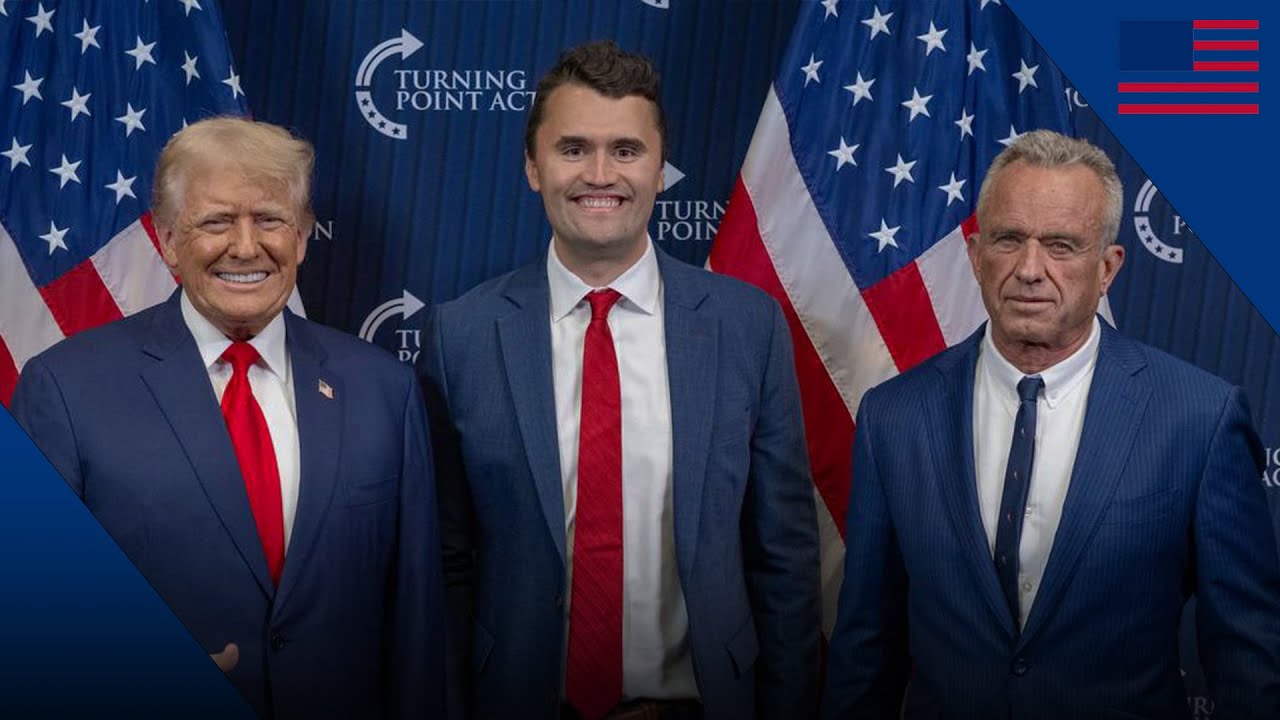
Charlie Kirk Breaks Down RFK Jr's Historic Trump Endorsement and What MAGA Really Means
14:31
Charlie Kirk on Trump's First Cabinet Meeting Opening with Prayer and National Revival
6:20
Charlie Kirk Exposes Professional Protesters at No Kings Rally with Journalist Nate Friedman
15:08
Charlie Kirk is the Founder and President of Turning Point USA, the largest and fastest growing conservative youth activist organization in the country with over 250,000 student members, over 150 full-time staff, and a presence on over 2,000 high school and college campuses nationwide. Charlie is also the Chairman of Students for Trump, which aims to activate one million new college voters on campuses in battleground states in the lead up to the 2020 presidential election. His social media reaches over 100 million people per month and according to Axios, he is one of the "top 10 most engaged" Twitter handles in the world. He is also the host of “The Charlie Kirk Show,” which regularly ranks among the top news shows on Apple podcast charts.
Subscribe on YouTubeJay Bhattacharya Breaks Down NIH's Fight Against Predatory Scientific Publishers Charging Taxpayers Twice
Jay Bhattacharya, Director of the National Institutes of Health, announces a major policy shift to stop predatory scientific publishers from double-charging taxpayers. Under the new rule, NIH-funded research must be available to the public for free, and the agency will cap what it pays publishers like Springer Nature, some of which have charged up to $13,000 per article while also collecting millions in subscription fees. Bhattacharya explains how this duopoly has exploited both scientists and taxpayers, and how open-access science could prevent the kind of information suppression seen during COVID-19. He also discusses the challenges of refocusing NIH on actual health outcomes rather than social justice initiatives, and why concentrating 60-70% of funding in just 20 universities creates dangerous groupthink in the scientific community.
Breaking Down the NIH's New Open Access Policy
Jay Bhattacharya, Director of the National Institutes of Health, made an important announcement regarding how taxpayer-funded scientific research will be published and accessed. The new policy addresses a little-known problem in scientific publishing: when taxpayers fund research through NIH grants, that research gets published in scientific journals that often charge the public to read it—even though they already paid for the research itself.
As of July 1st, the NIH implemented a policy requiring that any paper published by an NIH-funded scientist must be available to the entire public for free, without any paywall. This seems straightforward enough, but the response from the publishing industry revealed a deeper problem.
The Double-Dipping Problem
Many scientific publishers responded to the open access requirement by charging scientists exorbitant fees—sometimes as much as $13,000—for the privilege of making their work publicly available. Springer Nature stands out as a particularly problematic actor in this space. The company charges up to $13,000 per article for immediate open access while simultaneously collecting substantial subscription fees from government agencies.
Springer Nature receives more than $2 million annually in subscription fees from the NIH alone, plus tens of millions more through exclusive article processing charges (APCs). This represents classic double-dipping: charging both for access to the journals and for making individual articles freely available.
The economics become even more troubling when you consider that it costs publishers virtually nothing to put content on the web, and they don't even pay the peer reviewers who vet the scientific papers. Taxpayers end up paying twice—once for the research itself, and again for the privilege of accessing it.
The Duopoly Controlling Scientific Publishing
The scientific publishing industry operates as a duopoly, with two major players—Springer Nature and Elsevier—dominating the field and setting terms for most scientific journals. This lack of competition has created an unhealthy situation for science.
NIH pays these publishers subscription fees so that NIH scientists can access journals and stay current with their field—a reasonable library expense that has existed for a long time. The problem arises with the additional article processing charges that exploit the publishers' duopoly power.
Interestingly, private foundations like the Gates Foundation have negotiated better deals or refused to allow these kinds of charges altogether. For years, these publishing giants have given better terms to private foundations than to American taxpayers.
The New Fiscal Year 2026 Policy
To address this exploitation, the NIH announced a policy for fiscal year 2026 that will limit the amount of money the agency is willing to pay scientific journals for making taxpayer-funded publications available for free to taxpayers. This policy is expected to be controversial within the narrow world of science publishing, but it represents a significant step toward protecting taxpayer dollars and ensuring they're spent on actual science rather than exorbitant publication fees.
The expected result is that these journal publishers will lose some of their market power. The policy should lead to more competitive pricing and ultimately to a more open scientific ecosystem.
Open Access as a Tool for Democratic Science
Beyond the fiscal benefits, which could save tens of millions or even hundreds of millions of dollars, this policy has profound implications for public health and scientific discourse. The COVID-19 pandemic revealed how a small number of high-profile scientists could dominate the conversation and control what counted as "the science."
When access to scientific literature is locked behind paywalls and controlled by a few publishers, it becomes much easier for a scientific elite to determine what's true and false. Claims about masks, vaccines, school closures, and other interventions were presented as settled science, even when substantial scientific literature suggested otherwise.
Opening up access to journals so that the public at large can see what scientific debates are actually happening makes it much more difficult for a small number of scientists to dominate the conversation. Science is fundamentally democratic—not in a political sense, but in the sense that it should be open and free, allowing honest scientific discussions about data rather than having a few big actors dominate the field.
Scientists advance knowledge by challenging ideas, not by appealing to authority. They publish papers that examine evidence and test hypotheses. When that process is accessible to everyone immediately upon publication, it's much harder for anyone—even the NIH Director—to present their potentially wrong ideas as unchallengeable truth.
Science as Liberation, Not Control
Science, properly understood as a method for understanding the natural world and how we interface with it, should be a tool of liberation, flourishing, and the betterment of humanity. During the pandemic, however, science became a tool of suppression—restricting liberty, agency, and freedom. The phrase "trust the science" really meant "trust the scientists we approve of."
The new open access policy addresses this by democratizing access to scientific information. It ensures that heterodox journals and alternative viewpoints can be introduced and evaluated on their merits rather than being suppressed by gatekeepers. A more open scientific ecosystem creates space for real debate and correction.
Refocusing NIH on Actual Health Outcomes
Beyond the publishing policy, Bhattacharya has faced challenges in refocusing the NIH on its core mission: advancing the health and well-being of the American people. The most shocking discovery upon taking the job was how parts of the NIH's mission had been adulterated by other objectives.
Since 2012, there has been no increase in life expectancy in the United States—a major scandal that received little attention. While European life expectancy continued to rise, America experienced flat life expectancy alongside high rates of chronic disease including diabetes, cancer, obesity, and heart disease. Working-class Americans have felt the brunt of these trends.
Rather than focusing intensely on these pressing health problems, portions of the NIH had become focused on DEI (Diversity, Equity, and Inclusion) objectives—attempting to achieve social justice goals that science isn't well-equipped to accomplish. Instead of identifying what health problems minority populations face and developing solutions, resources were directed toward initiatives remote from actually advancing people's health.
The goal now is to refocus the NIH on real health priorities that matter to people, pursuing advances that improve the health of everybody regardless of race or color. If someone has a health problem, the NIH should study ways to help them—not try to achieve social justice, which is beyond the agency's capability and mission.
Breaking Up the University Concentration
Another structural problem undermining scientific progress is the concentration of NIH funding. Approximately 60-70% of all NIH funding goes to just the top 20 universities. This concentration creates scientific groupthink.
While elite universities like Stanford employ great scientists, great scientists exist all across the country. The current system creates a vicious circle: to have excellent scientists, you need excellent facilities; to get funding for excellent facilities, you need excellent scientists. This guarantees that excellent scientists outside the top 20 universities will have a much more difficult time getting their excellent ideas funded.
The NIH solicits research ideas from researchers around the country in a competitive process to determine which ideas are best. However, the fixed cost support—money given to universities for lab space and infrastructure—is tied to already having excellent grant-winning scientists at the institution. This circular system perpetuates concentration and groupthink.
Addressing this concentration is important not just for fairness but for the quality of science itself. The COVID-19 response demonstrated the dangers of scientific groupthink. A more decentralized, merit-based funding system would produce more robust science and more diverse perspectives.
The Make America Healthy Again Coalition
The policies being implemented at NIH are part of the broader Make America Healthy Again (MAHA) movement led by figures like Robert F. Kennedy Jr. While various political coalitions have experienced tension on issues like foreign policy and immigration, the MAHA coalition has remained remarkably strong and battle-tested. The movement has consistently delivered on what it promised: refocusing government health agencies on actual health outcomes, challenging corrupted relationships between agencies and industries, and prioritizing the well-being of ordinary Americans over institutional interests.
Video Transcript
We got some exclusive breaking news
today and it is from a great man uh
director of NIH Jay Baracharia. Uh
director, great to see you. Thank you
for taking the time. I know you have
some an announcement to share with the
audience here. Please uh the floor is
yours. It's very important. It's not
going to make the front page of the New
York Times, but it shows how the
administration is focused on real
results that benefit the taxpayer and
science. Please, Director Badacharia.
Charlie, thank you for having me on the
show and for making uh giving me the
floor to make this announcement. So, um
one of the things that's sort of a
little known secret about scientific
publishing is that when taxpayers pay
for research and they do that through
the National Institute of Health, lots
of great discoveries are made. You
publish it in a scientific journal and
everyone has these ideas about
scientific journals as if they're uh as
as as ways like you know clean places
where people can convey scientific ideas
to other scientists. They're
peer-reviewed. They they vet truth. Um
and you know some of that is true but a
lot of times the the economics of the
publishing of the scientific uh uh uh
scientific in uh you know sort of uh uh
publishing work for the publishing
industry is actually not so clean. Um
and in particular what happens uh we we
just made an announcement a few weeks a
couple weeks ago uh essentially saying
that when the an NIH funded scientist
publishes a paper in a scientific
journal that paper needs to be available
to the entire public for free without
any payw wall. That happened uh you know
a couple weeks ago we put we put that in
place um uh actually I think it was July
1st was with put that in place. A lot of
the industry, some of the industry
responded by ch essentially by telling
the scientists that they were going to
charge the scientists for the privilege
of publishing science in their journals.
Think about that. I'm an author. I'm a
scientist author and I publish some I do
some some great advance funded by
taxpayers. I go to a scientific journal.
The scientific journal then charges me
up to sometimes $13,000. Springer Nature
is a good is a is is a particular bad
actor on this. $13,000. Well, what
happens then is the taxpayers are then
charged for that $13,000 fee to for the
privilege of publishing in the
scientific journals. It it costs them
nothing, Charlie, to put it on the on
the web. I mean, this is it's a very
very cheap thing. They don't even pay
peer reviewers. So, what we're doing is
we are uh announced a policy that in
fiscal year 26 that we're going to limit
the amount of money that that that the
NIH was willing to pay to scientific
journals for having the scientific
publications paid for by taxpayers
available for free to taxpayers.
Taxpayers have already paid for it.
There's no good reason for scientific
journals to charge twice. Um, and this
is that's a big deal. a lot of the a lot
of the sort of predatory practices in
scientific journals that take advantage
of researchers. Um it we're finally
addressing that and we're sort of making
the uh the the sort of like publication
process more in line with the interest
of the of of taxpayers and with the
scientific community. Um it's going to
be controver weirdly controversial uh in
the scientific community in in sort of
the narrow world of science. But I think
for American taxpayers it is a big deal.
It's a big step because it says we are
taking um seriously the dollars that you
entrust us with. Making sure we spend it
on science, not on exorbitant
publication fees that don't produce any
good for anybody.
Well, yeah. And so, for example, I know
that you guys have had your eyes on many
of these publisher companies, one of
which is a company Springer Nature,
which is a foreign company. And correct
me if I'm wrong, but they charge as much
as $13,000 per article for immediate
open access while also collecting
substantial subscription fees from the
government agency. But then they also
receive more than $2 million annually in
subscription fees from the NIH in
addition to the tens of millions more
through exclusive article processing
charges or APCs.
So in if correct me if I'm wrong but
that double dipping by companies like
Springer Nature
it entirely it it it certainly feels
like it probably you've described it
exactly right right so what happens is
um uh in order okay so NIH employs a lot
of excellent scientists right so
scientists need to have access to the
journals so they can read the journals
and see what what fellow scientists are
doing and have discovered so the NIH
pays spring or nature elong big player
in this industry. This the industry is a
duopoly. I mean they they basically the
reason why it's such a a mess is because
it is a duopoly. It's not a competitive
industry. And then and a few other
smaller publishers including like
university presses uh a a contract that
says okay we would like to have access
for our scientists to the the stuff
that's in your journals. Like that that
makes sense. Like that's library fees
have been around for a long time and uh
that makes sense to do that. You want to
have access to these these uh these
these journals for the scientists that
are doing their work because that's how
they do their work is by sharing
information.
Absolutely.
What doesn't make sense, Charlie, is
charging scientists for publishing in
the journal exorbitant amounts of money
just for the right for the public to see
the papers without a payw wall. That's
double dipping in my view. And I agree
with your characterization of you. You
you absolutely nailed it. And the amount
of money on that is way way more than
the p the library fees. Um really the
big way that these journals take
advantage of their duopoly power that
the duopoly because there's really two
big players in this industry. There's
Springer Nature just as you said um and
and then and then um another another
company called Elsa. Those two companies
basically set the terms for a lot of the
scientific journals. Um, and they sort
of monopolize uh, you know, it's part
like one of the reasons why it was so
difficult to get the word out about what
science what scientists were actually
saying during co because they had the
such monopoly power over over scientific
publishing. It's it's really not a
healthy situation for science to be in
where you rely on a duopoly publishing
publishing industry. Um, I I don't know
much I can do about that, but I can tell
you there's no reason for taxpayers to
pay twice. And taxpayers ought to have a
right to see the product of the science
that they fund without having to do a
payw wall and the response to that.
Yeah. And the pay wall. So, I want you
not to talk about how this helps public
health because yes, it's great on the
taxpayer side. This will what saves tens
of millions of dollars, maybe hundreds.
Who I I I don't know how much money this
will spend. So, that's a win and the
president should be happy. But let's say
that we have another emerging public
health concern and by the way you were
phenomenal on COVID by the way Dr.
Badachara a team I think you were
Bington declaration you challenged
lockdowns you were phenomenal and I
remember it and I notice it so I just
want to make sure you know that but
let's say another public health concern
is emerging. How would this way of doing
open-source transparent
um publishing help public health more
than the payw wall model?
Yeah, I mean I think a lot of the
problem during the pandemic was this
sense that uh there is something called
the science like so and a relatively
small number of like clergy in science I
mean effective clergy in science get to
decide what's true and false right so
you have to wear a mask or else you're
going to spread COVID the vaccine stops
you from getting spreading COVID so
vaccine mandates are a good idea we
should close schools for for years
because that's the only way to stop CO
all that stuff was false Charlie and
there was a lot of literature scientific
literature published uh eventually
published that showed that that was
false. Um if you open up the access to
the journals so that the public and
large can see what the scientific
debates are actually happening it makes
it much more difficult for a small
number of science of highprofile
scientists to dominate the conversation.
You can point and say well look that's
the kicker everyone I just want to
interrupt just repeat that we know what
we we saw this during co when people
like Burks or Fouchy so please finish
that point so profound
yeah I mean I think the key thing is
that science is actually fundamentally
democratic right it even though I'm the
NIH director now I'm going to I mean
Charlie honestly I'm going to have ideas
that are wrong I I absolutely will and
what I want is for scientists to be able
to correct me and scientists the way we
do that is we publish papers that say,
you know, this uh this idea, we don't
generally go after people. We go after
ideas. This idea is not right. Here's
what the evidence says. Right? Um and
that fundamentally is a act of freedom.
If you allow people to have access to
those information, those data
immediately upon publication, you make
it much harder for a small number of
scientific elite to say to determine
what's true and false. Instead, you have
the data telling you what's true and
false. You have the scientific debate
telling you what's true and false. you
it's a it's that's why but as you you as
you started your your opening was
exactly right Charlie it seems like this
is a secondary issue but to me it's
absolutely fundamental to how our
democracy functions we have to
essentially democratize access to
science we have to make science not the
the domain of a small number of people
but something that's accessible to
everybody now of course you know people
have different scientific ideas and some
people are are better at science than
other people and it's fine but that's
not the question the question is um can
have this debate, can you have a
discussion? Can you see what the data
actually show? Um can you or or are you
going to have a situation where a few
people can dominate the scientific
discussion? Um dominate what's what's
what's available to the public. Um and I
think we're moving toward policies where
the science um is becomes a more of what
it's always meant to be a a science is
supposed to be to promote freedom not
suppress it as we saw during the
pandemic was.
That's right. It was unfortunately and
tragically science became a tool of
totalitarianism.
When science properly understood which
is understanding the natural world and
how we interface with it should be a
tool of liberation and of flourishing
and of the betterment of humanity where
science was used to actually suppress
liberty and to suppress agency and to
suppress freedom. I put science in air
quotes because it wasn't about trusting
the science it was about trusting the
scientists that they like. So now if
there is a heterodox journal that wants
to be introduced for example saying
lockdowns are no good this this you call
the duopoly we only have a minute or a
half remaining I'd love to keep you
doctor basically you know we what would
this I I suppose I asked this question
previously so let me rephrase it in this
way we know science as liberating
knowledge it should not be a closed off
racket what would this possibly do now
to have to to change these incumbent
major corporate publishing actors
because I believe you say that you're
going to have a cap on allowable
publication costs. What do you expect in
response to this?
Well, I I expect that the the these
journals um the duopouloolis essentially
will lose some of their market power. A
lot of the market power has to do with
the fact that they they essentially
bully scientists into paying large fees
and essentially end up bullying us.
Actually, you know, Charlie, it's
interesting because the private
foundations, the gate foundations are
not allowing these kind of charges to be
paid at all or or limiting the charges.
Also, for the longest time, essentially
this these journals, these like Springer
Nature have said okay to and and given a
better deal to private foundations than
they have to American taxpayers. Um, so
I I expect that this there's going to
have to be some more actions taken, but
ultimately endpoint will be uh
essentially a more democratic science,
democratic in the small dense, right?
more more science that's like uh open
and free where people can have real
honest scientific discussions about the
data uh rather than having a few big
actors get to dominate dominate the
field the way it has. That's that's the
ultimate endgame.
What do Andrea Belli, Steph Curry,
Justin Bieber, and Tim Tibo have in
common? All of their mothers were
encouraged to end their pregnancies.
When a woman faces an unplanned
pregnancy, she is often pressured to end
her child's life. She wants to make the
right choice, but society and those
around her are telling her that her baby
is not alive. That's where the Ministry
of Preborn steps in. Pre-born and their
network of clinics offers compassionate,
loving care to mothers and the support
they need to help them choose life,
including a free ultrasound. Once a
mother hears their child's beautiful
heartbeat, she is twice as likely to
choose life. If you consider yourself
pro-life, it's time to join forces with
pre-born. I'm a donor and you should be,
too. Together, we can empower women to
choose life. Empower the truth of
motherhood transforms families and
futures. One ultrasound is just $28 and
a $140 gift will help to rescue five
babies. When you donate monthly, you'll
receive stories and pictures of lives
you helped to save. Please dial pound
250 and see say the keyword baby. That's
pound250 baby. Or visit
pre-born.com/charlie.
That is pre-born.com/charlie.
sponsored by pre-born. Who was doctor?
Who was your equivalent head of NIH
during all the COVID nonsense?
Uh it was Dr. Francis Collins.
Oh, he was Yeah.
Yeah. No, no, no good on a lot of things
unfortunately because he was really good
on creation and God many years prior.
So, so doctor, let me ask you since
taking the job, what has been some one
of the most surprising things that you
have learned and what are the major
tasks uh that you are endeavoring to
solve as director of NIH?
Well, probably probably the most uh
challenging thing has been to try to
focus the NIH on the priorities of make
America healthy again. That what that
means to me is um you know, if you look
back, Charlie, over the last since 2012,
there's been no increase in life
expectancy in this country. Now, that's
not true of Europe, it's it's one it's a
it's a major scandal sitting in uh in
front of us, and no one ever talked
about it. We basically have had flat
life expectancy, high rates of of
chronic disease including diabetes,
including uh cancer, including including
uh uh uh you know, obesity, a whole host
of like diabs that really have gone
unressed where it's especially uh
working-class people and others who've
felt the brunt of it. Um and the NIH's
mission is to advance the health and
well-being of the American people, to
advance the health and longevity of the
American people. And so the shock most
shocking thing to me was that was
essentially like there are parts of I
mean I love that mission. That's why I
love the NIH. That's why I agreed to be
a director of the NIH because I think
that mission is really important. Um and
I think science can do a lot to help
achieve that mission. But I think there
have been parts of the uh of of the
mission of the NIH of the the actual
mission of the NIH which have been sort
of adulterated. A lot of it turned out
at least some parts of the NIH were
focused on DEI objectives essentially to
try to achieve sort of social justice
for something that the science isn't
really well equipped to achieve instead
of saying okay what problems health
problems do minority populations have
and how can we address them like it
turns out to be problems that everyone
has you know high rates of obesity
hypert untreated hypertension diabetes
heart disease all of these problems need
to get addressed in ways that really
address the problem. Um, instead it was
like, you know, uh, a lot of a lot of,
uh, the the portfolio were f focused on
sort of DEI kinds of kinds of objectives
that had were remote from, uh, the from
advancing the health of people. Um, and
so I've worked and this this happened
even before I got in after President
Trump took office. We've worked to try
to focus the NIH on real health
priorities that matter to people. We
want advances that improve the health of
everybody. No matter whether you're what
no matter what your race, color, it
doesn't matter. If you have a health
problem, the NIH ought to be studying
ways to help you. Not trying to achieve
social justice. That's something we're
not capable of. That's something that
other you know, that's that's beyond me.
Uh I just want to simply do science that
advances the health of every single
American. And that's I think that's
enough.
And also, aren't there only like 20
universities that get all the funding?
If we're on if we're serious, shouldn't
there be more of a decentralization and
a meritocracy around who gets NIH
funding?
Yeah. Something like the top 20
universities get something like 60 or
70% of all the NIH funding. And so you
what you end up is essentially like
scientific group think. I mean I taught
at Stanford University for many many
years. It's a great university. I don't
get me wrong. I love the place. Um but
there are great scientists all across
the country. Um and the NIH kind of
contributes to this group think by uh
concentrating where the money uh that we
give goes. Now so now of course when uh
the way the NIH gives grants out, we
solicit grant ideas uh research ideas
from the from researchers around the
country. They give us their ideas and
there's a big competition to say which
ideas are best. The problem is that the
the fixed cost support, the money we
give to universities so they can have
the lab space and all that. um we tie it
to having excellent scientists already
at the place they can win grants. Um but
it's kind of a it sets up this circular
system. In order to have excellent
scientists, you have to have excellent
facilities. In order to have excellent
support for those excellent facilities,
you have to have excellent scientists.
It's a sort of a a vicious circle which
guarantees that uh excellent scientists
outside of the top 20 universities will
have a much more difficult time of
getting their excellent ideas funded. Um
so that's something I'm looking into how
to fix. um we really do need to address
that because it's bad for science to
have a few concentrated places get all
the funding or so much of the funding um
and you get scientific group think as a
result you saw that again during co
without a doubt well doctor I just want
to say on behalf of our audience thank
you for your great work and anytime
there's breaking news you can come here
and I can rest easy that if there is
another pathogen on the horizon that you
will approach it with real science that
with real prudence and using the
scientific method to to restore trust
and to also uplift humanity. Doctor,
thank you so much. We have your back.
Thank you.
Thank you, Charlie.
Thank you. Uh everybody, I want to
encourage you guys to get tickets to the
student action summit. But let me just
say one other thing on Dr. Jada and that
whole team. Bobby Kennedy and the Maha
movement. Love them or hate them, they
have done what they said they are going
to do. There's a lot of coalition angst
on foreign policy, sometimes in
immigration, but I'll be honest, the
coalition that has been battle tested
and held together the most of all the
coalitions is MA. It's really something
to study and to behold. Maha is holding
strong and doing what they said they
would