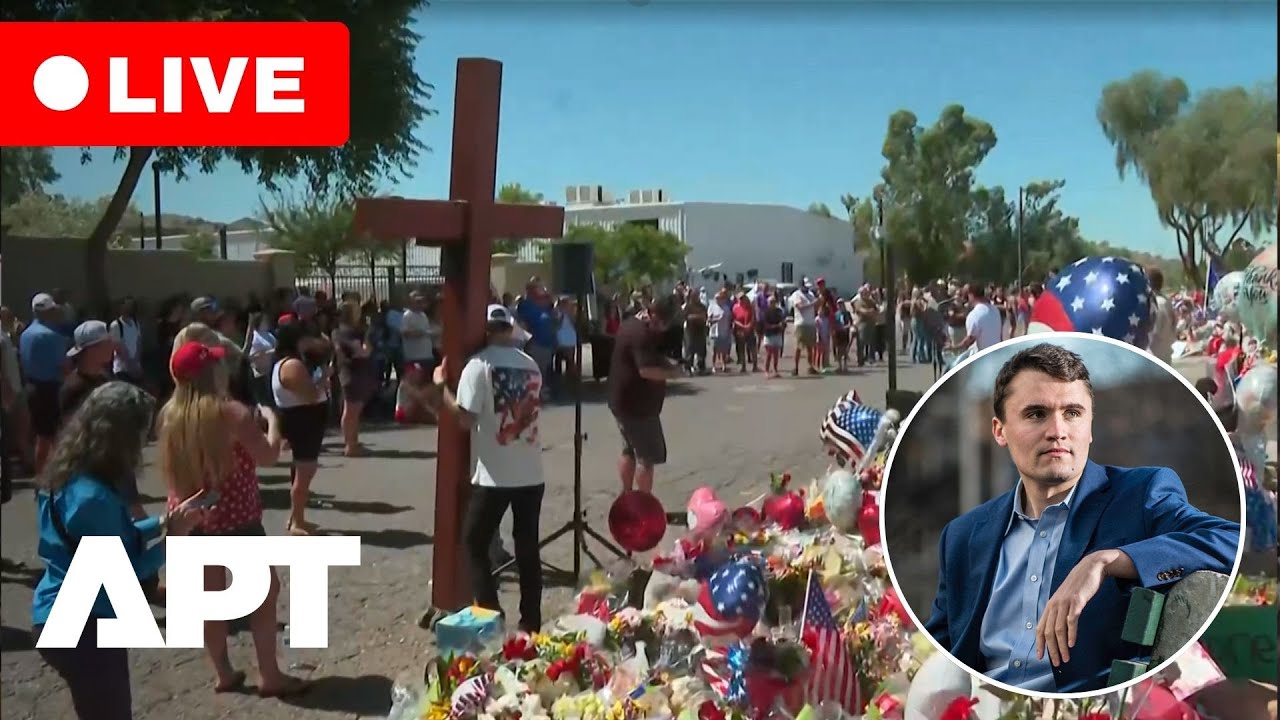
Michael Knowles Memorial Speech for Charlie Kirk: Faith, Forgiveness, and the Fight for America's Future
Enjoying this? Share it with someone who needs to see it.
Up Next
Charlie Kirk Remembered for His Faith, Courage, and Tireless Defense of Truth and Freedom in America
1:29:46
Ben Shapiro and Michael Knowles Share First Impressions of Charlie Kirk and What His Death Means for America
44:02
Tucker Carlson and JD Vance Remember Charlie Kirk's Legacy of Civil Discourse and Faith
9:07
Michael Knowles Memorial Speech for Charlie Kirk: Faith, Forgiveness, and the Fight for America's Future
In this powerful memorial speech delivered at what was originally planned as a conversation with Charlie Kirk, Michael Knowles honors the life and legacy of the conservative leader following his assassination. The address explores Kirk's character, his deep Christian faith, and his extraordinary accomplishments founding Turning Point USA at just 18 years old. Through reflections on grief, forgiveness, and the nature of political violence, Knowles calls for both Christian mercy toward enemies and decisive action to restore order in America's public square. The speech captures a pivotal moment when government leaders proclaimed the gospel at Kirk's memorial service, attended by over 100 million people worldwide.
What began as a scheduled conversation between two speakers transformed into a solemn memorial addressing the assassination of Charlie Kirk, one of the most influential conservative voices of his generation. Michael Knowles opened with a prayer to St. Michael the Archangel, noting Kirk's particular devotion to this patron saint, before addressing a crowd that gathered despite threats and hardship to honor the fallen leader.
Twelve days after Kirk's death, Knowles reflected on what made him truly exceptional. Beyond his rhetorical brilliance, his political genius in founding Turning Point USA at age 18, and his accomplishments in broadcasting, publishing, and coalition building, Kirk's defining characteristic was his character. There was a light and levity to everything he did, rooted in one fundamental truth: Charlie's savior lives.
The Right to Grieve and the Reality of Evil
Michael Knowles pushed back against modern religious sensibilities that discourage mourning when someone of faith dies. Death is bad, murder is bad, and those who commit and celebrate murder need to be punished. Death was not part of the original plan, a reminder that something has gone fundamentally wrong with the world. Even Jesus wept at the death of his friend Lazarus moments before raising him from the dead.
What the assassin took was not Charlie himself—Charlie belongs to God—but rather what everyone imagined his future would be. Everyone who knew Kirk personally, and many who didn't, believed he would one day be president. But "would" is a conditional verb depending on circumstances beyond human control. Charlie would have been president, but now he won't be.
Rejecting Presumption About What Charlie Would Have Said
Michael Knowles condemned those presumptuously declaring what Kirk would have believed about various issues if he had lived longer. This appropriation of authority is both absurd and unseemly. With the exception of Kirk's beloved wife Erika and those very closest to him, others have no right to speak for him. Such behavior is usurpation at best and a waste of time at worst—and Kirk never wasted time.
Working approximately 27 hours a day, eight days a week, Kirk accomplished more in his 31 years than most people achieve in multiple lifetimes. His most public accomplishments were political, but his most important were religious. He wanted to be remembered for his faith and his desire to help as many souls reach heaven as possible.
A Call to Faith and Action
If anyone wants to honor Charlie Kirk, Knowles urged, they should go to church, read the Bible, and pray—right now, not later, because now might be their only chance. Many people are already doing exactly that. Knowles recounted attending his traditional church the Sunday following Kirk's death and noticing something unusual: many newcomers in t-shirts and jeans rather than the typical suits and ties.
These were people who had left the church or perhaps never attended before, showing up because of Charlie Kirk's influence. Knowles was thrilled to see them, even if next week they should wear a jacket. It meant people were returning to faith or discovering it for the first time.
A Memorial Service That Shook the Nation
Over 100 million people watched Kirk's memorial service live, making it a remarkable event in multiple ways. Two moments stood out particularly. First, Kirk's widow Erika delivered one of the most powerful speeches Knowles had ever heard, leaving even the toughest politicians in tears. In an arresting moment, she forgave the man who murdered her husband because Christ on the cross asked his father to forgive his killers, and because Christians ask God to forgive them as they forgive those who trespass against them.
At a time when half the country seems to minimize, excuse, or even celebrate political violence, Erika Kirk gave everyone a glimpse of Calvary. The second most striking aspect was that the leadership of the federal government spent four hours proclaiming the gospel to the entire world.
A Christian Nation Remembering Its Roots
This should not have been surprising for a country founded by people who called themselves pilgrims, settled by those who said they would be a model of Christian charity, with a government established on the premise that people are endowed by their Creator with rights. The national anthem declares "conquer we must when our cause is just" and proclaims "in God is our trust." Yet seeing national leaders proclaim the gospel was surprising because it hadn't been witnessed in a very long time—many had never seen it in their entire lives.
The memorial was perfectly representative of Kirk himself. On one hand, it was about eternity and truths that transcend all ages and places. On the other, it was eminently political, temporal, local, and particular. There is no contradiction because humans are both: souls that are eternal and bodies that are temporal.
Avoiding Two Common Errors About Politics
People tend to fall into one of two errors regarding politics today. They either think politics is everything—more important than family or morality, so important that people murder over disagreements—or they think politics is nothing, that we should ignore policy fights and debates to keep our hands clean from the muck of practical politics.
Charlie Kirk understood that both errors miss the mark. We need to keep our eyes on eternal things, recognizing that we're never quite at home in this world because we are pilgrims on our way to the heavenly Jerusalem. But we are also political creatures in space and time, which means we have to do things, that our faith will look like something, that we will give a certain shape to our political community which exists for the common good.
Forgiveness and Justice Are Not Contradictory
So what should be done now? We should forgive our enemies' trespasses and prevent our enemies from trespassing again in the future. Some people misunderstand Christian forgiveness, thinking it's contrary to criminal justice, that it means being weak, letting criminals off the hook, or embracing anarchy. On the contrary, Christian forgiveness recognizes that vengeance belongs to the Lord who will repay, while criminal justice belongs to the civil authority which does not bear the sword in vain.
Erika Kirk forgave her husband's killer. The state of Utah will inject poison into that killer's veins until he's dead. There is no contradiction between these two things. Christian forgiveness does not demand allowing the cruel to ravage the whole earth. It demands loving our enemies, and sometimes love is tough. In personal lives, love means praying for those who persecute us. In politics, love usually means punishing the guilty, both for the protection of the innocent and for the good of the criminals themselves. No one benefits from crime, decay, and disorder—not the rest of society and not the criminals themselves.
Refortifying the Marketplace of Ideas
America cherishes what is called the marketplace of ideas. In the wake of Kirk's assassination, many are inclined merely to redouble devotion to the free marketplace of ideas. This instinct misses a crucial step: we had a marketplace of ideas, and the left shot it up. If we wish to restore healthy exchange of ideas, we need to refortify the marketplace.
Marketplaces of all kinds require rules, confidence, and common media of exchange. They require order. Liberty requires order. You cannot be undisciplined and free. You cannot be ignorant and free. What must now be done is reassert order for the exchange of ideas, for the flourishing of the public square, for liberty.
Establishing Foundational Truths
We must insist upon the acceptance of basic truths and moral goods not as the ultimate goal of endless debate but as the axiomatic foundation without which debate cannot occur. C.S. Lewis called these principles the Tao. Others call them the natural law or the first principles of practical reason.
In algebra, one must begin with certain axioms—premises like "a equals a" or "if a equals b, then b equals a." Those axioms are themselves unprovable, but without assuming them, nothing else can be proven. The same is true in politics and morality. We cannot quite prove that we should live in an ordered society, but without assuming so, we can't prove anything else.
Foreclosing Antisocial Behaviors and Suicidal Ideologies
If our society is to function, we must foreclose certain antisocial behaviors and certain suicidal ideologies. We must stop, to borrow a phrase from G.K. Chesterton, the thought that stops thought. Practically, this means we must stigmatize certain evil ideas and behaviors, and we must ostracize people who insist upon them.
More practically, this means people who persist in such disorder should lose their social standing. In certain cases, they should lose their jobs. With any political reform, we must err on the side of caution. But a good place to begin would be with those who celebrate the murder of an innocent man who simply wanted to talk it out.
Establishing Consequences to Heal National Trauma
You cannot maintain a hospital if the nurses seek to murder half the patients. You cannot operate a school if the teachers wish death upon the students. You cannot run a restaurant if the customers think the waiters want to poison them. There must be consequences to heal this national trauma and reestablish healthy politics.
Those consequences require clarity of vision, courage in convictions, and an extraordinary amount of God's grace. Knowles believes it can be done. Everyone who came out that night, despite the threats and hardship, demonstrated their belief that it can be done. The man being honored gave his life in confident hope that it can be done.
Never Despair, Never Surrender
We must never despair. We must never surrender to the forces that seek our destruction. And we must work tirelessly to ensure that this moment truly becomes a turning point for America.