Up Next

Charlie Kirk Defends Trump Against Oxford Professors Who Compare Him to Hitler and Weimar Germany
1:08:45

Jason Riley Chronicles Thomas Sowell: The Brilliant Scholar America Refuses to Acknowledge Despite Decades of Evidence-Based Research
5:49

Brandon Tatum and Candace Owens Discuss Black Culture, Faith, Family and the Battle for America's Soul
44:02
Milton Friedman's Revolutionary Journey: How One Economist Changed the World Through Freedom and Free Markets
Milton Friedman, Nobel Prize-winning economist and revolutionary intellectual, spent his life championing bold ideas that transformed how much of the world lives. From advising nations on economic freedom to ending the military draft, from creating school choice vouchers to pioneering monetary theory, Friedman's influence spans continents and generations. His ideas, once considered radical and outrageous, became the foundation for economic reforms in Estonia, Chile, China, and beyond. This is the story of a mild-mannered professor from the University of Chicago whose unwavering belief in free markets, individual liberty, and limited government sparked revolutions across the globe. Alongside his wife and intellectual partner Rose, Friedman battled the dominant Keynesian economics of his era, faced public protests, and ultimately watched his controversial theories become mainstream wisdom that lifted hundreds of millions out of poverty.
A Revolution Born in Medieval Streets
Outside the walls of a thousand-year-old medieval city, a revolution unfolds. In Estonia, once dominated by Soviet Communism, free markets now rule. The ideas of one innovative thinker have become part of the fabric of everyday life. Eight thousand miles away in Chile, another revolution has resulted in one of the highest standards of living in Latin America. Citizens recovered from a brutal past now enjoy the fruits of capitalism long advocated by a mild-mannered professor from the University of Chicago.
For most of the 20th century, Milton Friedman stood at the center of epic battles to control the world's economies. As he approached receiving what most would consider the greatest honor of his life, he faced angry surprises and fierce opposition. Yet his impact extends not only through the 20th century but deep into the 21st century and beyond.
The Foundations of a Revolutionary Mind
Milton Friedman was born in Brooklyn, New York in 1912 to poor immigrant parents who had come from Eastern Europe. Young Milton grew up above their dry goods store in Rahway, New Jersey, while his father struggled as a jobber in New York and his mother briefly worked in a sweatshop. The immigrant household emphasized survival, not intellectual pursuits.
At Rahway High School, Milton proved himself a voracious reader and excellent student. At fifteen, as he prepared to enter his senior year, his father suddenly died of a heart attack. With backing from his high school teachers and a scholarship, he entered Rutgers College in New Brunswick, New Jersey. To earn money, he and a friend capitalized on the Rutgers tradition requiring freshmen to wear green ties, buying and selling them door-to-door in dormitories. They expanded to books, arranging for Barnes and Noble to buy secondhand volumes, making money while students paid less—early benefits of a free market.
The Great Depression and Chicago
One year into his studies, the stock market crash of 1929 shook America and the world. Black Thursday evolved into the greatest depression in American history. Millions lost jobs, homes, and life savings. Half the nation's banks failed. By 1932, nineteen-year-old Milton realized economics was more than a college class. The state of the world led him to the University of Chicago.
The Economics Department at the University was among the very best in America. Stars included Frank Knight and Jacob Viner. Milton joined a group of brilliant students attracted to this vibrant intellectual atmosphere, including Paul Samuelson, who like Milton would become a Nobel Laureate. Throughout their lives, they would disagree on many things but remain good friends.
Milton felt immediately at home in Chicago's intense intellectual atmosphere. Jacob Viner's class in economics profoundly influenced him. Viner seated students alphabetically, placing Milton next to Rose Director, also majoring in economics. Six years later, she would become his life partner and co-author. They came from similar small-town backgrounds, which drew them together. Another powerful influence was Professor Frank Knight, whose unfailing suspicion of government intervention Milton and Rose would embrace as their own.
The New Deal Years
The continuing misery of the Great Depression convinced Americans to elect Franklin Delano Roosevelt, who proclaimed the New Deal as a social revolution to lead the nation out of depression. The government regulated major industries and created programs to put people back to work. By the time Milton completed his studies at Chicago, Roosevelt's New Deal was in full swing. Milton moved to Washington and a position with the National Resources Committee. Although he would become a tenacious critic, Milton Friedman was for now part of the New Deal.
Rose also came to Washington for a New Deal job at the Federal Deposit Insurance Corporation. In about a year, Milton moved to New York and the National Bureau of Economic Research, work that would later shape his career and plant seeds of his major contributions to economics. During 1937 and spring 1938, while Milton worked in New York and Rose in Washington, they exchanged 138 letters. They married in a traditional ceremony to please Rose's parents and honeymooned in a rented cottage on a New England lake, where married life required adjustments. Being economists, they devised a numbered list for things said repeatedly. Number two was the hardest: 'You were right and I was wrong.'
War, Withholding Tax, and Academic Life
New England would play an important role in their future together. When the world went to war again, Milton returned to Washington and the Treasury Department, where the assignment was raising money for the war effort. The answer was a withholding tax—the first since the Civil War. Ironically, he would spend the rest of his life fighting to limit taxes and government size.
On May 7, 1942, Milton testified before Congress for the first time about the danger of inflation and how to prevent it. He sounded Keynesian because everybody was Keynesian to some extent at that time. Keynes argued market economies don't naturally achieve full employment, requiring government assistance and investment. War raged in Europe and the Pacific as Milton returned to New York City and Columbia University where statistical research was part of the war effort. He finished his Ph.D. during these years.
Milton and Rose began their family. Daughter Janet was born in 1943 and would become an attorney. Son David was born in 1945 and would become a professor of law and economics. Like most Americans in 1945, the Friedmans were ready for life after war. Milton returned to the University of Chicago at age 34, succeeding his mentor Jacob Viner. For the next thirty years, the University of Chicago would be his spiritual home—a place where people were interested in understanding things, getting to the bottom of issues as a group.
The Post-War World and Mount Pelerin
Milton and Rose settled into academic life as post-war America became the most productive nation in the world. The economy tripled in a single decade. Yet elsewhere, war left the world in turmoil. Free markets were even less popular than before the war. Socialism and communism promised government protection from another depression and unpredictable markets.
Austrian economist Friedrich von Hayek saw ominous signs as the Soviet Union actively exported communism to Eastern Europe and Mao Zedong led communist revolution in China. In spring 1947, Hayek invited an elite group including Milton Friedman to consider the consequences. They called themselves the Mount Pelerin Society for the Swiss town where they held their first meeting. For Milton, it was thrilling—his first time overseas meeting economists and political scientists from around the world. The group organized because supporters of liberty and the classical liberal point of view were few, far between, and beleaguered.
Swimming Against the Tide
Milton came on the scene with what were perceived as radical ideas in the 1950s and 1960s, largely because John Maynard Keynes's influence was fully pervasive. The Chicago economists were not popular, but they felt they had something to say. They were warriors in combat with most of the rest of the profession.
By the 1950s, the Friedman family had been drawn back to New England hills, where Milton would develop some of his most important economic theories. The Dartmouth College Library in nearby Hanover served as Milton's research base. For over thirty years, New England would be their summer home. For the first few years, there was the hideaway at Orford, New Hampshire, totally isolated, reached by three or four miles of dirt road without a telephone. They built their dream house overlooking Lake Fairlee in Vermont, called 'Capitaf' after their classic book Capitalism and Freedom, in which Milton presented his economic philosophy for the first time.
The book opened eyes of hundreds of thousands of readers to the ways things were being done wrong in public policy areas. Milton was never content simply showing something wasn't working well—he usually came up with ingenious ways to improve it. Milton's most important thinking happened when work and play could be combined. His scientific focus was always technical economics, predicting the consequences of public policies.
Groundbreaking Scientific Work
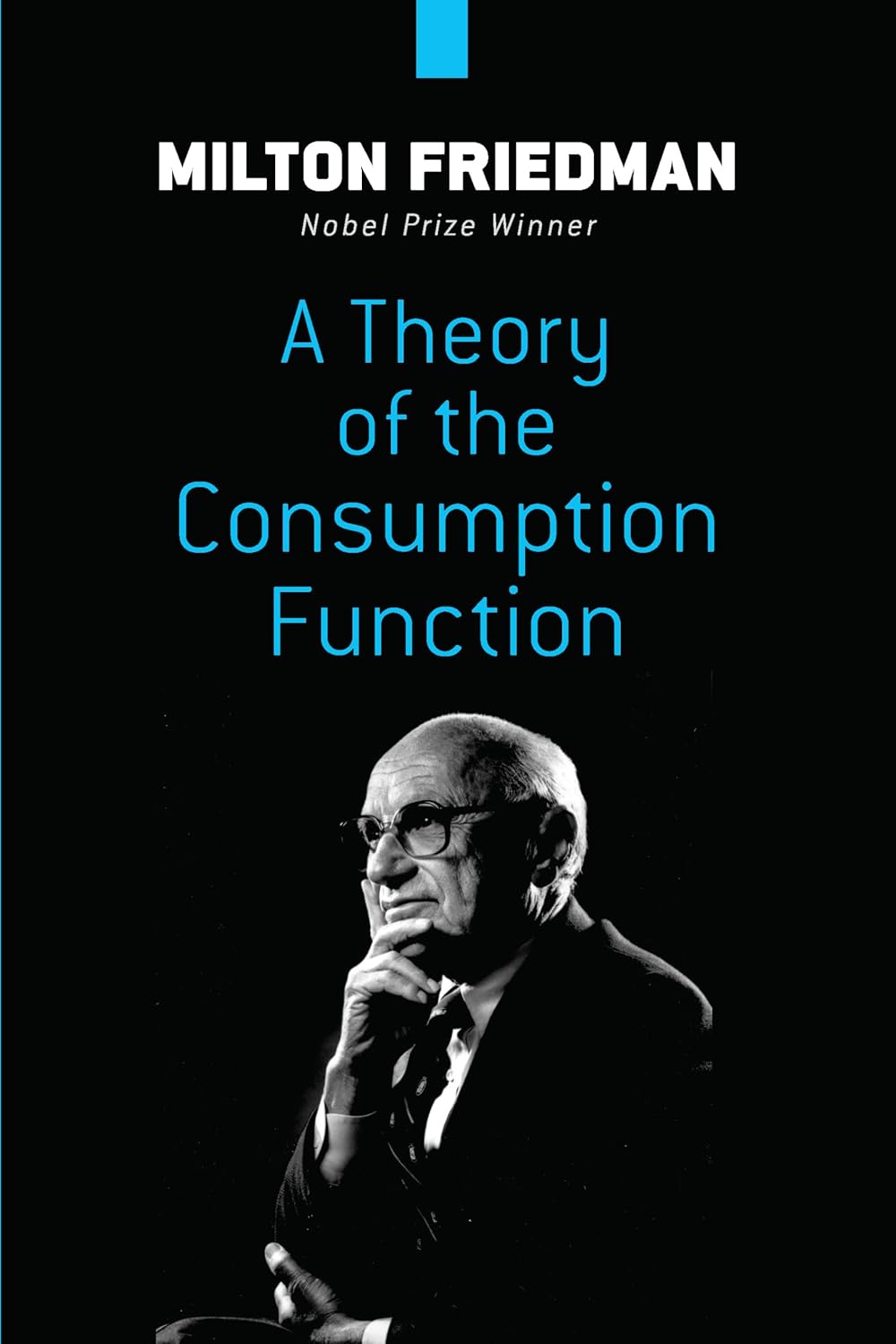
Milton's landmark scientific work, A Theory of the Consumption Function, was published in 1957. It would be one reason he would win the Nobel Prize in Economics. Milton had lost confidence in Keynesian economics and was beginning a counter-revolution through monetarism and various criticisms of Keynesian economics.
Traditional Keynesian theory relies on the belief that enough government spending can create jobs and trigger spending on goods and services, creating more jobs. But Milton argued people don't make spending decisions based on current income or short cash infusions. They make decisions based on permanent income—what they think they're likely to make over time. Today, Milton's theory is widely accepted.
The years in New England also produced A Monetary History of the United States, published in 1963 with colleague Anna Schwartz. Most consider this Milton's most influential work. There were great debates at conferences about what these people were saying—it just wasn't believable. It was commonly believed the Great Depression was caused by capitalism's failure. Milton argued the cause was Federal Reserve failure.
The crucial date regarding the depression wasn't the stock market crash or Black Thursday, but December 11, 1930—when the Bank of United States in New York crashed, the biggest bank failure in U.S. history. The occasion needed the Federal Reserve System to restore confidence, flood the country with liquidity, prevent other banks from failing. It did nothing of the kind. Milton was considered an oddball in the profession, his ideas ridiculed as way out, supporting the status quo and big business.
The Galbraith Debates
One who publicly disagreed with Milton Friedman was John Kenneth Galbraith, President Roosevelt's Price Czar during World War II and later President Kennedy's Ambassador to India. A Harvard professor and decidedly Keynesian, he was one of the most popular economists of the day. Galbraith saw the economy as a control problem requiring responsible action with no perfect solution. He believed wage and price controls were indispensable parts of economic policy.
Galbraith would blame everything from the First World War to Genghis Khan's invasions on monetary policy, using monetary policy as cure for both—a one cause, one cure man. Galbraith looked on the Chicago Economics Department and Milton with bemusement, feeling they were part of economics past, not its future. What Milton had to offer seemed like the finest thinking of the 18th century, not terribly relevant to the 20th.
What helped Milton get through this well were two personal characteristics. First, he was a tremendous optimist. Second, his analyses were so clear, straightforward and simple that he believed he was right on most issues and the profession just hadn't analyzed them sufficiently.
The School Choice Revolution
Milton and Rose were first and foremost teachers. One of their most original ideas concerned the power of choice in education. Full exercise of choice would invigorate the public school system through competition. They considered it a national disgrace that inner cities had become hells with deplorable living conditions, no safety, security or protection. Schools in those areas turned out kids who couldn't read, write or figure, with no economic future.
Milton and Rose said parents should be able to direct their tax money to any school of their choice—public or private, secular or religious. Today, some states and cities are experimenting. In Milwaukee, the oldest and largest program in the country is limited to only 15,000 poor students, with vouchers worth little more than half what would be spent on a child in public school.
Messmer High School and its elementary school are private inner city Catholic schools, no bastions of privilege. Students come from some of the poorest, roughest neighborhoods in the city. Wisconsin requires voucher schools take every child who applies, regardless of academic record. Still, at Messmer, nearly 90% go on to college. Students appear to be doing better in voucher schools after about three to four years, with statistically significant improvements in math and reading achievement, spending about half the money.
The voucher program also impacts Milwaukee Public Schools. Schools that stood to lose virtually 100% of their students if they didn't do something saw staggering changes in a couple years. Those schools improved student achievement more in the first two years after the voucher program expanded than in the previous 30-35 years. The fundamental assumption is simple: competition is better than monopoly. Milton and Rose created the Friedman Foundation to continue the fight for school choice.
International Influence
By the 1960s, Milton's writings and lectures were gaining international attention. Their home movies recall foreign travel—a trip to India where Milton had advised the government six years earlier, and trips throughout Europe, Asia and the Middle East. Milton's ideas about economics and fighting inflation were always conversation topics. In Israel, experts the new government turned to for advice included Milton Friedman. He suspected you could not find an economist in Israel, whatever political coloration, who would disagree with most of what he said. The problem was political—how to put it into effect.
The Goldwater Campaign
Although Milton had advised government leaders worldwide, he had until now never participated in politics at home. The 1964 presidential campaign officially launched with President Lyndon Johnson running for re-election after Kennedy's assassination. His challenger was Senator Barry Goldwater. Goldwater and Milton shared similar ideas about limiting government and deregulating industries. Milton became an economic advisor to the Goldwater campaign. There were very few intellectuals supporting Barry Goldwater at that time.
President Johnson successfully portrayed Goldwater as a radical, and Goldwater lost in one of the biggest landslides in American history. Goldwater's defeat was so disastrous that many thought Milton's ideas along with Goldwater's candidacy had pretty much finished that far right off in American politics. It looked like a low point for these ideas. But within four years, Milton's ideas would once again be tested on the national political scene.
Ending the Draft
By mid-1960s, America was becoming increasingly embroiled in the Vietnam conflict. As more Americans died, public debate intensified. Richard Nixon emerged as the Republican candidate, inviting Milton to serve as advisor. During these years, Milton and others succeeded with a dramatic, far-reaching policy initiative.
Milton had been writing and lecturing about benefits of ending the draft and creating an all-volunteer military. The unpopular Vietnam War drove the issue from lecture halls to streets. Milton talked to quite a number of SDS groups, always getting along well because objectives were the same—they talked about how to achieve those objectives, not the objectives themselves.
As the draft became one of the hottest issues, President Nixon created a commission to consider change, appointing Milton Friedman and Alan Greenspan. A general testified, and Milton asked if he would rather command a slave force. The general said he didn't like hearing drafted soldiers referred to as slaves. Milton replied he didn't like hearing patriotic volunteers referred to as mercenaries. Milton took the general's arguments apart piece by piece, never raising his voice, thoroughly demolishing the mercenary argument.
Nixon switched policy from universal military service to eliminating the draft in 1971. Milton downplays his personal role, noting many people wrote in favor of a volunteer army. But the ramifications have been enormous. The American military, suddenly forced into the marketplace, now has the most powerful force in the world.
The Chilean Connection
With the battle against the draft won and creation of an all-volunteer force a reality, Milton continued pressing his argument for minimum government and individual freedom. He could not know that years earlier, eight thousand miles away, seeds of the most public clash in his life had already been sown.
Between 1955 and 1964, graduate students from Santiago's prestigious Catholic University received scholarships to study economics at the University of Chicago. Most students developed ideas on free markets and freedom similar to those of Milton Friedman and others at the University. They became known as the Chicago Boys.
In 1970, with support from Cuba's Fidel Castro, Chile elected the first communist president in the Western World. Salvador Allende immediately nationalized basic industries and controlled prices and wages. The Chicago Boys remained quietly in the background. Under Allende, the rate of price increase in September '73 was one thousand percent annualized. There were food shortages and strikes. The banging of pots and pans was the sound of revolution in the making.
On September 11, 1973, General Augusto Pinochet led a military coup against Allende, covertly supported by the United States. Pinochet and his generals bombed the presidential palace. Allende was either murdered or committed suicide. The Chilean economy continued declining. In time, Pinochet began listening to the Chicago Boys as they offered their proposal for economic recovery.
In the midst of turmoil, Milton Friedman accepted an invitation from a local foundation to speak in Santiago about economic freedom. He said there was one condition for talking to the press—that he could say whatever he wanted. He wanted to talk about benefits of a free economy but also say that a free economy had to be accompanied by free democratic elections and free government.
Milton recalled that he said opening the economy to international trade was a key element of any economic reform, free enterprise was absolutely correct, and getting rid of regulations inhibiting entrepreneurship were great. It was a brief meeting, maybe half an hour or forty-five minutes. Milton publicly and privately agreed with the Chicago Boys that relatively short but painful shock treatment was needed to save Chile from continued inflation disaster.
The Nobel Prize Controversy
In December 1976, Milton arrived in Stockholm to accept the Nobel Prize in Economics. News of his trip to Chile and conversation with Augusto Pinochet had preceded him. From the time they landed in Sweden, they had 24-hour police protection. There was a demonstration of about five thousand people in front of the Nobel ceremony place. To go from one place to another, they had to go out a back door.
Milton emphasized he was offered two honorary degrees by Chilean universities before going down but refused to take them because those universities were supported in part by public funds, and he did not want to appear in any way to provide support to the political system in Chile. He was not a representative of Chile, not an advisor to Chile, had no commitments to the Chilean government.
A young man had used his father to pass a ticket onto him and came to the ceremony with express purpose of making a disturbance. The Royal Swedish Academy of Sciences asked Milton to step forward and receive from His Majesty the 1976 Nobel Memorial Prize. The Swedish people were wonderful. A very large number of people came up and apologized for what had happened.
Chile's Economic Miracle
Some 30 years later, Chile is a far different place, although past scars are etched in stone at Santiago's Monument to the Disappeared. For the majority of citizens, modern Chile has been called an economic miracle. In one of the fastest growing economies in Latin America, Chileans are more affluent than at any time in their history. That more socialistic governments of the early 21st century reaffirmed free market reforms of the 1970s and 80s seems a second economic miracle.
Shoppers live in a society of single-digit inflation and relatively low unemployment. Chile has one of the highest literacy rates in Latin America. Record housing starts reflect a solid middle class, and quality of life in suburban neighborhoods rivals that of North America or Europe. Chile is one of the world's major exporters of fruits and vegetables, especially during Northern Hemisphere's winter months. Today, Chile is the second largest exporter of fresh salmon in the world, and its award-winning wine industry has become an international success.
There are hundreds of bodegas or wineries in Chile. In the lush Colchagua Valley south of Santiago are highly profitable vineyards of the Montes Winery, employing more than three hundred people locally. They produce very high premium and ultra premium wines. When there are too many bunches per vine, they cut about 40 to 50 percent and throw them away so the vine can concentrate. They sell in sixty-nine different countries around the world, with exports representing 92% of production. Most important markets are the U.S., United Kingdom, and Asia.
Without free trade, Montes would not exist. They couldn't possibly think of operating solely for the local market because it's such a reduced market. One key component in Chile's transition from government command and control to free market economy was another of Milton Friedman's controversial ideas.
The Privatized Pension System
Instituted in 1981, Chile's privatized pension system dramatically raised savings. The country now boasts one of the highest savings rates in Latin America. Most workers have 10% of salary placed in a personal retirement fund they own and control. Various funds are private and competitive.
One of the first to join a private pension plan was Chilean businessman Alan MacKenzie, who admits being a little tentative to begin with. Some friends were even more tentative. Pensions are 70% at least or more of normal earnings of people who were contributing. Many honestly think it's the best investment they ever made, making retirement easier.
Nevertheless, the system is not without critics. Concerns include high administrative fees and lack of coverage for the self-employed and low wage earners. Many don't feel it's fair to blame the pension scheme for what's wrong in economic distribution, believing that has to be solved with other policies. But even with these problems, there has been progress. Since 1990, the poverty rate has been cut in half. Milton Friedman's ideas work in practice. They are very attractive to the intellect, but most importantly, they are the best systems so far proven for better and greater development of societies and people within them.
The 1970s Economic Crisis
In the 1970s, America experienced the worst economic downturn since the Great Depression. President Gerald Ford gathered the best economic minds in the nation to consider options. The meeting was chaired by Alan Greenspan and included John Kenneth Galbraith and Milton Friedman. The U.S. economy was fundamentally strong, but that strength was currently being eroded by the disease of inflation. If that disease wasn't checked, it would take a heavy toll, including likely destruction of personal, political and economic freedom.
By now, the name Milton Friedman was well known in the halls of government and around kitchen tables and in living rooms of America. One wonderful thing about Milton was that when he spoke, people almost always understood him. His appearances on national television made him an unexpected celebrity. He also appeared in print. Kathryn Graham of the Washington Post asked someone to persuade Milton Friedman to be a columnist. He was hesitant, writing about three or four trial columns to see whether he could do it. He resisted, saying he didn't like assignments and didn't know whether he'd have enough to write about. He wrote the column for seventeen years, and it turned out to be one of the most important factors enabling him to communicate to the public at large.
Free to Choose
While his ideas were getting attention in unusual places, Milton and Rose were about to begin yet another chapter in their life together. By late December 1976, the Friedmans had moved to San Francisco, where Milton accepted a permanent position as senior fellow at the Hoover Institution at Stanford University. They were contacted by the president of the public television station in Erie, Pennsylvania, Bob Chitester, who suggested a wild idea.
Three years in production, Free to Choose would illustrate Milton's philosophy in new ways that were easy to understand. Milton had three ground rules: no gimmicks, no talking down to the audience, and no pre-written script. Chitester recruited producers from the best of British television.
They went to places vital to understanding what Milton was talking about. They went to Hong Kong in its heyday, where everything was a free market. Like America a century ago, Hong Kong in past decades had been a haven for people who sought freedom to make the most of their own abilities. It made a huge amount of difference to the show because you could see it in action.
There was no script for Free to Choose. One sequence people remember was in the Federal Reserve Bank in New York in the gold vaults. They sat Milton on some gold bars, a huge pile of them. These vaults where U.S. gold was stored provided an excellent test of where the depression originated. One thing Milton most enjoyed was stopping the presses that were printing the money, showing how you can stop inflation. If you don't print the money, you won't get inflation—you stop the proximate cause.
On Milton's shoulder all the time was Rose, a true academic too, absolutely vital to the project. Free to Choose was broadcast in Japan and every country in Europe except France. Rose and Milton edited sound tracks from the programs into a best-selling book. Translated into sixteen languages, it sold over a million copies.
Sea Ranch and the Reagan Years
Following production of Free to Choose, the Friedmans found a long-sought hideaway outside San Francisco. Discovery of Sea Ranch was the answer to Rose's lifetime love of the ocean. Much like their beloved New England, this area along the Sonoma coast of Northern California provided Milton and Rose a quiet, peaceful place to think and work. Rose wanted to be on the ocean where she could hear waves all night long and smell the sea air. It was heaven. Mostly when they went on hikes, it was in the redwood forest in the hills above Sea Ranch. It was just a relaxed life with no speeches or anything else.
When Free to Choose was first broadcast on PBS in January 1980, America's Presidential campaign was already underway. Ronald Reagan was trailing President Jimmy Carter in the polls. But in November, Reagan won in a landslide. Many think Milton Friedman's ideas may have had something to do with the result. Ronald Reagan could not have been elected in 1980 except for what Milton Friedman wrote in preceding years. There had to be a climate of opinion receptive to certain ideas.
By espousing these ideas in both technical and popular media, eventually also in Free to Choose television series, the country became much better prepared to accept them when Ronald Reagan put forward some of them in his own inimitable and persuasive manner. After the election, Reagan asked Milton to join his Economic Policy Advisory Board along with George Shultz, Alan Greenspan and Martin Anderson. They would reinforce what Reagan wanted to do, but Milton was incredibly persuasive in that role.
Reagan limited government spending, cut taxes, deregulated major industries and supported monetary policy long advocated by Milton. You can't miss the Friedman-esque characterization of the world heard in Reagan's speeches. Milton has this extraordinary capability of talking to high school students and presidents of the United States in exactly the same language, the same demeanor. He is indifferent to whom he is speaking. It's the issue and the idea that is so dominant.
Presidential Medal of Freedom
In 1988, Milton Friedman traveled to Washington to receive the highest honor the United States government can bestow on a civilian. The Presidential Medal of Freedom citation read: 'Teacher, scholar and theorist, Milton Friedman restored common sense to the world of economics. It is for his celebration of the human spirit as well as the brilliance of his mind.'
In months ahead, Milton and Rose resumed international travels, including another visit to the People's Republic of China. The welcome was warm and friendly. Milton was invited to meet with Communist Party General Secretary Zhao Ziyang. During an unusually long two-hour discussion, the topic was economic reform and implementation of free markets in a communist nation.
Within a year after Reagan challenged Gorbachev to tear down the Berlin Wall, it would fall. The Soviet Union would dissolve, and in time, China would become the world's third most active trading nation. Times were changing. From Eastern Europe to Latin America and throughout Asia, Milton Friedman's ideas about the power of choice were clearly in the mainstream.
Global Impact
There are various ways to describe Milton's influence, but one way is to ask has he helped many people, poor people in the world. Just take India and China—37% of the world's population. Hundreds of millions of people in these two countries who used to live on less than $1 a day or $2 a day are now able to live at a much more decent standard of living as a result of reform of their economic policies toward more free market policies, less regulation, less government. But there was one person they are more indebted to than anybody else for their great improvement in their situation—that person is Milton Friedman.
In his own country, he remained the ever-controversial champion of the American dream. Milton Friedman used a brilliant mind to advance a moral vision. That vision changed America and is changing the world. The impression you get is he loves to talk and argues back and forth. If you pay attention, what he's doing is teaching. He was a great teacher, the greatest teacher many ever had. He made economics come alive—not simply a game clever academics played, but a way of understanding reality.
The Teacher's Legacy
Right at this moment there are people all over the land trying to prove Milton Friedman wrong. At some point, somebody else is trying to prove he's right. That's what constitutes influence. The principles of freedom, principles involved in Free to Choose, are those most applicable to advance human civilization. You can't work in a more important area than that.
In retirement, Milton and Rose Friedman are still drawn to those places that have been home for over half a century. Milton thinks his ideas stuck up very well and feels very good about them. The concept of a natural rate of unemployment is now conventional wisdom. The long argument between Keynesian and modern economics has disappeared. The theory of the consumption function, permanent income, and technical terms like that have become common language, part of the vocabulary.
We're better off than we were fifty years ago, but we stand on the shoulders of people who went before. Luck and chance play an enormous role in human affairs. The true test of any scholar's work is not what his contemporaries say, but what happens to his work in the next 25 or 50 years. The thing Milton will really be proud of is if some of the work he has done is still being cited in textbooks long after he's gone.
Video Transcript
Outside the walls of a thousand year old medieval city a revolution is in progress. Today we are really getting integrated. Not just into European Union, but into the whole of the world. Once dominated by Soviet Communism, free markets now rule in the eastern European nation of Estonia. I think it makes people much more open than they used to be, they are also much more tolerant for other ways of doing business. The ideas of one, once outrageous yet innovative thinker are now part of the fabric of everyday life. Eight thousand miles away another such revolution has taken place, resulting in one of the highest standards of living in Latin America. Recovered from a brutal past, the citizens of Chile now enjoy the fruits of capitalism long advocated by a mild-mannered professor from the University of Chicago. What year are you? I'll be starting my fifth year. Fifth year? Yeah. That's too long! Four years is plenty! (Laughter) On the eve of receiving what most would consider the greatest honor of his life, he is met with an angry surprise. You people have such a distorted idea of what went on. Let me tell you some facts. For most of the 20th century, he was at the center of the epic battles to control the world's economies. I believe that the major problem which faces this country is how we stop the growth of government. There's one and only one cure, and we all know it: We have to slow down total spending. Yeah, what one has to understand that Professor Friedman would blame everything from the First World War to the invasions of Genghis Khan on monetary policy. I don't agree with him at all. What Friedman had to offer as far as Galbraith was concerned was some of the finest thinking of the 18th century, and it didn't seem terribly relevant to the 20th. His impact is not only the 20th century, but the 21st century, and I suspect on-going. For most of his long life, this controversial and provocative American has championed bold ideas that have by now changed the way much of the world lives. He is Milton Friedman, teacher, scientist, winner of the 1976 Nobel Prize in Economics, and revolutionary intellectual. This is the story of his journey through life, and of his struggle to convince the world of the power of his ideas. On a warm San Francisco afternoon, Milton Friedman and his wife, Rose, are relaxing, prior to just one more interview on their remarkable lives together. On lots of things they thought I was crazy. I once had a graduate student come to see me from Harvard who said he wanted to come and see that crazy man of the West. Milton and Rose Friedman have been partners for sixty-eight years. As Rose says, "two partners, one career.' Fortunately, I was smart enough to get a degree in the same field that Milton did. Therefore I could really work with him. And there weren't very many things that he wrote without my sort of saying, it's okay, or giving him whatever suggestions I could, and he was very generous in this respect. Sometimes I helped, and sometimes I didn't. Twenty-nine years after being honored with the Nobel Prize in Economics, Milton Friedman still attracts the public spotlight. I am from Caracas, Venezuela. I came here just to see you. This evening at a festive ceremony in San Francisco's Ritz Carlton Hotel, guests gather for presentation of the 2004 Friedman Prize for Advancing Liberty. It's somebody with a really big brain and he's a fighter, and now so much of what he's done is accepted, that it is hard to understand how frightening it must have been and how hard he had to fight. This year's winner of the $500,000 prize is internationally recognized economist and property rights activist, Hernando De Soto. I am delighted to be awarded a prize that has Milton's name. I couldn't think of a greater honor. Ladies and Gentlemen, please welcome Milton Friedman. At 93, Milton Friedman is still a man of ideas. Challenging the status quo has been his life's passion. History shows that there's a very long lag between changes in the climate of opinion on the one hand, and changes in political practice on the other. And the problem that we all have is really to persuade people to practice what they preach. And that's a much more difficult task. If you're going to try to change things, you have to recognize that it's going to take some effort and there's going to be some sharp criticism. Federal Reserve Chairman Alan Greenspan has known Milton and Rose Friedman for more than fifty years. There are very few people over the generations who have ideas that are sufficiently original to materially alter the direction of civilization. Milton is one of those very few people. There is perhaps no more dramatic evidence of the impact of Milton Friedman's ideas in action, than here in the former Soviet Republic of Estonia. Strategically located on the Baltic Sea, Estonia is sandwiched between Russia and Finland. Its capitol, Tallinn, surrounds the most well preserved medieval city in northern Europe. Dominated by Czarist Russia and the Soviet Union for nearly two centuries, Estonia was an economic backwater. When the Soviet Union dissolved in the early 1990s, Estonia reclaimed its independence. Desperate for a new direction, Estonians elected the youngest prime minister in Europe's history. Mart Laar was 32 years old. Many in his cabinet were in their twenties. We started from 1992 with inflation 1000%, we had drop in economics 30%, we had prognosis for unemployment of 35%, we had a shortage of everything, and of course I didn't know very much about economy. The only book about economy what I read was Milton Friedman's Freedom of Choice, and that was the only one. But there was lot of good ideas in there and I introduced a big part of those. Racing to catch up with the rest of the world, the young Estonians created a low tax laboratory. The zero corporate tax on profits reinvested in Estonia has made the tiny country a magnet for foreign investment. It is now considered the most competitive of the new European Union members and ranked by the Wall Street Journal as one of the freest economies in the world. One of neighboring Finland's largest electronic companies, Elcoteq, built this manufacturing plant here in Tallinn in 1992. It produces communication equipment. Elcoteq is now Estonia's largest exporter and one of its largest employers. Antii Piippo is the CEO. Well, it's very simple to say that Estonia in my mind is one of the most attractive countries in the European Union. Among the more innovative aspects of life in Estonia are free Internet sites scattered throughout the country. The World Economic Forum reports that per capita, Estonia is more wired than Italy, Belgium and Spain. And Estonia has adopted one of Milton Friedman's most controversial ideas. We were the first country to institute and create this beautiful idea of the flat rate personal income tax. As a matter of fact, I didn't know that nobody had done it. But it worked; it worked exactly in the way how it was proposed by Mr. Friedman. In Estonia today, everyone but the poor pays the same flat tax rate of 24%. No loopholes. Eight other countries in the area, including Russia, are following Estonia's lead. Despite Estonia's obvious prosperity, life is not easy for those who felt cared for under the old Soviet system. This new situation has been very hard. Of course, again, it is not the age what makes the difference; it is the attitude of the people. Dmitri Jelokov has been an engineer at Elcoteq for three years. He is one of nearly 3,000 employees. Dmitri, his wife, Jelena, and their daughter, Christina, are enjoying life in the new Estonia. There are a lot of the new buildings erecting, new roads are coming. Basically how all the life is changing, and it is really interesting to see, actually. It's more possibilities for our children also. After generations of domination, Estonia is poised to catch up with the living standards of Western Europe. And they intend to do it in just one generation. The free market ideas at work in Estonia were first championed over 200 years ago by a Scottish professor. In his revolutionary book, Wealth of Nations, Adam Smith introduced the free market ideas that would drive the world's economy throughout the nineteenth and early twentieth centuries. From his theories came stunning technological innovations and industrial progress. But the horror of the First World War, left the world bitter, disillusioned, fearful of free markets, and drawn to the philosophy of government command and control of the economy--a philosophy long advocated by the famous British economist, John Maynard Keynes. There is no danger of a serious rise in the cost of living. His ideas would dominate economics for the foreseeable future. Keynes said, "The central controls necessary to ensure full employment will of course, involve a large extension of the traditional functions of government." Even so, in the American Midwest, in a place known for its intense intellectual atmosphere and tolerance of unconventional thinking, others were experimenting with new and different ideas. Here, at the University of Chicago, a derided minority of scholars was forging a link between Adam Smith and what they believed was a new economic science for the twentieth century. Among them was Milton Friedman. In time, his name and the Chicago School of Economics would be intertwined. But that would come later. Brooklyn, New York, 1912. Milton Friedman is born to poor immigrant parents. Both had come here from Eastern Europe. Young Milton grows up above their dry goods store in Rahway, New Jersey, while his father also struggles as a jobber in New York, twenty miles away. And for a short time, his mother works in a New York sweatshop. We're talking about an immigrant household whose emphasis is on how do we make a living. In the concept of ideas and of intellectual activity and so on, it was not a live concept, it just didn't enter in. At Rahway High School, he is a good student and a voracious reader. At fifteen, he is preparing to enter his senior year when his father suddenly dies of a heart attack. With the backing of his high school teachers and a scholarship, he goes on to Rutgers College in New Brunswick, New Jersey. To earn money for his education, he and a friend capitalize on the Rutgers tradition that freshmen are required to wear green ties. We got the green ties from his father, and went from door to door in the dormitory selling them. And that gave us the idea that we could do the same thing with books. So the next year, we arranged that spring for Barnes and Noble to come to New Brunswick and offer to buy secondhand books. Milton and his friend make money, and the students pay less, early benefits of a free market. One year into his studies, America and the world are shaken by the stock market crash of 1929. "Black Thursday" would evolve into the greatest depression in American history. Millions would lose their jobs, their homes, and their life savings. Half of the nation's banks would fail. By 1932, Milton is nineteen years old. He has come to realize that economics is more than a class in college. It's obvious that it was the state of the world in '32 that led me to go to Chicago. Here was a world in which you had unemployed people, and unemployed machines, obviously an irrational situation. It was crazy. Why couldn't you put these people to work to run those machines to produce those clothes that people so desperately needed? So the intellectual interest was in trying to explain that phenomenon. The Economics Department at the University is one of the very best in America. The stars are Frank Knight and Jacob Viner. Milton is among a group of brilliant students, who have been attracted to this vibrant intellectual atmosphere. Another is Paul Samuelson, a young man, who like Milton, would become a Nobel Laureate, and one of the most influential economists in America. Throughout their lives, he and Milton would disagree on many things, but remain good friends. Today, Samuelson is retired, but at M.I.T. in Cambridge, he still works with students. Milton was born smart. It wasn't a question of competitiveness, but just the quickness of his repartee and his IQ, and his fair-mindedness in argument. I felt almost immediately at home. It seemed like where I was supposed to be. I'm suddenly in Chicago, in an atmosphere where you've got intense intellectual activity, by people who are intellectually sophisticated, who have a much broader background than I did as a matter of fact and it opened up to a new field. I enter economics. I take Jacob Viner's course in which he makes me realize for the first time that there is such a thing as a coherent system. Jacob Viner's class in economics would have a profound personal influence on Milton Friedman. Viner seated his students alphabetically. Next to Milton sat a young woman, also majoring in economics. Six years later, Rose Director would become his life partner and co-author. Look, he'd grown up, as I had, in a small town. He wasn't exposed to many of the things that a lot of other kids had been exposed to. And I guess that's one of the things that drew us together, we sort of came from the same background, and therefore our ideas were pretty much the same. He was more intellectual than I was, but not too much. Another powerful influence on both Milton and Rose during these years is the professor, who would become their close friend. Frank Knight had an unfailing suspicion of government intervention. Milton and Rose would grow to embrace those ideas as their own. But the continuing misery of the Great Depression convinces Americans otherwise. Herbert Hoover leaves the White House for the last time as President, to share the car of America's president-elect, in the traditional ride down Pennsylvania Avenue to the steps of the Capitol and inauguration ceremonies. A nation in the depths of economic depression had elected its first democratic chief executive in twelve years: Franklin Delano Roosevelt. First of all, let me assert my firm belief that the only thing we have to fear is fear itself. The New Deal was proclaimed a social revolution to lead the nation out of a great depression. The government regulates major industries, and creates an array of programs to put people back to work. Today, depression is a fading memory, millions of men and women have found employment and with it, confidence and hope. By the time Milton completes his studies at Chicago, Roosevelt's New Deal is in full swing. Milton moves to Washington, DC and a position with the National Resources Committee. Although he would in time become a tenacious critic, Milton Friedman is for now a part of the New Deal. The Great Works Program has removed a vast army from relief roles. It revived lagging industry. The government market was booming because the government was hiring all sorts of people, and as a result, you had lots of young people, lots of social activities, lots of cocktail parties, and stuff like that. Rose, too, comes to Washington and a New Deal job at the Federal Deposit Insurance Corporation. In about a year, Milton moves to New York and the National Bureau of Economic Research. The work here will later shape his career and plant the seeds of one of his major contributions to the science of economics. During 1937, and the spring of 1938, while Milton works in New York and Rose in Washington, they keep in touch. After 138 letters, they are married in a traditional ceremony to please Rose's parents. They honeymoon in a little rented cottage on a lake in New England, and quickly learn that married life requires some adjustments. Being economists, they devise a list of numbers for those things they find must be said over and over. Number two was that: "You were right and I was wrong." That's the hardest thing in the world for anybody to say, as we discovered. There was no electricity. But we had the most wonderful lamps-- Aladdin lamps I think they called them, so that we could work late into the night while writing or reading, and it didn't bother our eyes at all. As a result we both stayed up very, very late. We slept until noon, and I didn't cook very well, but what I cooked didn't take very long. She's a wonderful person, she's very warm and thoughtful, and very, very much concerned with other people's welfare, and not particularly her own. He is the most tolerant, too much so, that I have ever known. And a little of it has rubbed off on me, but not very much. They didn't know it then, but New England would play a very important role in their future together. In less than a year, the world is once again at war. Milton returns to Washington, to the Treasury Department, where the assignment is to raise money for the war effort. The answer is a withholding tax- the first since the Civil War. Ironically, he will spend the rest of his life fighting to limit taxes and the size of government. On the 7th of May 1942, Milton testifies before Congress. It is his first such assignment. The subject is the danger of inflation and how to prevent it. He seems to echo the generally accepted, big government spending policies of the Englishman, John Maynard Keynes."... stimulus..." Everybody sounded Keynesian, because everybody was Keynesian more or less to a certain extent at that time. Gary Becker is a Nobel laureate and Professor of Economics at the University of Chicago. Keynes argued that the market economies don't have a tendency, left alone, to come and get full employment that unemployment could be a pervasive problem therefore one needed a lot of government assistance and investment and the like to bring us up to full employment levels, and that was a dominant paradigm in the study of macroeconomics all over the place. Keynes's ideas are welcome news to a world fearful of another depression. War rages on in Europe and the Pacific. Milton returns to New York City and Columbia University where statistical research is part of the war effort. While there, he finishes his Ph.D. During these years Milton and Rose begin their family. Daughter Janet is born in 1943. She will grow up to become an attorney. If my father flies on an airplane with some total stranger, at the end when he gets off of the airplane, he'll know everything about them. He'll know who their family is, what their job is, what they like. He's constantly interested in other people. Son David is born in 1945, and will go on to become a professor of law and economics. What I liked about it, I think, was that my father really believes in reason. If the child has the right argument and the parent has the wrong argument, then the parent has the same obligation to concede as the child does the other way around. And that was certainly one very important and attractive part of growing up in that family. I wish that Franklin D. Roosevelt had lived to see this day. General Eisenhower informs me that the forces of Germany have surrendered to the United Nations. The flags of freedom fly all over Europe. Like most Americans, in 1945, the Friedman's are ready for a life after the war. Milton returns to the University of Chicago, where at age 34, he succeeds his mentor, Jacob Viner. For the next thirty years, the University of Chicago will be his spiritual home. But I couldn't bring myself to leave Chicago, not because of its beautiful climate, but because of the quality and the spirit and the attitude of the Economics Department and indeed, in the University at large. It's a place, and a wonderful place, where people are interested in understanding things, in getting at the bottom of things as a group, and not primarily in creating a particular record, or getting their name in the paper. Milton and Rose settle into academic life, as post-war America becomes the most productive nation in the world. The government has been aiding in all ways to stimulate the construction of new homes. In a single decade, the economy triples. ...The greatest good. Building material prices are being controlled. Like the Friedman's, returning servicemen are starting families, buying new homes, and enjoying life. But demand still far exceeds supply and will for a long time to come. Yet, elsewhere the war has left the world in turmoil. In 1950, men throughout the world learned to look on the brutal face of communism. Free markets are even less popular than before the war. Socialism and communism now promise government protection from another depression and the "unpredictable" markets. It is my duty to place before you certain facts. Even though British war hero Winston Churchill has been defeated by a socialist candidate, he continues to sound the alarm. From Stettin in the Baltic to Trieste in the Adriatic, an Iron Curtain has descended across the continent. Churchill's words are prophetic. The Soviet Union is actively exporting communism to Eastern Europe. Mao Zedong is leading the communist revolution in China. To noted Austrian economist and eventual Nobel Prize winner, Friedrich von Hayek, these are ominous signs. In the spring of 1947, he invites an elite group of economists, political scientists, historians and other intellectuals including Milton Friedman, to consider the consequences. They called themselves the Mount Pelerin Society for the Swiss town where they held their first meeting. So far as I personally was concerned, it was a very thrilling meeting. It was the first time I was overseas, the first time I ever met economists, political scientists and others from other countries around the world. And it was organized, because as of that time, the number of people around the world who were firm supporters of liberty and the classical liberal point of view about human society were very few and far between and were beleaguered wherever they were, as a small minority. He came on the scene with what were perceived to be radical ideas in the 1950s and the 1960s largely because the influence of John Maynard Keynes was about fully pervasive, if I may put it that way. The Chicago economists were not popular in those days and Milton Friedman led that group and not being popular but, we felt we had something to say because of what we learned and it was exhilarating. We were warriors in combat with most of the rest of the profession. Milton and the others would continue to meet, yet for decades to come, they would be considered a minority. By the 1950s, the Friedman family had been drawn back to the hills of New England, where Milton would further develop some of his most important economic theories. The Dartmouth College Library in nearby Hanover served as Milton's research base. For more than thirty years New England would be their summer home. I always used to say you fly over Maine, New Hampshire or Vermont, anyplace you drop a rock is a nice place to spend the summer. For the first few years, there is the hideaway at Orford, New Hampshire. It was totally isolated. You got to it on three or four miles of dirt road. We didn't have a telephone. I think my parents got a telephone when I got my driver's license. They built their dream house overlooking Lake Fairlee in Vermont. It was called "Capitaf" after their classic book, Capitalism and Freedom, in which Milton presented his economic philosophy for the first time. It was an important book, because it opens the eyes of hundreds of thousands of readers and millions ultimately to that we were doing things wrong in so many different public policy areas, and that by analyzing it simply, but deeply, not only show why it was wrong, but to come up with improvements, so Friedman was never content simply to show that something was not working well. He usually came up with ingenious ways to improve it. Some of Milton's most important thinking is done when work and play can be combined. His scientific focus is always "technical economics," predicting the consequences of public policies. Milton's landmark scientific work, A Theory of the Consumption Function is published in 1957. It will be one of the reasons why much later he will win the Nobel Prize in Economics. Milton already had lost confidence in Keynesian economics and was beginning a counter-revolution through monetarism and a variety of other criticism of Keynesian economics. Traditional Keynesian theory relies on the belief that enough government spending can create jobs and trigger spending on goods and services. This in turn will create more jobs. But Milton argues that people don't make their spending decisions based on current income or short infusions of cash. They make decisions based on what is called "permanent income," what they think they are likely to make over time. Today, Milton's theory is widely accepted. The years in New England also produce A Monetary History of the United States, published in 1963 with his colleague Anna Schwartz. Most consider this Milton's most influential work. There were great debates at different conferences about, you know, what were these crazy people saying? I mean, it just wasn't believable. It was commonly believed that the Great Depression was caused by the failure of capitalism. Milton argues that the cause was a failure of Federal Reserve. The crucial date in my opinion, with respect to the depression, is not the stock market crash, not Black Thursday. It's December 11, 1930. That was the day on which the Bank of United States in New York crashed the biggest bank failure in the history of the United States. It was the occasion on which you needed the Federal Reserve System to come in and restore confidence, to flood the country with liquidity to prevent other banks from failing. It did nothing of the kind. He was, you know, considered an oddball in the profession, and his ideas were ridiculed by many people, as being way out, as just supporting the status quo, supporting big business. I'm sure it was very difficult on him, personally, and his wife, Rose. One of those who publicly disagreed with Milton Friedman was John Kenneth Galbraith, President Roosevelt's "Price Czar" during World War II, and later, President John Kennedy's Ambassador to India. Mr. Galbraith, will you tell us how you see our economy? Well, as how I see it is a control problem, I see it essentially as a problem of responsible action in which indeed there is no perfect solution. Wage and price control are an indispensable part of any economic policy that this country can have and we certainly, I hope, will not again pay attention to the people who are offering us this dream of the free market. A professor at Harvard University and decidedly Keynesian, he was one of the most popular economists of the day. Well, what one has to understand that Professor Friedman would blame everything from the First World War to the invasions of Genghis Khan on monetary policy, and would use monetary policy as a cure for both. He's a one cause, one cure man. Richard Parker is an economist at Harvard, and Galbraith's biographer. I think Galbraith looked on the Chicago Economics Department and Friedman and the like with bemusement, I mean, I think that he felt that they were part of economics past, not its future. What Friedman had to offer as far as Galbraith was concerned was some of the finest thinking of the 18th century, and it didn't seem terribly relevant to the 20th. I think what helped Friedman get through this well were two personal characteristics that were very important. One, he's a tremendous optimist. The second one was, his analyses were so clear and straightforward and simple, that he believed that he was right on most of these issues and that the profession just hadn't analyzed them sufficiently. Milton and Rose are first and foremost teachers. One of their most original ideas had everything to do with the power of choice in education. The full exercise of choice would invigorate the public school system, would improve it. Why? Competition always has that effect. It's a disgrace of the nation, in my opinion, that you should have the inner cities which are the kind of hells that they now are. Living conditions are deplorable, there's no safety, there's no security, there's no protection. The schools in those areas turn out kids who can't read, who can't write, who can't figure. They have no economic future. Milton and Rose say that parents should be able to direct their tax money to any school of their choice-public or private, secular or religious. Today, some states and cities are experimenting. Here in Milwaukee, the oldest and largest program in the country is limited to only 15,000 poor students and the school choice voucher is worth little more than half of what would be spent on a child in a public school. Messmer High School and its elementary school are private inner city Catholic schools, certainly no bastions of privilege. Students come from some of the poorest, roughest neighborhoods in the city. Tiara Gipson recently transferred to Messmer. I wouldn't want to be anywhere else because the atmosphere here is great. The school I went to for my first two years of high school was a public school, and it was supposed to be a college-bound school, but you had metal detectors to walk through to get to class certain times of the year, students yelling, screaming, cursing, fighting. It was just horrible. The state of Wisconsin requires that voucher schools take every child who applies, regardless of their academic record. Still, at Messmer, nearly 90% go on to college. Jeff Monday is the high school principal. It is a matter of justice that a parent is able to use a voucher, which is power. Money is power. Harvard professor Caroline Hoxby researches voucher programs across the country, including students in the Milwaukee program. They appear to be doing better in the voucher schools after about three to four years. We can see statistically significant improvements in their achievement in math and reading. So they're doing a little bit better, spending about half of the money. The voucher program also impacts the Milwaukee Public Schools. There were just staggering changes in a couple of years. There are schools in Milwaukee that stood to lose virtually 100% of their students if they didn't do something to ensure that their students didn't leave with the voucher. We saw those schools improve their student achievement more in the first two years after the voucher program expanded than they had in the previous 30-35 years. I don't assume that private schools are better than public schools. I assume that competition is a way in which both public and private schools can be required to satisfy their customers. Let's start with number five up there. In which the bad private schools will fail and the bad public schools will fail. So the fundamental assumption is simple: that competition is better than monopoly. Milton and Rose have created the Friedman Foundation to continue the fight for school choice. By the 1960s, Milton's writings and lectures are gaining international attention. Their home movies recall their foreign travel. A trip to India, where Milton had advised the government six years earlier, and trips throughout Europe, Asia and the Middle East. The worst of Israel's problems is inflation. One of the experts, the new government has turned to for advice is Professor Milton Friedman. Milton's ideas about economics and how to fight inflation are always the topic of conversation. I suspect that you could not find an economist in Israel, whatever his political coloration, who would not agree with most of what I've said. The problem is a political problem of how do you put it into effect? Although Milton had advised government leaders around the world, he had until now never participated in politics at home. The 1964 presidential campaign is officially launched. President Lyndon Johnson is running for re-election after the assassination of John Kennedy. Make no mistake. There is no such thing as a conventional nuclear weapon. His challenger is Senator Barry Goldwater. When I say that America must take a firm line with communist leaders until their evil system ceases to threaten the world... Goldwater and Milton share similar ideas about limiting government and deregulating industries. Milton becomes an economic advisor to the Goldwater campaign. During that year he was very active, not only in the campaign, but in speaking throughout New York City and being considered this crazy economist that was actually supporting Barry Goldwater. There were very few intellectuals who were supporting Barry Goldwater at that time. President Johnson successfully portrays Goldwater as a radical, and Goldwater loses in one of the biggest landslides in American history. Richard Parker. Goldwater's defeat was so disastrous, so overwhelming, that Galbraith thought that Friedman's ideas along with Goldwater's candidacies had pretty much finished that far right off in American politics. It looked like a low point for these ideas, and I think most people thought that at the time. But within four years, Friedman's ideas would once again be tested on the national political scene. By the mid-1960s, America is becoming increasingly embroiled in the conflict in Southeast Asia. As more and more Americans die in Vietnam, the public debate intensifies. I shall not seek and I will not accept the nomination of my party for another term as your president. Richard Nixon emerges as the Republican candidate. Milton is invited to serve as an advisor to Nixon. During these years Milton and others succeed with a dramatic and far-reaching policy initiative. The use of compulsion is repugnant to our society except in cases of dire emergency. Milton had been writing and lecturing about the benefits of ending the draft and creating an all-volunteer military. It is long past time that we return to our basic heritage, got rid of the compulsion in our military service and return to a voluntary system. Now, the unpopular Vietnam War has driven the issue from the lecture halls to the streets. I talked to quite a number of SDS groups, and I always got along very well with them because it was clear that our objectives were the same. And what we were talking about was not objectives, but how you achieve those objectives. As the draft becomes one of the hottest issues of the day, President Nixon creates a commission to consider change. He appoints Milton Friedman and Alan Greenspan. We had a couple of generals on that commission who obviously were brought up with the draft, believed it was essential and one of a general who was came before us in testimony. And so I spoke up and said General Westmoreland, would you rather command a slave force, and he said, "I don't like to hear my drafted soldiers referred to as slaves." And I said ''I don't like to hear my patriotic volunteers referred to as mercenaries.'' Milton sat there and took his arguments apart piece by piece, never raised his voice. In any event, General Westmoreland, you are a mercenary general, and I am a mercenary professor, we are served by a mercenary lawyer, we are served by a mercenary doctor. The general got redder and redder, and at the end of this little set of dissections, the mercenary argument was thoroughly demolished. And that was the end of the discussion. Martin Anderson was one of Nixon's official advisors. I wrote a policy paper recommending getting rid of the draft, and I borrowed liberally from Milton's paper. And Nixon agrees, switched his policy from a universal military service, he advocated it, drove it in the campaign, and in 1971, we eliminated the draft. Today, Milton still downplays his personal role in ending the draft. Many people were writing in favor of a volunteer army, it was not my idea in any way, shape, form or matter. Milton is rarely wrong about anything. He's wrong about that. The ramifications have been enormous. Nobody has gone back said now, this crazy idea that Milton had way back in the sixties, what were the ramifications? We now have the most powerful force in the world. And so the American military, long guaranteed a steady supply of recruits from the draft, had suddenly been forced into the marketplace. Brigadier General Sean Byrne was a draftee, one of the last. Today, he is the army's director of military personnel. We're in a market economy and we understand that, and we have what I think is a great product. The army spends $200 million a year to advertise that product. Leo Burnett is one of the nation's oldest and largest advertising agencies. They have been creating ad campaigns for the Army since before 9/11. The account director is Ray DeThorne. Advertising for the armed forces is much more complicated than it is for a consumer product. Going into an armed forces: it's a life decision. You're a changed man. How's that? We began crafting ads to reach influencers and specifically parents. So, Dad, there's something I need to tell you. How much is this going to cost me? Even more specifically, mothers. Mama...please. It's the mom who basically stands in the door and says "Whoa, wait a minute." Knowing right from wrong and believing in myself, wanting to go to college-that came from you. We're not trying to varnish over any kind of issues. It's tough. You can't tell them a lie. Cause all they have to do is watch TV at night and they know what the army's about. Now, in today's environment, the great thing is we have 502,000 soldiers in the army today. Every one of those soldiers is a volunteer. With the battle against the draft won and the creation of an all-volunteer force a reality, Milton continues to press home his argument for minimum government and individual freedom. He could not know that years earlier and eight thousand miles away, seeds of the most public clash in his life had already been sown. Between 1955 and 1964 graduate students from Santiago's prestigious Catholic University had received scholarships to study economics at the University of Chicago. Most of the students developed ideas on free markets and freedom similar to those of Milton Friedman and others at the University. They became known as the "Chicago Boys." In 1970, with the support of Cuba's Fidel Castro, Chile elects the first communist president in the Western World. Salvador Allende immediately nationalizes basic industries and controls prices and wages. The Chicago Boys remain quietly in the background. One of them is Rolf Luders, who earned his Ph.D. with Milton. Under Allende the rate of increase in prices annualized of the month of September '73 was one thousand percent. One thousand percent! There are food shortages and strikes. The basis of the economy is copper and the miners strike dozens of times in just two years. The banging of pots and pans is the sound of a revolution in the making. On September 11, 1973, General Augusto Pinochet leads a military coup against Allende. It is covertly supported by the United States. Pinochet and his generals bomb the presidential palace. Allende is either murdered or commits suicide. The Chilean economy continues to decline. In time, Pinochet begins to listen to the Chicago Boys as they offer their proposal for economic recovery. In the midst of the turmoil, Milton Friedman accepts an invitation from a local foundation to speak in Santiago about economic freedom. He said there's one condition for me to talk to the press, that I can say whatever I want to say, and I said, "Sure, why don't you do it and what do you want to say?" And he said, "Well, I want to talk about, you know, the benefits of a free economy and so on. But I also want to say that a free economy has to be accompanied by a free democratic elections and a free government." And I said, "Well, maybe Pinochet will not like that very much," and he said "Well, that's too bad, you know." As I recall, Milton Friedman said opening the economy up to international trade was a key element of any economic reform, free enterprise was absolutely correct. Getting rid of all these regulations which inhibited entrepreneurships were great. It was a brief meeting, maybe half an hour or so, or forty-five minutes. And that was it. And so Milton Friedman publicly and privately agrees with the Chicago Boys, that a relatively short, but painful shock treatment is needed to save Chile from the disaster of continued inflation. Large groups of Chileans paid a high price for the change of system. This meant low incomes, meant high unemployment, meant bankruptcies. You cannot have a free economy without political freedom. And if you have political freedom, you need economic freedom to preserve political freedom. In December 1976, Milton arrives in Stockholm to accept the Nobel Prize in Economics. The news of his trip to Chile and his conversation with Augusto Pinochet has preceded him. From the time we landed in Sweden we had 24-hour police protection. There was this demonstration of about five thousand people in front of the Nobel ceremony place. In order to go from the one place to the other, we had to go out of a back door. You know, you people have such a distorted idea of what went on; let me tell you some facts. Number one, I was offered two honorary degrees by universities in Chile before I went down, I refused to take them, because those universities were being supported in part by public funds, and I did not want to appear in any way to provide any support to the political system in Chile. I'm not a representative of Chile; I'm not an advisor to Chile; I have no commitments to the government of Chile. I now turn to you Professor Milton Friedman. (shouting & blowing whistle) FRIEDMAN GO HOME!! FRIEDMAN GO HOME!! The young man had used his father to pass the ticket onto him, and he came to the ceremony with the express purpose of making a disturbance. (still shouting at Milton) I am very sorry for this incident-- it could have been worse. (laughter & applause) The Royal Swedish Academy of Sciences asks you to step forward and receive from the hand of His Majesty, the 1976 Nobel Memorial Prize. Let me emphasize that the Swedish people were wonderful. There were a very large number of people who came up to us and apologized for what had happened. Now, some 30 years later, Chile is a far different place, although the scars of the past are etched in stone at Santiago's "Monument to the Disappeared." For the majority of its citizens, modern Chile has been called an "economic miracle." In one of the fastest growing economies in Latin America, Chileans are more affluent than at any time in their history. That the more socialistic governments of the early 21st century have reaffirmed the free market reforms of the 1970s and 80s would seem to be a "second economic miracle." These shoppers live in a society of single digit inflation and relatively low unemployment. Chile has one of the highest literacy rates in Latin America. Record housing starts reflect a solid middle class, and the quality of life in suburban neighborhoods like this one, rivals that of North America or Europe. Chile is one of the world's major exporters of fruits and vegetables, especially during the Northern Hemisphere's winter months. Today, Chile is the second largest exporter of fresh salmon in the world, and its award-winning wine industry has become an international success. There are hundreds of bodegas, or wineries, in Chile. Here in the lush Colchangua Valley, south of Santiago, are the highly profitable vineyards of the Montes Winery. Locally, Montes employs more than three hundred people. Alfredo Vidaurre is one of four partners. What we put ourselves as a goal was to produce very high premium and ultra premium wines. What we want is to have concentrated tastes and concentrated flavors. So when there's too many bunches per vine, we cut about 40 to 50 percent and throw them away, so that the vine can concentrate. We sell in sixty-nine different countries around the world. Exports represent 92% of what we produce. Our most important market is the US and then comes the United Kingdom and then it's in Asia. Today, people come from all over the world to taste the wines at Montes. The general perception in the United States is that you have to pay $25 plus to get a decent Pinot Noir, and yet this one sells over there for $14 or $15 and is amazingly successful. Well, without free trade Montes would not exist. We couldn't possibly think of operating solely for the local market because it's such a reduced market. One of the key components in Chile's transition from government command and control to a free market economy was another of Milton Friedman's controversial ideas. Instituted in 1981, Chile's privatized pension system dramatically raised savings. The country now boasts one of the highest savings rates in Latin America. Most workers have 10% of their salary placed in a personal retirement fund, which they own and control. The various funds are private and competitive. One of the first to join a private pension plan was Chilean businessman, Alan MacKenzie. I must admit I was a little tentative to begin with. Some of my friends were even more tentative. Juan Ariztia was the plan's first supervisor. The pensions are 70% at least or more of the normal earnings of the people who were contributing. I honestly think it's the best investment I ever made in my life. Thank goodness I did, because it's made retirement a lot easier. Nevertheless, the system is not without its critics. Concerns include high administrative fees, and the lack of coverage for the self-employed and low wage earners. I don't feel it's fair to blame the pension scheme for what's wrong in economic distribution. I think that has to be solved with other policies. But even with these problems, there has been progress. Since 1990, the poverty rate has been cut in half. Milton Friedman's ideas work in practice. They are very attractive to the intellect, but the most important thing is that they are the best systems so far proven for a better and greater development of societies and the people within them. The society that puts equality before freedom will end up with neither. The society that puts freedom before equality will end up with a great measure of both. In the 1970s, America is experiencing the worst economic downturn since the Great Depression. President Gerald Ford gathers the best economic minds in the nation to consider options. The meeting is chaired by Alan Greenspan, and includes John Kenneth Galbraith and Milton Friedman. The U.S. economy is fundamentally strong, but that strength is currently being eroded by the disease of inflation. If that disease is not checked, it will take a heavy toll, including, in my opinion, the very likely destruction of our personal, political and economic freedom. Any cure would have to be painful and deep to be worse than letting that disease rage unchecked. By now, the name Milton Friedman is well known in the halls of government... Joining us live from our San Francisco Bureau is the Nobel Prize-winning economist, Milton Friedman. ...And around the kitchen tables and in the living rooms of America. It's often described as a profit system. But that's a misleading label, it's a profit and loss system. One of the wonderful things about you is that when you speak, I almost always understand you. Professor Friedman, your expertise as an economist is, of course, indisputable. His appearances on national television have made him an unexpected celebrity. The long-term national security of this country will not be promoted by converting the United States into a protected enclave, protected from foreign competition. He also appears in print. I remember Kathryn Graham of the Washington Post asking me to persuade Milton Friedman to be a columnist. I was a little hesitant to do it. I wrote about three or four trial columns, and tried them out to see whether I could do it. He resisted, he said he didn't like assignments, and he said he didn't know whether he'd have enough to write about, and I said, "Milton you will never run out of things to write about." I wrote to the column for seventeen years, and I think that turned out to be one of the most important factors in enabling me to communicate to the public at large. He's even the subject of a serious interview in Playboy magazine. It did really surprise me, but they initiated it, and they took it very seriously. And it ended up to be an extremely effective statement of my philosophy. While his ideas are getting attention in such unusual places, Milton and Rose are about to begin yet another chapter in their life together. By late December 1976, the Friedman's have moved to San Francisco, where Milton has accepted a permanent position as senior fellow at the Hoover Institution at Stanford University. They are contacted by the president of the public television station in Erie, Pennsylvania, Bob Chitester, who suggests a wild idea. Three years in production, Free to Choose will illustrate Milton's philosophy in new ways that are easy to understand. On the other side of the world, in Japan... Thousands of people cooperated to make this pencil. This is India today. He was able to persuade me to get into this project because I feel so strongly that America is at a critical point in its history. For the past fifty years, we have been moving away from the fundamental principles that made this a great country. Milton had three ground rules: no gimmicks, no talking down to the audience. ...Because this is exactly the same kind of a factory that my mother worked in when she came to this country. No pre-written script... The number of handlooms roughly doubled in the first thirty years after India's independence. The free market enables people to go into any industry they want, to trade with whomever they want. Chitester recruits producers from the best of British television. Thirty years later, at a London hotel, where early conversations about the project were held, Chitester, Michael Latham, Sir Anthony Jay, and Eben Wilson remember the good times. Thinking back to the time I met him, I mean Milton was already a kind of god to me because all my life I'd wondered why I was too stupid to understand economics, and then I read his Playboy article, and I thought "Oh, if this is economics, that makes sense, I can understand that." And then one day in 1977, the phone rings, and I pick it up and it says it's Milton Friedman, here and it's like saying well, it's the queen here, are you free for a moment? It was extraordinary. My first meeting with Milton and Rose, I said, "I think you should know... I know nothing about economics. In fact, until I arrived here, I couldn't even spell it." We went to places that were vital to understanding what he was talking about. If you want to see how the free market really works, this is the place to come. We go to Hong Kong in its heyday, where everything is a free market. Like America a century ago, Hong Kong in the past few decades has been a haven for people who sought the freedom to make the most of their own abilities. It made a huge amount of difference to the show, because you could see it in action. I've often been asked over and over and over, who wrote the script for Free to Choose? My answer is... there was no script. Program 10, sequence 29, scene 2,268, take- I think I had 25 or something! One of the sequences I remember where Milton had to operate in extremis was in the Federal Reserve Bank in New York in the gold vaults. It's all a little threatening, and we sat Milton on some gold bars. A huge pile... A pile of gold bars. These vaults where the U.S. gold was stored provide an excellent test of where the depression originated. Isn't it true one of the things he most enjoyed was stopping the presses that were printing the money? That's right. ...showing how you can stop inflation. Political freedom cannot be preserved unless inflation is kept in bounds. And you just said "Stop!" If you don't print the money, you won't get inflation, you stop the proximate cause," and I think that gave him more pleasure than anything else- the moment he'd stopped inflation. What happened to all that noise? That's what would happen to inflation if we stopped letting the amount of money grow so rapidly. And there on his shoulder all the time was Rose, and she is a true academic, too. She was absolutely vital. I'm absolutely convinced that without Rose, we wouldn't have got the same sort of series. Free to Choose is broadcast in Japan and every country in Europe except France. Rose and Milton edit the sound tracks from the programs into a best-selling book. Translated into sixteen languages, it sells over a million copies. Following the production of Free to Choose, the Friedman's find a long-sought hideaway outside San Francisco. The discovery of Sea Ranch is the answer to Rose's lifetime love of the ocean. Much like their beloved New England, this area along the Sonoma coast of Northern California provided Milton and Rose a quiet and peaceful place to think and work. Milton really wanted to live up on the hill, but I wanted to be on the ocean. I can hear the waves all night long, and you know, just smell the sea air. It was heaven. Mostly, when we went on hikes, it was mostly in the redwood forest in the hills above Sea Ranch, and in some ways, that's the best part of Sea Ranch. What's the very best part of Sea Ranch? I don't know, it was just a relaxed life, for one thing. No speeches, no anything else. When Free To Choose is first broadcast on PBS in January 1980, America's Presidential campaign is already underway. Ronald Reagan is trailing President Jimmy Carter in the polls. But in November, Reagan wins in a landslide. Many think Milton Friedman's ideas may have had something to do with the result. Thomas Sowell was one of Milton's students. He is now a senior fellow with the Hoover Institution at Stanford University and a syndicated columnist. Sowell watched the election very closely. I'm convinced that Ronald Reagan could not have been elected in 1980 except for what Milton Friedman wrote in the years preceding that; that there had to be a climate of opinion which was receptive to certain ideas. I think by espousing these ideas in both technical and the popular media, eventually also in Free to Choose, a television series, the country became much better prepared to accept them when Ronald Reagan put forward some of them in his own inimitable and persuasive manner. After the election, Reagan asks Milton to join his Economic Policy Advisory Board along with George Shultz, Alan Greenspan and Martin Anderson. They would reinforce what Reagan wanted to do. But Milton was incredibly persuasive in that role, and had a lot to do with the fact that it actually passed and it went through. Reagan limits government spending, cuts taxes, deregulates major industries and supports a monetary policy long advocated by Milton. We should go further in reducing tax rates and making the whole system more fair and simple for everyone, but before we can do that, we must correct and control a budget system that has run amok. You can't miss the Friedman-esque characterization of the world that one hears in Reagan's speeches. The free market is an engine of economic progress and as an ancient Chinese philosopher, Lao-Tzu said, "Govern a great nation, as you would cook a small fish. Do not overdo it." Milton has this extraordinary capability of talking to high school students and presidents of the United States in exactly the same language, the same demeanor, he is indifferent to whom he is speaking to. All the king's horses and all the king's men couldn't put Humpty Dumpty together again. It's the issue and the idea that is so dominant, and he did that with Reagan, he did that with Nixon, in fact he's done it with everybody I know, sometimes much to their disconcertion. I have no doubt Richard Nixon had the highest IQ. He was the smartest of the lot. I will not take this nation down the road of wage and price controls. But what Nixon possessed in intelligence unfortunately was not matched by his character. If he could do it without cost, yes. But he was not willing to pay enough to stick by his principle. I am today ordering a freeze on all prices and wages throughout the United States for a period of ninety days. Ronald Reagan was altogether different. The Congress passed legislation in '78 requiring the budget to be in balance by fiscal year 1981. But, just like Rodney Dangerfield, that legislation "didn't get no respect." He was a very intelligent and widely knowledgeable person, but he was not an intellectual in the sense in which Nixon was an intellectual, but he had very strong principles and he was willing to stick by them. In 1988, Professor Milton Friedman travels to Washington to receive the highest honor the United States government can bestow on a civilian. We're all here today to present the Medal of Freedom to eight remarkable Americans. The citation for Milton Friedman, teacher, scholar and theorist, Milton Friedman restored common sense to the world of economics. It is for his celebration of the human spirit as well as the brilliance of his mind that I bestow upon Milton Friedman, the Presidential Medal of Freedom. In the months ahead, Milton and Rose resume their international travels, including another visit to the People's Republic of China. The welcome is warm and friendly. Milton is invited to meet with Communist Party General Secretary Zhao Ziyang. During an unusually long two-hour discussion, the topic is economic reform and the implementation of free markets in a communist nation. There is one sign the Soviets can make that would be unmistakable. Mr. Gorbachev, tear down this wall! Within a year, the Berlin Wall would fall. The Soviet Union would dissolve, and in time, China would become the world's third most active trading nation. Times are changing. Globalization: It's the central reality of our time. Of course change this profound is both liberating and threatening to people, but there's no turning back. From Eastern Europe... You must understand that without freedom of choice there is no freedom. ...To Latin America. The way we've changed peoples' lives, is incredible. Milton Friedman was the one that started it all. And throughout Asia, Milton Friedman's ideas about the power of choice are clearly in the mainstream. There are various ways to describe Friedman's influence, but one way is to ask has he helped many people, poor people in the world? And I would just take India and China, 37% of the world's population. Hundreds of millions of people in these two countries have- who used to live on less than $1 a day or $2 a day- are now able to live at a much more decent standard of living as a result of the reform of their economic policies toward more free market policies, less regulation, less government, and the like, but there was one person who they are more indebted to than anybody else for their great improvement in their situation, in my judgment, that person is Milton Friedman. In his own country, he remains the ever-controversial champion of the American dream. Thank you all very much. It's an honor for me to be here to pay tribute to a hero of freedom, Milton Friedman. He has used a brilliant mind to advance a moral vision. That vision has changed America and it is changing the world. I think the impression you get is he loves to talk and he argues back and forth. One of the reasons why I am in favor of less government, is because when you have more government, industrialists take it over. If you pay attention, I think what he's doing is he's teaching. He was a great teacher. I always say he was the greatest teacher I ever had. He made economics come alive, it was not simply a game that clever academics played, but it was a way of understanding reality. I remember doing a paper in which I said at one point either "A" this will happen or "B" that will happen, and he wrote in the margin, 'or "C" your analysis is wrong.' And when I saw him afterwards, I said, "Where was my analysis wrong?" He said, "I didn't say your analysis was wrong, I just wanted you to keep that possibility in mind." And so he really was a tough one. Right at this moment there are people all over the land, I could put dots on the map, who are trying to prove Milton Friedman wrong. At some point, somebody else (is) trying to prove that he's right. That's what I call influence. The principles of freedom, principles that are involved in Free to Choose, are those which are most applicable to advance human civilization. And you can't delve in a more important area than that. In retirement, Milton and Rose Friedman are still drawn to those places that have been home for over half a century. My Grandfather is not going to believe this photo! Thank you. How does he happen to have his degree with him? So are you a graduate student in economics? I'm a GSB student there and an MBA. Where are you from? India. India! I think my ideas stuck up very well and I feel very good about them. The concept of a natural rate of unemployment is now conventional wisdom. The long argument between Keynesian and the modern risk has disappeared. The theory of the consumption function, permanent income, technical terms like that have become common language, they've become part of the vocabulary. So I feel very good about that. We're better off than we were fifty years ago, but we stand on the shoulders of the people who went before. But, luck and chance play an enormous role in human affairs. The true test of any scholar's work is not what his contemporaries say, but what happens to his work in the next 25 or 50 years. And the thing that I will really be proud of is if some of the work I have done is still being cited in the textbooks long after I'm gone.
Related Books
Browse Conservative Books