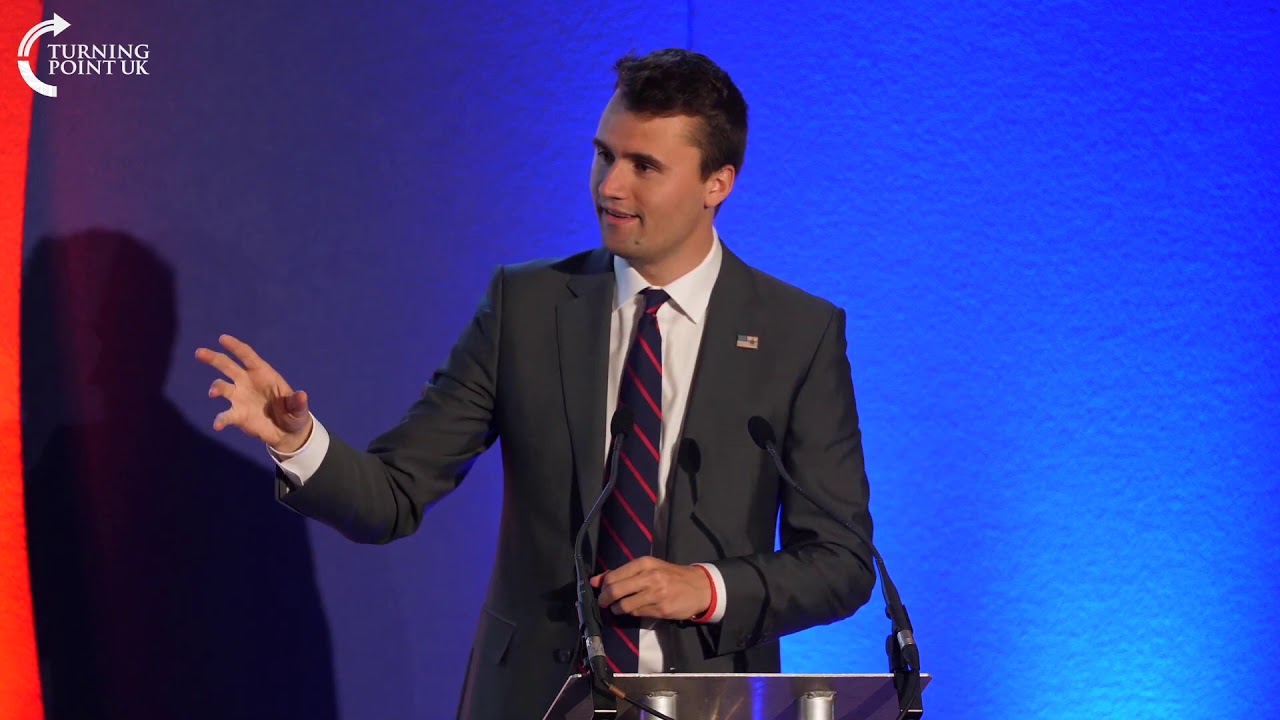
Rush Limbaugh Reflects on Three Decades in Radio and the Power of Authentic Connection
Enjoying this? Share it with someone who needs to see it.
Up Next
Charlie Kirk Launches Turning Point UK to Counter Left's Global Push Against Western Civilization
11:32
Charlie Kirk and Candace Owens Hit the Road to Talk Freedom and Trigger College Crybabies Across America
1:06
Charlie Kirk Exposes Socialism's Threat to College Campuses and America's Future Generation
15:34
Rush Limbaugh Reflects on Three Decades in Radio and the Power of Authentic Connection
Rush Limbaugh shares intimate stories from his 30-year radio career at Turning Point USA 2019 Winter Gala At Mar-a-Lago, revealing how he built trust with 27 million listeners, why Donald Trump's rally connection reminded him of his own early days, and the crucial lesson he learned about credibility when his audience believed a satirical claim about dodging the Vietnam draft. From his breakthrough in Sacramento to encouraging the next generation of conservatives facing peer pressure on college campuses, Limbaugh opens up about what keeps him passionate after three decades on air.
Rush Limbaugh began his acceptance speech at a Turning Point USA event with characteristic humor, noting that conservatives rarely receive awards because they're seldom offered any. What started 30 years prior as a simple ambition to become the best radio host in the country, defined by audience size, evolved into something far beyond his original vision. He never planned or architected the massive success that followed—it simply happened through his commitment to authenticity and his passion for the medium.
After 16 years as a struggling DJ, where hitting age 30 while still announcing Donny Osmond records felt like failure, Limbaugh finally broke through in Sacramento, California. He replaced Morton Downey Jr., who had been fired for telling an ethnic joke about a city council member and refusing to apologize. The timing proved perfect: the radio station hired a new morning team—Dave and Bob—and promptly forgot about Limbaugh's 9 a.m. to noon show. For the first time in his career, nobody was watching, nobody was telling him what he couldn't say or do.
Throughout his previous positions, Limbaugh had faced absurd restrictions. He was fired once for using the word "therefore" too many times, reprimanded for calling a female co-anchor "deer," and terminated for playing "Under My Thumb" by The Rolling Stones too frequently. But in Sacramento, he finally had the freedom to do radio his way, sharing his passions without supervision. The show succeeded beyond expectations, combining serious political discourse with irreverent humor in a way rarely found in media.
The Unique Blend of Serious and Satirical
Limbaugh highlighted what made his show distinctive: the ability to be credible when discussing issues seriously and forcefully, while also being credible when laughing, making jokes, and being irreverent. He illustrated this with examples from the television era: if Ted Koppel had opened Nightline with a 10-minute joke monologue, viewers would have been confused and turned off. Conversely, if Johnny Carson had spent 10 minutes seriously discussing politics, audiences would have felt equally uncomfortable. Limbaugh's show combined both elements, creating an unpredictability that kept listeners engaged.
As the program matured over three decades, Limbaugh evolved from his early 30s to age 67. The show changed as he gained experience, made mistakes, and learned from them. What remained constant was his commitment to sharing his passions and his desire for everyone to experience what excited him, whether they ultimately agreed or simply thought about it.
Recognizing Trump's Rally Connection
When Limbaugh witnessed Donald Trump's first rally, he immediately recognized something other political observers missed: Trump would win the election. Nobody else in American politics possessed that kind of connection with voters or audiences. When Trump descended the escalator on June 15 or 16, 2015, and made his controversial comments about Mexican murderers and rapists, the entire media landscape dismissed him as unserious, suggesting he was merely promoting a television show.
Limbaugh urged people to wait and watch. As the campaign continued and polling data showed Trump surging ahead—not just leading but way ahead of candidates including Jeb Bush—pundits insisted the numbers were wrong. Limbaugh understood what they missed: the authentic connection Trump built with his audience at every rally. Though the rallies appeared improvised, they were actually structured presentations that sometimes used a teleprompter and sometimes didn't. But at some point in every rally, whether for 30 seconds or two minutes, Trump would seriously thank people and tell them what an honor it was that they attended. That simple act created an unbreakable bond.
The media did not make Donald Trump, and despite their best efforts, they cannot destroy him. This represents a crucial distinction: when the media builds someone from nothing through buzz, PR, and hype, that person becomes a prisoner to media approval. The media loves building people up only to chop them down. But they cannot get rid of Trump. Neither can the Democrats, despite throwing everything at him. The Democrat Party had successfully removed every Republican they targeted in the past—one simple allegation and the Republican would quit. Not this time.
Understanding Trump's Strategic Pacing
Limbaugh had to educate even Trump supporters about what he called "pacing." During the Christine Blasey Ford testimony at the Kavanaugh hearings, when she claimed to be terrified about events from 30 years prior, most observers recognized the setup orchestrated by Dianne Feinstein. But Trump's initial response—saying he found Ford "very compelling" and would have no problem withdrawing Kavanaugh if the allegations proved true—caused panic among his supporters. They feared he would cave like every other Republican.
But Limbaugh saw the strategy clearly. Trump's first statement on any controversial issue demonstrates open-mindedness, showing no prejudice and a willingness to listen and understand. This approach buys off the media temporarily and forces them to acknowledge that Trump doesn't act in a prejudicial way. Within minutes, however, Trump unloaded on Ford at one of his rallies. The pattern repeated itself with the border wall funding debate.
The Border Wall Battle and Government Shutdown
During the Oval Office meeting with Chuck Schumer and Nancy Pelosi—"Chuck and Nancy," as Limbaugh called them, "like the latest stars of reality TV"—Trump refused to dismiss the cameras before discussing the wall. He told them directly that he would build the wall, and if they didn't provide funding, he would shut down the government and put his name to it. He told Chuck he would own it.
Nancy kept asking to discuss the matter after the cameras left, because Democrats cannot afford to be seen as who they really are. The left constantly wears a mask, remaining camouflaged to prevent people from learning what they truly believe. A still photograph from that meeting showed Chuck looking down at his lap while Trump spoke forcefully to him. Limbaugh's caption for the image: "What happened to my manhood?"
After leaving the Oval Office, Chuck and Nancy immediately went to cameras and microphones outside the White House to spin their version of events, suggesting Trump didn't really understand the issues and lacked experience, but they had it handled. They thought Trump was finished when the Senate and House votes showed no money for the wall. But Limbaugh emphasized that "wall" really means border security, and it must be fixed or America as founded will be lost.
Nobody in Washington truly wants border security—not the vast majority. Trump does, along with the Republican conservative caucus, but most of the town opposes it. Democrats need a permanent underclass, a permanent voter base that cannot speak English and won't be taught, that cannot do anything beyond menial labor. They need a never-ending parade of dependent people who can't survive without government assistance. The greatest threat to the Democrat Party is an upwardly mobile middle class. Republicans have their own reasons for wanting open borders, primarily related to cheap labor.
The Importance of Encouragement
Limbaugh shared a story about Byron Thomas, who introduced him to Charlie Kirk. Everywhere Limbaugh goes, he encounters Charlie Kirk—at McDonald's restrooms, White House Christmas receptions, even at the Everglades Club on Saturday morning before golf. But Byron Thomas exemplifies the importance of encouragement. Despite Limbaugh's 30 years of success, Byron treats him like he just discovered him. Every time they meet—sometimes weekly—Byron quotes things he heard Limbaugh say on the radio, tells him how important he is, and urges him not to stop.
After 30 years, success can become routine and taken for granted. But Byron's constant encouragement reminds Limbaugh of what matters. It's not about ego—it's about the power of building people up. Limbaugh used to give commencement speeches back when conservatives were still invited. In his early 30s, he would tell students that contrary to what every other commencement speaker said, they were not automatically "the future"—they had to go through people like him to get where they were going. Now at 67, when he looks at young people, he recognizes they truly are the future, and encouraging them is essential.
Young conservatives face immense pressure, especially on college campuses. Peer pressure, mocking, ridicule—it's the most powerful pressure imaginable. Nobody is raised wanting to be disliked or hated. Everyone wants to be loved, and that desire often causes people to change who they are, trying to become what others want them to be to gain approval. Young conservatives don't even have that chance with their opponents, who are predisposed to hate them. The left are the true bigots and prejudiced people who have no idea who conservatives really are.
The Value of Turning Point USA
Young people involved with Turning Point USA and other conservative youth organizations face absurd pressures on college campuses—the "snowflake" culture where people can't even speak or think freely. It takes fortitude and courage to stay committed to beliefs and remain true to how parents raised them. Encouragement works powerfully in these situations. No matter how much someone thinks another person already knows about themselves or how secure they appear, encouraging them creates confidence and assuredness.
There's no substitute for confidence—confidence in who you are, confidence in what you believe. It's confidence in your heart that allows you to persuade and engage people. It's confidence that says you don't need a teleprompter or notes. But forces constantly try to shake and destroy this confidence, especially in young people. Turning Point USA allows young conservatives who instinctively know right from wrong and understand conservative values to gather together and have those values validated person to person, rather than mocked and ridiculed. This makes them stronger, gives them confidence, and happens at the grassroots level—largely ignored or laughed at by the mainstream, which allows the movement to sneak up on people.
Lessons in Credibility and Trust
Limbaugh learned crucial lessons about the bond he built with his audience through two incidents that taught him the weight of responsibility that comes with credibility. In late 1989 or early 1990, during constant debates over the defense budget, he grew weary of leftists calling to say that because he hadn't served in the military, he had no right to discuss defense issues. This tactic aimed to cancel free speech—if you didn't do something, you couldn't weigh in about it.
One day, fed up with this argument, Limbaugh told a caller a fabricated story: coming from a prominent family in a small town where his family ran everything, he told his father in 1969 that he didn't want to go to Vietnam. His father went to the draft board, wrote a $3,000 check, and Limbaugh received a 4-F deferment. He said this on air as the last words before the show ended, believing his audience would recognize the brilliant satire.
When he got home, his phone rang. His father unleashed a string of profanity like Limbaugh had never heard: "What the hell did you do? They believe you. They trust you." Other family members held a council meeting to decide whether to publicly disown him. The controversy became enormous. Limbaugh had to correct the record the next time he was on air. The lesson proved invaluable: when you have a bond with people and credibility, they will believe what you say. It wasn't just critics or leftists—his own audience believed the story.
The Satanic Message Satire
A second incident reinforced this lesson in a more humorous way. A news story reported that an Ohio minister discovered a satanic message in the Mr. Ed TV show theme song when played backwards. Limbaugh operated on a philosophy of illustrating absurdity by being absurd. At the time, the left was conducting a "Great Peace March" from California to Washington, where they would simulate a nuclear bomb explosion with a "die-in." Limbaugh tracked their progress using Slim Whitman's "Una Paloma Blanca" as the update theme.
He decided to "discover" a satanic message in that song. Going into the production studio, he put the record on reel-to-reel tape (the only way to play it backwards), had someone turn on a voice analyzer synthesizer, and recorded a track with a message that would only be audible when the song played backwards. The message played twice in the song.
The next day on air, Limbaugh claimed he was devastated, having discovered he might be a tool of the devil thanks to the Ohio minister's technique. He said he didn't know if he could continue the show if he had been possessed by the devil. Naturally, the audience demanded to know what happened. He refused to tell them for three days, saying it was too horrible, that they had been exposed without knowing it, and he couldn't continue knowing they could become poisoned.
After three days of building suspense, he claimed station management forced him to reveal his discovery, though he protested subjecting the audience to it. With a big countdown, he played the song backwards. Slim Whitman's yodeling sounded hilarious in reverse, and the synthesized message said: "Yes, it's me, the old devil himself, lurking right here in the Slim Whitman record. Tell me, where'd you get a turntable that plays backwards like this? Well, I gotta be going way down the line, if you know what I mean. I'll be chatting with you."
While executing what he thought was the brilliant finale, Limbaugh expected his audience to think it was the smartest, most creative thing they'd ever heard—that Johnny Carson would call asking him to appear on the Tonight Show. Instead, people called the radio station switchboard asking if they should burn their Slim Whitman records. They believed it. One caller said he had the record and had been manually spinning his turntable backwards but couldn't hear any satanic messages. Limbaugh had to think fast, claiming that only turntables with "disgracificator circuitry"—special circuitry that splits out the highs and lows and boosts the mid-range where satanic messages work—could reveal them.
The bit continued for another week, but the lesson was clear: many people believed what he said. While many got the joke, many others didn't. Since these two incidents, Limbaugh stopped toying with things he passionately believes in. He still uses humor to mock and make fun of the left, but he doesn't manipulate his audience's trust. At 35 then and 67 now, his humor has evolved, but the understanding that people listen closely, have this bond, and believe what he says is something he honors every single day.
The Greatest Blessing
Limbaugh described his radio show as the greatest blessing he's ever had—the opportunity to reach people each day, which he has never taken for granted. If someone had told him 30 years ago that everything would happen as it did and he'd still be working at 65, he would have assumed he'd be doing three days a week, slowly fading away. The exact opposite occurred. He works harder now in terms of hours than ever before.
Preparing a three-hour radio show used to require reading five newspapers. Then the internet arrived, making it impossible to consume everything. There's so much to learn, remember, and have instant recall of, and far more competition. When he started in 1988, the media landscape consisted of three networks, the Washington Post, the New York Times, and a just-starting CNN that was nowhere near what it became—they were a genuine news network with leftist leanings but nothing like today.
His radio show started as the sole contrary voice. Contrary to media claims that his audience consisted of robots who blindly followed whatever he said, they were people who thought like him but never had anywhere in the media to validate those thoughts. As the show grew, other radio stations started talk shows, Fox News launched in 1997, and a burgeoning new media emerged. Without these alternatives to respond to the New York Times, Washington Post, and CNN, the situation would be frightening.
The expanded media landscape means far more competition than ever existed, requiring Limbaugh to spend more waking hours in what he calls "prep"—though it's really just absorbing and learning. He hasn't grown tired of it or reached a flatline. He remains as energized, maybe more so, than ever. The reason: audience expectations. He knows they expect excellence every day, and he feels compelled to deliver. Some days he goes home feeling he blew it, had great material he didn't get to, and let everyone down—even though he's the only one who knows.
The saving grace is that there's always tomorrow—he can fix it, apologize, or make it work. That opportunity is a blessing he never takes for granted. He looks forward to it every single day. The opportunity has allowed him to meet people he would never have otherwise encountered, like seeing Charlie Kirk in the White House. When Limbaugh needed to leave, Charlie asked which way he was going, called someone named Avi, and within five minutes, Avi appeared to escort him out. Limbaugh joked that Charlie Kirk runs the White House but doesn't have the ego to tell anyone.
Gratitude and the Christmas Spirit
Limbaugh closed by thanking everyone, apologizing for being long-winded but explaining his sentimentality during the Christmas season, which affects him more than Thanksgiving. He expressed deep gratitude to his audience for making his life meaningful. His radio audience now approaches 27 million unique people over the course of a week—a massive reach that brings both opportunity and responsibility. The bond he's built with these millions of listeners, the trust they place in him, and the platform he's been given to stand up for what he believes in front of 30 million people represents more than career success—it represents a mission he takes seriously every single day.