Up Next
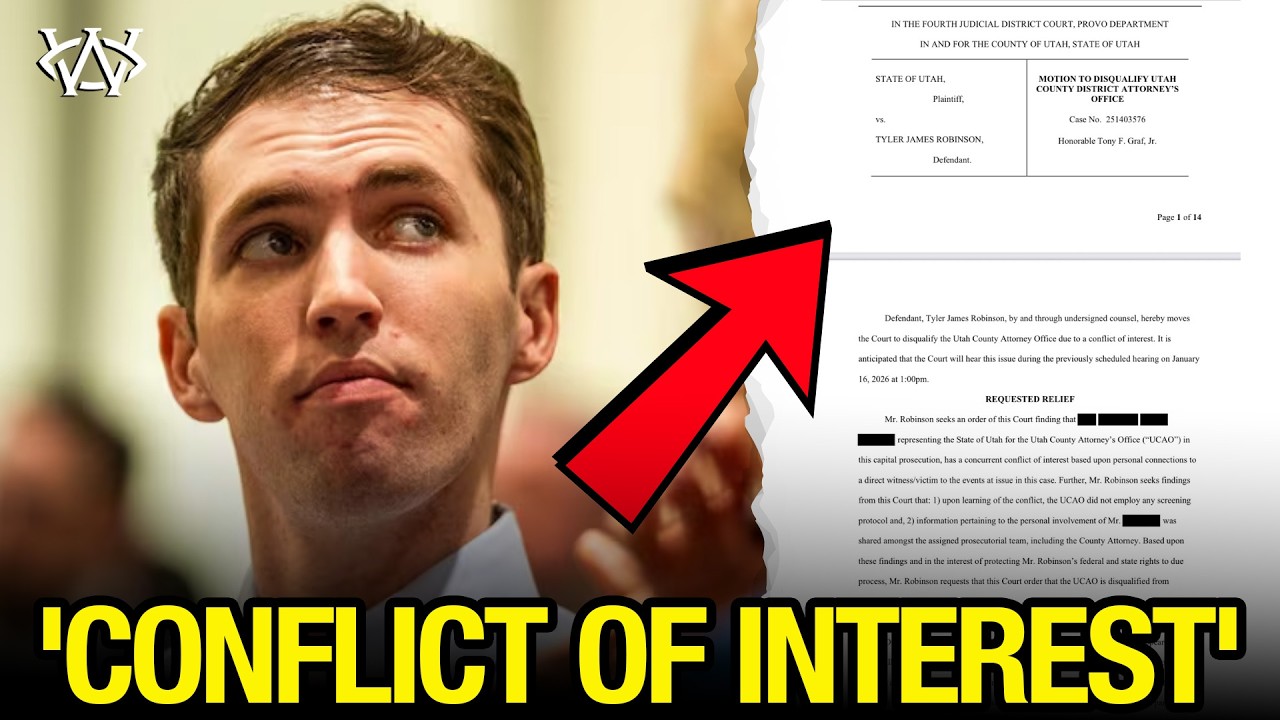
Angenette Levy Exposes Major Conflict of Interest in Charlie Kirk Murder Case Legal Battle
29:22
Tyler Robinson Trial Motion Denied: Defense Delay Tactic Fails as Justice for Charlie Kirk Moves Forward
7:16
Court Hearing Addresses Media Access, Publicity Orders, and Preliminary Hearing in State of Utah versus Tyler James Robinson
1:16:14
Secret Court Hearing Transcript Unsealed in Charlie Kirk Assassination Case Reveals Defense Battle Over Shackles and Cameras
The sealed court transcript from the Tyler Robinson case has been released with redactions, revealing what happened behind closed doors during an October hearing. Defense attorneys fought to have Robinson unshackled, dressed in civilian clothing, and to eliminate all cameras from the courtroom, while prosecutors argued for maintaining security protocols. The hearing exposed tensions over jury pool contamination, security concerns, and whether the alleged assassin should appear virtually or in person for proceedings. With over 1,400 discovery files already exchanged and a preliminary hearing scheduled for January, the case against the man accused of targeting Charlie Kirk continues to unfold under intense public scrutiny.
Sealed Hearing Transcript Released
The secret closed-door session transcript has been released in the Tyler Robinson case, the alleged assassin charged in connection with Charlie Kirk. A court proceeding took place in October that remained unknown to the public until media outlets discovered it happened in secret behind closed doors. After a significant battle over public access, the documents have been unsealed with slight redactions, revealing what transpired during the sealed hearing.
On October 24, 2025, the Fourth District Court in Provo, Utah convened for case State of Utah versus Tyler James Robinson. The proceeding involved multiple attorneys from both the prosecution and defense, along with representatives from the Utah County Attorney's Office and the sheriff's department.
Defense Requests Immediate Changes to Courtroom Procedures
Defense attorney Richard Novak opened by requesting that Robinson be allowed to have one hand unshackled during the hearing so he could take notes with pen and paper. The defense argued that in a sealed hearing with no public present, there was no specific reason to keep his hands completely restrained.
Ben Vanoi, representing the sheriffs, objected on their behalf, stating this issue was at the heart of what the court needed to decide. The prosecution requested that Robinson remain fully restrained during all pre-trial hearings. After discussion, the judge approved an alternative procedure that would allow one hand to be freed for note-taking while maintaining security protocols.
Roadmap of Defense Motions
The defense outlined several key issues they planned to address. They wanted Robinson to appear in civilian clothing rather than jail attire, sought to eliminate or modify restraints, requested elimination of all video and audio broadcasting, and planned to file additional motions including one to disqualify the Utah County Attorney's Office.
The motion to disqualify arose because a family member of one of the prosecutors was present at the incident where Charlie Kirk was shot. This individual, identified as a female child of a prosecutor, was located approximately 85 feet from where Kirk was killed and witnessed the event. Law enforcement was deployed to ensure her safety following the incident.
The defense indicated they would file all motions before Thanksgiving, acknowledging the substantial workload ahead. Both sides agreed on the roadmap for addressing these issues, with the prosecution noting they would respond quickly to filings.
Evidence Preservation and Discovery Disputes
The prosecution raised concerns about a defense motion to preserve evidence, arguing it was premature. The state filed a motion to set it aside. The real questions centered on what evidence needed to be preserved and what advance notice should be given before biological evidence could be used or might disappear, particularly DNA evidence potentially linking Robinson to the weapon or crime scene.
The parties agreed to meet and confer on these issues, though they acknowledged having different definitions of materiality that might require future litigation.
Sheriff's Office Status as Party
Defense attorney Kathy Nester argued that the sheriff's office should not be permitted to be a formal party to the case. While they could serve as witnesses and provide testimony during evidentiary hearings, the defense contended they shouldn't be allowed to file objections and participate as a party.
After discussion, the court clarified there had been confusion about an earlier order. The judge had been speaking colloquially when requesting the sheriff's position but understood how it could be interpreted as making them a party. Moving forward, the court determined the sheriff could make their positions known through the prosecution rather than entering an appearance as a formal party. Even the sheriff's department indicated they had not intended to become a party, resolving the issue relatively quickly.
Constitutional Arguments Against Shackling
The defense presented extensive constitutional arguments against shackling Robinson during court proceedings. They cited the Deck case, which held that blanket policies of shackling defendants are problematic, and the Cravens case, which requires individualized determinations for each defendant.
The defense outlined three primary reasons for not shackling Robinson. First, the presumption of innocence would be undermined if the defendant appeared in shackles before cameras. Second, it would offend the dignity and decorum of the courtroom. Third, the courtroom already had security measures in place, making shackles unnecessary.
Defense attorneys argued that Robinson had already demonstrated to the sheriff's department that enhanced security measures were not necessary, questioning why shackling was still required. They contended the sheriff had an obligation under state law to make an individualized determination rather than applying a blanket policy.
The defense also argued that intense public interest potentially drawing in "unstable fringe people from the left and the right and other places" should not be imputed to Robinson himself. They posed the question directly: Can the court trust him to sit in the courtroom without harming anyone? The defense argued the answer was obviously yes.
Civilian Clothing Request
The defense argued strenuously that if cameras were going to be permitted in the courtroom, Robinson should be dressed in civilian clothing rather than jail attire. The sheriff's department had already released a booking photo, and cameras captured Robinson wearing a jail jumpsuit with a vest during his first remote appearance.
The defense noted that Robinson had been placed in what appeared to be a suicide vest, though he was later validated as not being suicidal. They argued that if he would be broadcast to the world during court proceedings, he should be depicted as a citizen with the presumption of innocence, not as a jail inmate.
The defense indicated they didn't need shoelaces or a tie—a sweater would suffice—but unless all video would be shut down, he should not appear in jail clothing. This became a central point of contention with the prosecution.
Prosecution's Security Concerns
The prosecution raised two primary issues in response. First, when is Robinson's presence necessary at a hearing? Second, when his presence is necessary, what security measures are required?
The state argued that many non-critical hearings could be held virtually or in a hybrid format, allowing Robinson to appear from the jail. This would avoid issues related to shackling, reduce significant costs, and eliminate risks associated with transporting him to court.
Regarding civilian clothing, the prosecution initially suggested it posed security concerns because it would be harder to identify Robinson, though when pressed by the judge about whether Robinson might actually escape from the courtroom, the prosecution acknowledged that wasn't a realistic threat in the current setting.
The prosecution emphasized that in every other case that comes to trial, defendants appear in jail clothing and restraints, questioning why this situation should be treated differently. They argued the Fourteenth Amendment provides a right to be present, but that right can be satisfied through virtual appearances for many proceedings.
Judge's Questions and Deliberation
The judge pressed both sides with pointed questions, particularly asking the prosecution to explain what actual prejudice would result from allowing Robinson to appear in civilian clothing. When the prosecution raised security concerns, the judge asked directly whether escape was a realistic threat, noting that looking at the courtroom setup, it didn't seem plausible that Robinson would "just up and leave."
The judge explored whether ordering no videos or cameras and prohibiting written descriptions of clothing would solve the jury contamination concerns. The judge also questioned whether there would be actual prejudice to the jury pool from these courtroom decisions.
After extensive argument that the transcript describes as "talking in circles," the judge indicated a need to think through all the issues carefully before ruling. The court scheduled additional time to issue decisions and set future hearing dates.
Discovery Status and Preliminary Hearing
The prosecution provided an update on discovery, indicating their office had received 4,000 files from law enforcement and 1,700 files within the previous 12 hours. They had already delivered 1,442 files to the defense.
The prosecution explained they were prioritizing materials from September 10th as the most probative and important date, working backwards from there. They noted some hiccups in their filing system but indicated cooperation was proceeding smoothly with no discovery disputes at that point.
The parties discussed scheduling for a preliminary hearing in January, working around the judge's packed calendar of jury trials. The proceeding concluded at 5:19 PM with agreement to continue working cooperatively on scheduling and discovery.
Questions About Sealed Proceedings
The transcript reveals extensive debate over matters that arguably should have been conducted in public. Even participants in the hearing questioned whether the entire proceeding needed to be sealed, with suggestions that much of what was discussed could have been public.
With the transcript now unsealed and available for public review, questions remain about why these proceedings were sealed in the first place. The case continues to unfold under intense public scrutiny as the legal process moves forward in the prosecution of Tyler Robinson for the alleged assassination of Charlie Kirk.
Video Transcript
I'm objecting on behalf of the sheriffs.
Okay, this is the heart of what we're
trying to decide here. This is a
pre-trial proceeding. Yes, redacted,
redacted, redacted, but we request that
that be denied. Okay, it should be in
all pre-trial hearings keep his hands
locked up. So, I don't think that the
intense public interest which may be
drawing in unstable fringe people. Who
the heck are they talking about from the
left and the right and other places is
imputed to him. Can the court trust him
to sit there and not murder anybody? The
answer is obviously yes. The judge says,
"Is he going to escape?" He says,
"Looking at this courtroom today, if he
was in civilian clothing, is this a
realistic threat? Like, he's going to
just up and leave." The secret closed
door session transcript has now been
released. We're talking about the Tyler
Robinson case, of course, the alleged
assassin against Charlie Kirk. Had a
court proceeding back in October that we
didn't know about. Nobody knew about it.
The media found out about it, was
furious that this happened in secret
behind closed doors. and we had a big
battle over whether or not we the
people, the public would get to see
inside and learn what happened. But now
we've got the documents unsealed with
slight redactions asterisk. And so
here's what went down. October 24th,
2025, fourth district court, Provo,
Utah, case, state of Utah versus Tyler
James Robinson, the alleged Charlie Kirk
assassin. We see court reporter. We love
our court reporters. It's called Phoebe.
Court is now in session. Judge bursts
through the door. All rise. All right.
Here comes the judge. All right. Please
be seated. Court is now in session.
We're calling case 251403576,
state of Utah versus Tyler James
Robinson. Council, would you please
enter your appearances? Good morning,
your honor. Christopher Ballard on
behalf of the state government
prosecutor. Also here with me is Jeff
Gray. We've got Chad David's here.
What's up? Ryan's over there. Lauren's
here. We've also got Beth Vanoi from the
county attorney's office. He's going to
be representing the sheriff today. All
right. Thank you and good afternoon to
you all, says the judge to the
prosecution table. Now looks over to the
defense. Defense stands up. Miss Nester.
Good afternoon, your honor. Kathy
Nester, Richard Novak, Stacy Visser,
here on behalf of Mr. Robinson, who's
now seated to my left. Thank you. Good
afternoon, Mr. Robinson, says the judge.
Good afternoon to you as well. All
right, council, says the judge. We have
a few matters to deal with. Now, I
appreciate you making yourselves
available. I wanted to have a hearing so
that we could vet all of this out and
we'll have some further rulings later.
So, attorneys, how would you like to
proceed? There are for the defense,
maybe we'll start with you. You filed
the original motion Tyler Robinson
defense and so I want to make sure that
we pick a path that is organized and
easy to follow. What do you think
defense? Well, thank you your honor.
This is Richard Novak here. Yeah, there
are certainly some sort of related
partially brief issues. We want to talk
about shackling first and the handcuffs.
First thing we did want to ask the court
to do is have Tyler Robinson in this
hearing make one of his hands available.
Okay, he's shackled up. Unlock one hand
so we can give him some pen and paper
and he can write notes. I don't see why
he can't take notes during this hearing.
No one's going to be harmed and so we
should unshackle him. Redacted,
redacted, redacted. Something about him
writing and he's not able to write or
take notes during what could be an
extended hearing. And we'd like to have
him be able to do so. So, they might
also be just describing like what he is
in right now. Currently, his hands are
tied together. He can't extend his hands
to put both hands up to write. So,
they're describing the security posture.
So, they cut that out. So, we don't know
it. So, then we'd like him to be able to
do that redacted. redacted. Redacted.
It's a sealed hearing. The public's not
here. So, we just can't imagine any
specific reason why he can't have his
hands free. Just take his handcuffs off.
Judge says, "All right. How about you
prosecutors? You want to be heard on
this?" "Yes, we do, your honor. This is
Ben Vanoi. I'm from Utah." Now, given
the substance of this motion, I'm
objecting on behalf of the sheriffs.
Okay? This is the heart of what we're
trying to decide here. This is a
pre-trial proceeding. Yes, redacted.
Redacted. Redacted, but we request that
that be denied. Okay? It should be in
all pre-trial hearings. Keep his hands
locked up. All right. Any further input
from the defense or from the government?
No, your honor. All right. The judge
says, "Is there a way to unshackle one
hand for him to be able to write that
doesn't compromise the rest of the
baiff?" Says, "Oh, redacted. Redacted.
Redacted." Probably saying, "Yeah, we
can unshackle one hand. We'll tie the
other hand to the chair or to the desk,
something. There's an alternative
procedure." He says, "All right. Yeah,
let's go ahead and do that." All right.
And while we're waiting, your honor, you
know, I don't care if this is on the
record, says Mr. Novak, I have a really
bad sore throat. So if I put something
in my mouth, it's not gum, okay? And
it's not candy, okay? But if anybody
wants a rola, then I'm happy to share
them. Judge says, "All right, thank
you." Court says, "Well, it depends on
the flavor," says the judge. He says,
"Oh, it's original." He says, "Okay, all
right. Those are good. Some of them are
nasty." He says, "No, I don't like any
of that stuff. There's a pause in the
proceedings. They're all slamming back
reclas." Man, these are good. So the
court says, "All right, it's pretty
good." All right, I'm good. So before we
begin, I just want to make sure that
we're all on the same page. Now, Mr.
Novak, can you touch on the topics that
you want to get into? He says, "Yeah,
sure. I'll do a little bit of a road map
here, and I'll tell you what I want to
get into." So, the defense on Mr.
Robinson's behalf. We want him to appear
in civilian clothing. And that's
something we want to talk about, too.
The state hasn't responded at the time.
Some of the motions are related, but I
think we've got road map here. Couple
things we want to get into today, judge.
For civilian clothing, we want
restraints to be talked about. We want
to eliminate all video and audio
broadcasting or delayed feeds. The
defense wants the public cut out
completely. We haven't briefed it, but
we're going to come back on that. And
we're also going to bring other motions.
Now, you also, the court, came out with
a pre-trial publicity order, and we're
going to be asking to modify that as
well. There are two other reasons why
shackling, we believe, is
unconstitutional, and you can't have him
shackled in these proceedings. We've
also submitted another motion to
disqualify the Utah County Attorney's
Office. We read that motion because one
Utah County Attorney had a kid
apparently who was there. The court
says, "Okay, you want us to talk about
that? We're in a sealed hearing, right?
Maybe we can talk about that since it's
sealed." He says, "Yeah, go ahead. Talk
about it." Defense says, "Okay, and
look, I'm not trying to pre-argue these
issues," says the judge. But since this
is a sealed hearing, the defense, let me
explain it to you, judge. But Utah, the
prosecutors, they've advised us that a
family member of one of the attorneys
was present at the incident where
Charlie Kirk was shot and killed. That
this child, I don't know if they're an
adult or not, but I'm not referring to
them as a minor. It was a child of a
prosecutor. So, this child was present.
They observed it. They were 85 ft within
the distance where Mr. Kirk was killed.
They fled. Now, Utah was advised of all
of this. Law enforcement was actually
deployed to the area with her safety in
mind. Uh-oh. Yeah. So, now we know it's
a female. They redacted all the pronouns
in the last motion. So, now we know it's
a female child. I am not trying to
pre-argue this, your honor. I'm not
saying anything that we haven't already
discussed a couple of times with them.
So, we are going to file a motion to
disqualify them all. And all of these
motions, we've already talked about
getting them all filed before
Thanksgiving. Now, that doesn't mean
that we want the court or anybody else
to work over the holidays, but there's a
lot of work here. So, we need, you know,
a few weeks to get it all done. Now, you
might have a preference about how we
handle these motions. So, you let us
know and I think I should stop talking
here. [laughter] He's like, all right,
all right, that's good. Judge says, and
to the state, I just want to make sure
that from your perspective, you agree
with that? I don't want to go down the
path. And then somebody says, well, wait
a second. We weren't supposed to be
talking about that. We need to have a
starting point, right? Prosecution says,
yeah, that's perfect. Yeah, let's do it.
That sounds like a good road map. We
agree. We should start with the motion
about the sheriffs and explaining what
they filed and why they filed it. As
soon as they file, we'll respond
quickly. Now, there are two other things
I think you should be aware of. The
defense wanted to preserve evidence. We
think that's premature and the state
filed a motion to set that aside. And
so, we'll also want to discuss that,
too. Now, Tyler Robinson's response to
that motion is due in November. Then,
we'll file a reply. We'll meet and
confer. Obviously, we're going to
preserve evidence. And the real question
is what needs to be preserved and what
advanced notice needs to be given before
the biological evidence can even be used
even if it might disappear. Okay, so DNA
evidence, what did they find from Tyler
Robinson on the gun or elsewhere? And so
we're going to try to at least meet and
confer about that, but we'll have
different definitions of materiality. We
may have to fight about that later.
Okay. Anything else? Nope. Thank you.
All right. Judge says Okay, good. Fine.
All the preliminary stuff out of the
way. The one concern that I have though,
and I appreciate council laying this
out, is the issue of the media and
photographs and video because this is
very ripe. We have a hearing on the
30th, the judge says. And so, I'm just
trying to get an idea of where how much
time do we need? This is all
intertwined. So, where are the parties
at with that? We're going to have a
hearing coming up. They say, "Well,
actually, we don't even know if we need
a hearing on the 30th." Okay? And we
talked about that with Mr. Robinson. He
understands the consequences of further
delays in the case. I don't want to
speak for the prosecutors, but I don't
think we need a hearing. I think we can
have a hearing in early January. We're
going to get all our briefing done and
we can come back on that. Like, we're
not going to get anything done before
the 30th. So, I don't think, you know,
we don't need that hearing. Okay. So, if
the court's comfortable with vacating
the 30th or postponing it, that's fine
with us. Everybody's happy postponing
it. All right. Judge says we'll address
that later. Now, I want to talk, the
judge says, about the motion to strike
to get rid of the sheriff's office as a
party to the case and dress and
restraints. All right. Now, Mr. Nester
is going to handle this. Mr. Novak says,
"I'm going to sit down." Miss Nester
stands up. All right. Good morning, your
honor. This is Kathy here. Now, may it
please the court. We're talking about
procedure and what needs to happen here.
Now, I think we're all working really
hard to get this thing quickly solved
and I appreciate you working with us on
this, judge. Now, we've already laid the
groundwork for a lot of this and she
says, "We're hopefully, this is
interesting, because we are looking at a
very long case." This is the defense.
This case is probably going to last a
long time. She says hopefully. Yeah.
Delay, delay, delay. And you know, we're
very concerned about right from the
get-go a precedent being set where the
sheriff can come in, lodge objections,
and more. We've cited these cases. The
sheriff's issue, we've discussed the
sheriff is not going to be allowed to be
a party. It's not that interesting of an
issue. The judge spends a lot of time on
it just saying, "Well, how can we get
their opinions heard?" And the
prosecutors say, you know, they can
submit letters and things and they can
communicate their position, but they
don't actually have to be a party. So
affidavit and more and we just don't
want them to be a party. Okay. So you're
saying the state should be allowed to
call them as a witness, right? But not a
party. Yeah, sure. So they can put on
evidence and they can have evidentiary
hearings and all those things, right?
She says, "Yeah, exactly. So that's what
we want to do." And the sheriff can make
their positions heard and the court
says, "Okay, so your argument is the
sheriff is not a party. Is that right?"
Like they're not actually a party, but
they can't file objections and things
like that. Right. Defense says,
"Exactly." Yeah. Right. The motion says
the sheriff objects to. Okay, the
sheriff is not a party. So, the
prosecutor can object on behalf of the
sheriff and it's a pretty simple issue.
Then it goes to the prosecutors. They
say the sheriff can file whatever they
want. It's a joint response. You order
the sheriff to respond and so they
responded. The state was simply trying
to comply with your order. Like you
said, the sheriff should be responding
to this. They did. That's all. We
weren't trying to do anything strange.
The court says, "Oh, okay. Well, let me
clarify. Here's what happened. That was
a holiday. The court came out, issued an
order. So, I was like talking
colloquially like, "I need your position
on this, but I understand the
confusion." The judge says, "Okay, this
is what I ordered, and I didn't really
mean it that way, so let me clarify
this." And the court says, "Okay, moving
forward. We can just treat them as
witnesses." Does that work for
everybody? Yeah. Okay. Absolutely. The
sheriff wants to make it clear they're
not entering an appearance. So, even the
sheriff's like, "No, we didn't even want
to become a party." So, a lot of
confusion. They get through it. Any
other questions? No. Anything further on
this? One more thing, your honor. All
right, we got it. One more thing.
Anything else? And Miss Nester says,
"Let me talk to someone smarter than
myself." I love that line. Let me ask
Miss Visser really quick. Ask the
co-consel. And then sometimes the
sheriff could enter an appearance, but
most of the time not. So, they should
just go through the prosecutor. All
right. Anything else? No. Great.
Sheriff's issue is now over and done.
Great. Now, we get to some better
things. All right. Now, the judge with
that, we're done. Let's now talk about
his appearance in court and the
restraints. Sheriff can lodge objections
through the prosecution's office. That's
the end of that. All right, defense.
Thank you, your honor. Now, after these
introductory remarks, we did want to
take the weekend and think through some
things. We've done that. Now, as always,
we should start with the Constitution.
And I know you read our briefing. We
brought up this case called the Deck
case. And the Deck case said if you have
a blanket policy of shackling people,
that's a problem. There was another case
called the Cravens case. And it's about
you need an individualized determination
for the defendant. Should we shackle
this defendant or not? So, I will
address why I believe that we should not
have him shackled. The first is there's
a presumption of innocence. And how does
it look if our client is sitting there
shackled? And the third reason is that
we need dignity and decorum in the
courtroom. What do you think's going to
happen when the cameras see him come in
here with in shackles? It offends the
dignity and the decorum of the
courtroom. And this is not a jail,
judge. This is your honor's courtroom.
This is your courtroom, judge. And what
security measures are in place to ensure
safety? They're already happening here.
So, we don't need hypotheticals. Tyler
Robinson is not going to burst up, you
know, just start murdering everybody in
the courtroom. So, you need an
individualized determination that he
needs to be shackled in a courtroom,
redacted, redacted, redacted. We're not
asking that law enforcement officers not
be present. We're not asking you to
eliminate security concerns. Just why
does he need to be shackled? Here's
another one. When Mr. Robinson first was
arrested, something something something
redacted. Hm. And I think it's
interesting that the sheriff's
department hasn't provided the court
with any information about why that is.
That he has convinced the sheriff's
department that that's not necessary. H
So he wasn't shackled or I think we saw
him in a suicide vest, but he wasn't
placed on some status or considered to
be a high risk for whatever reason. So
now it's interesting that the sheriff
wants to keep him shackled. Now Mr.
Robinson has, as I understand it, is
under a state law. He's got a right to
privacy with his medical records and
more. And the sheriff has an obligation
to make an individualized determination.
So basically, you haven't done that. You
just have a blanket policy. You needed
to analyze him individually. So we want
you to do that. We were here a few weeks
ago. The sheriff's department took the
first appearance very seriously. We
appreciate that. Something something
something redacted. Redacted redacted.
That's not Mr. Robinson. So I don't
think that the intense public interest
which may be drawing in unstable fringe
people. Who the heck are they talking
about from the left and the right and
other places is imputed to him? Can the
court trust him to sit there and not
murder anybody? The answer is obviously
yes. So then I want to get to a slightly
more open question. Does this
constitutional right attached throughout
the entirety of the case and we've
briefed this more holdings. Sanchez
Gomez is another case. Four defendants
in that case. And the Ninth Circuit also
said this. Then it went to the Supreme
Court. They said it was moot. They said
they're not even in court. So they're
not being shackled anymore. case is
over. But he said, "I reviewed this
again and I've done some very deep
analysis on this." So, what we're asking
this court to conclude is that there is
nothing in Utah law that compels a
decision either way, you should follow
the US Constitution. We think here that
an individualized risk assessment of
Tyler Robinson would be warranted. And
while we understand that there's a lot
of what I call noise, there's noise on
the outside. Redacted, redacted,
redacted, redacted. Maybe not. I saw one
person with a camera in the lobby today
and I don't know. We also got here at 2
o'clock, so maybe there was more. Or
maybe nobody was interested. It was
going to be a sealed hearing. Nobody
knew about it. He's like, "Well, nobody
was there. Nobody knew about your secret
hearing." But none of that affects Mr.
Robinson's right to be free from
shackling. If we do have an evidentiary
hearing about this with an
individualized showing, I think you
should do that. Then you can make a
decision. But as long as the court
permits cameras, whether it's video or
still cameras, to broadcast either live
or with the light, we also believe that
he should be dressed roughly like
everyone else around him. The sheriff's
department released a booking photo and
because there were cameras in the first
remote appearance, we've already seen
him with the jail jumpsuit with the vest
on. We saw that. Yeah, like a suicide
vest. Now, the suicide vest something
Mr. Robinson redacted, redacted,
redacted. Was never suicidal or didn't
need that, but the sheriff put it on
anyways and he's since been validated to
be not suicidal. We get it. But if he's
going to be in this courtroom and we're
going to have a secure courtroom and
he's going to be broadcast to the world,
he should be depicted as a citizen, not
as a jail inmate. He has the presumption
of innocence. We want street clothes. We
don't need shoelaces. If we can't have a
tie, we'll get him a sweater. But unless
we're going to shut down all video in
here, he should not be in his jail
outfit. So, I think that is where we'll
leave it. Judge, I don't think there's
anything more. Thank you, your honor,
for considering it. So, that's from the
defense. Unshackle him. put him in
civilian clothing or ban all the
cameras. All right, prosecutors, what do
you think? Well, your honor, I think
this issue raises two things. First one
is this. When is his presence necessary
at a hearing? And then the second one is
when his presence is necessary, what
measures are necessary because he is
here? And I think of course the
overarching question involved in the
motion is how do we protect his
presumption of innocence? How do we
avoid tainting the jury pool? And let me
make it clear, we're just as concerned
about a fair trial in this case as the
defense is. So we are going to try this
case once. Now, as far as the first
question, whether his presence is
necessary, I think this court can
resolve many of those issues by holding
non-critical hearings either virtually
or hybrid when he can appear from the
jail. We can I don't know what this
redaction is like turn the cameras off.
And this court has discretion as to what
format this hearing will take. And I was
irritated about this at the beginning.
Why are they making everything virtual
so they can all just call in? It's a
pretty important case. Maybe put on your
pants and go into court. But rule 17,
they say we could we could just have
virtual hearings and he can be there. We
can just turn the camera off and he can
talk to his lawyers digitally. I think
the court could just do that. We could
avoid a lot of these problems. If we
have virtual hearings, we don't even
have to talk about Shackling. It also
avoids significant costs and risks,
including transporting him here to
court. It's like every other criminal
defendant in America charged with felony
and murder. You get transported to court
for your felonies. But this guy gets a
benefit of just sitting in jail. Being
transported is a lot of work. They hate
it. It sucks. You have to get up like
3:00 in the morning, get over there, get
transported, then you sit around forever
while the bus comes and it takes you
sitting around waiting. They absolutely
hate it cuz it sucks. I think it's
interesting that in one of the cases
that they site, it's called Luthie.
There's another subsequent case here and
there's a battle over the case law. So
again, I think the first issue is do we
even need him here? And once he is here,
then what do we do? So many of these
opinions they're citing are just
terrible. It's vacated. It's like it
didn't even exist. Why are they citing
it? Now, they say they've also looked at
the Supreme Court cases, and that's also
unremarkable. And the sheriff can do
what he needs to do under our rules. And
he says that if he's shackled, he can't
talk to his lawyers, but that doesn't
make any sense. Of course, he can. Just
use your mouth. His mouth's not
shackled. I think any suggestion that
this court might be prejudiced by seeing
him in jail clothing is because he's in
custody. These are all normal. Would
have the same effect on a judge as it
would on a jury. and the other cases
that they're citing are in different
phases. So all in all, there's
dissenting opinions in those prior cases
and they talk about various rationale,
talks about the Ninth Circuit case, fast
forwarding through the case law
analysis. So I think it's important for
this court to ask what the security
administrator wants to do as well. There
is significant publicity in this case.
And again, where Tyler Robinson has
suggested that he would be okay with not
having any photographs at all, these
images won't be broadcast to the
potential jury pool. The booking photo
did come from the sheriff, but it was
not the sheriff's office that released
it. That was a different law enforcement
agency that released it. So, don't blame
the sheriff's. So, that's what we have
to say. Judge, any questions? Yeah, I
do. Court, what prejudice is there if he
appears in civilian clothing? Like, how
is that going to hurt your case? Well, I
think it goes to security. It's harder
to identify him if he's in civilian
clothing, like if a judge escapes him
out her back door. So, the judge says,
"Is he going to escape?" He says,
"Looking at this courtroom today, if he
was in civilian clothing, is this a
realistic threat? Like he's going to
just up and leave?" Well, I'm asking
you. He says, "Let me have my colleague
answer that." Another prosecutor. He
says, "No, I want you to answer it. I'm
trying to understand your thinking. You
just said that he could be a security
risk. Is this how it's clothing? I
understand the rationale. I'm just
trying to ask how it would work here. Is
there a threat to security?" Well, we're
talking in this case, no. But we're
talking about public hearings as well.
And what about jail clothing? What if
he's in jail clothing? Isn't that also a
risk? And saying talking about
identifying jurors and more. But even if
I were, the judge says to go down that
route and say no one can comment on his
clothing, what if it's a member of a
blogger or something? Well, we have
general concerns about how he is
dressed. Some people say it's
undignified, redacted, and I think going
to the suggestion and I think agreement
that no video or photographic reporting
could happen. All right, any more
questions? Judge says, "I got to think
through all this. It's taking a little
bit for my brain to go through all this.
I'm still thinking. Judge is sitting
there going, "This is a lot of nonsense.
I just don't want to interfere." No. And
I appreciate it. I'm happy to answer
your honor's questions. He's sitting
there thinking, "All right, I'm still
trying to take detailed notes." All
right. Judge says, "Going back to the
clothing, what if we order no videos, no
cameras, and says you cannot write about
the clothing. Would that work? Would
that solve this? Does this prejudice the
jury pool?" No, I don't think it does,
your honor. Every case that comes to
trial, everybody comes in jail clothing
and restraints. I don't know why this
situation is anything different than the
other cases here. All right, talking
more about shackles and let's see what
the judge does with it. All right, I
appreciate the cand. Now, the second
question I have is about the
individualized approach. We know about
the court's question. He surrendered. A
neighbor of his, I'm sure the court has
read enough of the materials. I think
it's even in the probable cause
statement. You don't even have to read
the public accounting. A neighbor of his
was a retired sheriff from Washington.
He got in that man's car. They took him
to the sheriff's office with his parents
in the vehicle with him. So, what
information does the court have to say
that if somebody is testifying in a
preliminary hearing, said something that
he felt uncomfortable with and they're
just talking about all sorts of stuff?
14th amendment has a right to be
present, but we can have these things
virtually. More jail clothing stuff. And
I do want to say something about
presumptions. I think the last thing I
want to say, this is a very serious
offense. Anything further from either
side? I want to talk about the media,
says the judge. Lots of talking kind of
in circles is what all this reads like.
Now, I also don't think if this court
were to eliminate cameras, which hasn't
been fully brief, I don't think that
goes to the shackling issue. They're
different. We have to balance the
defendants's rights and about his right
to be present. State is saying we don't
need him here for some of the
non-mandatory proceedings. Now, even if
he were here in civilian clothing,
redacted, redacted, redacted again, more
talking in circles about the rules. And
because we're in a sealed proceeding,
says the judge, we're addressing
restraints and constitutional rights.
I'm going to come to an agreement by
Monday. We're going to have a WebEx
hearing. The judge is going to think
about all this. We're in agreement on
the striking the 30th date. So, we're
not going to have the 30th date. Let's
pull up a new date. Judge says, "I need
to think about all these things. Any
updates on discovery?" Yes. Our office,
the prosecution, has delivered 4,000
files from law enforcement. We've got
1,700 files within the last 12 hours.
There's a process we're going through.
We've given the defense 1442 files to
the defense. There have been a couple of
hiccups because of our filing system.
There's a lot of surveillance camera
there. We are starting with September
10th being the most probative, the most
important day. We're working backwards
from there. Working out a few kinks.
Okay. Anything else? No, this seems
accurate. We are getting that material.
The judge says good cooperation is
important. There's no discovery disputes
thus far. Judge talking about the
preliminary hearing. One more issue. How
long is the preliminary hearing going to
be in January? defense is going to
cooperate. Any other potential dates in
January? Assuming the court has a clear
day. This guy has a large homicide trial
coming up there. So, they're just
figuring out dates. Judge says, "What
about my dates?" Judge says, "You're
booked. You're booked with jury trials
every week." Every week, apparently,
that's a lot. So, okay, look at Friday.
They're all just looking at their
calendars to figure out dates. All
right, give us a heads up. Family member
getting emails. And so, I don't even
think we would need to seal the entire
hearing that we just heard. Then we're
going to have some hearing dates on the
ceiling. All right. Thank you everybody.
Have a good weekend. Proceedings
concluded at 5:19. All right. So, lots
of talking for that hearing for some
issues that probably didn't need that
much talking. But the transcript now
unsealed and inside we see them really
debating about things that should have
all been done in public. I don't know
why they sealed this in the first place
to be honest with you, but we now have
it out. And so hopefully this is a
pattern that continues. any of these
closed door hearings and closed and
sealed hearings are ridiculous. So,
we'll keep our eye on the Charlie Kirk
assassination case with the defendant
Tyler Robinson. Thank you for
subscribing and joining as we
Comments
Be the first to comment on this video.