Turning Point USA Reporter Faith Merrill Confronts Confused Protester Outside AmericaFest Who Won't Explain His Own Sign
Enjoying this? Share it with someone who needs to see it.
Up Next
Nick Shirley Confronts Anti-Charlie Kirk Protesters Outside AmericaFest in Phoenix Arizona
2:33:40
Cenk Uygur and Charlie Kirk Unite on Populist Issues Despite Deep Political Divides
25:02
Charlie Kirk Unveils Bold Vision for Conservative Movement at Turning Point USA Event
17:08
Turning Point USA Reporter Faith Merrill Confronts Confused Protester Outside AmericaFest Who Won't Explain His Own Sign
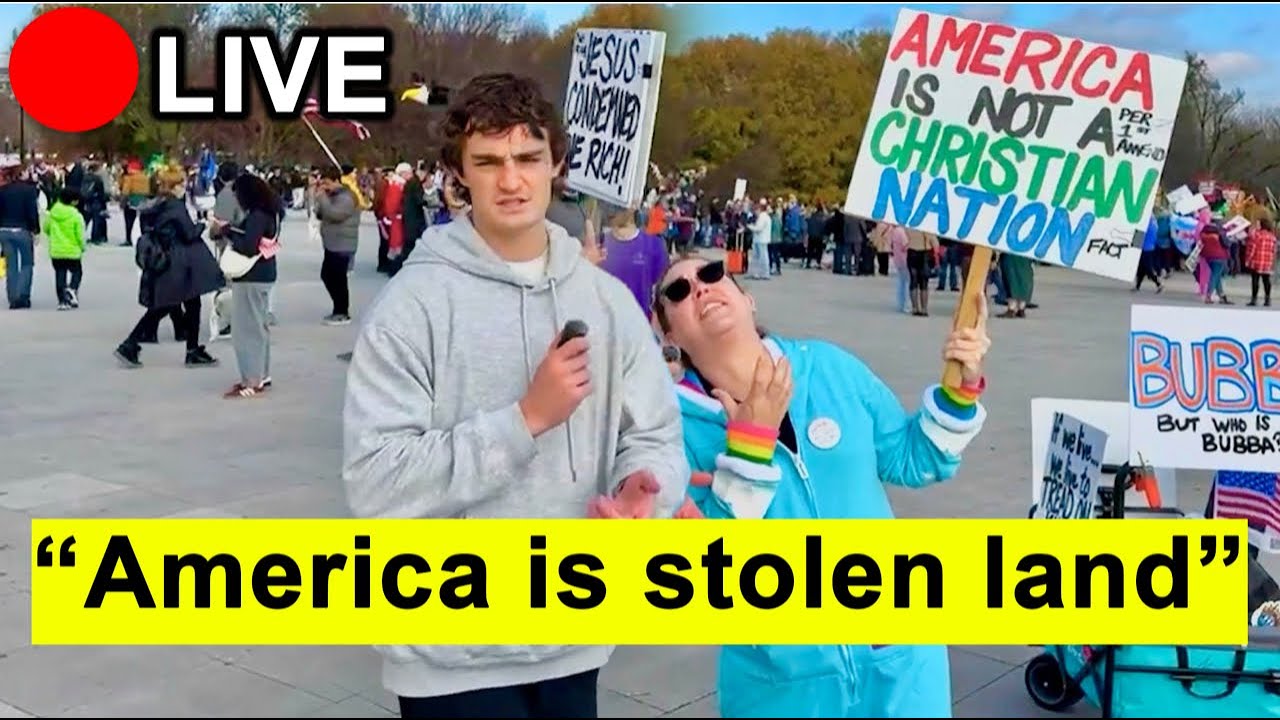
Faith Merrill, a Turning Point USA reporter, attempts to interview a protester standing outside AmericaFest in Phoenix, but the encounter reveals more about the protester's unwillingness to engage than his actual message. Despite spending his entire morning holding a sign with inflammatory false quotes attributed to Charlie Kirk, the man refuses to have a substantive conversation, instead repeating the phrase "brainwashing is available through these gates" on loop. The bizarre interaction highlights a growing trend of protesters who show up to events but cannot articulate what they're actually protesting, resorting to insults and deflection when given a platform to share their views. The reporter's patient attempts to engage in civil dialogue are met with hostility, profanity, and the claim that he's paid by Vladimir Putin, for the price of a beer, then $2,000 an hour, then $3,000.
Outside the gates of AmericaFest in Phoenix, a Turning Point USA reporter encountered a scene that has become all too familiar at conservative events: a lone protester holding a sign with inflammatory messages, but completely unwilling to explain or defend his position. The man's sign featured fabricated quotes falsely attributed to Charlie Kirk, including claims that Kirk wanted to "kill the gays" and statements like "Blacks are stupid, especially the women"—quotes that Kirk never said and that anyone familiar with his work would know are completely false.
What should have been a straightforward interview turned into a surreal loop of the same phrase repeated dozens of times: "Brainwashing is available through these gates. Thank you for coming to the brainwashing." Despite standing outside the event for hours, the protester claimed he didn't have time to talk, calling the reporter's station "idiot" media and telling attendees they were entering a "brainwashing" facility.
Refusing the Platform He Claims He Wants
The irony was thick. Here was a man who had dedicated his entire morning to making a public statement, yet when offered a genuine platform to explain his views and reach a wider audience, he refused. The reporter made multiple attempts to engage:
"Can you help me understand the brainwashing?"
"If you're out here protesting, can you explain your sign?"
"Why are you choosing to do this with your morning?"
"You can pick any topic and we can talk about it."
Each attempt was met with deflection, insults, or the same robotic phrase about brainwashing. The protester told the reporter to take off her cross necklace, called her an idiot, and claimed this was "not a Christian nation"—but wouldn't elaborate on any of these points when pressed.
The Vladimir Putin Defense
In one of the more bizarre moments, when asked who was paying him to protest, the man claimed Vladimir Putin was compensating him. First, he said Putin pays him "a beer." Then he upgraded his story to $2,000 an hour. By the end of the conversation, he claimed Putin had raised his rate to $3,000 per hour "because I have to listen to this from you people."
The absurdity of these claims seemed lost on the protester himself, who appeared to think he was making some kind of point. The reporter, maintaining her composure and sense of humor throughout, simply asked where she could sign up for such lucrative protest work.
False Quotes and Real Consequences
The sign's content deserves specific attention because it represents a disturbing trend in political discourse: the complete fabrication of quotes to demonize opponents. The reporter directly challenged the false quotes:
"I don't think Charlie Kirk ever said he wanted to kill gays. I think that's a little misleading."
"So I'm pretty sure that's definitely not a quote. I can tell you that for a fact," she said regarding the racist statement about Black people.
A young man named Alex Stone who appeared in the video also confirmed: "Charlie Kirk never said that. That is unequivocally false." He added that Kirk "doesn't want to kill the gays. That's propaganda and BS."
Stone offered a more nuanced take on Kirk's actual position: "He actually respects gay people. He just doesn't want to make it his whole personality and indoctrinating kids with this ideology."
The Pattern of Professional Protesters
The reporter noted her extensive experience with this phenomenon: "I go to hundreds of protests. I talk to protesters all the time." Her observation was pointed: "Notice how they love to come out here with signs, but they don't want to tell you what they're protesting. They're just going to insult."
Her colleague agreed: "They do not know what they're protesting."
This wasn't an isolated incident but part of a pattern where individuals show up to events with inflammatory signage designed to provoke, but possess no substantive argument to defend their position. When given the opportunity to persuade, educate, or even just explain their worldview, they retreat into slogans and hostility.
Civil Dialogue vs. Bitter Confrontation
Throughout the encounter, the reporter attempted to model the kind of civil discourse that seems increasingly rare in American political life. Even as the protester hurled insults and profanity, she remained calm and professional. When he made an inappropriate sexual comment, she simply stated she was Catholic and waiting until marriage.
She tried to find common ground: "See, look. We're already agreeing on things. All we have to do is have a conversation."
She also offered gentle criticism of his approach: "Stepping through here and yelling at people is not getting your message across." And later: "I think you should learn to have civil dialogue."
But the protester seemed incapable of or uninterested in such dialogue. His responses ranged from repetitive sloganeering to vulgar hostility, suggesting that provocation rather than persuasion was his actual goal.
Free Advertising for the "Enemy"
Perhaps the most ironic aspect of the entire encounter was the reporter's observation: "You know, this is great advertisement for Turning Point USA and AmericaFest. Honestly, he's doing this for free."
By standing outside the event all day, the protester was drawing attention to AmericaFest and its attendees. His inability to articulate a coherent criticism of Charlie Kirk or Turning Point USA only made the organization look more reasonable by comparison. His sign's obviously false quotes would convince no one who wasn't already convinced, and might even prompt curious observers to investigate what Kirk actually believes.
In essence, he had become free marketing for the very event he was protesting—a walking advertisement for the intellectual bankruptcy of his own position.
The Constitutional Question
At one point, the protester asked the reporter if she was familiar with the United States Constitution, apparently believing it supported his claim that America is "not a Christian nation." But when given the opportunity to make his constitutional argument, he simply repeated his brainwashing mantra.
This missed opportunity was emblematic of the entire encounter. Here was someone who clearly felt strongly about his political positions, but who lacked either the knowledge or the will to defend them in good faith dialogue with someone who disagreed.
What This Reveals About Modern Protest
The encounter outside AmericaFest offers a window into a troubling aspect of contemporary American political culture. Protest has always been a vital part of democratic life—a way for dissenting voices to be heard and for the powerful to be challenged. But effective protest requires more than showing up with a sign. It requires the ability to articulate a position, to engage with counterarguments, and to persuade those who might be on the fence.
This protester did none of those things. He stood outside an event for hours, holding a sign with demonstrably false information, refusing to engage in substantive dialogue, and hurling insults at those who tried to understand his perspective. In doing so, he embodied a form of political engagement that is all performance and no substance—designed to signal virtue to those who already agree rather than to convince anyone who doesn't.
The reporter's final summary was apt: "Our lovely friend doesn't want to talk to us anymore." He never really did.











Comments
Be the first to comment on this video.