Up Next
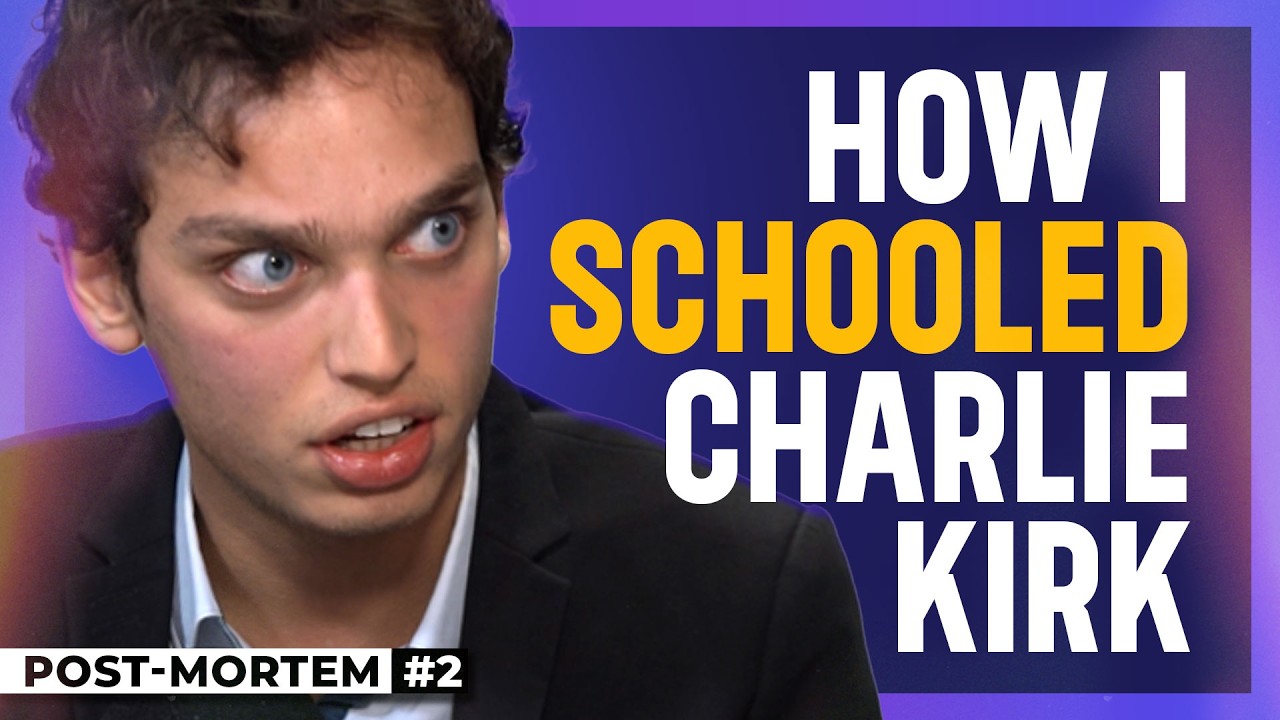
Charlie Kirk's Viral Portland Confrontation: Civil Dialogue Interrupted by Hat Incident
9:01
Briahna Joy-Gray Exposes Charlie Kirk's Debate Tactics and the Left's Moral Failures in Defending Him
12:15
Kai Bevan Dismantles Charlie Kirk's Pro-Life Arguments Using Medical Facts and Utilitarian Ethics
1:03:43
Archie Mackintosh Challenges Charlie Kirk on Moral Absolutism in Relationships and Why Traditional Marriage Systems Collapse
Archie Mackintosh, a left-leaning centrist with an anthropology background, reflects on his debate with Charlie Kirk about moral absolutism in relationships. While both agree that stable monogamy produces better outcomes for society, Archie argues that imposing rigid moral standards ignores genetic variation, attachment disorders, and evolutionary mismatch. He explores why prosperous societies consistently move away from traditional structures, questions why Charlie's preferred moral order collapsed under its own success, and proposes that morality should be adaptive rather than absolute. This analysis reveals the tension between top-down moralistic approaches and the biological reality that roughly 50% of adults develop attachment issues that make long-term pair bonding difficult.
Setting the Stage for Civil Discourse
Archie Mackintosh, now being called by Charlie Kirk's fans in the comments as "Mr. Man bun," reflects on his debate with the conservative commentator. People resonated with the civil, productive discussion in a world that is increasingly polarized. The debate centered on moral absolutism in relationships, a topic Archie believes left important discussion points hanging in the air. In this analysis, he reacts to the debate itself while sharing counterpoints he didn't have time to express and refuting logical traps he believes Charlie employed.
The Core Question: Why Do Societies Abandon What Works?
Archie's fundamental challenge to Charlie was straightforward: If stable monogamous relationships often produce the best outcomes for society, and if that structure really works for everyone, why do societies consistently move away from traditional monogamy once they become safer and more prosperous? Why do so many marriages still end in divorce even among people who try to make it work?
He posed an additional framing question: If you believe in free markets because they are decentralized and adapt to reality without top-down control, and given that individual ability to form healthy long-term pair bonds vary significantly with factors like genetics and attachment styles, why reject top-down control in economics but not extend that same rejection to human behavior in marriage?
Charlie's Response: The Law of Decay
Charlie answered by invoking the second law of thermodynamics, describing it as the law of decay. Societies tend to decay against the roots that created them. He pivoted to free speech, noting that the UK no longer has true free speech, with 30 people a day arrested for inflammatory social media posts. Someone named Lucy Connelly was facing prison time for a Facebook post critical of migrants. Charlie argued it's normal for civilizations to get away from how they once operated.
Archie acknowledges he can see where Charlie's coming from and completely agrees about how terrifying the decline in free speech is in the UK. However, he notes these are very different topics. Free speech is totally different from human relationships. Charlie, in Archie's view, was deliberately pivoting into a topic he's more able to control, that he knows more about, and that will resonate more with viewers watching his video.
Prosperity Leads to Degeneracy
When Archie pressed on why societies make this change once they become more prosperous, Charlie's answer was direct: prosperity leads to degeneracy. Once prosperous, you no longer have moral guard rails or limitations. You no longer have delayed gratification because you have instant gratification from a surplus of goods, and then you have a decline of a transcendent moral order.
Archie broadly agrees that prosperity leads to decline, but he's asking why. Charlie just says it's a rule that happens, but the deeper why is important. Charlie is very quick to reframe this transition away from an absolute moral view that aligns with his Christian background as a failure to achieve a transcendent moral order. Archie fundamentally disagrees with this.
There is too much ego in saying we already have the answer, these set of absolute morals, that's what's optimal. Especially because it didn't work. Those morals were widely imposed in the first half of the 20th century. If they were so stable, if this is the optimal morality, why did it collapse under the weight of its own success?
Finding Common Ground on Marriage
Archie made clear that he and Charlie largely agree on the foundation. He absolutely acknowledges that if everyone in society was able to maintain healthy long-term pair bonds, that would be best. There's strong data showing that independent of socioeconomic factors, broken homes are some of the strongest predictors of poor life outcomes. Even as countries become more socially egalitarian, rates of female depression and anxiety spike disproportionately.
This emphasis on common ground was intentional. Archie was making very clear that he's aware of all this research, some of it very uncomfortable. They both want the same thing: more monogamy in society. Where he disagrees is with Charlie's approach. Charlie's approach of moralistic top-down absolutism is not the way.
The Problem with Moral Absolutism
When you try to impose moral absolutism, Archie argues, inevitably due to variance in attachment issues, industrialized culture, absent parents, and screens raising kids, around 50% of adults in the West develop attachment disorders which make it very difficult to maintain long-term pair bonds. Additionally, there's variation in oxytocin receptors in density and shape, as well as vasopressin. There are going to be even 5% of people who feel these rules really do not fit them, and they will push back, creating ideologies that grow into more widely appealing ideologies which lead to change.
Archie believes this is what happened in the sexual revolution. It started with a push for female autonomy and then morphed into a really exaggerated expression of pushing for maximizing individual freedom. When you try to impose moral absolutism this way, it just inevitably causes pushback. If Charlie, as someone with a platform, instead said monogamy is great and works best for most people, but also acknowledged there are some people it doesn't work so well for, more people would hear the message he wants to push.
People aren't a blank slate. They can't all follow an imposed absolute moral order. There's real variation in genetics and attachment style. About 50% of adults have insecure attachment. Archie's core argument is that it's too optimistic assuming that if you impose a moral order for everyone to strive to, it will work, because there will inevitably be a minority of people who feel oppressed, who feel the rules don't work for them, who push back.
The Logical Trap: Are You Against Moral Absolutism Absolutely?
When Archie stated he's against moral absolutism, Charlie asked if he was against it absolutely. This made the room laugh. Archie believes the argument he made was very strong and Charlie didn't really have the knowledge or ability to refute it on an intellectual level. Instead, Charlie employed rhetorical trickery to try and make Archie seem like his argument stems from an inconsistent logical paradox.
The problem is you can be against moral absolutism without being a hypocrite. Archie is very open to having his mind changed. He doesn't have the ego to say he has all the answers, that his moral view is correct. An opinion that he rejects moral absolutism, that in itself is not a moral, it's an opinion. Morals in society are typically looked at as objective truths. Rejecting moral absolutism but not being totally absolute in that rejection isn't a moral, it's an opinion, and he's allowed to have an opinion.
The Straw Man: No Moral Standard at All?
Charlie then suggested it's all just preference, that Archie could basically do whatever he prefers, that there is no transcendent moral order. This is the beginning of Charlie's straw man. Archie says he rejects moral absolutism, and Charlie responds by saying he has no moral standard at all and just does whatever he wants. This incorrectly assumes a binary: that you either have moral absolutism or no moral standard at all.
Charlie stated definitionally that we must choose what moral standard we live by. He's very clear as to what moral standard he chooses. The lie of the West of modernity the last 30 years is that we're going to live and let live and there will be no moral standard. That itself is a moral standard and it's a really bad one. Charlie argued he has a moral obligation not to accommodate when people fall short, but instead try to lift them up towards the standard that is true and that he knows works.
An Anthropological Perspective on Morality
The reason Archie and Charlie disagree is that Charlie's worldview is very centered around Christianity, whereas Archie comes from an anthropology background. He studies societies across the world and a range of different cultures, and he's very aware there are around 300,000 years of evolution where humans lived in hunter-gatherer societies.
What morality actually is, Archie argues, is a combination of reputation management, emotional calibration, and adaptive altruism. The purpose of morality is to drive optimal behavior in order for you to cohesively fit into a society. The problem is human environments have been very variable. Under different environments, there are different sets of optimal morality. There isn't a one-size-fits-all.
What is risked if we impose moral absolutism is we take outdated, ineffective, suboptimal morals and lock them in forever. Morality should be adaptive. We should update it as we learn more about the world, as we learn more about ourselves. If we say we have all the answers now, there's so much ego in that. Of course we don't. We should be learning and growing. This is why Archie is a centrist.
That's not to say that in some societies, everyone's fine with murdering and hurting people. Across societies, even non-industrialized hunter-gatherer societies, we see consistently universal morals in terms of treating others with a degree of empathy in a way we would want to be treated. People are against murder, against hurting people, against unfairness, against stealing. That is deeply ingrained into human biology.
The problem with moral absolutism is it places equal weight on every single moral. Whereas in reality, there are some morals that are more fixed and some that are more loose that we don't know much about.
Why Do People Fall Short?
Archie asked Charlie: when he describes people falling short when they fail to engage in long-term monogamy, what does he think causes that? Why do some people struggle? Charlie answered there are many reasons. Economic is one, but the biggest is the death of religion and the death of Christianity in the West. In America, as the country has become less churched, so many social ills rise. The UK is unfortunately far less churched than America.
Archie studies the evolution of behavior, in particular sexual romantic behavior. If you track all the different hunter-gatherer cultures that we can study and track how agriculture shapes things, you see the ecological conditions really reliably predict the prevalence of monogamy, certain marriage systems, and what we refer to as attachment issues. They seem to be an ecological calibration to an environment.
In environments that are more unstable, it's less optimal for an individual to grow up with a tendency to rely on long-term pair bonds. There's a mismatch with the modern world. Coming back to industrialization, there are so many people who raise kids as absent parents. Daycare is massively linked to attachment issues. This causes people to struggle to bond long-term. Coming back to the genetic part, research shows that especially vasopressin mutations and oxytocin mutations mean some people really just do not have the proclivity for monogamy.
It's not realistic that everyone can just stick themselves into a moralistic view. We're in this weird position where absent parenthood, essentially absent attention during childhood, means that a huge number of people develop insecure attachment, which in Archie's opinion is essentially the brain's way of going, "My parents didn't give me much attention. I can't really rely on long-term pair bonds as an optimal strategy. So I'm going to develop a strategy where I grow up and I struggle to trust people. I'm more cautious and actually I'm more oriented towards short-term mating."
If the System Was So Stable, Why Did It Collapse?
When discussing what brings stability, Archie pointed out that we had what you might consider stability in the previous century, and then it became unstable. He asked: if moral absolutism like it was in the first half of the 20th century was so well imposed, why didn't it work out? Why did people reject it? It seems like a system which collapses under the weight of its own success.
Charlie keeps answering the question in terms of how, in terms of mechanism, but that doesn't answer the question of why these attitudes appeared in the first place. If this system was so stable, wouldn't you expect that everyone's happy? Wouldn't you expect that these attitudes wouldn't appear?
Charlie blamed modern feminism, calling it one of the worst decisions, not just worst ideas ever, largely from Betty Friedan's "The Feminine Mystique," which acted as if every woman in a monogamous marriage in the states is in some sort of tyrannical environment. This has led to the women of the West being the most miserable, most depressed, most suicidal, most prescription drug-addicted cohort on the planet. Charlie believes we need to appropriately challenge feminism and tell young women that it's okay, in fact it's courageous, to get married and have children again.
Breaking the Cycle: Hard Times Create Strong Men
This is Archie's key issue with Charlie's argument. In the comments on the debate video, you see this quote repeated: "Hard times create strong men. Strong men create good times. Good times create weak men." We need to figure out how to stop this cycle.
Archie agrees with this observation. When you have comfort, at the neurobiological level, serotonin goes up. It puts a brake on dopamine. It reduces your motivation to go out in the world and engage and pursue and build and create and seek things outside of yourself. It also causes rigidity of the ego because what triggers neuroplasticity is difficult resistance, discomfort, stressful salience, epinephrine, and acetylcholine.
When you live in a comfortable world where you're not challenged, you don't learn to change your mind. You aren't receiving the signals that cause you to change your mind that trigger neuroplasticity. Because the brain is designed to look for threat, we start to look for problems where they don't exist. Then we start to tear down the very systems that we built in the first place.
But the problem is conservatives keep saying we need to get back to the good old days where this moral absolute order, this transcendent moral order as Charlie calls it, was widespread. That's how it was great. But we're not acknowledging the cycle. Once we get back there, then prosperity will cause degeneracy again. That system obviously is not the optimal solution because it collapses under the weight of its own success.
What Is the Solution?
The next question is naturally: what is Archie's solution? He acknowledges it's going to be complicated and wants to explore this in depth. He plans to make more videos about society, about this mismatch between the way our brains evolved and modern society. He thinks it's a great lens for looking at social issues, unique and neither left-wing nor right-wing on the political compass.
How to Have Productive Debates
Archie had quite a lot of people coming up to him afterwards asking how he managed to have such a good discussion with Charlie, noting it really seemed like Charlie listened to him. First, you need to emphasize common ground. Archie did this right from the get-go, saying he agrees with Charlie that monogamy is mostly better for society. He emphasized multiple times that they agree, that he's aware of all this data. The reframing was: I'm not attacking your worldview, I just disagree with how to get there. So it's no longer an attack, it's working together to find a better solution.
Second, you need to absolutely quell any emotional reactivity. If you start bringing emotions into arguments, it makes someone defensive. It weakens your view and suddenly starts to appeal to other people in the audience with the emotions that you have. If you're getting cheers from the audience, it's because you're appealing to them, not your opponent. That means you're not debating properly.
Finally, begin with some humor and self-deprecation. Archie joked about his man bun and said he was a little bit nervous. This was a really tense event. The room was overwhelmingly against him. Making a joke, disarming the room like this says to your opponent: I'm not here to attack you. I'm here to learn from you. Let's have a fun discussion. Let's see how we can both make the world a better place. That's what we both want.
Looking Forward
Archie is left-leaning, slightly left of center and very libertarian on the political compass. He doesn't like how liberals, especially in the US and the UK, are approaching political discourse. It seems to be: we're totally right, you're totally wrong, we're going to attack you as a character. There's no effort to really bridge the gap and find common ground.
If you have two aggressive, loud, opposing ideologies, neither are correct. In reality, truth is complicated, difficult, nuanced, and in the middle somewhere. That's why he's a centrist at heart. He thinks everyone should be a centrist.
Archie runs a startup where he researches human behavior and teaches founders and ambitious people how to become really productive, how to unlock the optimal potential of their brain. In addition, he explores academically how evolutionary mismatch can explain lots of social issues. For his channel, he plans to do more commentary looking at how science and evolution can explain social issues and how that can provide an important lens.
Video Transcript
It's good to meet you, Charlie. I hope
you can understand first rule. I'm a
little nervous. There's a very real
chance I could wake up tomorrow front
page of YouTube. Charlie Kirk owns man
Idiot with facts and logic. So,
destroys. Yeah, destroys.
[Music]
All right. So, that happens. Archie
here, as I'm now being called by
Charlie's fans in the comments, Mr. Man
bun. And speaking of the comments,
honestly, people seem to really resonate
with this debate. They liked that it was
civil, that we actually were having a
productive discussion. And I think this
highlights two important issues. We
actually had a civil, meaningful,
interesting discussion that was getting
somewhere. It was productive. And I
think in a world that is increasingly
polarized, this is really important.
Secondly, the actual topic we were
debating, moral absolutism in
relationships, is really important. And
I think we left some really important
discussion points hanging in the air.
So, I'm going to go through my debate
with Charlie and do two things. I'm
going to react to the debate itself and
secondly I think there's a lot that was
left undisussed so I'm going to share
more of my thoughts share some
counterpoints which I didn't have a
chance to share due to time and I'm also
going to refute a few logical traps that
I think Charlie used which I failed to
call out in the moment I agree that
stable monogous relationships often
produce the best outcomes for society
but if that structure really works for
everyone why do we consistently see
societies once they become safer and
more prosperous move away from
traditional monogamy and why do so many
marriages still end in divorce even
among people who generally try to make
it work. And just one final framing
there. If you believe in free markets
because they are decentralized and they
adapt to reality without top down
control and given that individual
ability to form healthy long-term pair
bonds vary significantly with factors
like genetics and ecologically
calibrated attachment styles, why do you
reject top down control in economics but
not extend that same rejection to human
behavior in times of marriage? So the f
the first one uh the second law of
thermodynamics answers your question is
that it's the law of decay. Societies
tend to decay against the roots that
created them. For example, as a side
note, here in this country, you guys
invented Okay, so notice how little
amount of time it takes Charlie to
deflect the question into a topic that
he's more comfortable with. Free speech.
You brought it to the world. You guys do
not have free speech in this country
anymore. 30 people a day are arrested in
the UK for inflammatory social media
posts. Someone by the name of Lucy
Connelly is currently facing prison time
for a Facebook post that was critical of
migrants. It is normal unfortunately for
civilizations to get away from how they
once operated and how they once were.
Now to your question, does that answer
the first part of your question? You you
were saying why do they get away from
monogamy? I I I want I want to make sure
I'm answering your question. I I would
say I don't feel that that's a full
answer. Yeah. And I don't I can see
where Charlie's coming from and I
completely agree with him in terms of
just how terrifying it is the decline in
free speech we're seeing in the UK and
people being arrested in this way and I
can see what he's doing. He's trying to
make an analogy to explain how society's
decline. But they're very different
topics. Free speech is a totally
different topic to human relationships.
I think what he's doing is deliberately
pivoting into a topic that he's more
able to control that he knows more about
and that will also resonate more with
the viewers watching his video. You're
an You're asking why do they get away
from what works? That's is is that
correct? Yes. Yes. Well, why do
societies make this change once they
become more prosperous? Oh, yeah. Okay.
I mean, because prosperity leads to
degeneracy. For sure. That would be the
answer. And so, once you are prosperous,
you tend to no longer have the moral
guard rails or the limitations, the the
let's just say you no longer have
delayed gratification because you have
instant gratification because you have a
surplus of goods and then you have a
decline of a transcendent moral order.
He says that prosperity leads to
decline, to degeneracy. I would broadly
agree with that, but I'm asking why. Why
does that happen? And he's sort of just
saying, well, it's a rule that happens.
But what the deeper why is important.
And notice he's very quick to reframe
this this transition away from an
absolute moral view that aligns with his
Christian backgrounds as a failure to
achieve a transcendent moral order. And
I fundamentally disagree with this.
There is just too much ego for me in
saying we already have it. We already
have the answer. these set of absolute
morals, that's what's optimal.
Especially because it didn't work. We
had those morals really widely imposed
in the first half of the 20th century.
If they were so stable, if this is the
optimal morality, why did it collapse
under the weight of its own success? And
we talk more about this later. I believe
in intervention in markets, if there is
something that is improper morally. So,
for example, I do not believe that you
should be able to scam your neighbor or
have misleading advertising because I
believe in a transcendent moral
standard. And the same goes for my my
personal views on marriage. Okay. So I
think we largely agree on the
foundation. I would like to propose
something that you might like to think
about. So firstly, I absolutely
acknowledge that again if everyone in
society was able to maintain healthy
long-term pair bonds, that would be
best. Again, there's strong data showing
that independent of socioeconomic
factors, broken homes are some of the
strongest predictors of poor life
outcomes. We totally agree. Yes. And
even I'm not sure if many people here
are aware of this but if you track you
know as countries become more socially
egalitarian somewhat surprisingly rates
of female depression and anxiety also
spike disproportionately. Okay. So what
I'm doing here is intentional. I am
making very clear our common ground. I'm
saying look I'm aware of all of this
research. Some of it very uncomfortable.
We both want the same thing. We want
more monogamy in society. We think it's
best. Where I disagree is with your
approach. I think Charlie's approach of
moralistic top- down absolutism is not
the way. I think one of the problems
here is that when you try and impose
moral absolutism inevitably again due to
variance in attachment issues um you
know due to industrialized culture
absent parents screens you know raising
kids around 50% of adults in the west
develop attachment disorders which make
it very difficult to maintain long-term
pairorns and then additionally you have
things like variation occin receptors in
density and shape also invasive prein
there are going to be even you know Even
if there's 5% of people who feel that
these rules really do not fit them, they
will push back and this will create
ideologies that then grow into more
wider appealing ideologies which then
you know lead to a change. I think this
is what happened in the sexual
revolution. It started with a push for
female autonomy and then it was almost
morphed into a really exaggerated
expression of pushing for maximizing
individual freedom. And I think that
when you try and impose moral absolutism
this way, it just inevitably causes push
back. And I think if you were to as
someone with a platform instead say,
"Hey, monogamy is great. It works best
for most people." But I also understand
there are some people doesn't work so
well for, more people would hear the
message that you want to push. People
aren't a blank slate. They can't just
all follow an imposed absolute moral
order. There's real variation. We know
genetics and attachment style. About 50%
of adults have insecure attachment. And
you'll see in the comments on this
video, there are a few people saying
they're really glad I mentioned this
because they really struggle with
monogamy. So my core argument here is
that it's too optimistic assuming that
if you really impose a moral order for
everyone to strive to it will work
because it won't there will be
inevitably a minority of people who feel
oppressed who feel the rules don't work
for them who push back. I think this is
the problem and I think this is what
Charlie is failing to address. So let's
hear what he says. Okay. Thank you for
that. That's an interesting I've
actually never gotten that question
before. It's very thoughtful. Would you
say you're against moral absolutism
then? Yes. Yes. Yes I would. Are you
against that absolutely? Okay.
No, I'm very open to having my mind
changed and um So it's it's not an
absolute thing. Well, I'm against moral
absolutism. Do you are you against moral
absolutism? Absolutely. No. Okay. So
then you're consistent. So Okay. This is
where things go downhill a little bit
and you can hear the room laughing.
What's happening here in my opinion is
the argument I made was very strong and
I don't think Charlie really has the
knowledge or ability to refute it on an
intellectual level. So, I think what
he's instead doing is enforcing some
rhetorical trickery to try and make me
seem like my argument stems from an
inconsistent logical paradox. The
problem here is you can be against moral
absolutism without being a hypocrite.
The reason is, as I say, I'm very open
to having my mind changed. I don't have
the ego to say that I have all the
answers, that my moral view is correct.
And I'd go one step and argue that an
opinion that I reject moral absolutism,
that in itself is not a moral, it's an
opinion. Morals in society are typically
looked at as objective truths. Me
rejecting moral absolutism but not being
totally absolute in my rejection. That
isn't a moral. That's an opinion and I'm
allowed to have an opinion. Okay. So
then you're consistent. So it's all just
kind of it's preference, not it's it's
about preference then. You could just
basically do whatever you prefer. There
is no transcendent moral order. So this
is the beginning of Charlie's straw man
here. I say I reject moral absolutism.
And Charlie says, "Oh, so you have no
moral standard. you just do whatever you
want. And this is incorrectly assuming a
binary. It's not that you either have
moral absolutism or you have no moral
standard at all. Well, I think what
you're doing there is slightly unfairly
putting me into a loop because I'm very
open to having my mind changed. What I'm
saying though is that so here I start
trying to refute what Charlie said and
notice he interrupted me. So I'll listen
to his response and then we'll try and
explain what I would have said if I
wasn't interrupted. Definitionally, and
this is something that will keep on
coming back. You must choose what moral
standard we live by. I'm very clear as
to what moral standard. The lie of the
west of modernity the last 30 years is
that we're going to let have you live
and let live and there will be no moral
standard. That itself is a moral
standard and it's a really bad one. And
to your point that yes, it creates more
suffering. It creates more despair. And
no, I disagree with what you say and I
respect the heart of which you're saying
it. I will say that I have a moral
obligation not to accommodate when
people fall short, but instead try to
lift them up towards the standard that
is true and that I know that works. The
reason me and Charlie disagree is his
worldview is very centered around
Christianity. Whereas I come from an
anthropology background. I study
societies across the world and a range
of different cultures and I'm very aware
there are around 300,000 years of
evolution where we lived in Hunter
Galler societies. What morality actually
is is it's a combination of reputation
management, emotional calibration, and
adaptive altruism. The purpose of
morality is to drive optimal behavior in
order for you to cohesively fit into a
society. And the problem is human
environments have been very variable
under different environments. There are
different sets of optimal morality.
There isn't a one-size fit. And what
this risks what is risked if we impose
moral absolutism is we take outdated,
ineffective, suboptimal morals and we
lock them in forever. Morality should be
adaptive. We should update it as we
learn more about the world as we learn
more about ourselves. If we say we have
all the answers now, there's so much ego
in that. Of course we don't. We should
be learning. We should be growing. And I
think this is why I'm a centrist. Now,
by the way, that's not to say that in
some societies, everyone's fine with
murdering and hurting people. Across
societies, even non-industrialized
huntergatherer societies, we see
consistently universal morals in terms
of treating others with a degree of
empathy in a way that we would want to
be treated. We're against murder. We're
against hurting people. We're against
unfairness. We're against stealing. That
is deeply ingrained into human biology.
So, the problem I have with moral
absolutism is it places equal weight on
every single moral. Whereas in reality,
there are some morals that are more
fixed and there are some that are more
loose that we don't know much about. So
where I'd push this is that I'd ask you,
you describe people falling short when
they fail to engage in long-term
monogamy. Why what do you think causes
that? Why do you think some people
struggle? Many reasons. Economic is one
of them, but the biggest is the the
death of religion and the death of
Christianity in the west as America I'll
just talk about America. I don't the UK
is unfortunately far less churched than
America. But as America has become less
churched, so many of these social ills
rise. So one thing I'd say, I study the
evolution of behavior, in particular,
sexual romantic behavior. Um, if you
track all the different hunter gatherer
cultures that we can study, and we track
how agriculture shapes things, you see
the ecological conditions really
reliably predict the prevalence of
monogamy, certain marriage systems, and
what I think is what we refer to as
attachment issues. They seem to be an
ecological calibration to an
environment. In environments that are
more unstable, it's less optimal for an
individual to grow up with a tendency to
rely on long-term pair bonds. And I
think there's a mismatch with the modern
world. Again, coming back to
industrialization. There are so many
people who raise kids, you know, as
absent parents. Daycare is massively
linked to attachment issues. This then
causes people to struggle to bond long
term. And then again coming back to the
genetic part there's again real research
showing that especially vasopressin
mutations and oxytocin mutations some
people really just do not have the
proclivity for this. It's not realistic
that everyone can just stick themselves
into your moralistic view. We're in this
weird position where absent parenthood,
essentially absent attention during
childhood means that a huge number of
people develop insecure attachment,
which in my opinion, and I'm working on
a paper arguing this, is essentially the
brain's way of going, "Oh, my parents
didn't give me much attention. I can't
really rely on long-term pair bonds as
an optimal strategy." So, I'm going to
develop a strategy where I grow up and I
struggle to trust people. I'm more
cautious and actually I'm more oriented
towards short-term mating. What brings
stability? because you say stability is
a good thing and what what would bring
stability? So first of all I would say
we had what you might consider stability
in the previous century and then it
became unstable and then things why I'm
saying because moral absolutism was
imposed if moral absolutism was lost.
You see modernity rose we started to
teach our kids moral relativism and we
got rid of moral absolutes. If your
system is so stable, if moral absolutism
like it was was so well imposed in the
first half in particular of the 20th
century, why didn't it work out? Why did
people reject it? It seems like a system
which collapses under the weight of its
own success. So it's the opposite. So
why was it lost? Again, here Charlie
keeps answering my question in terms of
how in terms of mechanism, but that
doesn't answer the question, why did
these attitudes appear in the first
place? If this system was so stable,
would you not expect that everyone's
happy? do not expect that these
attitudes wouldn't appear. It's honestly
one of the worst decisions, not just
worst ideas ever, which is modern
feminism. Uh, largely from Betty
Fredane's feminist critique, feminist
mystique, I'm sorry, feminist mystique,
which acted as if every woman who's in a
monogous um marriage in the states is in
some sort of tyrannical environment. And
it has led to the women of the West
being the most miserable, most
depressed, most suicidal, most
prescription drugaddicted cohort on the
planet. And I think we need to
appropriately challenge feminism and
tell young women that it's okay. In
fact, it's courageous to get married and
have children again. I think it would
solve a lot of our problems. So, this is
my key issue with Charlie's argument and
with arguments in general. And if you
look at the comments on this video, you
see this quote repeated. Hard times
create strong men. Strong men create
good times. Good times create weak men.
And we need to figure out how to stop
this cycle. I agree. When you have
comfort you have at the neurobiological
level, serotonin goes up. It puts a
break on dopamine. It reduces your
motivation to go out in the world and
engage and pursue and build and create
and seek things outside of yourself. It
also causes rigidity of the ego because
what triggers neuroplasticity is
difficult resistance, discomfort,
stressful salience, epinephrine, and
acetylcholine. And when you live in a
comfortable world where you're not
challenged, you don't learn to change
your mind. you aren't receiving the
signals that cause you to change your
mind that trigger neuroplasticity. And
also because the brain is designed to
look for threat, we start to look for
problems where they don't exist. And
then we start to tear down the very
systems that we built in the first
place. But the problem is conservatives
keep saying we need to get back to the
good old days where this moral absolute
order, this transcendent moral order as
Charlie calls it, was widespread. That's
how it was great. But then we're not
acknowledging the cycle. Once we get
back there, then prosperity will cause
degeneracy again. That system obviously
is not the optimal solution because it
collapses under the weight of its own
success. So, the next question you
probably have is, "Well, Archie, that's
all great, but then what is your
solution?" It's going to be complicated
and I want to explore this in depth.
This video is already long, so I'm going
to call it here. I'm going to go away
and think, and I'm going to make more
videos on this channel about society,
about this mismatch between the way our
brains are evolved and modern society. I
think it's a great lens for looking at
social issues. I think it's unique and I
think on the political compass, it's
neither leftwing or rightwing. It's just
a different view. So, if you want to
stick around, if you want to hear more
of my ideas, more of my critique, drop a
subscribe. Um, in terms of other
thoughts about just my debate
experience, I think there's some
interesting stuff to go into. Now, as I
keep saying, I'm left-leaning. I'm
slightly left of center and I'm very
libertarian on the political compass. I
don't like how liberals, especially in
the US and the UK, are approaching this.
It seems to be around we're totally
right, you're totally wrong. We're going
to attack you as a character. There's no
effort to really bridge the gap and find
common ground. Because if you have two
aggressive, loud, opposing ideologies,
neither are correct. In reality, truth
is complicated. It's difficult. It's
nuanced. It's in the middle somewhere.
And that's why I'm a centrist at heart.
I I think everyone should be a centrist.
Let's talk about how I actually managed
to have this discussion with Charlie cuz
I had quite a lot of people coming up to
me afterwards saying, "Hey, it really
seemed like he listened to you and like
you had a great conversation. How did
you do it?" First of all, you need to
emphasize common ground. And you'll see
I did this right from the get-go. I
said, "Look, Charlie, I agree with you
that monogamy is mostly better for
society." And I emphasized multiple
times, we agree. We agree. I'm aware of
all this data. Where the reframing was
was, I'm not attacking your worldview. I
just disagree with how to get there. So,
it's no longer an attack. It's let's
work together to find a better solution.
And you'll see Charlie really listened
to me in this video. I was really
grateful. I was really surprised. People
in the comments were as well. Secondly,
I think you need to absolutely quell any
emotional reactivity. If you start
bringing emotions into arguments, it
makes someone defensive. Um, it weakens
your view and it suddenly starts to
appeal to other people in the audience
with the emotions that you have. If
you're getting cheers from the audience,
it's because you're appealing to them,
not your opponent. And that means you're
not debating properly. Finally, just
you'll see again as I did at the start.
I began with some humor, with some
self-deprecation. I joked about my man
bun. I said that I was a little bit
nervous. And this was a really tense
event. It was pretty hostile. I disagree
with Charlie on loads of views as do
lots of people in the room. Um, but the
room is overwhelmingly against Charlie.
And so, I think making a joke, disarming
the room like this says to your
opponent, hey, look, I'm not here to
attack you. I'm here to learn from you.
Let's have a fun discussion. Let's see
how we can both make the world a better
place. That's both what we want. So, I
don't know how many people watch this
video. There could be no one. It could
go mega viral. If you look at my
channel, I haven't posted much. I've
posted like six or seven videos about
the science of self-improvement and then
I took a break. What I do is I run a
startup. So, I research human behavior
and then I teach founders, ambitious
people how to become really productive,
how to unlock the optimal potential of
their brain. In addition to that, I
explore academically how evolutionary
mismatch can explain lots of social
issues. So, for this channel, what I'm
going to be doing in the future is more
commentary like this. I'm looking at how
science, how evolution can explain all
these social issues and how that can
provide an important lens. So if that
resonates with you, obviously like and
subscribe, but more importantly, please
share your views below. Drop a comment.
What did you think of this debate? Be
keen to hear what you think. Let's have
a discussion. Okay, thanks for watching.