2,277 videos 1,364,597,333 views US Joined Aug 30, 2018
Charlie Kirk is the Founder and President of Turning Point USA, the largest and fastest growing conservative youth activist organization in the country with over 250,000 student members, over 150 full-time staff, and a presence on over 2,000 high school and college campuses nationwide. Charlie is also the Chairman of Students for Trump, which aims to activate one million new college voters on campuses in battleground states in the lead up to the 2020 presidential election. His social media reaches over 100 million people per month and according to Axios, he is one of the "top 10 most engaged" Twitter handles in the world. He is also the host of “The Charlie Kirk Show,” which regularly ranks among the top news shows on Apple podcast charts.
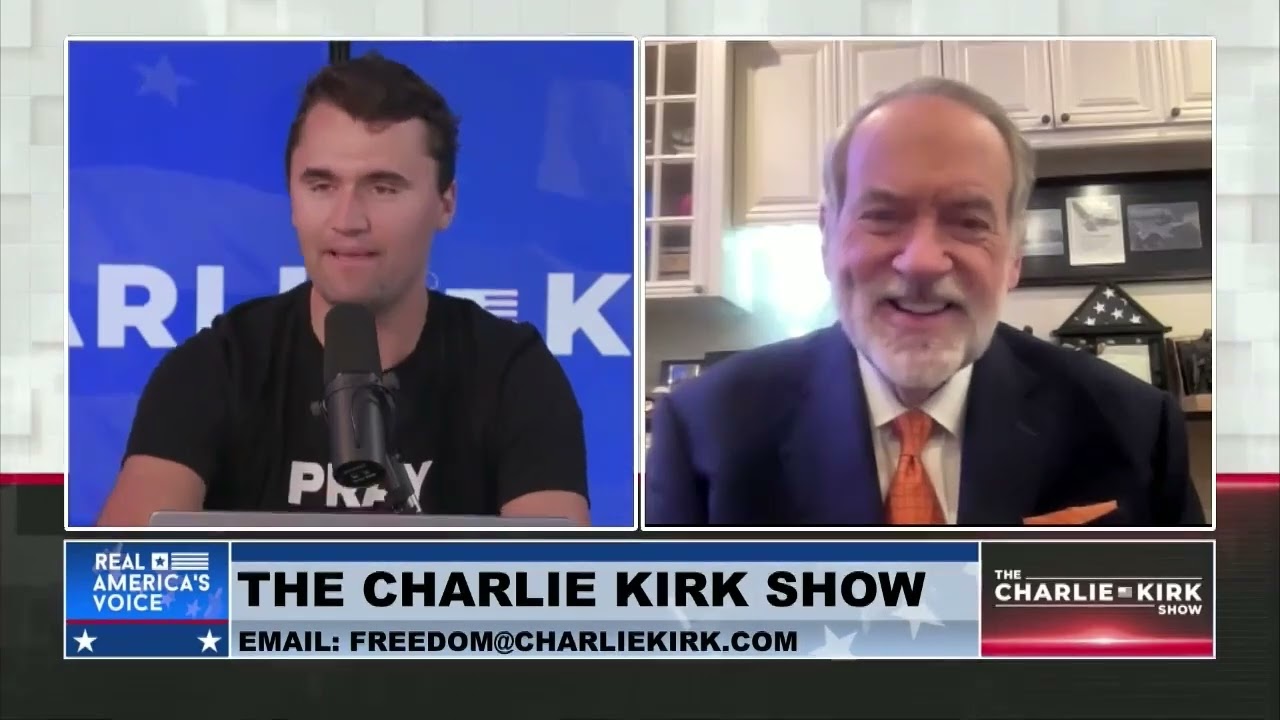
Charlie Kirk and Mike Rowe Discuss the Blue Collar Renaissance America Desperately Needs
Charlie Kirk sits down with Mike Rowe to discuss the urgent need for skilled tradespeople in America. With 7.6 million open jobs and 500,000 vacant manufacturing positions, Rowe explains why AI threatens coders but not welders, plumbers, and electricians. The conversation explores how parents and educators have steered an entire generation away from the trades, creating a cultural crisis that threatens American prosperity. Rowe shares his experience speaking at a Pittsburgh energy summit where CEOs pledged $92 billion to create jobs, but warns that creating jobs is meaningless without creating enthusiasm for them.
Mike Rowe joined Charlie Kirk to discuss one of America's most pressing yet underreported crises: the massive shortage of skilled tradespeople. Speaking from his recent appearance at an energy and AI summit in Pittsburgh, Rowe painted a stark picture of the American economy. While artificial intelligence threatens to displace coders and white-collar workers, the country desperately needs welders, electricians, plumbers, steam fitters, pipe fitters, and HVAC technicians.
The numbers are staggering. At the time of the conversation, America had 7.6 million open jobs, the vast majority of which don't require a four-year degree. Within that cohort, 482,000 manufacturing jobs sit vacant. Larry Fink, speaking at the same Pittsburgh summit, declared the need for 500,000 electricians in the next few years. The maritime industry needs 140,000 welders for submarines. The automotive industry requires 80,000 people in collision repair. The energy sector is short 67,000 workers.
Yet despite this overwhelming demand, these positions remain unfilled. The problem isn't a lack of opportunity. It's a cultural disease that has convinced parents, students, and educators that these jobs represent failure rather than success.
The Pittsburgh Energy Summit and a $92 Billion Commitment
Rowe described attending what he called "one of the craziest events I've ever attended" due to its importance and the lack of media coverage it received. The energy and AI summit in Pittsburgh was convened by Pennsylvania's two sitting senators, Republican David McCormick and Democrat John Fetterman. The event brought together hundreds of attendees and 30 to 40 CEOs from the biggest companies in the country.
President Trump was there, and Rowe found himself on stage with the president and 30 CEOs as they pledged $92 billion to create jobs in the energy sector, specifically in Pennsylvania, for building data centers that function as AI factories. Rowe was invited, he explained, "to sort of remind the crowd that creating jobs is different than creating enthusiasm for jobs."
Rowe positioned himself as "kind of a Debbie Downer in a situation like that" because many people still believe that creating jobs or opportunities automatically solves the unemployment problem. But that idea, he argued, "collapses under its own weight" when you consider the millions of jobs already sitting vacant.
The Obama Promise and the Shovel-Ready Problem
Drawing a historical parallel, Rowe recalled supporting President Obama in 2009 when he promised 3 million shovel-ready jobs through his highway infrastructure act. But even then, Rowe warned publicly that "you're going to have a tough time selling 3 million shovel-ready jobs to a country that is not all that enthused about picking up a shovel."
The same concern applies today. Rowe supports President Trump's efforts toward reshoring and reindustrialization, describing himself as wanting to see a manufacturing renaissance in America. But he worries that if the president succeeds in creating a couple million jobs, those positions will go unfilled just like the 500,000 manufacturing jobs that currently sit vacant.
The problem isn't economic. It's cultural. And that's why Rowe showed up to the Pittsburgh summit in "the only suit and tie that I actually own," as he put it, dressed so formally that even President Trump said he didn't recognize him. Rowe joked that all his other suits are rubber.
The Death of Shop Class and the Removal of Proof
Charlie Kirk, who identifies as an outspoken critic of the current college model and someone who represents blue-collar workers he calls "the muscular class," pressed Rowe on the cultural problem. Parents around the country, Kirk noted, would rather have their children go into debt studying sociology at Wellesley than work in construction. Even when a son expresses interest in becoming an electrician, parents often discourage it rather than celebrating a path that could lead to better character, a healthier financial balance sheet, less debt, and greater job opportunities than studying communications at University of Illinois.
Rowe acknowledged being sympathetic to parents who are desperately trying not to mess up their children's futures. Without a playbook for parenting, they fall into cookie-cutter thinking, influenced by politicians and others who paint with a broad brush and tell them that the best path for most people is the most expensive path, and that their kids are doomed without it.
This messaging, combined with federal student loans creating "a bottomless pile of free money," allowed universities to charge whatever they wanted. An entire generation was encouraged to borrow whatever it takes to fulfill their dreams. But the most damaging decision, according to Rowe, was "the removal of shop class from high school."
The elimination of shop classes didn't just widen the skills gap. It removed "any optical proof that a regular kid could have that these muscular jobs exist." Walking from English to math class and sticking your head in the metal shop provided students with at least a glimpse of what work looked like. When schools removed these programs, they eliminated the evidence that alternatives to college existed.
Parents were left believing there was only one path for their children, and everything else, including welding, became viewed as "some sort of vocational consolation prize." Rowe's conclusion: "Well, the chickens have come home to roost."
AI Is Coming for Coders, Not Welders
One of the most powerful points Rowe made, which Charlie Kirk noted went viral, was his observation that artificial intelligence is coming for white-collar jobs, not blue-collar ones. "AI is coming for the coders," Rowe declared. "It's not coming for the welders. It's not coming for the plumbers. It's not coming for the steam fitters or the pipe fitters or the HVAC. They're not coming for the electricians."
For 15 years, young people were told to "learn to code." Now those jobs face disruption from AI, while the welder's job remains secure. And that welder is making mid-six figures.
The Individual Success Stories Behind the Numbers
Rowe emphasized that while it's difficult to give definitive salary figures because they vary state by state, the earning potential in the trades is substantial. Through his work, he has trained 2,500 welders, many of whom earn well into the six figures. He recently spoke with someone who returned from the Gulf of Oman doing underwater welding for $300,000 a year, tax-free. At the same time, there are welders in Louisiana and Ohio making $55,000 to $60,000.
But Rowe stressed that the conversation shouldn't stop at hourly wages. People talk about welders, electricians, steam fitters, and pipe fitters as workers, period. But the reality is that the vast majority of small businesses in America were formed by people, mostly men, who mastered a skill in demand and then bought a couple of vans, hired their buddies, and built mechanical contracting companies doing millions of dollars a year.
"Those stories need to be told as well," Rowe insisted, distinguishing between macro and micro economics. While the Pittsburgh summit focused on the macroeconomy and macro work, Rowe focuses on "microworks." He doesn't want to lose sight of the individual or the fact that mastering a skill in demand can put the right person, with a modicum of entrepreneurial spirit and ambition, on a road that leads to prosperity.
More Welders Who Read Philosophy, Not Fewer Philosophers
When Kirk praised Rowe for giving dignity to people who are often looked down upon, Rowe agreed but added an important nuance. He recalled Marco Rubio saying during his 2015 campaign that "our country needs more welders and fewer philosophers."
"He's right, but he's not correct," Rowe explained. On a macro level, the country isn't facing a crisis over a shortage of sociologists or philosophers. But on an individual level, the message is more nuanced. "What we need, I believe, on an individual level are more welders who can talk intelligently about Nietzsche and Descartes."
Rowe pointed to Kirk himself as an example, noting that Kirk didn't go to college but is educated, curious, and has a better liberal arts background than most liberal arts students Rowe has met. Equally true, Rowe argued, is that society would benefit from "more philosophers who could run an even bead" and have intelligent conversations about the muscular trades.
The point isn't to paint with too broad a brush. But when a billionaire like Larry Fink is "freaking out over 500,000 empty slots in electricians," the urgency becomes clear. Not a week goes by, Rowe said, without hearing from the American industrial base, the maritime base, the automotive industry, or the energy sector about their desperate need for skilled workers. "A memo has gone out. The C-suite are paying attention and that's good news."
The Solution: Authentic Stories That Move the Needle
Kirk pressed Rowe on what he identified as the biggest impediment: the cultural gap. How do we make parents comfortable with their children entering the trades? How do we make it socially and culturally acceptable?
Rowe's answer was clear. First, it will take time. Second, it's a multi-front war. But there's only one thing he's seen that actually moves the needle with parents, guidance counselors, and students: honest, authentic conversations with people who look like them, talk like them, have mastered a skill in demand, and are prospering as a result.
At Mike Rowe Works, Rowe now spends most of his time finding people the foundation assisted five or six years ago and getting their stories through Zoom calls or in-person meetings. He told the crowd in Pittsburgh: "Look guys, you just committed $92 billion with a B. I was in the room. I see what you're doing. For the love of God, carve off a fraction of a percentage of that and allocate it to tell the stories of the people in the industries you hope to reinvigorate."
Rowe offered to help, noting that while Mike Rowe Works is modest by foundation levels, they'll give away $5 million the following month in work ethic scholarships. But he needs resources to tell those stories from sea to shining sea, because that's how the needle will move.
"The evidence is on our side," Rowe said. "The proof is in the pudding. We simply have to tell it and then parents will get it. But it will take time. I wish I could flip a switch. I can't."
A Voice Made for This Moment
Charlie Kirk concluded by noting that Mike Rowe has been consistent on this theme for Kirk's entire life, and that Rowe's voice is more important now than ever. "I really think that he is made for this moment," Kirk said. There are millions of young people, primarily young men, looking for purpose who don't know what to do other than get good grades, become lawyers or consultants, and then potentially watch AI take their jobs away.
The conversation between Kirk and Rowe illuminated a crisis that sits at the intersection of economics, education, culture, and opportunity. With 7.6 million jobs unfilled and an entire generation steered away from the skills that could fill them, America faces a challenge that billions of dollars in job creation cannot solve alone. What's needed is a cultural shift that restores dignity, respect, and enthusiasm for the work that literally keeps the country running.









Comments
Be the first to comment on this video.