Charlie Kirk Calls Christians to Action: Why Biblical Duty Demands Political Engagement This Election Day
Enjoying this? Share it with someone who needs to see it.
Up Next
Charlie Kirk on Dobbs Decision: How Donald Trump's Supreme Court Appointments Saved Millions of Lives from Abortion
1:21:15
Charlie Kirk Rallies Arizona Crowd After RFK Jr Endorsement of Donald Trump
17:45
Charlie Kirk and Frank Turek Examine Evidence for Christianity and the Implications of Roe v Wade Reversal
1:14:18
Charlie Kirk Calls Christians to Action: Why Biblical Duty Demands Political Engagement This Election Day
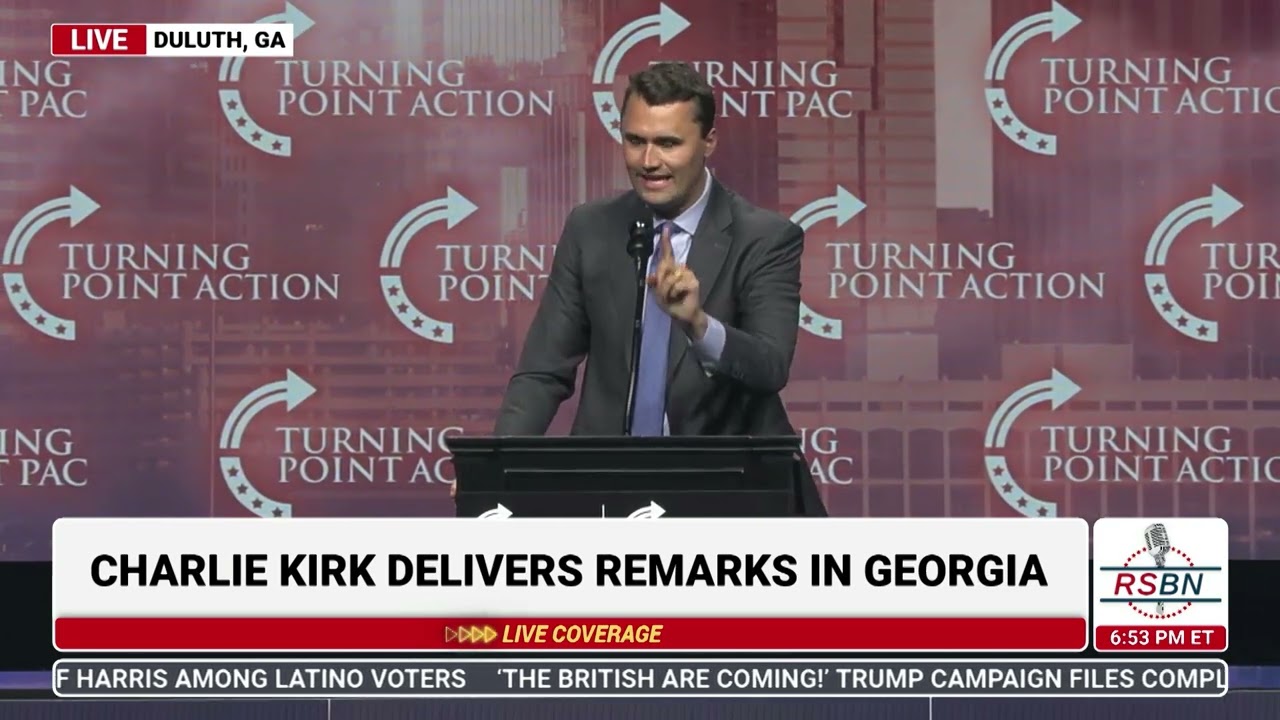
Charlie Kirk addresses Christians in New Mexico about their biblical responsibility to participate in government and elections. Speaking from Legacy Church in Albuquerque, Kirk argues that scripture commands believers to seek the welfare of their nation, citing Jeremiah 29:7 and other passages. He outlines three critical issues on the ballot: affirming the church as essential, protecting children from gender ideology in schools, and defending life from conception. Kirk challenges common Christian objections to voting, from the belief that politics don't matter to concerns about vote integrity, while emphasizing that imperfect political candidates can still serve God's purposes, just as biblical figures like David, Paul, and Samson did despite their flaws.
The Biblical Case for Christian Political Engagement
Charlie Kirk opened his message at Legacy Church in Albuquerque, New Mexico, by addressing a fundamental question facing Christians: should believers involve themselves in politics, or should they remain detached? Kirk argued that a growing belief among some Christians that they should not care about government represents a dangerous heresy.
While affirming that Jesus must remain at the center of everything believers do, Kirk described his political work as "the second most important thing"—ensuring that Christians can freely do the first and most important thing: spreading the gospel. He emphasized that protecting religious freedom, keeping churches open, and preserving Christian education systems are essential prerequisites for effective ministry.
Jeremiah 29:7 and the Command to Seek National Welfare
Kirk anchored his argument in Jeremiah 29:7, which instructs believers to "seek the welfare of the nation that you are in because your welfare is tied to your nation's welfare." He explained that the Hebrew word translated as "seek" carries the stronger meaning of "demand," "require," or "go to your leaders and say you want it a certain way."
This scripture, Kirk argued, provides clear teaching that Christians should care deeply about what happens in their communities and nation. He pointed to visible deterioration in New Mexico over the past decade, particularly along Route 66 and Central Avenue in Albuquerque, as evidence of what happens when political leaders fail and Christians disengage.
Three Non-Negotiable Issues for Christian Voters
Kirk identified three biblical issues that he believes are literally on the ballot, affecting churches, Christianity, and the gospel itself.
The Church Is Essential
Kirk praised Pastor Steve and Legacy Church for their stand against what he called the tyranny of New Mexico's governor during pandemic-related church shutdowns. He argued that the church proved more essential than strip clubs, liquor stores, Home Depot, marijuana dispensaries, and abortion clinics—all of which remained open while churches were forced to close.
Addressing the common phrase "separation of church and state," Kirk clarified that this concept does not appear in the Constitution, the Federalist Papers, or the Declaration of Independence. He explained it originated from a single letter Thomas Jefferson wrote to the Danbury Baptist Convention, actually guaranteeing the church protection from government persecution, not the other way around.
Kirk challenged the inconsistency: if separation of church and state truly existed as commonly understood, why could the government shut down churches while Christians supposedly cannot participate in government? He argued this represents an attempt to control Christians while denying them a voice in governance.
God Created Male and Female
The second issue Kirk identified was affirming that God created man and woman, and that men cannot become pregnant. While acknowledging this topic is controversial, he argued that even in a pluralistic society, there must be a clear line: such ideology should never be taught to children in public schools.
Kirk expressed particular concern about what he called "incredibly aggressive irreversible medical interventions" that are "medically mutilating tens of thousands and soon to be hundreds of thousands of children across the country." He called on Christians to declare that children are off limits, especially when schools introduce pornographic content and teach gender ideology to eight, ten, eleven, and twelve-year-olds.
Life Begins at Conception
Despite being told this is a "losing issue" politically, Kirk insisted that protecting life from conception is non-negotiable for Christians. He cited multiple biblical passages supporting this position: Psalms teaching that people are "fearfully and wonderfully made," Jeremiah stating "I knew you before you were in the womb," and the account of John the Baptist leaping in Elizabeth's womb at the sound of Jesus.
Kirk connected this issue to the fundamental Christian belief that humans are made in the image of God with eternal souls. He contrasted this with a worldview based on Darwinian evolution, arguing that if humans are merely accidents of random processes, there would be no moral barrier to abortion. But when each person is understood as having a soul made in God's image, every life deserves equal protection under the law.
Kirk noted that Albuquerque has become the late-term abortion capital of the world, suggesting this contributes to the "spiritual darkness and pressure that plagues this city." He referenced Ephesians 5:2, which calls believers to expose evil deeds, arguing the church must take a stand on this issue.
Addressing Common Objections to Christian Voting
The "My Vote Will Be Stolen" Excuse
Kirk addressed the objection that there's no point in voting if votes might be stolen. While acknowledging this possibility, he argued that not voting guarantees a zero percent chance of saving the Republic, while voting provides at least some chance. He characterized refusing to vote as essentially acknowledging that the enemy has won.
The "I Don't Have Time" Excuse
Kirk dismissed the excuse of not having enough time to vote, pointing out that people willingly wait 20 minutes at Starbucks for coffee or 15 minutes at McDonald's, but claim they cannot spare 10 to 20 minutes to vote early or on Election Day. He suggested this represents spiritual opposition whispering excuses.
The Apathy Problem Among Christians
Kirk shared a troubling statistic: only half of regular church-attending Christians vote in midterm elections, while 56 percent of secular people vote. He suggested part of the problem is that most churches, unlike Legacy Church, do not encourage their congregations to vote and participate in civic life.
He cited James 4:17, which states "for whoever knows the right thing to do and fails to do it, for him it is sin," arguing that failing to vote after understanding its importance constitutes rebellion against God.
Biblical Examples of Political Engagement
Kirk challenged the notion that Jesus was not political or that Christians should ignore worldly affairs. He asked whether anyone could find scripture where God encourages believers to ignore what's happening in the world around them, arguing instead that Jesus tells believers to lean into evil and "be not afraid."
He cited Matthew 28:19, the Great Commission, emphasizing that Jesus commanded disciples to make disciples "of all nations." Kirk argued that true discipleship goes deeper than conversion and includes caring about the welfare of the nation. He listed biblical examples of believers who sought to influence secular government for God's purposes: Daniel, Esther, Mordecai, Jeremiah, and Nehemiah.
Kirk also referenced Jesus's teaching in Matthew 5 about believers being salt and light. Salt and light both change the environment they encounter—salt preserves and transforms, while light drives out darkness. Kirk challenged Christians to ask themselves whether they are actually changing their environment or simply blending in.
God Uses Imperfect Vessels
Addressing the objection that political candidates are not "Christian enough" or "Christ-like enough," Kirk argued that God consistently uses broken, imperfect people throughout scripture. He provided a lengthy list of biblical figures with serious flaws: Joseph, Job, Samson, Rahab, the Samaritan woman, Noah, Jeremiah, Jacob, David, Jonah, Naomi, Peter, Martha, Zacchaeus, and Paul—people who were adulterers, prostitutes, tax collectors, and persecutors of Christians.
Using Donald Trump as an example of a controversial political figure, Kirk clarified that he was not suggesting electing such a person to church leadership, but rather hiring someone who "knows how to fight" as a kind of bodyguard for religious freedom. He credited Trump with doing more for the unborn than almost any other president through his Supreme Court appointments of Kavanaugh, Amy Coney Barrett, and Gorsuch.
Kirk illustrated this point with the example of Samson, whom God used despite finding him in a prostitute's bed, enabling him to kill a thousand Philistines with the jawbone of a donkey and eventually earning a place in Hebrews' Hall of Faith. Similarly, Paul—who wrote most of the New Testament—had persecuted Christians before his conversion.
Responding to Eschatological Objections
Kirk addressed Christians who say Jesus is coming soon so political engagement doesn't matter. While acknowledging he doesn't know the timing of Christ's return, he argued that uncertainty about timing should never become an excuse for inaction. Instead, if believers truly think Jesus is coming soon, they should want to do more for His kingdom, not less, and should be even more determined to be salt and light.
The Unique Gift of American Citizenship
Kirk emphasized the unprecedented nature of American citizenship, where people are co-owners of their nation rather than serfs, slaves, or subjects. He highlighted the brilliance of the Constitution's structure: separation of powers, consent of the governed, and an independent judiciary. The ability to participate in elections, he argued, is something unique, beautiful, and unprecedented that demands Christian gratitude and engagement.
He cited Proverbs 14:34—"righteousness exalts a nation but sin is a reproach to my people"—as a reminder that Christians have a responsibility to communicate what righteousness means and how to glorify God in the public square.
A Call to Reject Apathy and Enter the Arena
In his closing appeal, Kirk described sensing something "seismic" developing across the country—from Pennsylvania to North Carolina, Michigan, Wisconsin, Arizona, Oregon, and New York. But he emphasized this momentum would mean nothing if Christians remained mere spectators.
Kirk specifically praised New Mexico believers for their dedication despite being overlooked by national political organizations. He noted the fasting, praying, organizing, and fundraising happening in the state, and argued that if every person in the room brought three friends to the polls, the multiplication effect could shock the world.
His final call to action was for Christians to fulfill Jesus's commandment to be salt and light by changing their environment. He framed voting not as an extraordinary sacrifice like storming Normandy Beach, but as a simple duty that honors those who sacrificed for freedom and serves future generations.
Kirk concluded with an appeal to reject apathy and pessimism, to get into the arena, and to recognize that political engagement is ultimately about protecting the gospel and serving "the least of these." He challenged Christians to flood the polls on Election Day as a biblical duty, ending with a blessing over New Mexico.