2,428 videos 1,380,136,590 views US Joined Aug 30, 2018
Charlie Kirk is the Founder and President of Turning Point USA, the largest and fastest growing conservative youth activist organization in the country with over 250,000 student members, over 150 full-time staff, and a presence on over 2,000 high school and college campuses nationwide. Charlie is also the Chairman of Students for Trump, which aims to activate one million new college voters on campuses in battleground states in the lead up to the 2020 presidential election. His social media reaches over 100 million people per month and according to Axios, he is one of the "top 10 most engaged" Twitter handles in the world. He is also the host of “The Charlie Kirk Show,” which regularly ranks among the top news shows on Apple podcast charts.
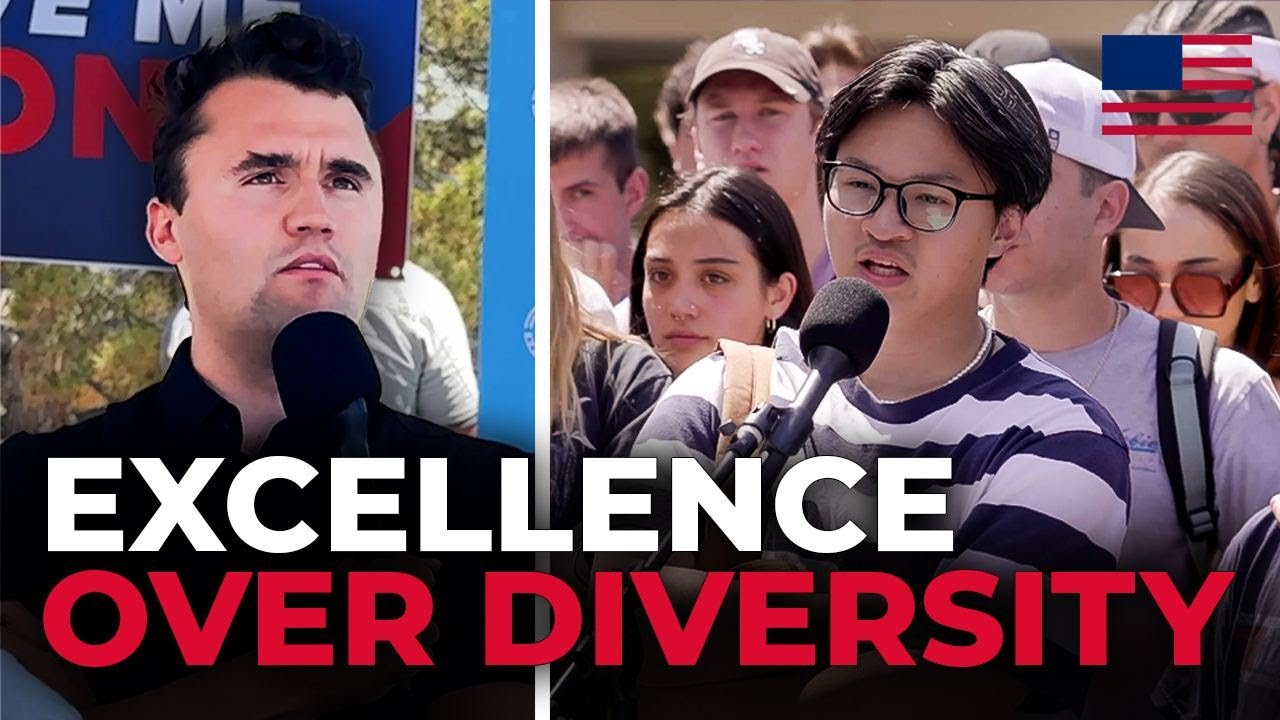
Charlie Kirk Challenges Student on Diversity Versus Excellence in College Admissions at Campus Debate
Charlie Kirk engages in a pointed exchange with a college student who advocates for diversity as a measure of campus excellence. When pressed to provide examples where racial prioritization leads to academic achievement, the student struggles to respond. Kirk argues that merit and competency should be the sole criteria for college admissions, regardless of the racial makeup that results. The conversation exposes fundamental tensions in how Americans think about diversity, excellence, and fairness in higher education, with Kirk insisting that pursuing the best outcomes, even if that means a classroom of 100 Asian students in Harvard math, should trump demographic engineering.
Charlie Kirk confronted a college student in a campus discussion that cut to the heart of one of America's most contentious debates: Should universities prioritize diversity or excellence? The student opened by expressing a preference for attending a diverse college campus, equating diversity with excellence. Kirk immediately challenged this assumption, asking the student to provide concrete examples where prioritizing race has led to genuine academic achievement.
The student struggled to answer, unable to name a single institution where racial preferences have demonstrably produced superior outcomes. Kirk seized on this moment of clarity, not to shame the student, but to establish the core principle at stake in the debate over college admissions policies.
Merit Should Trump Demographics
Kirk articulated a straightforward position: American institutions, particularly elite universities like Harvard, should focus exclusively on competency and merit when making admissions decisions. If this approach results in 100 Asian students in every Harvard math class, Kirk argued, so be it. The goal should be achieving the best possible outcomes, not engineering a student body that looks diverse on paper but may sacrifice academic standards in the process.
This perspective challenges the prevailing orthodoxy at many American universities, where diversity initiatives have become central to admissions policies. Kirk suggested that the current approach often produces environments where "everyone looks different but thinks the same," questioning whether surface-level diversity actually delivers the intellectual diversity and academic rigor universities claim to value.
Clarity Over Comfort
Throughout the exchange, Kirk emphasized the importance of clarity in these discussions. He acknowledged that people must be honest about their priorities: Do they want institutions that look diverse, or institutions that perform at the highest levels? Kirk's argument rested on the premise that these goals often conflict, and that Americans must choose which value takes precedence.
The conversation highlighted a fundamental tension in American higher education—between those who believe diversity itself is a form of excellence and those who believe excellence should be the sole measure of success, with demographic outcomes being incidental rather than intentional. Kirk firmly planted himself in the latter camp, arguing that competency must be the non-negotiable standard.