Charlie Kirk Confronts Socialist Student on Private Property and Individual Freedom in America
Enjoying this? Share it with someone who needs to see it.
Up Next
Charlie Kirk Debates Socialist Student on Capitalism, Billionaires, and Healthcare at Turning Point USA Event
2:31
Charlie Kirk Debates UVM Socialist Student on Native American Policy and Failed Economic Systems
5:40
Voluntary Charity Versus Government Coercion: A Powerful Exchange on Socialism and Capitalism
1:04
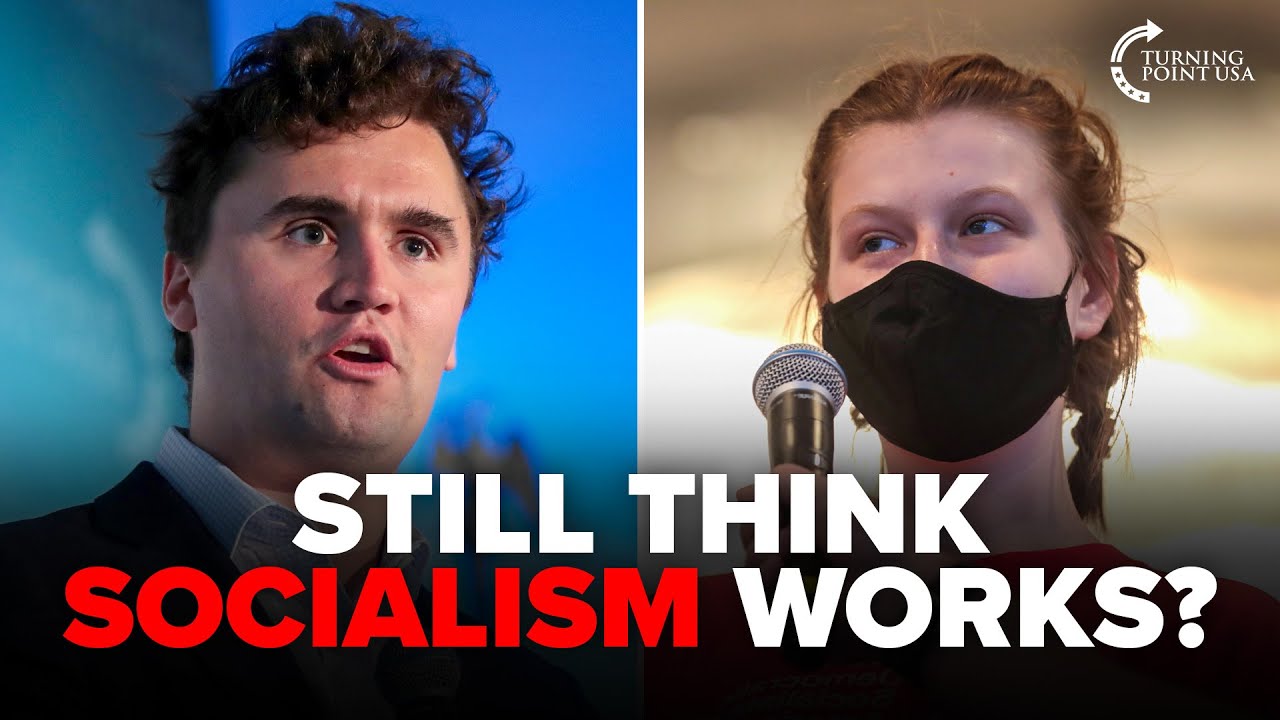
Charlie Kirk Confronts Socialist Student on Private Property and Individual Freedom in America
A heated exchange unfolds as Charlie Kirk challenges a student defending socialism. When the student claims to have no problem with profit but questions factory ownership, Kirk cuts through the rhetoric with a pointed observation: socialists always want to impose their moral compass on others. He illustrates how capitalist societies allow socialist communities like the Amish to thrive peacefully, while capitalist individuals face violence in socialist nations like Venezuela. The conversation exposes the fundamental tension between individual liberty and collectivist control.
The debate began with a direct confrontation over definitions and honesty. Charlie Kirk pressed the student on their characterization of his position, asking them to clarify what exactly he was supposedly lying about. The student claimed Kirk had misrepresented socialist beliefs about property ownership, arguing there have been thousands of different variations of socialism throughout history.
Kirk acknowledged this diversity but pointed to a consistent pattern: when socialism has been implemented over the past century, it has consistently abolished private property. He defined private property not as personal possessions but as ownership of productive assets - owning four factories, for example, which employ workers who earn benefits, send their children to school, and put food on their tables. Kirk challenged the fundamental premise that there is something inherently wrong with owning a factory or business that creates wealth in society.
The Economics of Profit and Risk
The student attempted to explain their economic framework, noting that profit requires selling goods or services for more than production costs. They acknowledged that someone must provide initial capital to purchase materials and that this involves risk - either through personal investment or loans. The student stated they had no problem with people being compensated for their initial investment.
This is precisely where Kirk interrupted with his most pointed critique.
The Problem With Socialist Moral Imposition
Kirk cut through the student's conciliatory language to expose what he sees as the central flaw in socialist thinking. He emphasized that he doesn't care what the student thinks or believes - the issue is that socialists constantly try to impose their beliefs on others. When the student said "I have no problem with people being paid back their input," Kirk fired back: "I don't care what you think. You say I have no problem - this is the problem with socialists. It's always like what I believe. I'm never going to tell you how to live your life. Why are you trying to tell other people how to live theirs?"
The student protested that they weren't trying to tell others how to live, but Kirk had already identified the contradiction: the student had just said "I have no problem" with certain economic arrangements, as if their approval mattered. Kirk argued that this reveals the socialist mindset - that one's personal moral compass should be imposed on society at large.
Freedom: You Can Be Socialist in Capitalism, But Not Capitalist in Socialism
Kirk then delivered what he considers the definitive argument for capitalism over socialism: in a capitalist society, people are free to live as socialists, but in a socialist society, people cannot live as capitalists. This isn't theoretical - it's demonstrated by real-world examples.
He pointed to the Amish as his prime example. The Amish live as peaceful socialists within the United States, a predominantly capitalist country. They live in communes, produce their own goods and services, and share resources among their community. No one prevents them from this lifestyle or forces them to participate in capitalism beyond their choosing. They exist peacefully alongside capitalist society.
The contrast with socialist nations couldn't be starker. Kirk noted that if someone tries to live as a capitalist in Venezuela - a socialist country - they face violent consequences. The implication is clear: capitalist systems tolerate and even protect alternative economic arrangements, while socialist systems enforce conformity through coercion and violence.
The Fundamental Question of Freedom
This exchange crystallizes the deeper philosophical divide between these worldviews. Kirk's position rests on the principle that individual liberty must be the foundation of society. People should be free to organize their economic lives as they see fit - whether that means starting businesses, joining communes, or anything in between - as long as they don't force their choices on others.
The socialist position, as Kirk characterizes it, inherently requires imposing a particular economic structure on everyone. Even when individual socialists claim to be tolerant of different arrangements, the logic of their system requires control over productive property and economic decision-making. There's no mechanism in socialist theory for allowing true capitalist activity to continue, because private ownership of productive assets is seen as exploitative and must be eliminated.
Kirk's challenge to the student was ultimately about consistency and honesty. If socialists truly believed in freedom and voluntary association, they would have no objection to others choosing capitalism. But socialism as a governing system cannot tolerate capitalist activity, while capitalism can and does tolerate socialist communities. This asymmetry reveals which system truly values individual freedom and which demands conformity to a collective ideal.