2,422 videos 1,389,747,653 views US Joined Aug 30, 2018
Charlie Kirk is the Founder and President of Turning Point USA, the largest and fastest growing conservative youth activist organization in the country with over 250,000 student members, over 150 full-time staff, and a presence on over 2,000 high school and college campuses nationwide. Charlie is also the Chairman of Students for Trump, which aims to activate one million new college voters on campuses in battleground states in the lead up to the 2020 presidential election. His social media reaches over 100 million people per month and according to Axios, he is one of the "top 10 most engaged" Twitter handles in the world. He is also the host of “The Charlie Kirk Show,” which regularly ranks among the top news shows on Apple podcast charts.
Charlie Kirk Debates Affirmative Action and Merit With Student Who Claims You Cannot Be Racist Against White People
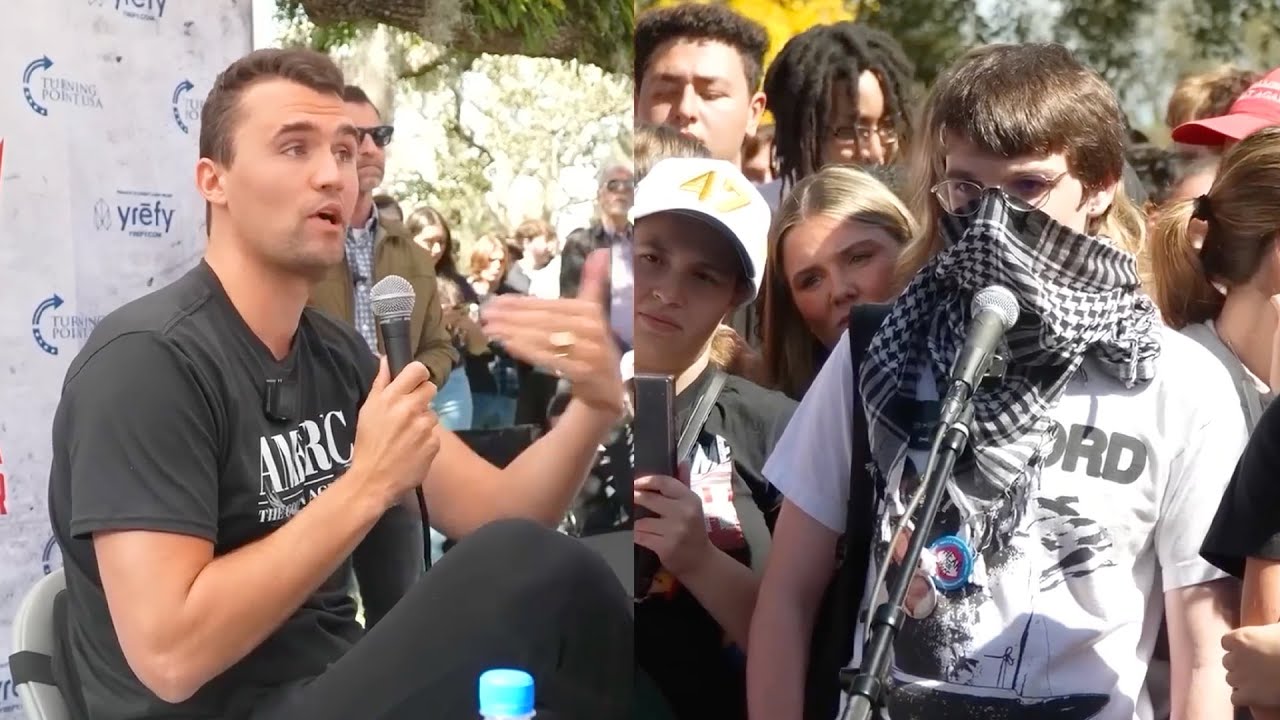
Charlie Kirk engages with an anonymous student at the University of South Florida who challenges his views on the Civil Rights Act and affirmative action. The conversation turns heated when the student argues that anti-white racism doesn't exist and defends race-based admissions policies as necessary for equity. Kirk counters by explaining how affirmative action practices amount to discrimination based on skin color, arguing for a merit-based system instead. The exchange culminates in the student's admission that you cannot be racist against white people, highlighting the stark divide between race-obsessed and merit-focused worldviews in modern America.
An anonymous student at the University of South Florida approached Charlie Kirk with a provocative question about the Civil Rights Act. After an awkward introduction filled with nervous humor, the student claimed that Kirk had said the Civil Rights Act was bad and questioned why he would hold such a position.
Kirk clarified his stance, explaining that while he believes in part of the essence of the Civil Rights Act, it went too far and too wide. He specifically pointed to how it created what he calls a "Civil Rights Leviathan" that gave rise to affirmative action policies. According to Kirk, these policies allowed the Department of Justice to discriminate against people based on skin color, particularly white people, preventing them from getting jobs and college admissions on equal footing.
The Equity Argument
The student, who identified as having a high GPA, pushed back by introducing the concept of equity. He argued that students born in poor areas with failing schools face systemic disadvantages. According to this view, lowering admission standards for students from these circumstances would be fair because they demonstrated merit relative to their opportunities.
Kirk responded with a thought experiment, asking the student if he would be willing to give his GPA to a woman of color standing nearby. When the student said he could just work it back up, Kirk pressed further, explaining that in an equity system, there is no working back up because resources are continuously redistributed. He emphasized that "that which is given must first be taken."
Breaking Down Affirmative Action
Kirk explained how affirmative action works in practice using college admissions as an example. With a finite number of spots available at any university, lowering test score requirements for some students necessarily means raising the bar for others. If a woman of color can enter with lower scores, then a white student must have higher scores to compete for the same limited positions. This, Kirk argued, is definitionally a redistribution based on race.
The student questioned whether eliminating these policies would prevent black people from uplifting themselves economically and creating prosperous families. Kirk turned the question around, asking whether affirmative action had actually made black America more successful over the past 40 years despite robust implementation of such policies.
Defining Racism
Kirk challenged the student to define racism. After some hesitation, the student provided what he called a simple answer: discrimination based on the color of someone's skin. Kirk immediately pointed out the contradiction in the student's position. If racism is discrimination based on skin color, then affirmative action policies that penalize white people in college admissions and hiring based on their skin color would be racist by the student's own definition.
The conversation took a dramatic turn when the student declared that you cannot be racist against white people. This statement drew audible reactions from the crowd and became what Kirk later acknowledged as "the clip" from the exchange.
Two Competing Worldviews
Kirk contrasted two fundamentally different approaches to organizing society. He argued that the student's worldview, which prioritizes racial categorization and different treatment based on skin color, is indistinguishable from the ideology of the KKK. Both organize the world based on racial identity rather than individual merit.
In contrast, Kirk presented the conservative vision of organizing society based on merit and character, evaluating people by how hard they work and what they bring to the table. He described race-based policies as destructive, tribalistic, and divisive, arguing they undermine national excellence. He rejected the idea of treating people as members of tribes to be managed for political purposes rather than as individuals made in the image of God.
The Soft Bigotry of Low Expectations
When the student asked whether black neighborhoods would improve under Trump without affirmative action policies, Kirk pointed to economic data from Trump's first term. He noted that black Americans experienced what he described as their greatest economic renaissance since the 1950s, with record-low unemployment, community revitalization, and investment through opportunity zones.
Kirk argued that all communities do better when society stops operating under what he called "the soft bigotry of low expectations." He challenged the inherent assumption in the student's argument that certain communities need special treatment based on skin color because they cannot perform as well as white people. Kirk rejected this premise entirely, advocating instead for evaluating everyone by the same standard regardless of skin color.
Race-Obsessed vs. Merit-Obsessed
Kirk highlighted examples of what he sees as the extreme consequences of race obsession in modern America. He mentioned that hundreds of schools now have black-only dormitories where white people are not allowed, and many universities hold separate black-only graduation ceremonies. When the student dismissed these as "aesthetic" issues that don't affect material conditions, Kirk pointed out the double standard: white-only dormitories would trigger protests and outrage.
He presented a stark choice: society can be either race-obsessed or merit-obsessed. Conservatives, Kirk argued, choose to build a country based on how hard people work and what they deliver, not on the color of their skin.
Economic Policy and Results
The student attempted to credit Obama-era policies for the economic improvements black Americans experienced during Trump's first term, arguing that economic policies work on a time delay. Kirk predicted that when the economy improves under Trump's current term, critics will similarly attribute the success to Biden-era policies.
The conversation shifted to Elon Musk's efforts at government efficiency, which the student criticized as simply firing everyone, comparing it to what happened with Twitter. The student claimed Twitter had become a "Nazi haven" and referenced what he believed was a Nazi salute by Musk. Kirk dismissed this characterization.
The exchange concluded with Kirk thanking the student, noting that the conversation perfectly illustrated why conservatives won in November. The student's positions and arguments, particularly the claim that racism against white people is impossible, served as a reminder of the ideological divide that motivated voters.