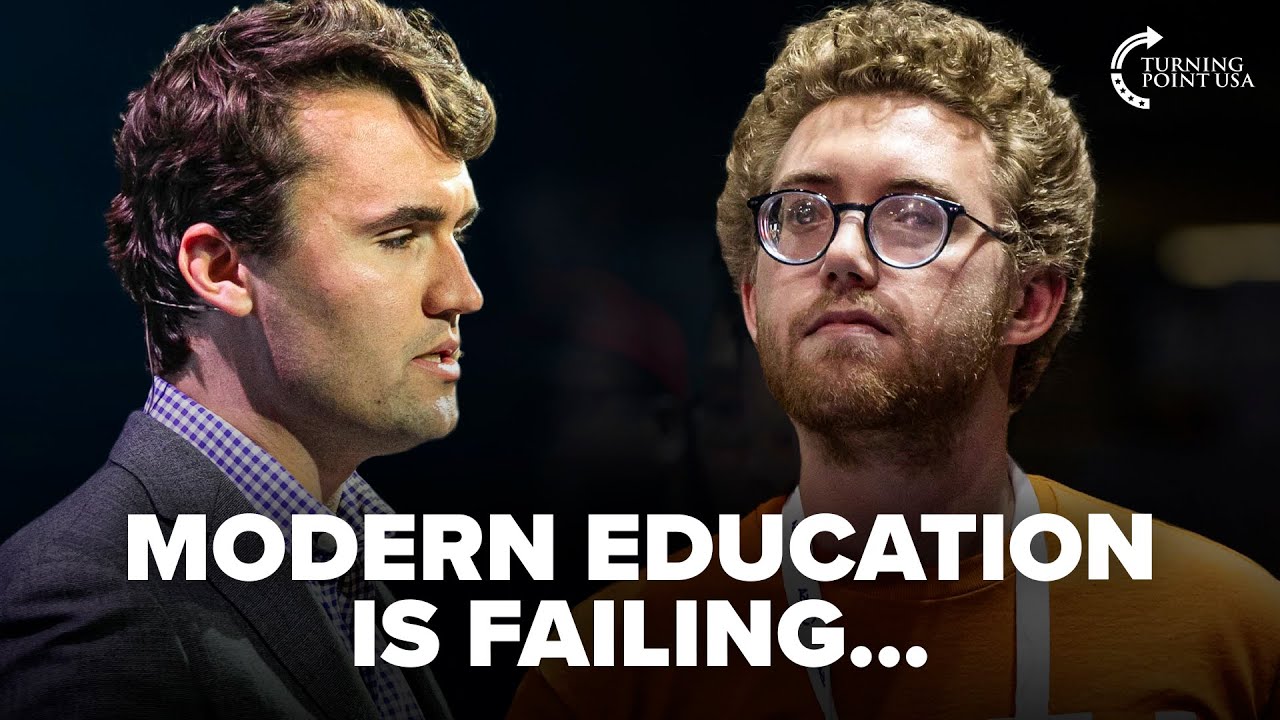
Charlie Kirk Debates College Student on Why College is a Scam and the Economics Degree Dilemma
Enjoying this? Share it with someone who needs to see it.
Up Next
Charlie Kirk Debates University of Washington Students on Whether College Is a Scam
13:31
Charlie Kirk Tells Math Major Why AI Will Replace Actuaries and College Is a Scam
9:30
Charlie Kirk Debates College Student on Whether Higher Education Is a Scam in America
7:22
Charlie Kirk Debates College Student on Why College is a Scam and the Economics Degree Dilemma
Charlie Kirk engages in a revealing debate with an economics student about whether college is truly worth the investment. The discussion explores sobering statistics: 41% of students don't graduate, half will get jobs that don't require their degree, and most are forced to take meaningless classes like mandatory diversity requirements. Kirk argues that 11 million jobs paying $75,000 annually require only 6 weeks of training, not a four-year degree. The student pushes back with Federal Reserve data suggesting college pays off by age 40, but Kirk counters that only the top 10% of graduates actually see returns. This exchange captures the tension between traditional college advocacy and the emerging critique of higher education's value proposition.
A direct exchange between Charlie Kirk and a college student studying economics reveals the fundamental disagreements about higher education's worth in America. The student challenges Kirk to explain his position that college is a scam, setting up a debate that touches on dropout rates, financial returns, and the institution's structural problems.
Kirk opens with three devastating statistics: half of college students will end up in jobs that don't require their degree, 41% won't graduate at all, and 60-70% study subjects that are "completely worthless, meaningless, and don't enrich society at all."
Who's Really to Blame for Dropout Rates?
The student immediately pushes back, suggesting that dropout rates aren't the fault of colleges but rather stem from students lacking financial support, facing mental health challenges, or not receiving family backing. He compares it to buying a gym membership and then blaming the gym for not working out.
Kirk counters this argument by pointing to FAFSA and federal student loans, which fully underwrite any four-year college education. Financial difficulty, he argues, isn't really a barrier since the federal government will grant loans to anyone attending a four-year university. While acknowledging the student loan burden is real, he disputes that finances explain the 41% dropout rate.
The Mandatory Class Scam
Kirk then asks the entire audience to raise their hands if they've had to take classes that are a waste of time, money, and resources. Every hand goes up. This moment crystallizes his argument: colleges force students to take expensive, mandatory classes that don't contribute to their education or career prospects simply to get the credential.
He contrasts this with every other aspect of modern life, where customization rules everything from Netflix accounts to burrito bowls to Amazon carts. But in college, students must take three, four, or five required classes that are expensive, especially for out-of-state students, to "study things that don't matter to find jobs that don't exist."
The Diversity Class Requirement
When the economics student claims he has flexibility in choosing his general education classes, Kirk asks if the school has specific criteria. The student admits there's a diversity class requirement. Kirk seizes on this: "They are robbing you to take a diversity class." The audience confirms that yes, diversity classes are mandatory at their institution.
The student tries to explain that it's not what you would typically think, but Kirk has made his point about institutional requirements that don't serve students' actual educational needs.
Defining the Scam
When asked to define what constitutes a scam, Kirk explains: "When you are getting ripped off of your money, your time, your resources, either beyond what is a market rate or against your will." He offers the example of Spirit Airlines charging $2,500 for a one-way ticket to New York—you know it when you see it.
The Federal Reserve Data Debate
The student brings up a Federal Reserve Bank of San Francisco newsletter showing that by age 40, the average student recoups all their college costs, assuming they graduate. This seems like strong evidence for college's value.
But Kirk has a crucial rebuttal: that data applies to the top 10% of graduates and income earners. The top 10% flourish with a college degree, but the other 90% do not. This distinction completely reframes the conversation about college's return on investment.
The 11 Million Job Opening Alternative
Kirk then presents what he sees as the real alternative: 11 million job openings in America paying $75,000 annually that require only 6 weeks of training. These jobs involve muscular labor or working with your hands, but they're available right now.
He argues that many students are pushed into college by society, parents, or their own internalized beliefs that they "must get the piece of paper," even when these well-paying jobs exist without requiring a four-year degree and the accompanying debt.
Finding Common Ground
The student acknowledges there's truth to Kirk's argument about people being pressured into college even when they make poor choices. But he insists students can make better choices while in college to improve their outcomes.
Kirk agrees with this point but asks: do most people make good choices? When the student can't definitively say yes, Kirk suggests this is because "the institution incentivizes bad choices." It's easy to coast and still graduate, to just check the boxes. The system isn't designed around excellence but rather getting students "through the mill as quickly as possible" to get the piece of paper and pay the bill.
What College Should Be
Kirk argues that colleges have lost their way. He points to Hillsdale College as an example of what higher education should be: focused on wisdom, beauty, truth, and goodness, not just job preparedness. The modern college experience, with forced diversity classes and DEI requirements, represents everything wrong with the institution.
He acknowledges that college makes sense for doctors, lawyers, and engineers who need specific skills. And he even concedes that studying economics, like his debate partner, is "a good reason to go to college"—though notably not the best reason. Economics is a serious discipline and a real science that requires rigorous study.
The Bottom Line
Kirk's fundamental position is clear: America needs far fewer students going to college. The institution is broken at a structural level, and for most students, there are better alternatives available. While some fields and some students genuinely benefit from higher education, the current system pushes too many young people into debt for credentials that won't serve them well in the job market.
The debate reveals the complexity of this issue—the student brings legitimate data about college's long-term financial returns, but Kirk successfully reframes that data to show it only applies to a small percentage of graduates. The exchange demonstrates how statistics can support different narratives depending on how they're interpreted and which populations they actually represent.