2,428 videos 1,380,136,590 views US Joined Aug 30, 2018
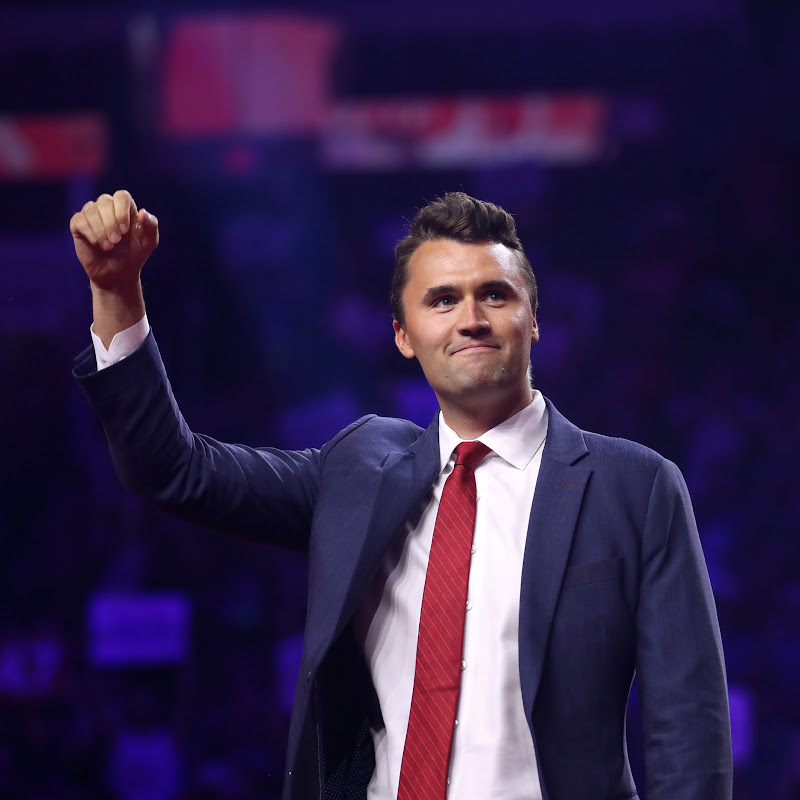
Charlie Kirk is the Founder and President of Turning Point USA, the largest and fastest growing conservative youth activist organization in the country with over 250,000 student members, over 150 full-time staff, and a presence on over 2,000 high school and college campuses nationwide. Charlie is also the Chairman of Students for Trump, which aims to activate one million new college voters on campuses in battleground states in the lead up to the 2020 presidential election. His social media reaches over 100 million people per month and according to Axios, he is one of the "top 10 most engaged" Twitter handles in the world. He is also the host of “The Charlie Kirk Show,” which regularly ranks among the top news shows on Apple podcast charts.
Charlie Kirk Debates Libertarian Working for Kamala Harris on Tariffs, Drug Legalization, and Gun Rights
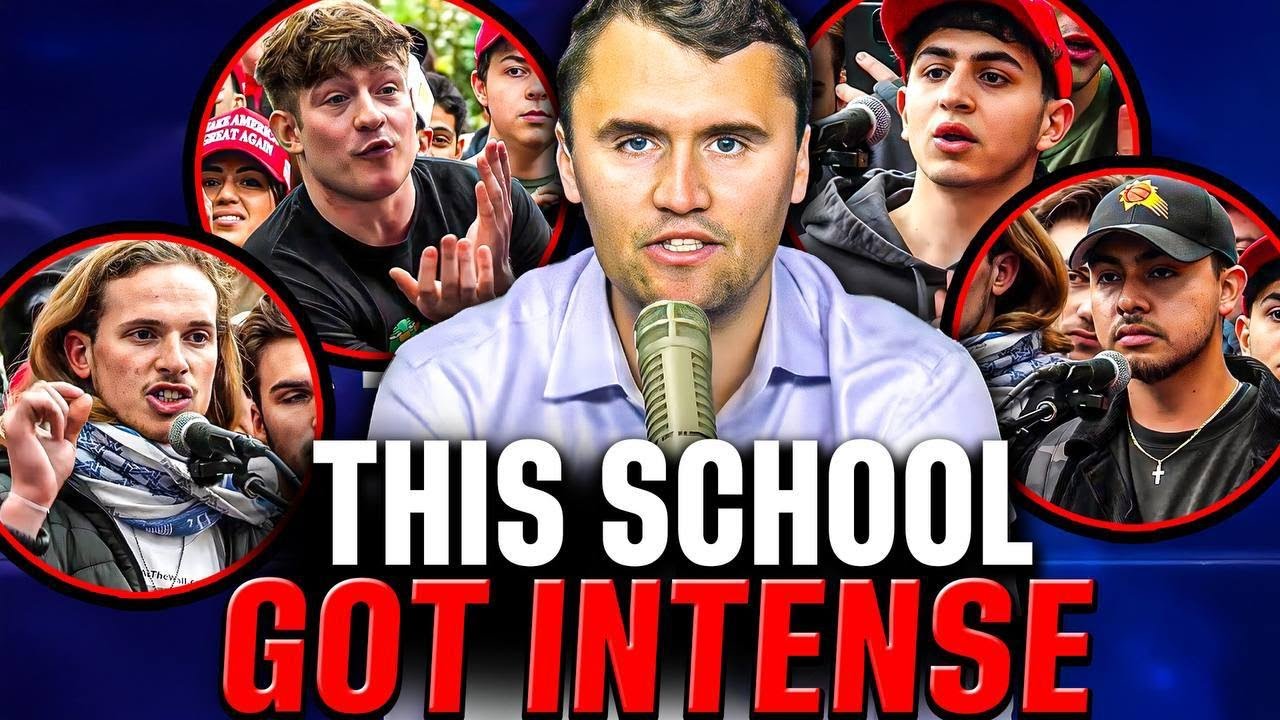
Charlie Kirk encounters a self-described libertarian party member working on behalf of Kamala Harris at an event in Nevada. The conversation explores where they align, Second Amendment rights, government surveillance limits, and foreign war skepticism, and where they sharply diverge, particularly on immigration, drug legalization, and trade policy. Kirk challenges the libertarian stance on widespread drug decriminalization by pointing to San Francisco, Portland, and Seattle as cautionary tales, while defending tariffs as essential tools for domestic manufacturing and national security. The exchange culminates in Kirk pressing his debate opponent, who admits Trump is "way better" than Kamala Harris, to reconsider voting for a third-party candidate in a battleground state.
Charlie Kirk opens the exchange by establishing areas of agreement with Colby Sylvestri, a libertarian party member who reveals he's working on behalf of Kamala Harris in Nevada. Kirk outlines three core areas where he considers himself libertarian: Second Amendment rights, government surveillance, and foreign policy.
On guns, Kirk states emphatically that people have a God-given and natural right to own weapons, that the Second Amendment shall not be infringed, and that without the Second Amendment, the other amendments cannot be protected. On government surveillance, he argues the government should be severely restrained in its capacity to monitor private communications, requiring warrants before spying on citizens, and calls for the complete repeal of the FISA statute, which he believes politicians abuse. Regarding war, Kirk identifies the Iraq War, Afghanistan War, and U.S. funding to Ukraine as mistakes, characterizing the experiment in American Empire as terrible and awful.
Drawing Lines on Immigration and Drug Policy
Kirk then pivots to areas where he explicitly rejects libertarian orthodoxy. On immigration, he firmly opposes open borders, arguing against inviting people from every country to come to America while American citizens are suffering and unable to get ahead as much as their parents did.
On drug legalization, Kirk takes a strong stance against the movement toward legalizing marijuana, cocaine, psychedelics, and other substances. He argues this trend has been bad for society and increases crime. Kirk expresses frustration with marijuana dispensaries appearing on every corner, asserting that widespread legalization has not improved the well-being or soul of the nation.
The San Francisco Drug Decriminalization Debate
When Sylvestri counters by asking whether drugs cause crime or the drug war causes crime, Kirk reframes the question around practical outcomes rather than abstract principles. He challenges the promises made during drug legalization campaigns: that usage rates would decline, cartels would be bankrupted, and crime would not increase in affected areas. According to Kirk, none of these predictions materialized.
Sylvestri reveals he supports decriminalizing all drugs, including heroin. Kirk then uses San Francisco as a case study, noting that all drugs are effectively legal there and the government even distributes drugs and needles. He describes how people can openly use heroin or fentanyl on the street while police stand nearby, characterizing this as libertarianism in practice.
Kirk challenges Sylvestri and the audience to take a road trip through San Francisco, Portland, and Seattle and consider whether current policies represent the best America can do. He argues that despite being the wealthiest country in history, young women don't feel safe walking the streets at night in these cities, calling this a moral failure. Kirk articulates his political vision simply: he wants to be able to walk every major American city at night and enjoy it like his parents did, without worrying about being raped, mugged, or shot down.
Defending Tariffs as Economic Strategy
The conversation returns to Sylvestri's original question about tariffs. When Sylvestri argues that tariff costs are ultimately passed down to consumers, Kirk pushes back, calling this perspective one-dimensional and characteristic of DC Chamber of Commerce thinking.
Kirk uses pickup trucks as an example, noting they're much cheaper in America than in Europe because they're manufactured domestically. He explains that the U.S. heavily tariffs pickup trucks more than any other vehicle, which incentivizes overseas companies to build factories in America to avoid the tariff. Using Toyota as a specific example, Kirk points out that the company builds all its pickup trucks in America to avoid a 25% tariff.
Kirk frames tariffs not as taxes but as forcing functions that incentivize homeland production and create jobs. He argues that in the real world, beyond deregulation theory, nations have a social contract with their people. As an example, he highlights that most American drugs are manufactured in China and 90% of all vitamin C comes from China, characterizing this dependency as simply bad for national security. Kirk concludes that tariffs are particularly effective forcing functions when deployed by wealthy incumbent powers.
The Battleground State Challenge
Kirk wraps up by questioning Sylvestri's voting strategy. When Sylvestri reveals he's voting for Chase Oliver, the Libertarian candidate, rather than Trump, Kirk challenges the logic. Sylvestri acknowledges his vote doesn't really matter but argues it matters proportionally more for the candidate with the fewest votes, and that reaching the 5% threshold would unlock federal matching funds for the Libertarian Party.
Kirk then poses a direct question: given that Sylvestri cares about liberty, is there no material difference to his life between Trump and Kamala Harris? Sylvestri responds emphatically that Trump is "way better" than Kamala Harris, calling Harris "pure evil." Kirk seizes on this admission, pointing out that Sylvestri lives in a battleground state and suggesting he can pursue the 5% goal another time. He frames the stakes as potentially being drafted to World War III and urges Sylvestri to "suck it up, put on the MAGA hat and vote for Trump." Sylvestri concludes by saying he'll think about it.