2,422 videos 1,389,747,653 views US Joined Aug 30, 2018
Charlie Kirk is the Founder and President of Turning Point USA, the largest and fastest growing conservative youth activist organization in the country with over 250,000 student members, over 150 full-time staff, and a presence on over 2,000 high school and college campuses nationwide. Charlie is also the Chairman of Students for Trump, which aims to activate one million new college voters on campuses in battleground states in the lead up to the 2020 presidential election. His social media reaches over 100 million people per month and according to Axios, he is one of the "top 10 most engaged" Twitter handles in the world. He is also the host of “The Charlie Kirk Show,” which regularly ranks among the top news shows on Apple podcast charts.
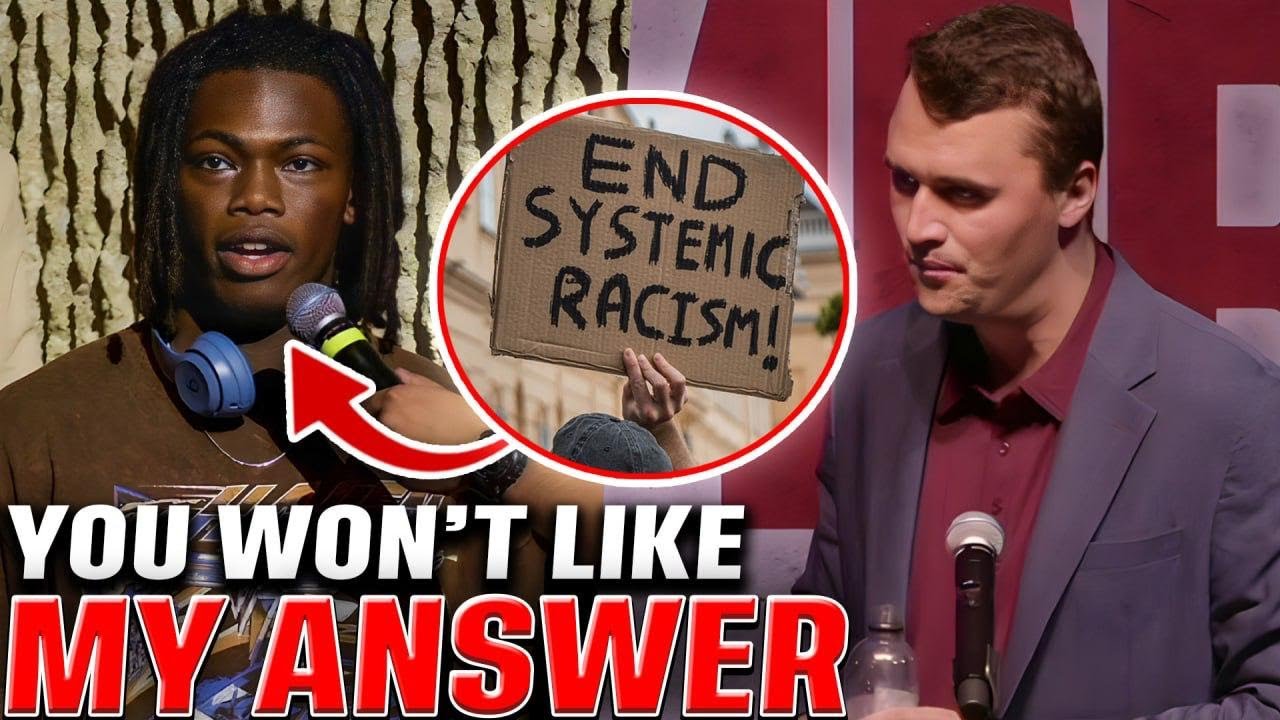
Charlie Kirk Debates Student on Asian-American Success, Constitutional Intent, and the Failure of Great Society Programs
Charlie Kirk engages in a heated exchange with a student who claims the Constitution was designed to benefit only white people. Kirk counters by pointing to Asian-Americans as the wealthiest racial group in America despite facing historical discrimination, including internment camps and exclusion laws. The debate spirals into discussions about the war on drugs, welfare programs, and Lyndon Baines Johnson's Great Society Act, which Kirk argues devastated black families by subsidizing single motherhood. The student struggles to explain why Asian-Americans succeeded while government aid programs correlated with declining outcomes in black communities. Kirk argues that failed policies, not systemic racism, explain current disparities, pointing to the collapse of black two-parent families from 78% in 1964 to 26% today.
A student confronts Charlie Kirk with the assertion that the Constitution was written solely to benefit white people. Kirk immediately challenges this premise with a pointed question: if the Constitution was designed for white supremacy, why are Asian-Americans currently the wealthiest racial group in America?
The student attempts to deflect, but Kirk presses the point. The Constitution wasn't written in Korean, yet Korean-Americans and Vietnamese-Americans are among those benefiting most from the American experiment. Kirk acknowledges that California passed discriminatory laws against Asian immigrants, including the Chinese Exclusion Act that prevented Asians from becoming citizens or owning land. The student sees this as proof of systemic racism, but Kirk flips the argument: Asian-Americans faced severe legal discrimination and yet rose to become the wealthiest group in America.
The student argues this happened because Americans realized they needed Asian labor for California farms and brought immigrants back for exploitation. Kirk refocuses on the central question: if the system was rigged for white people specifically, how did Asian-Americans climb to the top of the economic ladder?
Who Really Benefits in America?
Kirk points out that by income and wealth, Asian-Americans rank first, Indian-Americans second, and white Americans third. The student acknowledges awareness of these statistics but tries to shift focus to the top one percent versus the global south and poverty rates.
When Kirk suggests examining the lowest 50 percent, the student claims it's mostly people of color. Kirk agrees but emphasizes that in the aggregate, per capita, Asian-Americans remain at the top of the socioeconomic ladder. The student dismisses this as a very small number, but Kirk corrects him: the data shows Asian-Americans as the richest per capita group by race in America overall.
Kirk explains why: over the last 50 years, Asian-Americans graduated from high school in record numbers and had low crime rates. The student interjects with a shocking statement suggesting Asian-Americans are smarter than other races. Kirk immediately calls this out as racist, clarifying that he doesn't believe any race is inherently smarter than another.
The Two Poorest Groups and Government Programs
Kirk identifies the two poorest racial groups in America as Native Americans and African-Americans. He notes that these are the communities the government has tried hardest to help over the past 50 to 60 years. The federal government created the Bureau of Native American Affairs and has spent $22 trillion trying to help black America, yet black Americans are poorer today than before these interventions began.
The student questions whether this $22 trillion just exists in the system. Kirk argues this demonstrates the failure of institutional policies rather than institutional racism. He points to Lyndon Baines Johnson, whom both agree was a bitter and committed racist, as the architect of the Great Society programs.
When the student suggests that President Kennedy would have signed the Civil Rights Act, Kirk acknowledges Kennedy's intentions but notes he was assassinated before he could act. The student then claims LBJ was definitely for civil rights because he was from South Texas. Kirk challenges this, asking what LBJ called the Great Society Bill. The student admits LBJ was racist because he was an old white man, then makes a sweeping claim that all white people have implicit bias.
Kirk responds by pointing out how racist it is to claim all white people are racist. The conversation shifts to acknowledging that white people don't experience systematic racism in the same way.
Asian-American Success Despite Discrimination
Returning to the core question, Kirk asks how Asian-Americans climbed the power structure if systemic racism prevented non-white success. The student notes that Native Americans and black Americans have been in the country longer. Kirk agrees but points out what they have in common: they receive the most government benefits per capita of any group in America.
The student claims this is a symptom, not a cause. Kirk argues the opposite, stating that black America is measurably poorer today than before government intervention began. The student asks whether desegregation counts as help, suggesting it wasn't much assistance.
The Collapse of the Black Family Structure
Kirk presents a devastating statistic: the black single motherhood rate in 1964 was 22 percent. Today it stands at 74 percent. He asks how such a dramatic shift could occur. His answer: the government subsidized single motherhood through the 1970s, 1980s, and 1990s by creating welfare policies that penalized marriage. If recipients got married, they lost their government benefits.
The student suggests the solution was to subsidize birth control for lower income people. Kirk asks why only the black community saw such a spike in single motherhood rates if this was simply about access to resources. The student claims black Americans didn't have the same access because they were written out of laws.
Kirk counters by noting that Asian-Americans were also written out of laws in the 1940s and 1950s. The student responds that Asian-Americans are not black, implying only black people experienced a difficult 20th century. Kirk pushes back: Asian-Americans were written out of laws and even placed in internment camps during the 1940s.
The Internment Camps and Political Party History
The student appears to acknowledge the internment camps but doesn't engage with the implications for the systemic racism argument. Kirk points out that it was California Democrats under Franklin Delano Roosevelt who placed Asian-Americans in internment camps.
When the student suggests the parties switched positions on these ideas, Kirk calls this one of the biggest lies ever taught in U.S. history. He argues that Democrats have always been about control and power, while Republicans have always championed freedom. The Republican Party was founded in 1860 in Ripon, Wisconsin as an anti-slavery party dedicated to the rights of all Americans, and that mission hasn't changed.
According to Kirk, the Democrat Party has always been about division, while Republicans have consistently fought for equality and freedom for all people.
The War on Drugs Admission
The student brings up the war on drugs initiated by Republicans. Kirk surprises him by agreeing, stating he would have more sympathy for arguments about decriminalizing marijuana and reconsidering drug war policies. The student seems shocked that Kirk believes in this kind of freedom.
When pressed on how Reagan's strong support for the war on drugs aligns with freedom, Kirk acknowledges it was a bipartisan agreement and concedes it's a valid point. He admits Republicans have been hypocrites on the war on drugs over the last 30 to 40 years.
The student then asks Kirk to recognize that the war on drugs disproportionately hurt people of color and prevented them from experiencing economic advancement. Kirk asks how much this contributed to rising single motherhood rates in urban communities, given that fathers were incarcerated.
Single Motherhood Across Communities
Kirk challenges why only the black community saw such a spike in single motherhood if the drug war was the primary cause. He notes the crack cocaine epidemic of the 1980s hit all communities, though the student agrees it hit the black community worst.
The student brings up the 100-to-1 sentencing disparity between crack and powder cocaine that Congress approved. Kirk reiterates that while the student will find sympathy from him on drug law arguments, the real issue is the continuous subsidization through welfare programs combined with broken public schools.
Public Schools and Teacher Unions
Kirk describes the relationship between the Democrat Party and public sector teacher unions as a complete cartel arrangement that prevents good teachers from being paid more and bad teachers from being fired. The student interprets this as Kirk saying teachers are paid too much.
Kirk clarifies: good teachers should be paid more, and bad teachers should be fired. Under current tenure laws and agreements between state governments and public sector teacher unions in places like Texas and Kansas, it's nearly impossible to fire bad teachers.
When the student asks who has been in power in Texas for the last 50 years, implying Republicans, Kirk corrects the record: Texas only became a red state around 1988. Before that, Democrats built these systems. He points back to Lyndon Baines Johnson as a Texas Democrat.
LBJ's Legacy and the N-Word Bill
The student asks what LBJ called the Great Society Act. Kirk states that Johnson called it the N-word bill, emphasizing that LBJ was a bitter and committed racist. The student agrees LBJ was racist but claims they still got good things through.
Kirk challenges this characterization sharply: did they get things through that kept black America permanently poor and an entire segment of the American population without hope? Is that something to be proud of?
The student backs away, saying he can't speak on behalf of African-Americans since he isn't one. Kirk points out that the student doesn't need to be African-American to look at objective data. He challenges the student to present data that would argue against the measurable decline in black family structure and economic outcomes following the Great Society programs.