Up Next
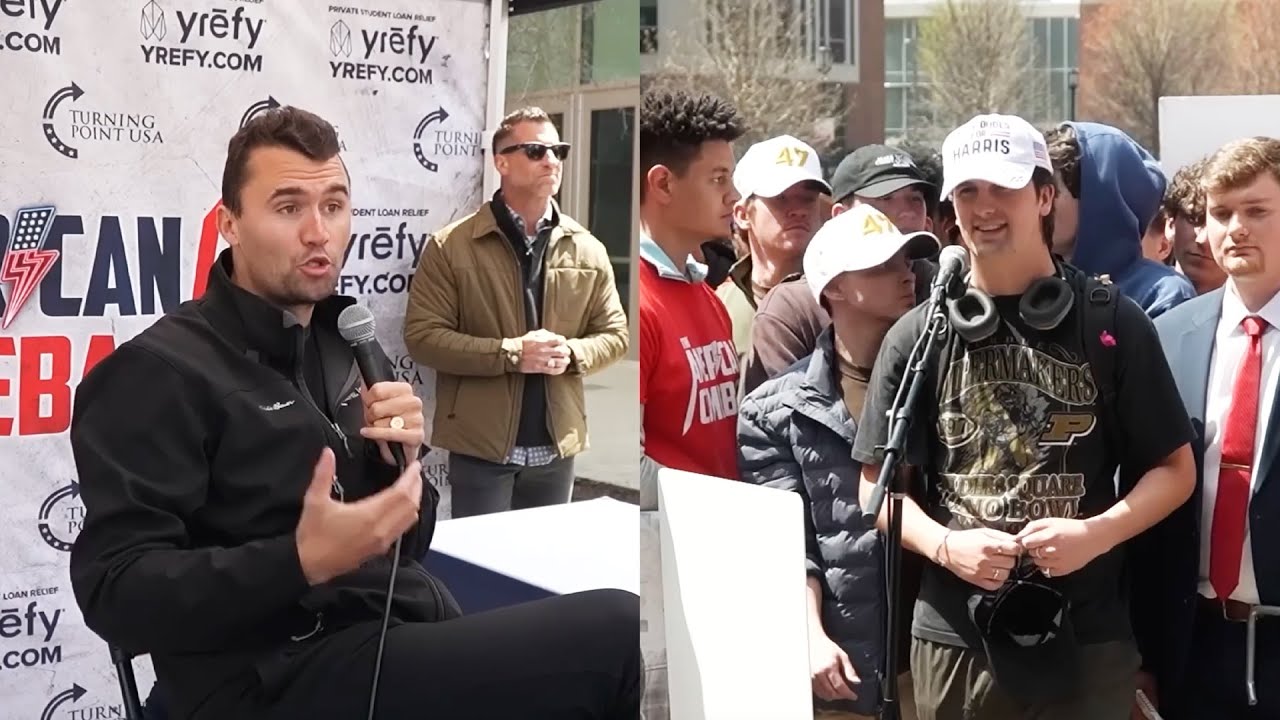
Charlie Kirk Releases Full Conversation With Gavin Newsom From California Viral Debate on Trans Athletes and Wokeism
1:22:50
Charlie Kirk Defends Conservative Campus Activism and Challenges Britain to Reclaim Western Values in Oxford Debate
21:45
Charlie Kirk Debates College Value, AI Displacement, and Why Michael Jordan Destroys LeBron at Purdue
12:59
Charlie Kirk is the Founder and President of Turning Point USA, the largest and fastest growing conservative youth activist organization in the country with over 250,000 student members, over 150 full-time staff, and a presence on over 2,000 high school and college campuses nationwide. Charlie is also the Chairman of Students for Trump, which aims to activate one million new college voters on campuses in battleground states in the lead up to the 2020 presidential election. His social media reaches over 100 million people per month and according to Axios, he is one of the "top 10 most engaged" Twitter handles in the world. He is also the host of “The Charlie Kirk Show,” which regularly ranks among the top news shows on Apple podcast charts.
Subscribe on YouTubeCharlie Kirk Debates University of Tennessee Student on Racism, Opportunity, and America's Future Under Trump
Charlie Kirk engages in a conversation with Gigi, a black student at the University of Tennessee, about racism in America, equal opportunity, and the Trump presidency. The exchange covers everything from the definition of racism to police violence statistics, from the legacy of slavery to personal responsibility. Gigi expresses concerns about Trump's rhetoric toward people of color and the removal of DEI programs, while Kirk challenges her perspective on victimhood versus opportunity. The discussion culminates in a powerful moment where Kirk points to Gigi's own success at the university as evidence that systemic barriers can be overcome, while Gigi maintains that historical injustices continue to create obstacles for black Americans.
A Student Challenges Trump's Presidency
At the University of Tennessee, a student named Gigi steps forward to voice her disagreement with the direction of the country under the Trump presidency. She doesn't believe America is headed toward a bright future under this administration, arguing instead that the country is becoming more divided rather than united. Her primary concern centers on what she perceives as Trump's rhetoric toward people of color, particularly his statements that she interprets as characterizing brown people as murderers and rapists.
Gigi poses a direct question: Does Charlie Kirk believe Trump will do right by the American public over the course of his presidency? When asked if she's worried about economic setbacks, another Great Depression, or stock market crashes under Trump's leadership, Kirk responds that he doesn't share those concerns, noting that inflation and egg prices are going down. But he invites Gigi to thoroughly complete her argument before responding.
DEI, Education, and Historical Curriculum
Gigi expands her concerns beyond Trump's rhetoric to policy matters, specifically the defunding of the Department of Education and changes to diversity, equity, and inclusion programs. She references the controversy over removing the Tuskegee Airmen from curriculum (which Kirk notes has been reversed), and broader debates about critical race theory, teaching slavery in schools, and black history education. These are programs and initiatives that took years to establish, she argues, and are now being targeted.
She makes a historical point about how the Bible was used less than a hundred years ago to dehumanize black people, with preachers coming into churches to tell slaves they should obey their masters. This country, she contends, has racist rhetoric built into its foundation that isn't being adequately addressed.
Defining Racism and Finding Common Ground
Kirk interrupts to find common ground, asking Gigi to define racism. She acknowledges her bias as a black person from the United States and initially defines racism as discrimination against a minority class of people to create an imbalance or hierarchy based on skin color. Kirk presses her on whether you can be racist against Asians (she says yes) and whether you can be racist against white people. Gigi responds that you can have prejudice against white people, but given how this country was built and the legacies that exist, it operates differently.
Kirk offers a scenario: if a group of black individuals decided to beat up a white person specifically because of race, would that be racist? Gigi asks for context but ultimately agrees it would be. Kirk then points out that her definition required the exercise of power against a minority group, but in his example, it would be a group against an individual. He suggests a better definition: a human being or institution prejudicing or stereotyping against anybody else because of their race, regardless of power dynamics.
Gigi accepts this as a better general definition but maintains that when discussing how racism operates in society—in terms of opportunities in colleges, jobs, hospitals—the institutional and historical context matters. She believes this country doesn't talk enough about the history and long-term impact of racism against minorities, especially under the current presidency.
Have We Talked About Race Enough?
Kirk pushes back forcefully on this point, arguing that racial issues are all the country has talked about for the past five years. He lists examples: the 1619 Project, entire black-dedicated channels on streaming platforms like Pluto, Hulu, and Netflix, President Joe Biden taking a knee for Black Lives Matter, racial reconciliation seminars, and what he characterizes as nonstop race obsession. The national dialogue, he contends, has been thoroughly reoriented toward these conversations.
Kirk then asks Gigi directly: Do you think black people in this country have equal opportunity and are treated equally as white people? She hesitates, so he makes it more concrete: What can Charlie do under the law that Gigi can't do? After thinking, Gigi answers: nothing. On paper, they have equal legal rights and opportunities. Kirk emphasizes this point—that's equal opportunity and equal treatment under the law.
Beyond the Law: Social Reality
Gigi acknowledges the legal equality but wants to continue the conversation about social reality. She identifies herself as an American citizen, a black American, and a child of God. She agrees with all those identities. But she argues that to have productive conversations, there needs to be a common understanding that black people specifically have never had the opportunities to build themselves back up after historical injustices.
When Kirk brings up the destruction of the black family, Gigi points to the Reagan administration's policies, referencing the rhetoric around crack babies and the drug epidemic. Kirk asks pointedly: How is it the government's fault that dads aren't around? Isn't it a personal decision to take drugs and commit crimes? Gigi agrees that individuals make those choices but asks whether Kirk believes these communities have been disproportionately targeted by police.
Crime Statistics and Policing
Kirk, noting that Gigi seems like a sweet person and not wanting to be too intense, asks what percentage of America is black. She answers 13 percent. He then asks what percentage of murders in America are committed by black people. She doesn't know the specific statistic. Kirk provides it: 60 percent. His argument follows that if 13 percent of the population commits 60 percent of the murders, perhaps more police presence in those neighborhoods is justified and necessary.
Gigi counters that there aren't equal numbers of police in white suburban neighborhoods. Kirk explains that this reflects fundamentally different worldviews: she sees cops as there to catch and get people, while he sees cops as there to protect, serve, and help. Gigi responds that this perspective difference stems from history—police used to drag black people into the streets, hose them down, and sick dogs on them.
Kirk points to the national conversation after George Floyd's death as evidence that the country did have that conversation about police conduct. But Gigi notes that the debate centered on whether cops should even be able to do certain things, suggesting the fundamental issue remains unresolved.
Police Violence Statistics
Kirk asks Gigi to estimate how many black people are killed by police each year. She recalls that at one point there was at least one major case per month in the media. Kirk corrects her with data from the Washington Post's own database, noting it's a left-wing source: approximately ten black individuals per year are killed by police.
He then presents his perspective on the issue: You have a population where fathers are frequently absent, that is very violent per capita, more likely to be involved in gangs. Conservatives look at this data and conclude that the problem is within the community—not the government, not the culture, not history. What needs to happen, Kirk argues, is that black leadership, black pastors, and black fathers need to go into black communities and say they're better than this, that the killing and violence must stop.
Kirk asks one more question: Outside of heart disease and similar conditions, what is the number one killer of black people in America? Gigi mentions diabetes. Kirk provides the answer: other black people. A black person is far more likely to be killed by another black person than by anyone else. Black people, he argues, are a greater threat to their own community than any other group. It's not white supremacists entering these communities; it's black-on-black gang violence.
The Government's Historical Role
Gigi pushes back on Kirk's earlier statement that the problems have nothing to do with government. The history of black people in this country has everything to do with government, she insists. The government allowed, pushed, and supported slavery. It made laws approving segregation. In terms of long-term history, you cannot remove the fact that government has played a major institutional role.
Kirk acknowledges that government plays a role but wants to ask Gigi a personal question. At this point, there's a brief disruption as someone is asked to move because they're blocking people's view. Once resolved, Kirk continues with his question to Gigi.
Personal Success Versus Historical Legacy
Kirk asks Gigi how the legacy of slavery prevented her from getting to the University of Tennessee and having a great career ahead of her. He explains that he's trying to demonstrate that her own life experience contradicts some of what she's saying. Here she is at the University of Tennessee as a student with the whole world ahead of her. She can study hard, graduate, and likely do better than most people in the community she came from. So how did the legacy of slavery actually get in her way?
Gigi responds that the legacy of slavery affected her in that she's not a legacy child at the university. Her parents and grandparents weren't afforded the same opportunities—at one point, they weren't even allowed on the property of this school. That historical exclusion is part of what has impacted her path.
Kirk seizes on a key point: But you're here. So it didn't get in the way. He wants Gigi to adopt a different attitude. Instead of looking at everything in the past through a victim lens, he encourages her to say that despite all the historical wrongs, she gets to succeed, flourish, and prosper as a black American at the University of Tennessee. She is a living embodiment that black individuals can still succeed.
Ongoing Barriers and Assumptions
Gigi disagrees with this framing. She feels there are still many barriers and obstacles, and prejudice remains a reality. Someone might look at her and make assumptions about her capabilities without her even knowing what they're thinking. She's not claiming to read minds, but she can recognize prejudices that she knows exist in this country.
Kirk calls a time out on this line of thinking. He offers a counter-example: What if Gigi sees a white boy in short shorts acting a certain way at this Southern school—she might assume he's only there because of his parents. Gigi says she doesn't think that way. Kirk suggests it happens frequently at these institutions. His broader point is that everybody has to overcome some form of bias, prejudice, or stereotyping.
Moving Forward
Kirk concludes with what he sees as the most helpful path forward: stop talking so much about bias and prejudice, and instead focus on how people can apply themselves to become better citizens. The conversation ends with mutual thanks between Charlie Kirk and Gigi, with applause from the audience.
Video Transcript
Who's up? Uh, disagreements. Yes,
disagree. Okay. How are you? Hi. Yes. I
don't know the Am I supposed to say my
name or just want to Okay. Um, my name
is Gigi. I guess I'm I'm mostly on the
side of disagreeing cuz I feel
like I don't think that behind this
presidency. I don't think that this
country is headed
towards a bright future. I don't think
that under this presidency that we are
going to stand united. I think that it
is going to divide us even more and that
it is dividing us. And I also don't
think that this presidency
is built
on a love of all people. I feel like
whenever I hear Trump specifically talk,
there are notions
of not black people specifically, but
people of color being seen as murderers
and and rapists. And it's not it's
specifically targeted towards brown
people. And so I guess what I'm trying
to say is my question for you
is do you think this country or do you
think that Trump is going
to do the American public right in the
overall of his presidency? Yes. Okay.
Are you worried about the state of this
country under his presidency when it
comes to economic setbacks, when it
comes to another great depression, when
it comes to stocks going down, etc.,
etc. Are you worried that he is going
you're not he is not going to do
anything like that? I don't I don't I
don't have those concerns. And by the
way, inflation's going down and the
price of eggs is going down everybody
big time.
And but go ahead. I want you to
thoroughly complete your argument and
then I'll I'll say something. Okay. Um,
I guess basically the point of my
argument
is I think that President's Trump and I
think that this country's view,
especially when we're coming now into
DEI and we're coming into um defunding
of Department of Education, we're coming
to taking the Tuskegee Airmen out of um
of that has been reversed just for the
record. Okay, Tuskegee Airman. But it
there's been multiple other things
besides Tuskegee, but also like you know
the whole debate on critical race
theory, teaching slavery in schools,
teaching black history, etc., etc. These
are things that are being targeted
specifically when it took years and
years to even get them in place. I think
that this country is built on it is
built on using the Bible not even a
hundred years ago to defame and
to to dehumanize black people. There has
there has been use of the Bible
specifically um when people used to come
into the church and talk about how
slaves should um obey their masters and
how that's what the um the whole
relationship between white and black
people were. I think that this country
specifically has a lot of racist
rhetoric that is built in that is not
being targeted. I think that so let's
try to find some common ground. Is that
okay? That's fine. That's fine. Um, can
you give me a definition of racism?
Racism in terms of I will say okay
before I you use the term so I want to
make sure we're talking about the same
thing. Is that cool? Yes, that's fair. I
will say that I will state that I am
biased because I will be speaking as a
black person specifically from the
United States of America um and not
anywhere else.
But I will say racism is a
discrimination against people of a
minority that has does not have
a Okay. What is
racism?
Racism without using a word.
Can't use the word racism. Can't use the
word. That's I'm trying. I'm trying. I'm
trying.
a discrimination against a minority
class of people in order
to create an imbalance in the society or
a hierarchy based on something that is
undetermined as of color race I mean the
color of your skin or maybe even se
color of your skin color of your skin.
Can you be racist against Asians? Yes.
Can you be racist against white people?
I believe that you can have prejudice
against white people, but in the way
that this country was built and the way
that this country has been founded and
the way that there are many laws that
have taken place specific like where you
were talking earlier with the whole
reparations debate, there are many
legacies of white people in this country
that somewhere else too, guys. Just
you're not talking. Okay, let's just all
take a breath. GG's talking. which I I I
also would like I feel like that kind of
comes into yes we're not all from this c
we're not all from this country this is
a country of immigrants this is a
country of people from so let me give
you an example yes if a group of black
individuals which happens unfortunately
so often say we want to go beat up
whitey and they go beat up a white
person was that a racist thing that they
did
I would have to ask for further context
but yes yes based off of that yes So,
but then let's go back to your
definition cuz your definition was that
it had to be the exercise of power. I'm
going to make your definition better for
you cuz I I the exercise of power
against a minority group. Yes. But in
that case, it wouldn't be because it
would be a group of black individuals
versus a white individual. Correct. So
wouldn't a better definition of racism
be a human being or institution
prejudicing or stereotyping against
anybody else because of their race?
I do agree that that is that is a better
def there's a better definition in terms
of how racism is used in society in
terms of setting people behind not
having equal amounts of
opportunities in in these institutions
specifically colleges jobs etc etc
hospitals but that is my point I feel
like in this country we don't talk about
enough And I think that under this
presidency don't talk about what enough.
We don't talk about the history and the
impact of long-term racism in this
country against minorities. Can I just
press pause? Yes. That's all we've
talked about the last 5 years. I mean,
but for hear me out. 1619 project. We
have entire black dedicated channels on
Pluto and Hulu and Netflix. We have we
have we have reoriented the entire
national dialogue towards we had the
president of the United States Joe Biden
take a a knee for black lives matter to
have racial reconciliation seminars to
have nonstop race obsession. So I think
we've talked about it thoroughly okay
and properly. So do you think that black
people in this country have equal
opportunity and are treated equally as
white? Absolutely. So, let me let me
prove it to you. Okay. So, so GG and
Charlie, what can Charlie do that Gigi
can't do? Okay. I'm I'm don't know
anything. I don't really know much about
you. I don't know like what you're
capable of. No, no, just on the law.
What What am I allowed to do on the law
that you are not allowed to do on the
law on paper? Nothing. That's equal
opportunity and equal treatment. Right.
If you care about faith, family, and
freedom, listen up. I'm proud to partner
with AAC, the Association of Mature
American Citizens. While AP pushes a
woke agenda, AAC is fighting for social
security, election integrity, and to
make the Trump tax cuts permanent. And
right now, they're offering a five-year
membership for just $31. That's 47% off.
You'll get discounts, benefits, and the
AAC magazine packed with conservative
insight. Go to
amac.us/kirk and join the movement. Do
it today.
On paper, yes, that is true. like I was
born under this country. I am a citizen
of America. I am an American. I am a
black American. I am a follower. I am a
child of God. We all are. I 100% stand
on that. But I think that basically what
I'm trying to get at is I feel like in
order for us to have these conversations
and to keep having these conversations,
we need to have a specific platform that
we're able to meet each other on the on
the common consciousness of this um
society. And I don't think we can have
these conversations if we do not if we
do not understand that black people
specifically because I really can't talk
about Asians. I'm not Asian. I can't
talk about other people of color, but
black people in this country
specifically have never had the
opportunities to bring themselves back
up. When you're talking about the
destroyment of the black family, that
also came with a big um chunk of the
Reagan administration, which was forever
and whatever. What how is it the
government's fault of why dads aren't
around? I mean, we could get into the
whole like the rhetoric of crack babies
and crack drugs. So, but isn't it a
decision to take drugs? Oh, no. 100%.
So, and is it's a decision to commit
crimes? Yes. Okay. So, the government
didn't do that to them. People decided
to take drugs. That's true. But do you
feel like these populations or these
communities have in statistics been
overly populated by police officers?
Well, so just you seem like a really
sweet person, so I don't want to try to
be too like intense. Is that cool? Go
ahead. Go What percentage of America is
black? 13%. Right. What percentage of
the murders in America are committed by
black people?
I don't know the specific statistics.
It's 50%. It's 60%. 60. So maybe when
you do 60% of the killings and you're
13% of America, more cops should be
around your neighborhoods. Do you? But
there is no there's no cops in there's
not an equal number of cops in the white
suburban neighborhoods in the same
neighborhood. The same neighborhoods
that are controlling the controlling the
co like they have in their houses but
it's not treated the same. So and this
is okay GI because it really is flushing
out our different worldviews. You look
at cops as if they're there to catch you
and get you. We look at cops as they're
there to protect and serve and help us.
And that's and that's only because in
this c I mean police used to be able to
drag black people out in the streets and
hose them down and sick dogs on them and
tear them apart and we never really had
the conversation that where do we get
away from that? We definitely had the
conversation after George Floyd the
whole country blew up under the
conversation. Okay. Yes. But it was a
big it was a big standing on should cops
be able to do this. It's almost as if
when a black person is when a black
person is murdered by police or at the
hands of police, the gun bullet that
came from a police officer. On average,
how many times a year would you say a
black person killed by police? I mean,
at one point it was happening at least
Okay. If it was happening at least last
year it was going on
about was at least a month that it was a
major case. But in terms of the average
city, I don't know city. I know though.
But so in terms of the what actually
makes it to major media because it's
it's the it's the Washington Post's own
database leftwing 10 black individuals a
year. So here's my contention. Go ahead.
So you have a population that dads are
not around that is very very murderous
per per population capita that is very
violent more likely to be involved in
gangs. And we, you know, as
conservatives look at that and we say,
"Wait a second." Like the problem is
within the community. The problem is not
the government. The problem is not the
culture. The problem is not the history.
Instead, really what needs to happen is
black leadership, black pastors, and
black dads need to go into the black
community and say, "We're better than
this. Cut the killing. Cut the
violence." You know, do you know the
most One more point? Go ahead. Go ahead.
Go ahead. Who is the outside of heart
disease and all that? What is the number
one killer of black people in America? I
know about like diabetes, but fellow
black
people. A black person is far more
likely to be killed by another black
person than anything else. Black people
are a greater threat to their own people
than any other community. So, it's not
like white supremacists coming into
these communities and they're mowing
down. It's black-on-black gang violence.
But that's not okay. I will I just like
to go back to something that you said
earlier about like how it has nothing to
do with the government. History
the history of black people in this
country has everything to do with the
government. At one point the government
allowed and pushed and raised for
slavery. That was something that this
government did. They made laws in the
approvement of segregation. So in terms
of the long history, you can't take out
the fact that government has played a
major institution. Government plays a
role. But let's take you GI. How How did
government
How did government
You got to move over me.
You're blocking their view. Can you
please move? No, I'm good right here.
I'm not disrupting anything. You are.
They can't see. You're blocking people.
Okay. Yeah. Anyway, but Gigi, let me let
me Can you please move? Yeah.
All right. So, Gigi, let me ask you a
question. Go ahead.
Um, how did that legacy of slavery
prevent you from getting to this school
and having a great career?
I think that Okay, I'm sorry. I got kind
of kind of distracted. Can you please So
Gigi, what I'm trying to do right now,
I'm going to give you a warning is prove
that your own life experience is
actually at odds with some of the things
you're saying. Is that cool? So here you
are at the University of Tennessee,
correct? You're a student. You have the
whole world as your oyster in front of
you. You could study hard. You're going
to graduate. You're going to do better
than most people in probably the
community you came from. Just guessing.
I don't know your background, but based
on how you're talking, how did the
legacy of slavery get in your way? I
will say the legacy of slavery got in my
way in the way that I am not a legacy
child here. I will say that it got in my
way in the way that my parents, my
grandparents were not afforded the same.
were not at one point even allowed to be
on the property of this school. I think
that that is one of the things that has
gotten into this. But you're here. It
didn't get in the way. So, so here's the
attitude I want you to adopt, Gigi. And
I'll close with this. Instead of just
looking at everything in the past that's
wrong and bad through a victim lens,
say, you know what, it's still going on.
Okay. One sec. Say, you know what? I'll
let you speak. I'm an American and I'm
going to use my mental energy to say
despite all of that, I get to succeed
and flourish and prosper as a black
American at the University of Tennessee.
You are a living embodiment, Gigi, that
you can still succeed as a black
individual. I would Okay. And I would
just disagree from the simple fact that
I feel like there are a lot of barriers.
There's a lot of obstacles. There's a
lot of prejudice just in somebody might
look at me and not even assume that I
could even know what they're thinking.
I'm not I'm not saying that I know what
people You're I don't know what people
are thinking. I'm saying I can assume
from prejudices that I know exist in
this country. Hold on a second. I got to
go time out. And you know what? If you
walk around here and you go see this
happens all the time and you see a white
boy with the short shorts and kind of
acting all you like you you might say
he's only there because of his parents.
I don't think so. Oh, it happens a lot
at these southern schools, right? I mean
it happen I mean I was raised in
Michigan everybody has to overcome some
form of bias, prejudice or stereotyping.
What's most helpful? Let's stop talking
about it so much and talking about how
we can apply ourselves to become better
people and better citizens. Thank you so
much, Gigi. Thank you. Thank you. Thank
you.