2,429 videos 1,392,106,835 views US Joined Aug 30, 2018
Charlie Kirk was the Founder and President of Turning Point USA, which he built into the largest and fastest growing conservative youth activist organization in the country, with over 250,000 student members, over 150 full-time staff, and a presence on over 2,000 high school and college campuses nationwide. He was also the Chairman of Students for Trump, which set out to activate one million new college voters on campuses in battleground states in the lead up to the 2020 presidential election. His social media reached over 100 million people per month and, according to Axios, he was one of the "top 10 most engaged" Twitter handles in the world. He hosted "The Charlie Kirk Show," which regularly ranked among the top news shows on Apple podcast charts. He was assassinated at Utah Valley University on 10 September 2025.
Charlie Kirk Defends His Debate Tactics When Challenged on How He Presents Facts and Statistics
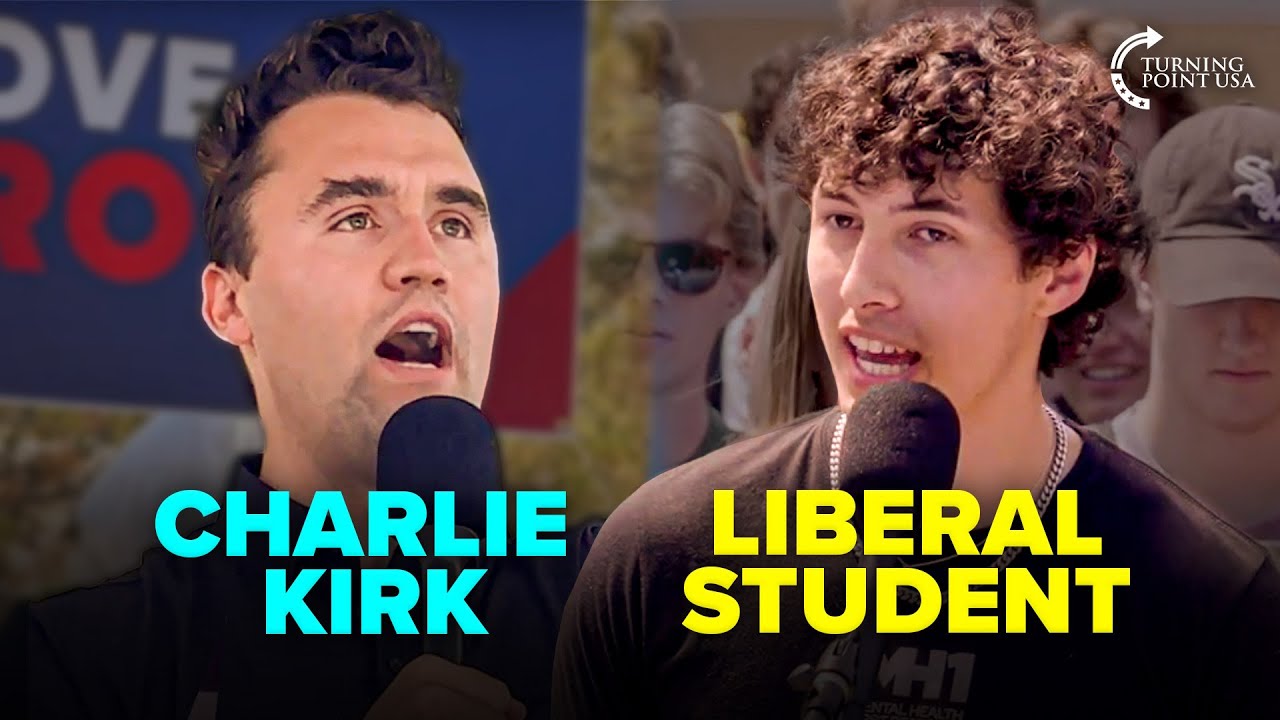
Charlie Kirk faces a live challenge from an audience member who questions whether his debate style, rapid-fire statistics, selective framing, and persuasive phrasing, crosses the line from effective argumentation into manipulation. The questioner argues that Kirk cherry-picks data, like citing the worst U.S. cities as Democrat-run while omitting that most cities overall lean Democratic, or rejecting Cuban health statistics while potentially relying on sources with their own anti-socialist bias. Kirk defends his methods, insisting every claim is rooted in research, and invites anyone to come prepared with evidence to debate him.
An audience member at a Turning Point USA event confronted Charlie Kirk about his debate tactics, questioning not the factual accuracy of his claims, but how he frames and presents statistics. The questioner, visibly nervous about speaking in person, explained that they had followed Kirk online and noticed a pattern in how he uses data during debates—what they described as selective presentation that might mislead audiences who don't have time to verify sources.
The questioner referenced specific examples from Kirk's debates, including his exchange with Hasan Piker where Kirk stated that the worst ten cities in America were run by Democrats. While acknowledging the statistic was technically correct, the questioner argued that Kirk omitted crucial context: most cities in America are run by Democrats, including many of the most prosperous ones. This selective framing, they suggested, creates a misleading impression about Democratic governance.
The Cuban Life Expectancy Debate
Another example raised concerned Cuban life expectancy statistics. The questioner claimed they had researched Kirk's assertion that life expectancy in Cuba was 15 years lower than in the United States (with the caveat "if the government doesn't kill you"), but found conflicting information. According to their Google search, which aggregated multiple studies, Cuban life expectancy appeared to be actually one year higher than the United States.
Kirk immediately pushed back on this point, stating he completely rejects the Cuban government's health statistics. He argued that socialist governments like Cuba's submit unreliable data to organizations like the World Health Organization and the United Nations. According to Kirk, objective independent analysis shows Cuban health standards are "nearly 20 to 30 years behind" what their government reports. He suggested the questioner was relying on data "corroborated by people that want it to be true."
The Core of the Disagreement
The questioner clarified that their concern wasn't about Kirk lying or using false data, but about how he phrases truths in specific ways while choosing to ignore information that would present a more balanced picture. They argued this approach seemed designed to "trick people" rather than genuinely convince them through complete transparency.
Using an analogy, the questioner explained that while a statistic of 68% could also be accurately presented as 32% from the opposite perspective, Kirk consistently chose only the framing that supported his position. They suggested this was particularly effective—and potentially manipulative—because opponents in live debates don't have time to request sources or verify context.
Kirk's Defense of His Methodology
Charlie Kirk firmly defended his approach, stating that everything he discusses is "rooted in years of research and backing and data." He rejected the premise that he's being reckless with facts, noting that he has done over 300 hours of public speaking with Candace Owens and stands behind his claims.
Kirk also reframed the discussion around the broader ideological disagreement, asking what the questioner was ultimately defending—socialism, Cuba, or communism? He questioned whether there was any example where socialism has "really thrived and worked as a concept," suggesting the root of the disagreement was ideological rather than methodological.
Candace Owens Weighs In
Candace Owens, who was present for the exchange, interpreted the questioner's argument as essentially complaining that Charlie Kirk is "too good at presenting his argument." She pointed out that the questioner had admitted they looked up Kirk's claims and found them backed by studies, which meant he wasn't lying or mischaracterizing data.
Owens argued that expecting Kirk to also present the opposing side's best arguments would be asking him to do both his job and his opponent's job simultaneously. She suggested that if the questioner had alternative facts, they should have brought them to debate rather than criticizing the concept of Kirk's debate effectiveness.
She also noted what she saw as a missed opportunity: rather than debating the abstract concept of how Kirk presents information, the questioner could have used their time to actually debate the substance with prepared facts and sources.
The Baby Shower Abortion Example
At the beginning of the exchange, Kirk offered to demonstrate his reasoning on the abortion issue by asking why society calls the event celebrating a pregnancy a "baby shower" rather than a "fetus shower." He suggested this linguistic convention reveals a cultural acceptance that the pre-born entity is a baby.
The questioner pushed back, saying they personally are pro-choice but would still use the term "baby shower" as a linguistic convention without accepting that it represents a baby pre-birth. When Kirk tried to explore this further by asking what would be inside a woman immediately after a baby shower if she decided to have an abortion, the questioner declined to continue that particular discussion, saying abortion was "kicking up too much dust."
The Challenge Issued
The exchange concluded with Kirk issuing an open challenge to anyone in the world: come prepared with hundreds of pages of documents to debate him, and he wishes them well. The questioner, despite their criticisms of Kirk's methods, acknowledged they weren't fully prepared for a substantive debate and struggled at times to articulate their concerns.
The interaction highlighted an ongoing tension in political discourse between persuasive communication and complete transparency. While Kirk's supporters see his style as effective advocacy grounded in facts, critics argue that selective framing—even when technically accurate—can mislead audiences who lack the time or resources to investigate the full context behind statistics and claims.