Street Interviews Reveal Divided Student Opinions on Israel-Palestine Conflict and Armed Resistance
Enjoying this? Share it with someone who needs to see it.
Up Next
Tucker Carlson Exposes How US Politicians Openly Celebrate and Fund Civilian Deaths in Gaza
12:20
Black Woman Confronts Charlie Kirk Supporters About His Legacy and Lack of Empathy After His Death
16:47
Tucker Carlson and Cenk Uygur Discuss American Sovereignty, Foreign Influence, and Money in Politics
2:24:42
Street Interviews Reveal Divided Student Opinions on Israel-Palestine Conflict and Armed Resistance
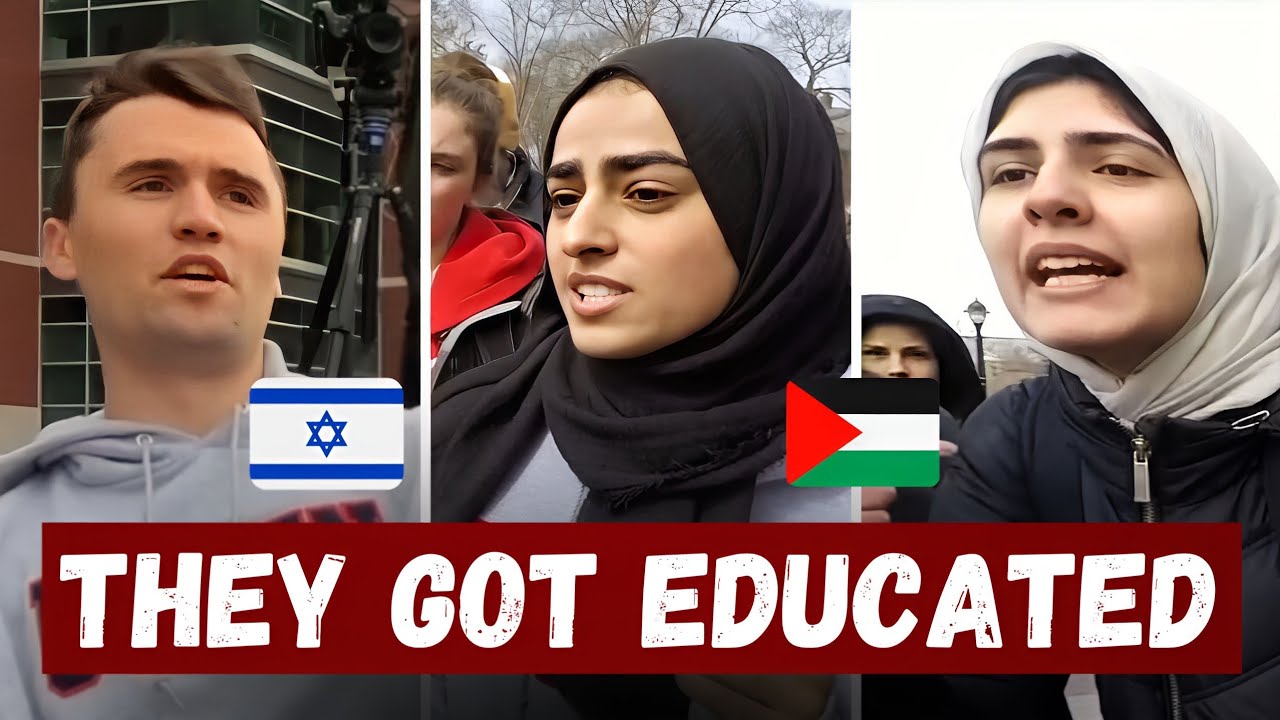
What do everyday people think about one of the most contentious conflicts of our time? This video documents raw, unfiltered street interviews that expose the vast spectrum of opinions on the Israel-Palestine situation. From students defending armed resistance as justified decolonization to others struggling to articulate their positions, these conversations reveal how polarized public discourse has become. Featuring Palestinian voices calling for recognition of 75 years of displacement, Western students questioning Israel's designation versus Hamas, and conflicting views on violence, occupation, and the path forward, these interviews capture the complexity and emotion surrounding Gaza, the Israeli Defense Forces, and the question of what constitutes terrorism versus legitimate resistance.
In a series of candid street interviews, individuals shared their perspectives on the Israel-Palestine conflict, revealing a wide range of opinions from condemnation of both sides to explicit support for armed resistance. The interviews, conducted with consent from each participant, capture the raw and often contradictory nature of public discourse on this deeply divisive issue.
Several respondents framed the conflict through the lens of colonialism and decolonization, with one stating that "decolonization is inherently violent" and describing the situation as "chickens coming home to roost." This individual argued that Israel has been conducting an occupation "basically since its inception in 1948" and characterized recent events as "the natural sort of conclusion of 80 years of colonialism and then later apartheid within the existing Israeli territories."
Armed Resistance: Justified or Condemned?
When pressed on whether Hamas is justified in their actions, responses varied significantly. One respondent carefully navigated the legal implications, stating: "I wouldn't specifically say I condone the specific group of Hamas because that's illegal in this country now, but I think the Palestinians as a people have a right to resist in whatever method they specifically see as useful."
This same individual drew a distinction between condoning and condemning: "I don't think with specific things like indiscriminate killing of civilians I don't know how useful that is. I certainly wouldn't say I'm pro that, although on a purely tactical basis I don't know how useful I would say it is and I wouldn't condemn it either."
Another respondent echoed similar sentiments, saying: "In terms of their goal to free Palestine from Israeli control, yes, but in terms of the actions of violence that are going on, obviously not, because violence overall is not a way to achieve the means that you need. But if an uprising is what it takes to free the people of Palestine, that's what it takes. It's just as simple as that."
The Question of Terrorism Designation
A Palestinian respondent challenged the asymmetric designation of terrorist organizations, asking: "Hamas has been designated as a terrorist organization but Israel hasn't, you know. Israel, do you think Israel should be designated as a terrorist organization? Well, if the shoe fits, wear it, right?"
This individual emphasized that the conflict has been ongoing for 75 years, not just the recent weeks that have captured media attention: "I think the terminology of conflict is wrong because a conflict just denotes that there's an equal side, you know, both states, both countries have same kind of weapons, same stuff, but actually they don't. This has been going on for 75 years. I think the world, it's about time they're waking up to it."
Personal Stories of Displacement
The Palestinian respondent shared family history, explaining: "75 years ago my granddad was expelled from his country. He had to leave. There's been genocide and massacres. Yeah, I think people just need to wake up, take some action, we say to our leaders it's about time to take action too."
This perspective challenged the notion of Israel as simply a Western ally: "People say it's a western outpost, whatever your opinion is, if you are a state and you want to be recognized as a sovereign state, that doesn't give you a right to kill innocent people, cut off food and water to people who won't receive it from anywhere else, or you know, attack any aid given to these people in an open-air prison."
Calls for Dissolution and Western Accountability
Some respondents offered radical solutions. One stated their position clearly: "The reality of it is that Israel is a power and I would think that Palestine really does deserve to be free. Like it's just in what way could you say it being free as such? I would think the best way to go about it is really like the dissolution of Israel, honestly."
Another respondent placed responsibility squarely on Western powers: "My dream solution is that the Western powers like the UK government, like the US government and several others, they all come together and realize that they made a mistake in authorizing the creation of such a state and for basically being the reason that so much death is going on in that region and that every ideology has basically been hypercharged by their involvement, simple as that I think."
Standards for Military Conduct
The question of military standards emerged as a key theme. One respondent argued: "While Hamas definitely there has been there's not much restraint in the way they act, they aren't a military in the same way that the IDF is. But in that sense they, I think they are held, the IDF has to be held to a higher standard if they are supposedly a western military with their Rules of Engagement."
Pessimistic Outlooks on Peace
When asked about possible solutions, responses were often bleak. One individual stated: "Not that can be conducted peacefully, I don't think. I don't think Israel wants to conduct something peacefully. The Palestinians don't have a choice. I think what was going on before was a very slow destruction of the State of Palestine. What is now going on is a very quick one."
This respondent continued: "I think basically it comes to successful armed resistance from the Palestinians or nothing, or there will be no Palestine left. I think the closest we will have to a solution if the Israelis win is what the Israelis think of a solution, which is the destruction of the State of Palestine."
Media Representation and Historical Context
Several respondents criticized media coverage. One noted: "I do feel like the media is representing a false narrative with Israel in terms of like how long the conflict has been going on. But I mean, and like now with the terrorist group coming in and like just pushing that forward, that story forward, instead of like all the atrocities that's been happening over the years."
However, this same individual admitted limitations in their knowledge: "I can't, I'm not too educated I guess." When asked to name specific Israeli atrocities, they responded: "I couldn't name any off the top of my head but I just know that they've been just pushing the border. I mean, from what I've been told so it's not full, you know. But they've just been pushing on the border for like the last like forever pretty much, the Holy Land as such."
Nuanced Condemnations and Proportionality
One of the more measured responses came from an individual who condemned Israel's response while acknowledging complexity: "I feel again that it's very complicated. It does seem to me that it seems a bit out of proportion given the power and the presence they already have over that area and the situations, the relative inequities in terms of Israel's resources versus what Gaza has and Gaza being essentially the prisoners of Israel."
When asked about Hamas, this respondent declined to address justification directly: "I don't really want to address justification, um, frankly, but as always when with an act of war there's a retaliatory response. As I said, it seems to me that Israel's response was perhaps out of proportion. Again, this particular incident has to be considered within the larger context of the Israel-Palestine longstanding conflict and standoff. So I think it's quite complicated and difficult to sum up in a few words."
The Human Cost
The Palestinian respondent emphasized the human dimension: "It doesn't matter how much funding they receive from the US governments or any Western government, you know. People say it's a western outpost, whatever your opinion is, if you are a state and you want to be recognized as a sovereign state, that doesn't give you a right to kill innocent people, cut off food and water to people who won't receive it from anywhere else."
They continued: "Doesn't matter who they are, doesn't matter where they're from, doesn't matter what their lineages, doesn't matter who their ancestors are, you know. They have a right to live where they stand. You can't just kill them because you disagree with their existence. I don't agree with how the European settlers came to Palestine. You know, Europe didn't want them, they were welcomed in Palestine."
A Call for Historical Awareness
Multiple respondents emphasized the importance of understanding history. One stated: "It's such a complicated issue but the reality of it is that Israel is a power and I would think that Palestine really does deserve to be free. It's just in what way could you say it being free as such. I would think the best way to go about it is really just the dissolution of Israel honestly. It's something that I really hope gets sorted out soon but in the grand scheme of things I think people just really need to research their history, they really need to look into it and see that in so many cases, in practically every other case, Israel is in the wrong."
This individual added a critical observation about Palestinian motivations: "I'm not condoning the fact that there's so much violence going on by so many different groups on both sides of the conflict, but the reality is the Palestinian people are fighting for themselves and so long as they get their freedom that they've been fighting for like over 75 years or roughly 75 years, until they get that they aren't going to be as focused on the fact of who's leading the charge."
The interviews collectively reveal a public grappling with historical grievances, current violence, questions of proportionality, and fundamentally different frameworks for understanding occupation, resistance, and terrorism. The lack of consensus and the willingness of some to justify or refuse to condemn violence highlights the deep divisions and moral complexities surrounding the Israel-Palestine conflict.