Up Next
Andrew Kolvet on Charlie Kirk's Assassination, Candace Owens Conspiracy Theories, and the Future of Conservative Movement
1:10:32
Candace Owens Reveals Liberty University Scandal That Led to Charlie Kirk's Assassination and Jerry Falwell Jr.'s Fall
53:09
Alex Newman Exposes Deep State Attack on Turning Point USA Following Charlie Kirk's Assassination
28:37
Ben Shapiro Honors Charlie Kirk While Condemning Candace Owens and Tucker Carlson for Spreading Conspiracy Theories
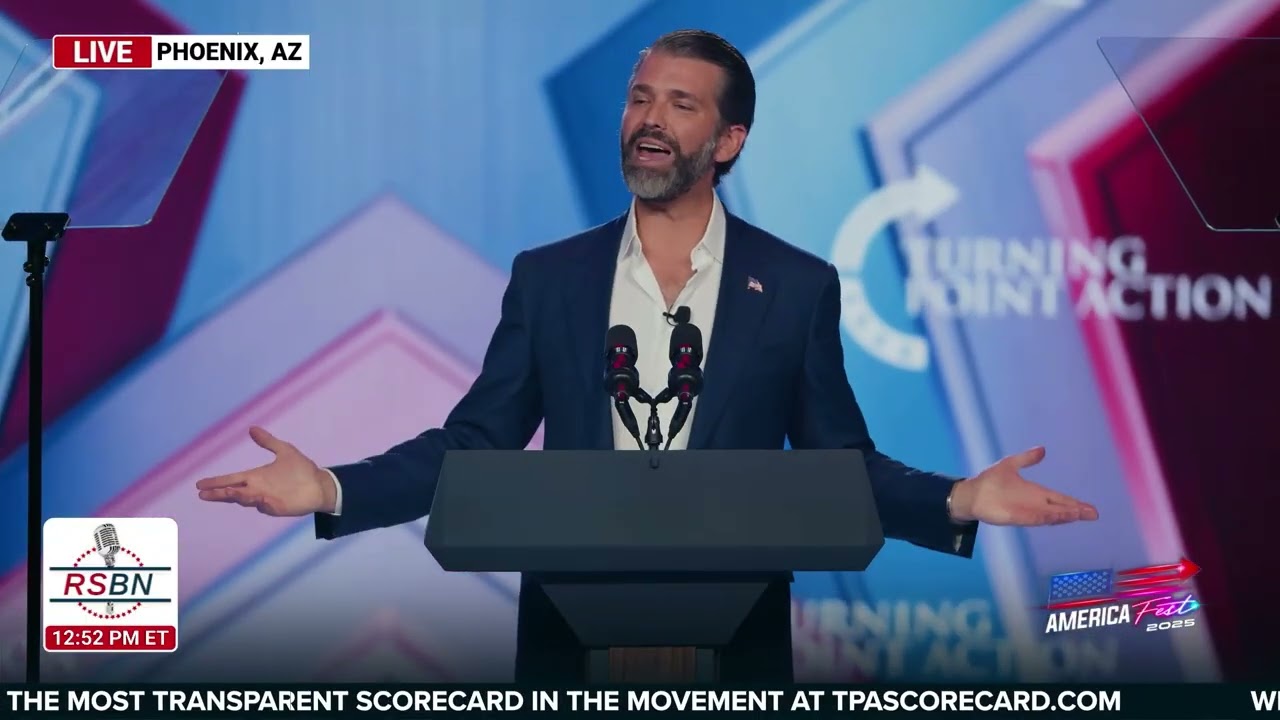
Ben Shapiro delivers a powerful tribute to Charlie Kirk at Turning Point USA, celebrating the life of his friend while calling out prominent conservative figures for spreading dangerous conspiracy theories about Kirk's murder. Shapiro condemns Candace Owens for accusing TPUSA and Erika Kirk of covering up the murder, criticizes Tucker Carlson for platforming extremists like Nick Fuentes, and challenges the conservative movement to prioritize truth over friendship and loyalty. In this emotional and confrontational speech, Shapiro lays out five key obligations that public figures owe their audiences, emphasizing evidence-based reasoning over conspiracy thinking and demanding accountability from those who claim to speak for conservatism.
A Bittersweet Tribute to Charlie Kirk
Ben Shapiro opened his speech at Turning Point USA with a tribute to Charlie Kirk, describing the moment as "incredibly bittersweet." He praised Erika Kirk as "a heroic figure and a true American patriot," stating his belief that "the best way to judge the goodness of a man is to see the goodness of his wife and his children. And on that measure, Charlie was unsurpassed."
Shapiro reflected on his long friendship with Kirk, noting, "I knew Charlie from the time he was 18 years old. And I watched him build himself into one of the most powerful exponents of conservatism in America, one of the most powerful coalition builders in American history." He acknowledged the bitter reality of Kirk's murder while finding solace in "the number of people who continue to remember Charlie each and every day and to carry on his mission."
The Future Depends on Truth
Shapiro shifted to his central theme: the critical importance of truth in the conservative movement and American politics. "The future of this country, this amazing country relies on the future of the conservative movement," he declared. "It relies on what TPUSA defines as its core mission. Freedom, free markets, and limited government. And most of all, most of all, the future of this country relies on truth."
He emphasized that "victory, true, real lasting victory cannot be achieved without truth. Victory without truth is victory for a lie. And that is no victory at all. And unity without truth is no unity. It is merely solidarity and falsehood."
Shapiro acknowledged the legitimate debates within conservatism about "the relationship between free markets and traditional virtue," foreign policy pragmatism, and appropriate governmental means. However, he warned that the movement faces danger "not just from a left that all too frequently excuses everything up to and including murder" but also from "charlatans who claim to speak in the name of principle but actually traffic in conspiracism and dishonesty."
Five Obligations to the Audience
Shapiro outlined five duties that public figures owe their audiences:
First Duty: Truth
"We owe you the truth," Shapiro stated. "That means we should not mislead you. It means we shouldn't hide the ball. We shouldn't be deliberately obscure about what we're telling you. We have an obligation to clarity and to honesty."
He criticized vague language and conspiracy thinking, specifically addressing those who say "they shot Charlie without specifying whom we mean by they." He clarified: "The person who allegedly shot Charlie Kirk and whom all the evidence points at, all of it is a gay trans." He argued that if people want to target ideological movements, they should "talk about the fact that the radical trans movement treats all those who oppose it as existential threats" or discuss "the Democratic party making room for the radical trans movement and echoing its inflammatory rhetoric."
"When people say they shot Charlie, however, they are instead trafficking in vaguery that results in increased hatred without proposing any effective response. They are fostering despair and rage, and that makes things worse," Shapiro explained.
Confronting Candace Owens Directly
In one of the speech's most dramatic moments, Shapiro directly condemned Candace Owens by name. "We must not let fear of audience deter us from telling the truth. We must not let fear of other hosts deter us from telling the truth," he declared.
"If Candace Owens decides to spend every day since the murder of Charlie Kirk casting aspersions at TPUSA and the people who work here who worked with Charlie every single day his best friends to cast aspersions at Mikey McCoy and Andrew Kolvet and Blake Neff and Tyler Bowyer and yes at Erika Kirk and to imply or outright claim complicity in a cover up over Charlie's murder to spew absolutely baseless trash implicating everyone from French intelligence to Mossad to members of TPUSA in Charlie's murder or a cover up in that murder, then we as people with a microphone have a moral obligation to call that out by name."
He continued with passion: "Erika Kirk and TPUSA never never should have put in never should have been put in the position to have to defend themselves against such specious and evil attacks, particularly in a time of mourning."
Second Duty: Principle Over Personal Feeling
"Because we owe you the truth, we owe you the duty to speak out of principle, not personal feeling," Shapiro argued. "It should not matter whether we despise someone or whether we love someone. The question is what they say and what they do and whether those things are morally decent or not."
He directly criticized other conservative figures for their silence on Owens' behavior: "The people who refuse to condemn Candace's truly vicious attacks, and some of them are speaking here, are guilty of cowardice. Yes, cowardice."
Shapiro called out Tucker Carlson specifically: "No, Tucker Carlson, it is not an excuse to go silent on Candace's targeting of TPUSA or to mirror her lines of questioning because you love Candace personally."
He also addressed Megyn Kelly: "The same holds true of Megyn Kelly, a person I consider a friend, characterizing Candace as a young mother and thus shying away from condemning her actions or filming me about them. That is a non-starter. Meghan Markle is a young mother. Ilhan Omar is a young mother. That doesn't matter."
Shapiro quoted Kelly's recent statement and responded: "When Megyn said this week, quote, 'My goal and my job here is to try to understand, yes, where Candace is coming from on this and says she sees no purpose in inserting herself quote into this on one side.' That is a moral and logical absurdity. There is only one moral side here. Erika Kirk's side, you know, the side of the widow with two children whose husband was shot live on camera in front of all of us."
Third Duty: Take Responsibility
"We have a duty to take responsibility for what we say and do," Shapiro stated. "If we hire awful people, we're responsible for that." He noted he has "some experience there."
He then launched into a scathing critique of Tucker Carlson's guest choices: "If you host a Hitler apologist Nazi loving anti-American piece of refuse like Nick Fuentes, you know the Nick Fuentes who said that the vice president of the United States is a quote fat gay race traitor married to a Jeet. The person who said that Charlie Kirk was a quote idiot. The person who said, and pardon my language here, it's his quote, that he quote took Turning Point USA and effed it, and that's why it's filled with groypers. If you have that person on your show and you proceed to glaze him, you ought to own it."
Shapiro explained why this matters: "There is a reason that Charlie Kirk despised Nick Fuentes and indeed even chided Dinesh D'Souza for debating him. He knew that Nick Fuentes is an evil troll and that building him up is an act of moral imbecility. And that is precisely what Tucker Carlson did. He built Nick Fuentes up and he ought to take responsibility for that just as he ought to take responsibility for glazing pornographer and alleged sex trafficker Andrew Tate or for mainstreaming fake historian and pseudo Nazi apologist Darryl Cooper as America's best and most honest popular historian."
"Hosts are indeed responsible for the guests they choose and the questions they ask those guests," he concluded.
Fourth Duty: Provide Evidence
"Because we have a duty to truth, we also have a duty to provide you with evidence of the claims that we make," Shapiro argued. "Emotive accusations, conspiracy theories, and just asking questions. That's lazy and stupid and misleading. None of them are a substitute for truth. None of them are a substitute for evidence."
He addressed Stephen Bannon's tactics: "When Steve Bannon, for example, accuses his foreign policy opponents of loyalty to a foreign country, he's not actually making an argument based in evidence. He's simply maligning people that he disagrees with, which is indeed par for the course from a man who was once a PR flack for Jeffrey Epstein. Check the record."
Shapiro criticized the "just asking questions" approach: "Just asking questions is something my 5-year-old does, and it's really cute when it comes from my 5-year-old. But when grown men and women spend their days just asking questions without, you know, seeking answers, they are lying to you. In fact, they're doing something even worse. They are seeding distrust in the world around you and they are enervating you in the process."
He provided a specific example: "If many speakers, including Tucker Carlson and others, get on stage here at TPUSA and claim without proper evidence that Jeffrey Epstein was running a Mossad rape ring being covered up by the Trump administration. They are not actually uncovering a conspiracy or effectuating a solution. They are claiming a special providence to information they won't let you see, which builds their power and leaves you with none."
Shapiro pointed out the implications: "They are also implicating in their speculation actual human beings, good human beings like Kash Patel and Dan Bongino and Pam Bondi and yes, the president of the United States, even if they're too cowardly to say President Trump's name. And that means you won't trust those good people in the future. You haven't gotten smarter. You've just been manipulated."
He noted the hypocrisy of some conspiracy theorists: "When forced to demonstrate their evidence, these same people will often refuse to provide it. They'll claim ignorance. They'll pretend they're outside the system and they don't have access to actual information. You know, they're just asking questions. But many of these same people have direct pipelines to informational sources. So, for example, if Tucker wants answers to his questions about, say, Jeffrey Epstein, he could call the vice president of the United States. He's quite close with him. But he won't because that might undermine the empty speculation."
Shapiro clarified his position on conspiracies: "None of this means there aren't actual real conspiracies in the world. Of course, there are. But actual conspiracies require actual evidence. Yes, there was a Russiagate conspiracy and we know the names of the people involved and what they did. We know Hillary Clinton and Fusion GPS and James Comey and Loretta Lynch and Adam Schiff. We know all of those people. Yes, there was a COVID-19 conspiracy. We know that Anthony Fauci worked to shut down alternative solutions from people like Jay Bhattacharya. But when people posit a conspiracy and then provide you no evidence, they are doing you a fundamental disservice and they are making you stupider in the process."
Fifth Duty: Propose Solutions
"Finally, because it is our job to make the lives of our audience better, right? That's really our job is to give you more information to make your lives better. We have a duty to propose solutions," Shapiro stated. "That's why we have to talk about our problems in order to find the solutions. That's what politics was supposed to be about after all, finding solutions to our common problems."
He warned against endless negativity without constructive purpose: "If we speak endlessly about the problems we face without ever positing a solution other than wrecking the system or centralizing power in a cult-like figure, we are not finding solutions. We are merely making problems worse. Just asking questions, positing vague conspiracies, raving like Alex Jones about the secret confederacies that control your life. None of it makes your life better. None of it. In fact, it makes your life markedly worse."
Shapiro explained the danger of this approach: "That's because if you truly come to believe that nothing in your life is in your control, you can't even take control of your own life. You despair of your ability to change your own circumstances and then you fail. And you must not fail."
America's Greatness and the Path Forward
Shapiro concluded with optimism about America: "For all of its problems, many of which a huge number of which are real and serious, the United States is still the greatest constitution ever devised by man."
He emphasized the mutual obligations between public figures and their audiences: "We owe you that quest for truth. You owe yourselves that quest for truth."
Questions and Charlie Kirk's Legacy
During the Q&A session, Shapiro was asked about balancing truth with polite delivery. He responded: "I think obviously the truth comes first. We ought to be polite, but the truth comes first. And if you can tell the truth in a polite way, that's the best way to do it. But sometimes people perceive truth as impolite and that's just the way of the world."
He reiterated his famous principle: "I rather famously have said that facts don't care about your feelings. And that happens to be true." He advised that "truth always has to take precedence over politeness if the two come into conflict. Particularly if you're talking publicly as we all do for a living."
When asked about bridging divides in the conservative movement, Shapiro emphasized principles: "Unity has to be reliant on first principles. No one would ask conservatives to unite with radical trans activists because that would be silly. And so we first have to decide what are the principles that we hold in common and then actually determine who are our allies in that particular fight."
In a final question, a college student asked for encouragement on starting a TPUSA chapter. Shapiro pointed to Charlie Kirk as the ultimate example: "Look at Charlie Kirk, right? That's the words of encouragement. Charlie was your age when he started doing this. Again, I referenced earlier that I met Charlie when he was 18 years old. It was actually at David Horowitz Freedom Center conference and Charlie was going around trying to meet donors and I saw this really nerdy tall gangly kid walking around trying to meet people and I started introducing Charlie to a few of his sort of original donors."
Shapiro shared a personal memory: "I've said this before but it's true. Charlie walked away and I turned to my friend Jeremy Boreing I said that dude's going to be the head of the RNC one day because Charlie was just that much of a go-getter and it turns out that he was a lot bigger than that."
He emphasized that anyone could follow Kirk's example: "Everyone has the potential to do that. Not everybody has the same exact skill set and you have to find the skill set that best suits you. Maybe you're great at debate. Charlie was great at debate. Actually, what's fascinating about Charlie is that Charlie made himself great at debate. I knew Charlie when he wasn't great at debate and then I knew Charlie when he was great at debate. He actually cultivated a skill set. It was really impressive and cool to watch him do that."
Shapiro concluded with inspiration: "If Charlie can do that, a raw kid out of high school, no college degree, and build the most powerful conservative organization in America, then you can do it, too, because that's what America's all about. You're an American. Go do it."
Video Transcript
Well, I couldn't be more excited to be
here today. The golden age of America is
just beginning. I really believe that
America right now is divided between
what I like to call the lions and the
scavengers. Lions are people who want to
build things, people who are productive.
The scavengers believe that if you fail,
it's probably somebody else's fault.
Donald Trump and the American people are
about to make our economy dynamic again.
Free markets are merit. Free markets are
justice. Free markets are innovation and
they are dynamism. How do we retain the
momentum? And the answer is we do the
right things. The future of the country
is not just President Trump. The future
of the country is in this room. These
young people here, it's the people who
are in the audience. The future of the
country is beginning right now.
>> Ladies and gentlemen, Ben Shapiro.
Well, thank you so much. Thank you so
much. It's obviously a massive honor to
be here at Turning Point USA.
It's even more of an honor to follow
Erica Kirk, a heroic figure and a true
American patriot.
I really believe that the best way to
judge a goodness of a man is to see the
goodness of his wife and his children.
And on that measure, Charlie was
unsurpassed.
Erica and her children are in all of our
hearts.
And of course, this is an incredibly
bittersweet moment. It's absolutely
bitter because of the murder of our
friend Charlie Kirk, an irreplaceable
human being.
I knew Charlie from the time he was 18
years old. And I watched him build
himself into one of the most powerful
exponents of conservatism in America,
one of the most powerful coalition
builders in American history.
But it's also sweet to see the number of
people who continue to remember Charlie
each and every day and to carry on his
mission.
Well, today I want to talk about the
future of the country. And the future of
this country, this amazing country
relies on the future of the conservative
movement. It relies on what TPUSA
defines as its core mission. Freedom,
free markets, and limited government.
And most of all, most of all, the future
of this country relies on truth.
This country relies on truth because
victory, true, real lasting victory
cannot be achieved without truth.
Victory without truth is victory for a
lie. And that is no victory at all. And
unity without truth is no unity. It is
merely solidarity and falsehood.
You see, we live in a chaotic time. In a
time when lots of people are asking lots
of legitimate questions about the
conservative movement, what ought we to
think about the relationship between
free markets and traditional virtue? How
should we craft a pragmatic foreign
policy that spreads our interests and
upholds our ideals? What governmental
means are appropriate to achieve
political ends? All of these questions
aren't new, of course. They've been
asked for as long as human beings have
been talking about politics, thousands
of years. And over the course of this
conference, you'll hear a lot of
opinions on a lot of these questions. I
have my own perspectives on them. Of
course, you can hear them every single
day on my show. My fundamental values
have been the same for 25 years. Peace
through strength on foreign policy,
traditional values on social policy,
free markets with regard to economics.
But today, I want to talk about
something even more important. How to
discern those attempting to speak truth
from frauds and grifters
because something is new. Anformational
environment rife with both opportunity
and chaos. Opportunity because the
legacy media gatekeepers are no longer
in charge of what we see and what we
hear. and chaos because an
anarcticformational environment means we
actually have to be smart in how we
assess the information and arguments
that we hear. Why does that matter?
Well, because today the conservative
movement is in serious danger. It is in
danger not just from a left that all too
frequently excuses everything up to and
including murder. The conservative
movement is also in danger from
charlatans who claim to speak in the
name of principle but actually traffic
in conspiracism and dishonesty who offer
nothing but bile and despair who seek to
undermine fundamental principles of
conservatism by championing innovation
and grievance. These people are frauds
and they are grifters and they do not
deserve your time. And they are
something worse than that. a danger to
the only movement capable of stopping
the left from wrecking the country
wholesale.
So today I want to discuss five
obligations that people who speak to you
on matters of importance have to you. I
want to speak to you about our duties.
Our first duty is truth. We owe you the
truth. That means we should not mislead
you. It means we shouldn't hide the
ball. We shouldn't be deliberately
obscure about what we're telling you. We
have an obligation to clarity and to
honesty. This means that we actually
have to be clear in the language that we
use. We should not traffic in
generality. We should not say things
like they shot Charlie without
specifying whom we mean by they. The
person who allegedly shot Charlie Kirk
and whom all the evidence points at, all
of it is a gay transl.
If we are going to target ideological
movements, we should talk about the fact
that the radical trans movement treats
all those who oppose it as existential
threats. Or if we're going to talk about
the Democratic party making room for the
radical trans movement and echoing its
inflammatory rhetoric, well, we should
talk about that. Those are specific
problems and they require specific
responses. When people say they shot
Charlie, however, they are instead
trafficking in vagory that results in
increased hatred without proposing any
effective response. They are fostering
despair and rage, and that makes things
worse. We must also be honest about what
people say and do, regardless of what
that means coalitionally.
It is the job of politicians to build
coalitions. It's the job of those of us
who try to shape public opinion to hold
politicians to account and to hold them
accountable to our values.
We must not let fear of audience deter
us from telling the truth. We must not
let fear of other hosts deter us from
telling the truth.
So, for example,
if Candace Owens decides to spend every
day since the murder of Charlie Kirk.
So if Candace Owens decides to spend
every day since the murder of Charlie
Kirk casting aspersions at TPUSA and the
people who work here who worked with
Charlie every single day his best
friends to cast dispersions at Mikey
McCoy and Andrew Kovvin and Blake Nef
and Tyler Ber and yes at Erica Kirk and
to imply or outright claim complicity in
a cover up over Charlie's murder to spew
absolutely baseless trash implicating
everyone from French intelligence to
MSAD. to members of TPUSA in Charlie's
murder or a cover up in that murder,
then we as people with a microphone have
a moral obligation to call that out by
name.
Erica Kirk and TPUSA never never should
have put in never should have been put
in the position to have to defend
themselves against such specious and
evil attacks, particularly in a time of
mourning.
And the people who refuse to condemn
Candace's truly vicious attacks, and
some of them are speaking here, are
guilty of cowardice.
Yes, cowardice.
The fact that they have said nothing
while Candace has been vomiting all
sorts of hideous and conspiratorial
nonsense into the public square for
years is just as cowardly.
Second, because we owe you the truth, we
owe you the duty to speak out of
principle, not personal feeling. It
should not matter whether we despise
someone or whether we love someone. The
question is what they say and what they
do and whether those things are morally
decent or not. On a political level, do
they foster freedom, justice, and
prosperity? On a personal level, do they
treat others as they would wish to be
treated? Personal feeling is not a
substitute for moral judgment. To take
again the Candace Owen situation as an
example, friendship with public figures
who say or do evil things is not an
excuse for silence on the matter.
Politics is not the sisterhood of the
traveling pants.
Politics is about principle. And if you
are willing to sacrifice basic truth and
simple principle in favor of emotional
solidarity, you have betrayed your
fundamental duty to the American people.
First off, I should break the omera here
and just be a little bit clear. The
notion that people in our industry are
close friends, like we all take holiday
breaks with each other and go to each
other's kids graduations and stuff is
generally untrue. Some people do that,
most of us don't. We see each other at
conferences and we talk on the phone and
all the rest. We're business colleagues.
But even if it were true that other
public figures were our best friends,
our very best friends, that does not
relieve us of our duty to speak out of
principle and not to cover up evil or
shy away from addressing it out of
friendship.
So, no, Tucker Carlson, it is not an
excuse to go silent on Candace's
targeting of TPUSA
or to mirror her lines of
questioning because you love Candace
personally. The same holds true of Megan
Kelly, a person I consider a friend,
characterizing Candace as a young mother
and thus shying away from condemning her
actions or filming me about them. That
is a non-starter. Meghan Markle is a
young mother. Ilhan Omar is a young
mother. That doesn't matter. And when
Megan said this week, quote, "My goal
and my job here is to try to understand,
yes, where Candace is coming from on
this and says she sees no purpose in
inserting herself quote into this on one
side. That is a moral and logical
absurdity. There is only one moral side
here. Erica Kirk's side,
you know, the side of the widow with two
children whose husband was shot live on
camera in front of all of us. Friendship
with the person accusing TPUSA of a
cover-up of Charlie's murder is no
excuse for cowardice.
Third, and relatedly, we have a duty to
take responsibility for what we say and
do. If we hire awful people, were
responsible for that. I have some
experience there, as you might suspect.
That means that if we offer a guest for
your viewing, we owe it to you to ask
the kinds of questions that actually get
at the truth. If we agree with a guest,
that's fine, but we should own it. So
for example, if you host a Hitler
apologist Nazil loving anti-American
piece of refugees like Nick Fuentes,
you know the Nick Fuentes who said that
the vice president of the United States
is a quote fat gay race traitor married
to a Jeet. The person who said that
Charlie Kirk was a quote idiot.
the person who said, and pardon my
language here, it's his quote, that he
quote took Turning Point USA and
it, and that's why it's filled with
gripers. If you have that person on your
show and you proceed to glaze him, you
ought to own it.
There is a reason that Charlie Kirk
despised Nick Fuentes and indeed even
chided Desh Douza for debating him. He
knew that Nick Fuentes is an evil troll
and that building him up is an act of
moral imbecility. And that is precisely
what Tucker Carlson did. He built Nick
Fuentes up and he ought to take
responsibility for that just as he ought
to take responsibility for glazing
pornographer and alleged sex trafficker
Andrew Tate or for mainstreaming fake
historian and pseudo Nazi apologist
Daryl Cooper as America's best and most
honest popular historian. Hosts are
indeed responsible for the guests they
choose and the questions they ask those
guests.
Fourth, because we have a duty to truth,
we also have a duty to provide you with
evidence of the claims that we make.
Emotive accusations, conspiracy
theories, and just guessing questions.
That's lazy and stupid and misleading.
None of them are a substitute for truth.
None of them are a substitute for
evidence. So when Candace Owens says, "I
don't know." No, but I know that is
And we are all more
for having heard it.
When Steve Bannon, for example, accuses
his foreign policy opponents of loyalty
to a foreign country, he's not actually
making an argument based in evidence.
He's simply maligning people that he
disagrees with, which is indeed par for
the course from a man who was once a PR
flack for Jeffrey Epstein.
Check the record.
Our duty to provide you evidence means
we actually have to do much more than
just ask questions. Just asking
questions is something my 5-year-old
does, and it's really cute when it comes
from my 5-year-old. But when grown men
and women spend their days just asking
questions without, you know, seeking
answers, they are lying to you. In fact,
they're doing something even worse. They
are seeding distrust in the world around
you and they are enervating you in the
process.
So, for example, if many speakers,
including Tucker Carlson and others, get
on stage here at TPUSA and claim without
proper evidence that Jeffrey Epste was
running a MSAD rape ring being covered
up by the Trump administration. They are
not actually uncovering a conspiracy or
effectuating a solution. They are
claiming a special providence to
information they won't let you see,
which builds their power and leaves you
with none. They are also implicating in
their speculation actual human beings,
good human beings like Cash Patel and
Dan Bongino and Pam Bondi and yes, the
president of the United States, even if
they're too cowardly to say President
Trump's name. And that means you won't
trust those good people in the future.
You haven't gotten smarter. You've just
been manipulated. When forced to
demonstrate their evidence, these same
people will often refuse to provide it.
They'll claim ignorance. They'll pretend
they're outside the system and they
don't have access to actual information.
You know, they're just asking questions.
But many of these same people have
direct pipelines toformational sources.
So, for example, if Tucker wants answers
to his questions about, say, Jeffrey
Epstein, he could call the vice
president of the United States. He's
quite close with him. But he won't
because that might undermine the empty
speculation.
None of this means there aren't actual
real conspiracies in the world. Of
course, there are. But actual
conspiracies require actual evidence.
Yes, there was a Russia gate conspiracy
and we know the names of the people
involved and what they did. We know
Hillary Clinton and Fusion GPS and James
Comey and Loretta Lynch and Adam Schiff.
We know all of those people. Yes, there
was a CO 19 conspiracy. We know that
Anthony Fouchy worked to shut down
alternative solutions from people like
Jay Bodacharia. But when people posit a
conspiracy and then provide you no
evidence, they are doing you a
fundamental disservice and they are
making you stupider in the process.
>> Finally, because it is our job to make
the lives of our audience better, right?
That's really our job is to give you
more information to make your lives
better. We have a duty to propose
solutions.
That's why we have to talk about our
problems in order to find the solutions.
That's what politics was supposed to be
about after all, finding solutions to
our common problems. If we speak
endlessly about the problems we face
without ever positing a solution other
than wrecking the system or centralizing
power in a cult-like figure, we are not
finding solutions. We are merely making
problems worse. Just asking questions,
positing vague conspiracies, raving like
Alex Jones about the secret
confederacies that control your life.
None of it makes your life better. None
of it. In fact, it makes your life
markedly worse. That's because if you
truly come to believe that nothing in
your life is in your control, you can't
even take control of your own life. You
despair of your ability to change your
own circumstances and then you fail. And
you must not fail.
Because here is the most fundamental
truth of all in the United States. For
all of its problems, many of which a
huge number of which are real and
serious, the United States is still the
greatest bit of that begins with truth.
We owe you that quest for truth. You owe
yourselves that quest for truth. and
true victory only constitution ever
devised by man. Thanks so much. Happy to
take a couple questions.
Hi, my name is Jenna. I'm one of the
co-presidents of the Turning Point
chapter at JMU. Um,
I have a question. Um, how do you
balance telling the truth with delivery
and speaking to people who disagree with
you?
>> So, I think obviously the truth comes
first. We ought to be polite, but the
truth comes first. And if you can tell
the truth in a polite way, that's the
best way to do it. But sometimes people
perceive truth as impolite and that's
just the way of the world. You know, I I
rather famously have said that facts
don't care about your feelings. And that
happens to be true. You know, when you
when you engage in a conversation, I've
said this to a lot of people, when you
engage in a conversation, it's very
important to sort of determine the end
of the conversation. If it's going to be
impossible to tell somebody the truth in
a productive way, you probably shouldn't
engage in that kind of conversation, and
you should make that judgment ahead of
time. But truth always has to take
precedence over politeness if the two
come into conflict. Particularly if
you're talking publicly as we all do for
a living. I'm not talking about you're
talking to your, you know, kid and they
bring you a macaroni painting and
they're like, "Is it good or not?"
You're like, "No, this is terrible." And
you stuff it in the trash. It is
terrible. But, you know, say that it's
good and then later you kind of put I
understand. But when we're talking about
politics and policy, obviously the truth
has to come first because if we can't
agree on fundamental facts, there's no
possibility for solutions.
Thank you for being here, Ben. You cited
during your speech truth as the most
important tenant of American
conservatism.
Why therefore did you call irrelevant
the Israeli attack in 1967
on the USS Liberty which left dozens of
American servicemen dead and hundreds
wounded.
So what I actually said is that if we're
looking at modern Israeli American
relations, looking at an attack that
happened mistakenly by multiple Navy
reports, multiple Israeli reports and
all available evidence and using that
attack in order to undermine today's
relations between Israel and America,
that's irrelevant. As irrelevant as it
would be to site a piece of evidence
from World War II or from 1776 to define
America's relations with, for example,
Great Britain or Germany today. That
does not mean that the attack wasn't
horrible for the Americans involved,
that it wasn't bloody and terrible. The
Israeli government paid reparations to
the people who were killed. If you look
at the actual military record of what
happened on the USS Liberty, it was
clearly a mistaken and tragic attack.
The people who frequently cite the USS
Liberty, however, are not talking about
the specifics of the USS Liberty. I
suspect that the vast majority of people
who bring this up are doing so in order
to suggest that Israel deliberately
attacked an American ship because Israel
deliberately wants to harm America is
connected generally with a larger point.
I wonder if that's your point.
If the truth matters, then the Israeli
government must be held accountable for
that attack. The American flag was
flying on that ship. You do not mistake
an American ship for a foreign one when
our flag is flying. So,
and we can spend the rest of the time
talking about the specifics of the US
Liberty attack or you can actually go
look at the naval investigations that
were done. Multiple naval investigations
that were done. The reality is that
people were flying Mirage planes for the
Israeli military at the time. The USS
Liberty was sailing in an area where it
had essentially gone off-rid. The
Israeli military mistook it for an
Egyptian ship. They thought it was
showing all arish which happened not to
be true. In the initial attack, the
American flag was knocked down and then
the attack went on for about 90 minutes
and then as soon you can hear this by
the way on the tapes of the Israeli
pilots talking to each other. As soon as
they realize that it's an American ship,
they call off the attack. They speed a
ship to try and help the USS Liberty.
There have been multiple unfortunate
friendly fire incidents between Allied
forces, including, for example, in the
Gulf War, where US forces were
responsible for killing about nine
British troops during the Gulf War. It's
an unfortunate reality of war. But
you're not answering my question which
is what is your broader agenda in asking
the question because I suspect that your
question is not limited to your specific
over an incident that happened in 1967.
>> I think we should question any foreign
country's relationship with our
government.
>> That's totally fine. But I'm just
wondering why you
>> serve American interests.
>> Again, that I'm I'm perfectly fine with
questioning any country's relationship
with the United States. But again, I'm
wondering what your motivation is in
bringing up a six decade old attack as
though it is the number one issue in
assessing the relationship between
Israel and the United States today.
>> Well, many problems persist to this day.
But it's interesting that you say six
decade old incident when there are many
people in this audience who are alive
for that attack as if this is something
that's irrelevant that doesn't
>> No, it's just not particularly relevant
to assessing the relationship between
the United States and Israel today in
the same way that in 1967 there are a
wide variety of countries with which the
United States had different relations.
Okay, it's it's clearly not going to
actually answer the question, so I'm
happy to move to this one.
Unfortunately, this will be the last
question.
>> Hi. Um, my name is Natasha and I'm a
TPUSA chapter member at Lyola Marry
Mount University in Los Angeles.
So my question is just with the divide
in the conservative movement right now,
what is your suggestion as to how young
people can kind of come together and
bridge that divide and just, you know,
bring unity, right?
>> Reality is that people were flying
Mirage planes for the Israeli military
at the time. The USS Liberty was sailing
in an area where it had essentially gone
off-rid. The Israeli military mistook it
for an Egyptian ship. They thought it
was shelling all arish, which happened
not to be true. In the initial attack,
the American flag was knocked down and
then the attack went on for about 90
minutes and then as soon you can hear
this by the way on the tapes of the
Israeli pilots talking to each other. As
soon as they realize that it's an
American ship, they call off the attack.
They speed a ship to try and help the
USS Liberty. There have been multiple
unfortunate friendly fire incidents
between allied forces, including for
example in the Gulf War where US forces
were responsible for killing about nine
British troops during the Gulf War. It's
an unfortunate reality of war. But
you're not answering my question which
is what is your broader agenda in asking
the question because I suspect that your
question is not limited to your specific
over an incident that happened in 1967.
>> I think we should question any foreign
country's relationship with our
government.
>> That's totally fine. But I'm just
wondering why you
>> serve American interests.
>> Again, that I'm I'm perfectly fine with
questioning any country's relationship
with the United States, but again, I'm
wondering what your motivation is in
bringing up a six decade old attack as
though it is the number one issue in
assessing the relationship between
Israel and the United States today.
>> Well, many problems persist to this day.
But it's interesting that you say six
decade old incident when there are many
people in this audience who are alive
for that attack as if this is something
that's irrelevant that doesn't
>> No, it's just not particularly relevant
to assessing the relationship between
the United States and Israel today in
the same way that in 1967 there are a
wide variety of countries with which the
United States had different relations.
Okay, it's it's clear you're not going
to actually answer the question, so I'm
happy to move to this one.
Unfortunately, this will be the last
question.
>> Hi. Um, my name is Natasha and I'm a
TPUSA chapter member at Loyola Marry
Mount University in Los Angeles.
So my question is just with the divide
in the conservative movement right now,
what is your suggestion as to how young
people can kind of come together and
bridge that divide and just, you know,
bring unity right now?
>> So again, I think that unity has to be
reliant on first principles. No one
would ask conservatives to unite with
radical trans activists because that
would be silly. And so we first have to
decide what are the principles that we
hold in common and then actually
determine who are our allies in that
particular fight. Now again the
coalition may shift depending on the
issue. That's kind of a normal thing in
politics. Sometimes you're going to have
different allies than you have with
regard to other issues. But when it
comes to how young people ought to
decide what they believe, that's the
thing I most care about because if I'm
talking about the long-term friends of
America, not merely the coalitions of
the moment, which break and reform and
reform and break constantly, right?
George W. Bush's coalition was obviously
not Donald Trump's coalition and Donald
Trump Trump's coalition is not going to
be JD Vance's coalition. Meaning every
politician has their own coalition.
That's the nature of electoral politics.
What I'm more concerned about is the
trajectory of how people think and what
people think. And so before determining
how to unify with others, you should
first decide what are the things that
are important to you. What are your
fundamental values? And then you should
find people who agree with those
fundamental values. Because the problem
is if you don't then when push comes to
shove things come apart pretty quickly.
I'll take one more.
Uh hi Ben. Um big fan of yours and stuff
and I'm currently a college sophomore
and my university just started a chapter
and it got approved. Um, so just for
your advice, how can we spread um,
conservatism on campus and any hate or
anything like that? Um, just combat
that. And what would your be words of
encouragement?
>> I mean, my words of encouragement are
look at Charlie Kirk, right? That's the
words of encouragement. Charlie was your
age when he started doing this. Again, I
referenced earlier that I met Charlie
when he was 18 years old. It was
actually at David Horwit Freedom Center
conference and Charlie was going around
trying to meet donors and I saw this
really nerdy tall gangly kid walking
around trying to meet people and I
started introducing Charlie to to a few
of his sort of original donors and I I
by the way in the first conversation
with Charlie I've said this before but
it's true. Charlie walked away and I
turned to my friend Jeremy Boring I said
that dude's going to be the head of the
RNC one day because Charlie was just
that much of a go-getter and it turns
out that he was a lot bigger than that.
I think that everyone has the potential
to do that. Not everybody has the same
exact skill set and you have to find the
skill set that best suits you. Maybe
you're great at debate. Charlie was
great at debate. Actually, what's
fascinating about Charlie is that
Charlie made himself great at debate. I
knew Charlie when he wasn't great at
debate and then I knew Charlie when he
was great at debate. He actually
cultivated a skill set. It was really
impressive and cool to watch him do
that. That's something you can do too.
So again, if Charlie can do that, a raw
kid out of high school, no college
degree, and build the most powerful
conservative organization in America,
then you can do it, too, because that's
what America's all about. You're an
American. Go do it. Thank you so much.