Charlie Kirk and Candace Owens Challenge College Student on Climate Change Claims and Scientific Consensus Debate
Enjoying this? Share it with someone who needs to see it.
Up Next
Charlie Kirk Debates Animal Rights, Factory Farming Subsidies and Republican Free Market Principles at University of Wisconsin Madison
4:31
Charlie Kirk Addresses Ninth Annual Young Women's Leadership Summit on the Fight to Preserve Womanhood
39:18
Charlie Kirk on Strong Men, Western Civilization, and Why the Left's Cultural Revolution Failed
1:38:11
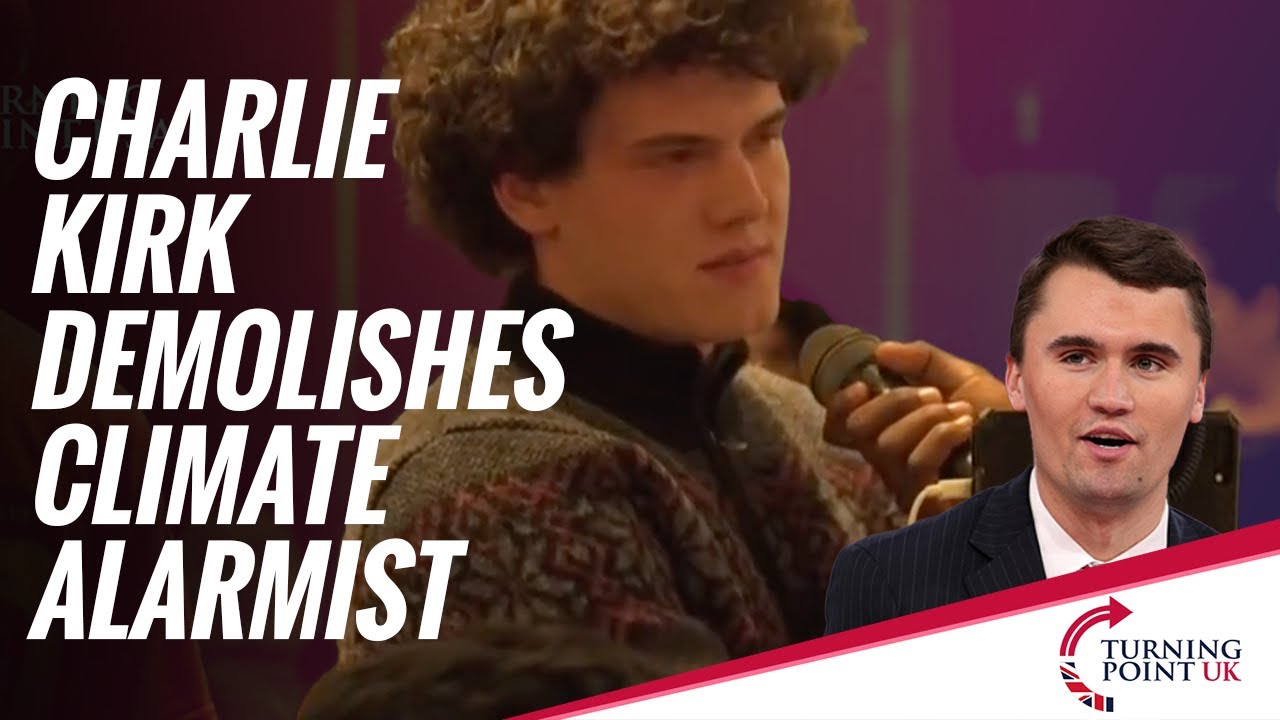
Charlie Kirk and Candace Owens Challenge College Student on Climate Change Claims and Scientific Consensus Debate
Charlie Kirk and Candace Owens engage with a college freshman who questions how Turning Point USA's commitment to facts over feelings aligns with climate policy. What follows is a pointed exchange about scientific proof, the difference between global warming and climate change terminology, and whether a 97% consensus in science actually proves causation. Kirk challenges the student to answer three key questions about human contribution, causation, and actionable solutions while defending economic competitiveness over international agreements like the Paris Climate Accord.
During a Turning Point USA event, a college freshman approached Charlie Kirk with a question about how the organization reconciles its emphasis on facts over feelings with climate policy. The student pointed out that climate change represents a significant threat based on the evidence and research available, setting the stage for a substantive debate about scientific proof and consensus.
Kirk immediately challenged the framing of the question by asking why scientists changed terminology from "global warming" to "climate change." He suggested the shift occurred because there was no factual data to back up claims about global warming, so the term was changed to the broader "climate change" because "the climate's always changing." Kirk characterized this as scientists telling a lie to extract tax dollars for agreements like the Paris Climate Accord, which he said had no actionable plan and caused America to lose economically. He defended President Trump's decision to withdraw from the agreement.
Three Questions That Demand Proof
Rather than accepting the premise that climate change is settled science, Kirk posed three specific questions to test whether the threat is proven: Can you prove humans are contributing to climate change? Can you prove how long it's been happening and what the causation is? And can you prove that anything we can do can actually stop it?
When the student said he could answer those questions, Kirk pressed him to do so. The student acknowledged he was just a freshman in college but attempted to explain the scientific evidence. He introduced the Seuss Effect, explaining that certain isotopes of carbon decay when taken in by plants and turned into fossil fuels underground. When these fossil fuels are burned, those isotopes are released into the atmosphere, and the increasing concentrations of these isotopes show the link is almost certain.
Kirk challenged whether this could draw a direct correlation using the scientific method between the aggregation of those isotopes and rising global temperatures, especially more so than natural factors like sunspots or natural climate activity. He noted that real climatologists who are not government-funded or highly politicized are still debating these questions.
The Problem With Consensus
The student invoked the often-cited statistic that there's a 99% consensus among scientists on climate change. Kirk immediately challenged this notion, asking about the remaining one percent. He emphasized that science is not a democracy—we don't vote on gravity or Newton's second law. Just because 99% of people believe something doesn't make it true.
The student clarified that he was referring to scientists who have put their entire work and life on the line, not just random opinions. Kirk and another speaker corrected the statistic to 97%, calling it a totally flawed statistic but agreeing to engage with it for the sake of argument. Kirk said he wanted to know why the three percent that disagrees and defects does so, because that dissent is what science is all about.
He argued that if scientists were able to prove without a shadow of a doubt that there's direct causation or correlation between fossil fuel activity and rising global temperatures, the consensus would be 100%. The fact that there's still disagreement demonstrates that it hasn't been proven. That three percent represents the scientific method in action—gathering, disagreeing, and discussing.
Economic Competitiveness Versus International Agreements
Kirk raised the question of cost, asking at what expense would we completely restructure our carbon-based economy for something that still has an immense amount of debate, dialogue, and discussion around it. He pointed out that other countries like India and China are trying to get their hands on as many fossil fuels as possible.
He stated that if the market wants to move toward a carbon-free economy, that's fine, but the government should not subsidize it. The United States should not enter international pacts that restrict economic competitiveness while countries that oppose America burn as much coal and natural gas as they can. Kirk and his colleague agreed that the Paris Agreement wasn't worth the paper it was written on and had nothing actionable in it, making Trump's decision to withdraw the right call.
Facts Versus Feelings
Kirk concluded the exchange by circling back to the original framing. The student had approached with the assumption that disagreeing with climate change consensus contradicted a commitment to facts. Kirk flipped this, stating he was giving the student a fact: that climate change causation hasn't been proven. The disagreement wasn't about rejecting facts but about what actually constitutes scientific proof versus political consensus.