2,387 videos 1,376,944,188 views US Joined Aug 30, 2018
Charlie Kirk is the Founder and President of Turning Point USA, the largest and fastest growing conservative youth activist organization in the country with over 250,000 student members, over 150 full-time staff, and a presence on over 2,000 high school and college campuses nationwide. Charlie is also the Chairman of Students for Trump, which aims to activate one million new college voters on campuses in battleground states in the lead up to the 2020 presidential election. His social media reaches over 100 million people per month and according to Axios, he is one of the "top 10 most engaged" Twitter handles in the world. He is also the host of “The Charlie Kirk Show,” which regularly ranks among the top news shows on Apple podcast charts.
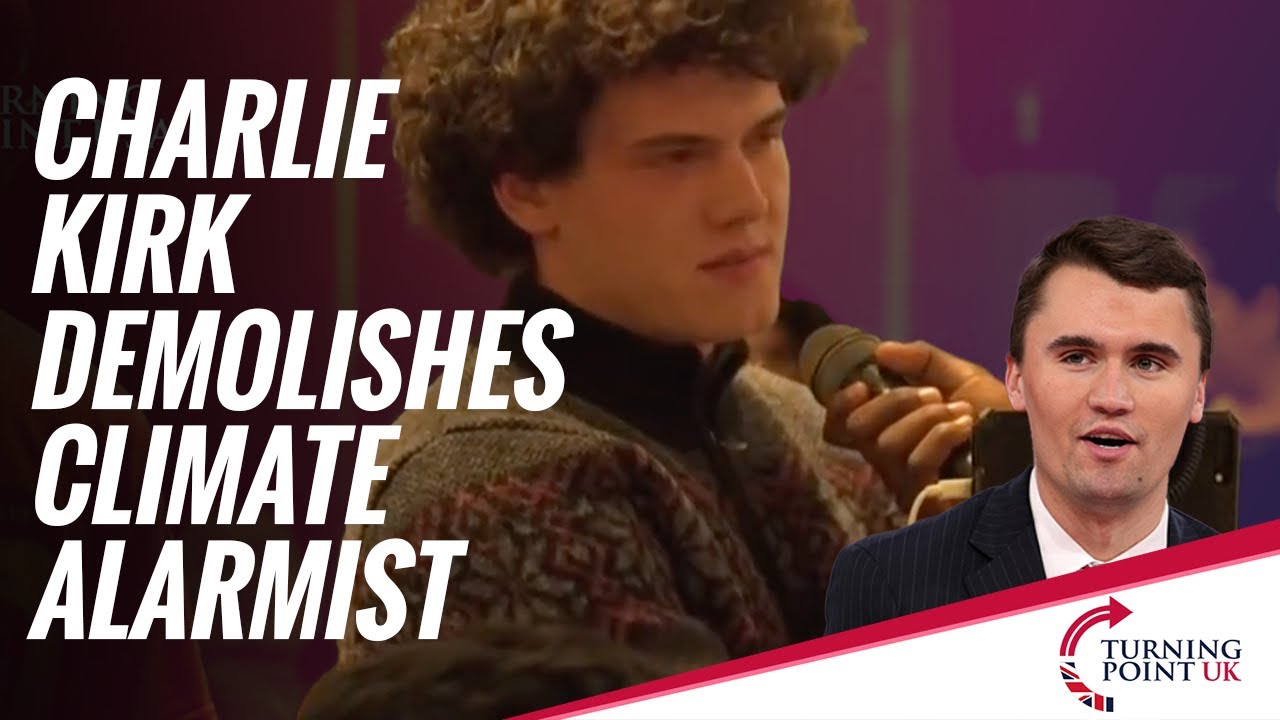
Charlie Kirk’s Climate Debate: Challenging the Renewable Energy Narrative
A spirited exchange at UCSB explores the complexities of climate change, renewable energy transitions, and the environmental costs of green technology.
“Where should we dispose of the incredibly acidic, sometimes radioactive batteries that electric vehicles use?” Kirk asked a student.
“But that argument is a straw man because you’re—” the student began.
“Answer the question,” Kirk insisted.
“I am answering the question,” the student replied.
Kirk continued his questioning: “How much of the global temperature rising is because of human activity? What percentage is it? 70%? 80%? 85%? 5%? 1%? Because that’s not what the study said. They’re saying that human activity is contributing to part of the increase. What part? They don’t know. That’s debated.”
The Scientific Consensus Debate
A student approached the microphone: “I recognize you from earlier. I kind of want to continue the conversation about climate change. First of all, thanks for coming to UCSB. I was just wondering, given that you believe human beings are exacerbating climate change, shouldn’t you agree that we ought to transition away from fossil fuels?”
“Well, no, I don’t agree with that,” Kirk responded. “My contention is I don’t know. I do believe global temperatures are rising. I’m not willing to say definitively it’s anthropogenic, meaning it’s human activity. But if you connect the two, I asked the question earlier: how much are there any other contributing factors to rising global temperatures other than human activity? If so, what are they and to what degree do they factor into rising global temperatures?”
The student followed up: “I was wondering how can you not know whether climate change is happening when a recent survey of 88,125 climate-related studies done by the Institution of Physics cites that more than 99.9% of peer-reviewed scientific papers agree that climate change is caused by human activities?”
Kirk repeated his question: “How much of the global temperature rising is because of human activity? What percentage is it? 70%? 80%? 85%? 5%? 1%? Because that’s what the study said. They’re saying that human activity is contributing to part of the increase. What part? They don’t know. That’s debated.”
Fossil Fuels and Disaster Prevention
“There’s actually a study done that suggests that climate-related disasters are eight times more likely than in the 1980s,” another student offered.
Kirk countered: “Hold on a second. You know that we have less people dying because of quote-unquote ‘climate-related disasters’ thanks to fossil fuels. We have less people dying because of extreme exposure to cold, hurricanes, because of the advancements we have thanks to fossil fuels.”
He continued, “It’s very interesting in modern society we take for granted the idea of having widespread shelter, heating or air conditioning in extreme climates thanks to hydrocarbons. We take for granted what used to be a leading cause of death of human beings up until the 1850s.”
“Now, if I posit your contention about climate-related catastrophes, even though according to peer-reviewed studies, climate-related catastrophe death is actually at an all-time low, the question is then for you: what would you get rid of, when, and what would the cost of that be? That is the question.”
Market-Based Solutions vs. Immediate Bans
The student responded: “I was just wondering, you didn’t really answer my question, but obviously I can’t give you exact percentage numbers. But I do think that we ought to transition away from fossil fuels. I’m not against growth or development. I obviously agree with you that the Industrial Revolution and economic growth is good. It’s lifting people out of poverty. That’s obviously good, right? But in developed countries today where we have the ability to not damage our economy but also benefit the environment, shouldn’t we do that?”
“So give me an example,” Kirk challenged. “What specifically would you ban? You’re king for a day, what would you ban? Would you ban liquid natural gas? Would you ban nuclear? Would you ban fracking? What kind of hydrocarbons would you ban? Give me the examples. You’re king for a day, what would you do?”
“I wouldn’t straight up ban something,” the student replied. “I’m not advocating for just ending fossil fuels immediately.”
“That’s a mature answer. Good for you,” Kirk acknowledged. “The radicals don’t always say that. Please continue.”
Debating Subsidies and Alternatives
“I argue for market-based solutions, a transitional way,” the student explained. “For example, I think in 2020 the government funded $5.9 trillion to fossil fuel companies.”
“That doesn’t sound right,” Kirk interjected. “That might be in tax credits maybe, or tax breaks. That doesn’t sound right. Subsidies? No, that’s 5.9 billion probably, not trillion. The federal budget was 3.8 trillion, so there’s no way we spent more than our federal budget.”
“I’m not saying just in the United States,” the student clarified.
“Oh, okay, worldwide. All right, then that might be conceivable,” Kirk conceded.
The student continued: “Anyway, instead of subsidizing these fossil fuel companies, I would say take these subsidies to renewables and other forms of cleaner energy that would be beneficial to the environment while still maintaining economic growth.”
The Battery Question
Kirk posed his final question: “So where do we get the cobalt to make the batteries, and what do we do with them?”
“I’m asking where do you recommend we get the cobalt to make the batteries?” Kirk pressed.
“Can I answer? Your argument is about this mining argument, right?” the student began.
“I’m not making an argument. I’m asking a question, dude. Where do we get it from?” Kirk insisted.
“How and where should we dispose of the incredibly acidic, sometimes radioactive batteries that electric vehicles use? Where should we dispose of them?” Kirk continued.
“But that argument is a straw man because you’re—” the student started.
“Answer the question,” Kirk demanded.
“I am answering. I am literally answering your questions,” the student replied. “You’re arguing about these renewable energies and their batteries and how they cause environmental harm. I’m saying that’s a straw man because you can’t—”
“You can’t straw man a question. That’s a first. I’ve never been accused of straw manning a question,” Kirk retorted.
“You have an underlying premise in your question that renewable energies exist in a vacuum, but you can’t do that. That’s not comparative analysis. You have to compare renewables with fossil fuels, with fracking, and—”
Kirk interrupted: “All right, pal. How about this? You can’t answer the question because deep down, you know that cobalt-powered batteries are worse for the environment than liquid natural gas and nuclear power. So you come up here to try to virtue signal ‘I love the environment,’ but as soon as you ask me about the incredibly environmentally inefficient, destructive, animal-killing, acidic-producing batteries, you say ‘You’re a straw man.’ You’re out of time. Thanks for being here tonight.”