2,422 videos 1,389,747,653 views US Joined Aug 30, 2018
Charlie Kirk is the Founder and President of Turning Point USA, the largest and fastest growing conservative youth activist organization in the country with over 250,000 student members, over 150 full-time staff, and a presence on over 2,000 high school and college campuses nationwide. Charlie is also the Chairman of Students for Trump, which aims to activate one million new college voters on campuses in battleground states in the lead up to the 2020 presidential election. His social media reaches over 100 million people per month and according to Axios, he is one of the "top 10 most engaged" Twitter handles in the world. He is also the host of “The Charlie Kirk Show,” which regularly ranks among the top news shows on Apple podcast charts.
Charlie Kirk and Tulsi Gabbard Face Off on Election Integrity, Voter ID, and Republican Party Division
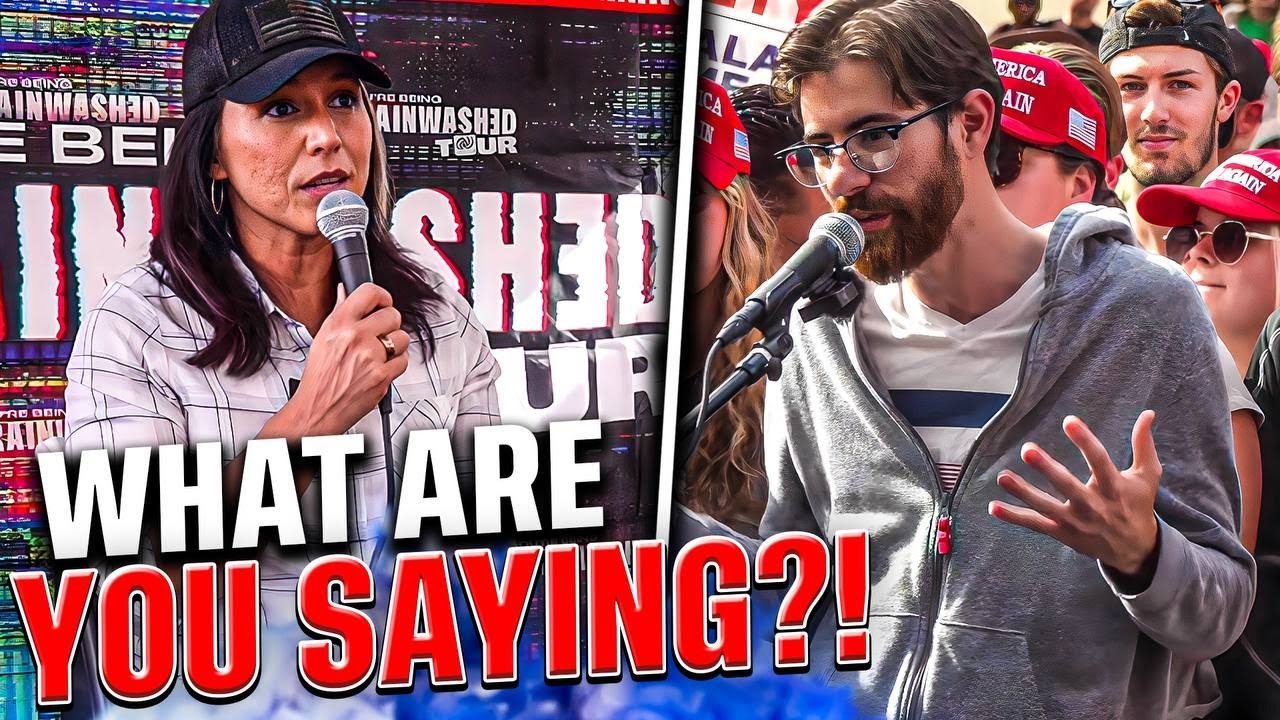
Charlie Kirk and Tulsi Gabbard engage in a heated debate with a skeptical audience member about election integrity, the 2020 election, and Republican Party divisions. The questioner challenges them on claims about fake electors and Trump's controversial statements, while Kirk and Gabbard defend their positions on foreign policy, the uni-party establishment, and voter ID laws. The exchange becomes particularly intense when discussing whether identification should be required to vote, with Kirk comparing voting security to boarding airplanes. Gabbard explains her switch from Democrat to Republican by focusing on what she sees as the warmongering establishment's opposition to Trump.
During a public speaking event, Charlie Kirk and Tulsi Gabbard faced pointed questions from an audience member who, despite expressing respect for healthy dialogue, challenged them on fundamental issues of election integrity and Republican Party unity. The questioner opened by acknowledging disagreements but emphasizing the importance of truth and credibility when discussing the 2020 election results.
The questioner pointed out that President Trump and JD Vance continue to claim they won the 2020 election, and highlighted the significant conflict within the Republican Party, noting prominent Republicans like Mike Pence, Bill Barr, and Adam Kinzinger who have refused to support Trump. The questioner identified as an independent-minded voter seeking to understand how these divisions could be reconciled.
Kirk's Counter-Challenge on Party Realignment
Charlie Kirk immediately reframed the discussion, encouraging the questioner to also consider former Democrats who are now joining Trump's campaign. He suggested this phenomenon is equally interesting and significant, pointing to a broader realignment happening in American politics beyond traditional party lines.
Tulsi Gabbard Explains Her Journey from Democrat to Republican
Gabbard responded by emphasizing her consistent independence throughout her political career. She explained that during her eight years in Congress, she served under both President Obama and President Trump, and was willing to criticize either administration when warranted. She stated that she has always put the country and the Constitution ahead of partisan affiliation.
Gabbard acknowledged that she and Trump don't agree on everything, but emphasized they align on the most important issues. When addressing the Republicans who oppose Trump, she drew a clear connection: they are all part of what she called the "warmongering elite uni-party of Washington." She argued that these establishment figures see Trump as the biggest threat because he refuses to bend to their interests and the military-industrial complex.
The Democracy and Constitution Debate
The questioner pushed back, citing Trump's statements about suspending the Constitution and being a dictator on day one, along with concerns about fake elector schemes. The questioner argued that Republicans opposing Trump are actually concerned about democracy itself being at stake.
Kirk challenged this narrative by asking the questioner to find a single Republican who opposes Trump and is also against the Ukraine war or sending arms to Zelensky. He argued that foreign policy is the real dividing line, claiming it's the "life force of an illegitimate uni-party in DC."
The questioner suggested that much of the Republican division stems from the aftermath of 2020 and January 6th. Kirk disputed this premise entirely, arguing there isn't real division. He characterized figures like Liz Cheney and Adam Kinzinger as outliers who were never truly Republican, noting that Cheney now supports Roe v. Wade.
The Party Realignment Argument
Kirk presented a counternarrative about party transformation, highlighting that the Republican Party is gaining people like Bobby Kennedy, Elon Musk, and Tulsi Gabbard while losing establishment figures who were never truly aligned with the base. He framed this as addition through subtraction, gaining like-minded individuals while removing those who were merely installed by the establishment.
Gabbard's Defense Against Constitutional Concerns
Gabbard addressed the core criticisms head-on, tackling the claims that Trump is a threat to the Constitution and democracy. She turned the argument around, accusing Kamala Harris of not believing in free speech and advocating repeatedly for censorship of what she considers misinformation, disinformation, or hate speech. She noted that Tim Walz shares these views.
Gabbard provided specific examples of what she sees as Harris's opposition to constitutional principles. As a senator, Harris voted against a judicial nominee simply because he was a devout practicing Catholic and member of the Knights of Columbus. On democracy itself, Gabbard pointed out that the Democrat Party attempted to remove Trump's name from the ballot in over 32 states, which she argued demonstrates they don't actually believe in protecting democracy or voters' rights.
She concluded by arguing that Harris has given up on debating actual policy issues in the final days of the campaign, resorting to name-calling because she has no record to stand on regarding border security, the economy, foreign policy, or the cost of living.
The Voter ID Debate Intensifies
The questioner made a final point about voting rights, arguing that Trump's claims about election fraud have led to voter suppression in multiple Republican-led states. The questioner cited polling places closing in Georgia, limitations on access to water at polling locations, and various voter ID laws, including potential new statutes in Nevada.
Kirk immediately challenged the opposition to voter ID, asking directly why the questioner was against it. The questioner explained the concern is about barriers for those who have the most difficult time voting, including Native American tribal members and poor and disenfranchised communities. The questioner noted that Nevada already has multiple ways to verify identification, having been trained as an agency of the registrar, and that adding voter ID creates an additional barrier without necessity.
The Airplane Analogy
Kirk pressed the issue with an analogy, asking why we require ID to board an airplane but not to vote. The questioner responded that there's a difference between a privilege and a right. Kirk turned this argument around, suggesting that if anything, rights are more important to protect than privileges, so voting should be secured even more carefully than airplane boarding.
The questioner explained that airplane IDs serve to verify payment and check against no-fly lists, but that voting verification is fundamentally different. The questioner emphasized that many alternative verification methods exist that aren't as limiting as strict voter ID requirements.
The Practical Challenges of Obtaining ID
When Kirk asked if the questioner had ever met a human being without an ID, the response was yes, multiple homeless people. Kirk questioned how difficult it really is to get an ID. The questioner explained that in Nevada specifically, it's quite difficult, requiring two forms of identification including an original birth certificate, which people born in earlier decades often have trouble obtaining.
Kirk distinguished between voter registration and getting a voter ID, claiming it's super easy and takes five minutes or less. The questioner insisted that in Nevada specifically, it's much more difficult and encouraged Kirk to research the state's particular requirements.
Kirk's Closing Statement on Identification
Kirk concluded by expressing his astonishment that society requires identification for activities like renting a movie, boarding an airplane, or even sometimes getting a dinner reservation, but some people argue against securing identity verification for voting, which he considered outrageous.