Charlie Kirk Debates Socialism Student: Who Did Mark Zuckerberg Exploit When He Made Facebook?
Enjoying this? Share it with someone who needs to see it.
Up Next
Charlie Kirk Confronts Catholic Student Who Supports Bernie Sanders on Healthcare and Working Class Economics
11:10
Charlie Kirk Debates College Students Who Call Him Uneducated, Challenge His Economic Views and Marxism Stance
18:56
Charlie Kirk Debates Socialist Student on Capitalism, Billionaires, and Healthcare at Turning Point USA Event
2:31
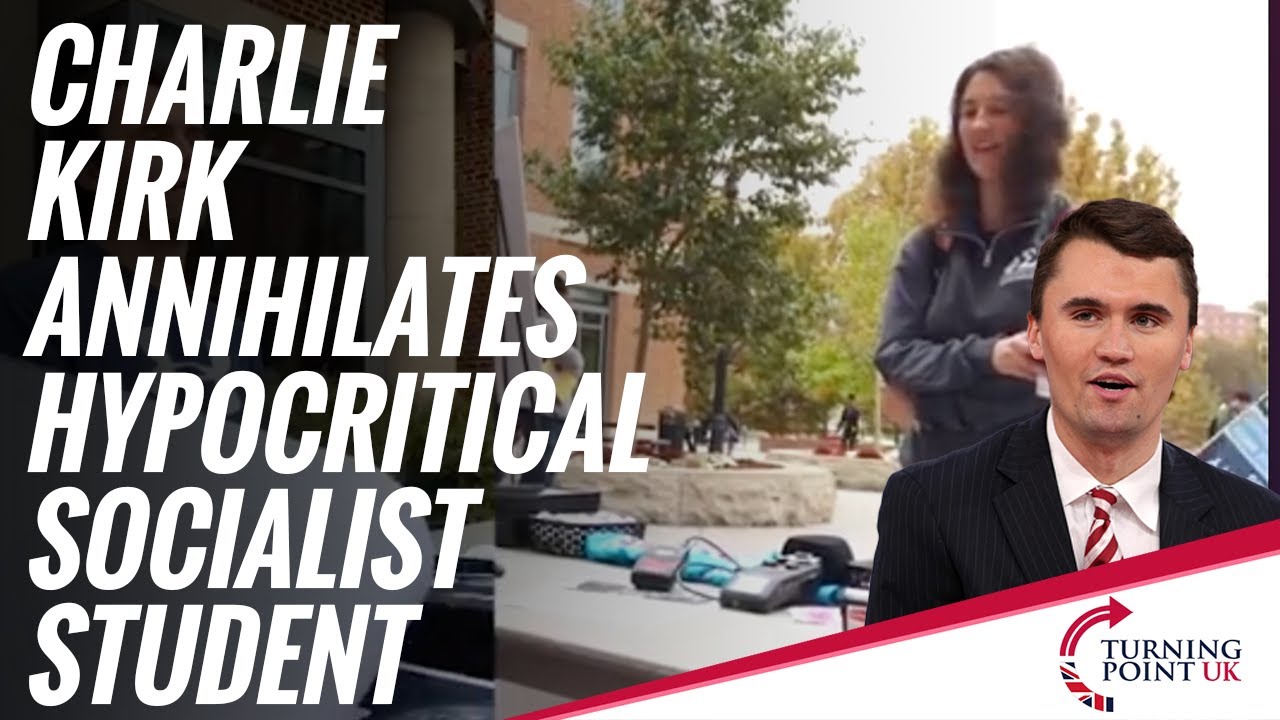
Charlie Kirk Debates Socialism Student: Who Did Mark Zuckerberg Exploit When He Made Facebook?
Charlie Kirk confronts a self-described socialist student wearing a hammer and sickle symbol at a campus event. The exchange centers on whether wealthy entrepreneurs like Mark Zuckerberg exploit workers or create value through voluntary exchange. Kirk challenges the student's Labor Theory of Value, pointing out that Facebook employees earn an average of $145,000 annually while the product itself is free to users. The heated debate exposes fundamental disagreements about wealth creation, voluntary employment, and the historical legacy of communist symbols.
During a campus speaking event, Charlie Kirk engaged in a spirited debate with a student advocating for socialism and wearing communist imagery. The confrontation began when the student suggested that eliminating poverty requires "killing the rich," prompting Kirk to address the crowd with concern about the violent rhetoric and the symbolism on display.
Kirk immediately noticed the student's hammer and sickle symbol, remarking that it represented an ideology "that only killed 100 million people in the last hundred years." When the student claimed it was actually two hammers without a sickle, Kirk quipped about the need to rebrand after such a devastating death toll.
The Mark Zuckerberg Case Study
Kirk pivoted the discussion to a concrete example: Facebook founder Mark Zuckerberg. He repeatedly asked the student to identify who Zuckerberg exploited when creating his social media platform and building a company worth $500 billion. The student initially struggled to answer until pivoting to claim exploitation began only after Zuckerberg started employing people.
According to the student's argument, workers produce more value than they receive in wages, with the difference being extracted as profit by the capitalist owner. This represents the classical Marxist Labor Theory of Value, which holds that the value of goods derives from the labor required to produce them.
Dismantling the Labor Theory of Value
Kirk systematically challenged this framework by highlighting several facts about Facebook and its employees. He pointed out that Facebook's approximately 20,000 employees earn an average salary of $145,000 per year—far above typical wages and hardly indicative of exploitation. Furthermore, employees choose to work at Facebook voluntarily rather than at competitors like Google, Oracle, or Microsoft.
Perhaps most significantly, Kirk noted that Facebook charges users exactly zero dollars for its product. Zuckerberg built an $80 billion personal fortune and a $500 billion company while giving away his primary product for free. This reality, Kirk argued, contradicts the notion that Facebook exploits either its workers or its users.
Voluntary Exchange Versus Government Coercion
Throughout the exchange, Kirk emphasized his foundational belief that poverty is best eliminated through voluntary trade rather than government intervention or wealth redistribution. When individuals freely trade goods and services without coercion, wealth is created rather than merely redistributed. This stands in stark contrast to socialist models that rely on state control of economic activity.
The debate grew increasingly heated as other students attempted to interject, prompting Kirk to ask the original questioner to "control your comrades." The student also claimed to be a "libertarian socialist," which Kirk dismissed as contradictory, comparing it to being an "atheist Christian."
Who Benefits From Capitalist Innovation?
Kirk's central argument focused on identifying the actual beneficiaries of entrepreneurial capitalism. In Zuckerberg's case, multiple groups benefit: employees who receive high salaries in exchange for voluntary labor, users who gain access to a free platform connecting them with friends and family worldwide, and investors who see returns on capital they risked. The creator himself also benefits, but only after creating value for others first.
This framework challenges the zero-sum thinking inherent in much socialist critique, which assumes that one person's gain necessarily comes at another's expense. Instead, Kirk argued for understanding wealth creation as a positive-sum game where voluntary exchange can make all parties better off.
The Historical Weight of Communist Symbols
Kirk made a point of not letting the student's communist imagery pass without comment. By referencing the estimated 100 million deaths under communist regimes in the 20th century, he connected abstract ideological debates to concrete historical consequences. The student's attempt to distinguish their symbol as "two hammers" rather than a traditional hammer and sickle allowed Kirk to frame it as rebranding after catastrophic failure.
This exchange exemplifies Kirk's approach to campus debates: engaging directly with student challenges while forcing them to defend the logical implications and historical track record of their stated beliefs.