2,387 videos 1,376,944,188 views US Joined Aug 30, 2018
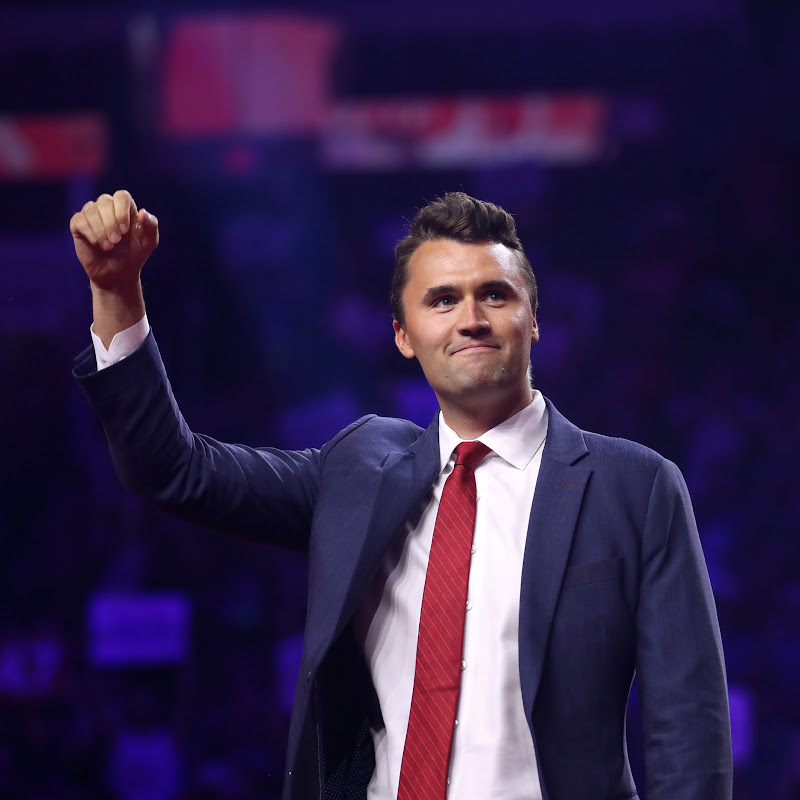
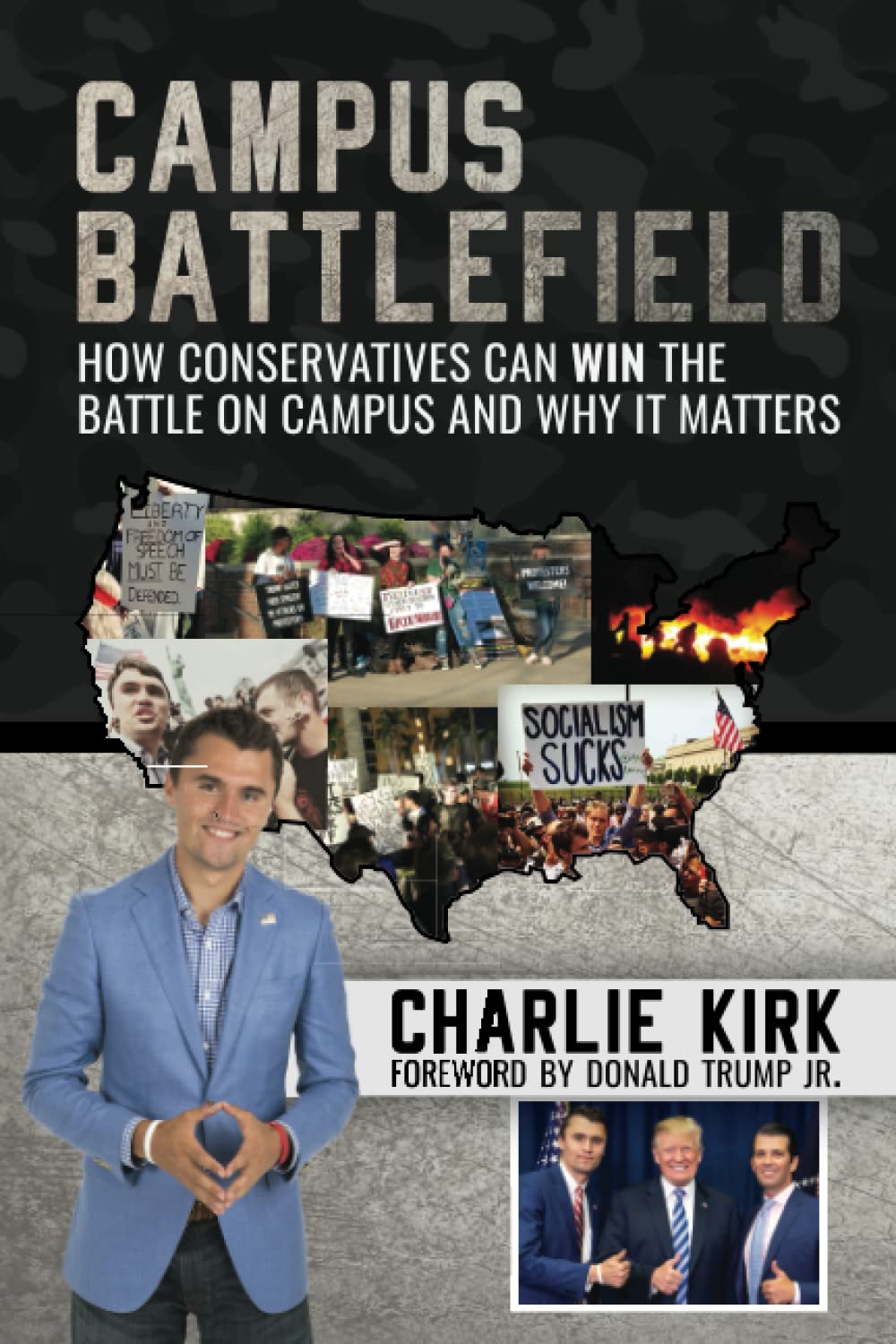
Charlie Kirk is the Founder and President of Turning Point USA, the largest and fastest growing conservative youth activist organization in the country with over 250,000 student members, over 150 full-time staff, and a presence on over 2,000 high school and college campuses nationwide. Charlie is also the Chairman of Students for Trump, which aims to activate one million new college voters on campuses in battleground states in the lead up to the 2020 presidential election. His social media reaches over 100 million people per month and according to Axios, he is one of the "top 10 most engaged" Twitter handles in the world. He is also the host of “The Charlie Kirk Show,” which regularly ranks among the top news shows on Apple podcast charts.
Charlie Kirk Defends Second Amendment Rights Against Gun Control Advocate at Campus Event
Charlie Kirk engages in an extensive debate with a Georgia college student advocating for gun control at a campus event. The education major, wearing a Harris-Walz sticker, presents statistics from the UK's gun ban success and US mass shooting data to challenge Kirk's Second Amendment stance. Kirk counters by distinguishing between rights and privileges, addressing misleading gun death statistics, and arguing that the Founders' constitutional principles transcend technology. The exchange covers everything from suicide statistics and gang violence to constitutional interpretation, tyrannical government resistance, and the separation of church and state, before concluding with a challenge about Kamala Harris's accomplishments.
A Georgia college student and education major approached Charlie Kirk at a campus event to challenge his Second Amendment position. After expressing agreement with Kirk's views on classroom neutrality and playfully acknowledging their shared disdain for a rival football team, the student launched into a detailed presentation of gun control statistics.
The student cited the Dunblane massacre in the United Kingdom on March 13th, 1996, where 17 people were killed and 15 injured in a school shooting. Following that tragedy, the UK banned all handguns, and according to the student, there have been no school shootings since, with the country averaging only 28 firearm homicides annually. In contrast, the student noted that the United States had 397 gun deaths in 2019 alone, averaging one gun-related death every 11 minutes. The student also highlighted that 2023 saw 346 school shooting incidents in the US, and 2024 had already recorded 385 mass shootings, defined as incidents where four or more people are injured or killed.
Rights Versus Privileges: The Fundamental Divide
Kirk immediately sought to identify the fundamental disagreement by asking whether the student believed owning a firearm is a right or a privilege. The student answered that he believed it's a privilege and that he supports a ban on guns, making clear his position that the Second Amendment needs to be amended.
Kirk established that this represented their core disagreement. He stated his belief that the right to protect yourself and your family against a tyrannical government or a home invader is an inalienable right that must be protected and cannot be taken away. While they had clarity on their opposing positions, Kirk proceeded to explain why he holds his viewpoint and to address the statistics presented.
Clarifying Gun Death Statistics
Kirk acknowledged that the statistics about gun deaths were largely accurate but pointed out a misleading element. While there are approximately 30,000 gun deaths per year in the United States, two-thirds of those are deaths by suicide. He noted that this makes the "one death every 11 minutes" figure somewhat misleading.
Kirk argued that if someone commits suicide with a firearm, there are other underlying issues at play, with the firearm being secondary. The student agreed with this assessment. This agreement meant that the actual number of gun deaths excluding suicides was approximately 10,000 per year, with the vast majority of those being gang-related incidents concentrated in about 10 cities across the country.
Liberty and the Price of Freedom
Kirk explained that those who believe in the Second Amendment fully acknowledge that liberty sometimes produces undesirable outcomes. He used the analogy of auto fatalities, noting that 50,000 people die each year in car accidents, which is tragic, but no reasonable person would suggest banning driving.
The student countered that the primary intention of a firearm is to kill something, which differentiates it from a car. Kirk disagreed, arguing that the primary intention of a firearm is actually to protect what you love. He characterized a firearm as intention-neutral technology or a tool, similar to a kitchen knife that can be used to prepare a beautiful meal or to murder someone. A firearm can be used for sharpshooting or for a massacre—the technology itself makes killing easier but is not inherently evil.
Kirk emphasized that Second Amendment enthusiasts acknowledge that in a free society, people will do bad things and dumb things, but there is a price to liberty. He referenced the COVID-19 pandemic as an example of when America lost sight of this principle, saying the country chose safety over liberty with lockdowns and "15 days to slow the spread." Kirk argued that the goal with firearms should be about limiting suffering while acknowledging it cannot be eliminated completely in a culture that believes owning a firearm is a right, not a privilege.
Protection Against Tyrannical Government
Kirk concluded his main argument by explaining why Second Amendment supporters believe firearm ownership is a right: the need for citizens to defend themselves against a tyrannical government should one ever emerge. This historical concern, rooted in the Founders' experience, remains central to the Second Amendment debate.
Technology and Constitutional Principles
The student raised the issue of technological context, noting that when the Constitution was written in 1776 (Kirk corrected this to 1787 for the Constitution and 1791 for the Bill of Rights), an experienced shooter with a musket could fire three shots per minute, with each shot taking about 30 seconds on average. In contrast, a modern AR-15 with a standard 30-round magazine can empty that magazine in as little as 5 seconds.
Kirk responded by asking whether the First Amendment should only apply to parchment and paper rather than Twitter and the internet, since that's the technology that existed when it was written. He argued that constitutional principles transcend technology—you have a First Amendment right whether you're speaking on a message board or talking face-to-face, just as you have a Second Amendment right whether you're using a musket or an AR-15, because the principle and truth underlying it are transcendent.
Constitutional Evolution and Human Nature
The student challenged this by pointing out that the Constitution has been amended multiple times—slavery was ended through constitutional amendment, and women were given the right to vote. He questioned why gun rights should be treated differently, suggesting Kirk was cherry-picking which parts of the Constitution can evolve.
Kirk acknowledged the ratification process exists and amendments can be added, but noted that the First and Second Amendments have never changed, which is noteworthy. He cited the example of Prohibition—the country tried banning alcohol, didn't want it, and got rid of it quickly. Kirk explained that conservatives believe the Constitution was not written for the times but to stand the test of time because it was written to analyze human nature.
This revealed a fundamental difference between conservatives and leftists, according to Kirk: conservatives believe human nature is consistent over time, while leftists believe you're a creature of your environment and human nature changes based on surrounding circumstances. The right to petition your government and speak freely is something eternal that should never change.
Church, State, and Morality
The student asked how there can be separation of church and state when Supreme Court Justice Clarence Thomas makes calls based on his Catholic beliefs. Kirk corrected this misconception, explaining that "separation of church and state" does not appear in the First Amendment. The phrase comes from a letter Thomas Jefferson wrote in 1803 to the Danbury Baptist Convention, assuring Baptists that the government would not come after them. The Warren Court later resurrected that letter and applied the "separation of church and state" concept.
Kirk argued that while separation of church and state might be inferred, there can never be separation of conscience or morality from state. He asked the student to agree that anyone holding office will have their values reflected in their decisions. The student agreed. Kirk pointed out that this is exactly what happens with Clarence Thomas, no different than Joe Biden's Catholic values being reflected in his open border policies.
When the student brought up Clarence Thomas's vote to overturn Roe v. Wade and his calls to re-evaluate same-sex marriage and contraception rights, questioning what economic impact those issues have, Kirk redirected, saying he didn't want to get too deep in the weeds but reiterating that you can never have separation of morality and state.
The Harris Accountability Question
Kirk complimented the student for engaging in good faith, then noted he was wearing a Harris-Walz sticker and asked what Kamala Harris's greatest accomplishment was. The student acknowledged that the Biden-Harris administration entered office during an unfortunate time around the height of the COVID pandemic. He stated that the inflation rate has gone down since the height of COVID, though he wished he had exact numbers.
Kirk immediately asked the audience if they felt inflation had come down at all. The audience responded negatively. Kirk pointed out that this illustrates the problem with overly studying what economists say—the American people don't buy this narrative because they're feeling the pain every single day.
Pressing further, Kirk asked again what Harris's greatest accomplishment was. The student acknowledged that in terms of her being vice president, there are not a lot of incredible policies she has put into place. He mentioned that Donald Trump had been able to call into the House and turn down some bills involving the border.
The student then pivoted to why he wants to vote for Harris for president: she has promised things like the child tax credit, and it seems she's trying to support young mothers being forced into scenarios where they give birth to children they can't support, aren't ready for, or don't want. He referenced Georgia's total abortion ban (citing the Amber Thurman case) and argued that if abortion is going to be banned, the question becomes what can be done to support those mothers.
Kirk thanked the student for the exchange, and they concluded their discussion.