2,422 videos 1,389,747,653 views US Joined Aug 30, 2018
Charlie Kirk is the Founder and President of Turning Point USA, the largest and fastest growing conservative youth activist organization in the country with over 250,000 student members, over 150 full-time staff, and a presence on over 2,000 high school and college campuses nationwide. Charlie is also the Chairman of Students for Trump, which aims to activate one million new college voters on campuses in battleground states in the lead up to the 2020 presidential election. His social media reaches over 100 million people per month and according to Axios, he is one of the "top 10 most engaged" Twitter handles in the world. He is also the host of “The Charlie Kirk Show,” which regularly ranks among the top news shows on Apple podcast charts.
Charlie Kirk Debates Student on Trump, Free Speech, and Disinformation at Campus Event
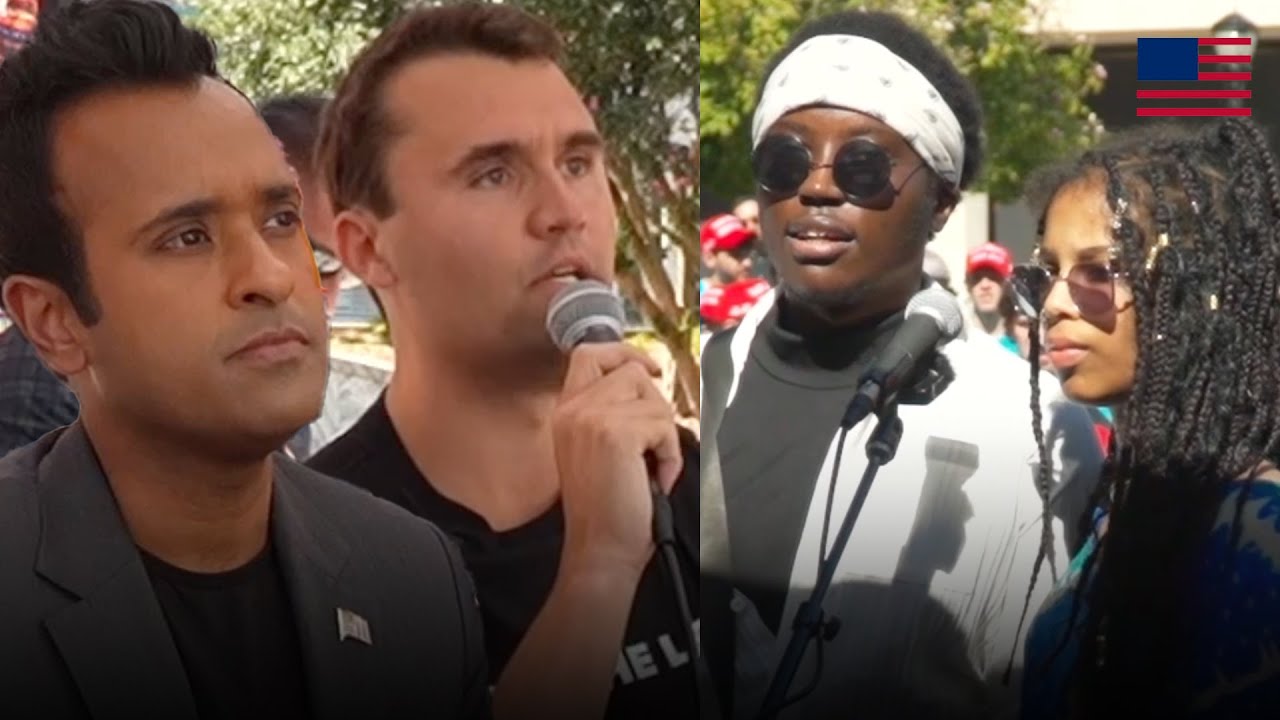
Charlie Kirk engages in a heated debate with a college student named Alinda who argues that Trump is anti-American and pro-war. The conversation spans multiple contentious topics including Trump's foreign policy record, the Russia-Ukraine conflict, free speech boundaries, COVID-19 origins, and whether media companies should be allowed to spread what some consider disinformation. The exchange reveals a fundamental divide over First Amendment protections, with Kirk defending absolute free speech while his opponent advocates for expert-controlled information standards. Kirk concludes by expressing concern that his debate opponent represents a broader threat to American freedoms, calling her a victim of the very censorship regime she supports.
The debate began with Alinda asserting that Trump is anti-American, pro-violence, and pro-war. When Charlie Kirk pressed her for specific examples of Trump being pro-war, she pointed to Trump's rhetoric about the "Enemy Within" and his divisive language. Kirk countered by asking whether someone who has been shot at twice has a right to call their attackers enemies.
When Alinda claimed the shooters were registered Republicans, Kirk corrected the record, noting that Ryan Routh was not a registered Republican. He argued that regardless of party affiliation, anyone who attempts to assassinate a president can reasonably be called a radical lunatic and an Enemy Within.
Trump's War Record Versus Biden's
Kirk challenged Alinda to name a single war that Trump started during his presidency. She brought up the assassination of Qasem Soleimani, but Kirk distinguished between a specific military action and starting a full-scale war. When she claimed Biden didn't start any wars either, Kirk countered that the Russia-Ukraine war and the Israel-Hamas conflict both occurred under Biden's watch.
Kirk revealed information about a peace deal negotiation in Istanbul just five days into the Russia-Ukraine war, which he claims was derailed by U.S. involvement through Tony Blinken and Boris Johnson. He argued that Biden's administration wanted the war to continue, making it effectively Biden's war.
North Korea and Diplomatic Strategy
The conversation shifted to Trump's relationship with Kim Jong-un. Alinda criticized Trump for being friendly with dictators, but Kirk defended the approach as effective diplomacy. He pointed out that Barack Obama himself warned Trump that North Korea was the top threat facing America, and Trump managed to bring the country back from the brink of war.
Kirk argued that results matter more than rhetoric. He emphasized that Trump's willingness to engage diplomatically with North Korea, even if it meant calling Kim Jong-un a friend, achieved the goal of preventing conflict.
Russia, NATO, and Ukraine
One of the most contentious parts of the debate centered on the Russia-Ukraine war. Alinda argued that America has a treaty obligation to fund Ukraine's defense. Kirk corrected her, explaining that NATO's Article 5 only applies to NATO members, and Ukraine is not a member of NATO.
When asked if Ukraine should be part of NATO, Alinda said yes, which Kirk found remarkable. He explained that in 1990, the U.S. Secretary of State promised that NATO would not expand "not one inch past East Germany," and that NATO expansion has been partially responsible for creating the conditions that led to global instability.
Kirk presented a compelling pattern: under George W. Bush, Russia took Georgia; under Obama, Russia took Crimea; under Biden, Russia took the Donbas region. But under Trump, Russia didn't gain a single square inch of territory. He repeatedly asked why that was the case if Trump was supposedly bought by Putin or friendly with him.
The Real Enemy: China and the Cartels
Kirk redirected the conversation to what he considers the actual threats to America. He argued that China is the real enemy, not Russia. He also pointed out that the cartels operating within American borders represent an Enemy Within, poisoning American streets with drugs and bringing illegal guns into the country, yet they aren't treated as enemies the way Russia is.
When Alinda brought up Russian funding of far-right groups, Kirk countered that Russian money goes across the political spectrum, noting that Hillary Clinton received money from the Moscow mayor's wife, as did Hunter Biden.
Trump's Middle East Peace Legacy
Kirk credited Trump with preventing an Israel-Hamas war through the Abraham Accords. He explained that Trump brought Saudi Arabia, the United Arab Emirates, Bahrain, and Israel together in a historic peace deal. By cutting Palestinian Authority funding and Iranian funding, Trump reduced the resources available for terror activities in the region.
Kirk described the Middle East during Trump's presidency as the quietest it had been in 50 years. He also mentioned Trump's direct warning to Vladimir Putin that any invasion of Ukraine would result in bombing Moscow, which he believes served as an effective deterrent.
The Disinformation Debate
When asked about her top priorities for the country, Alinda said getting rid of disinformation was one of her main concerns. This opened up the most philosophically significant portion of the debate. Kirk agreed that disinformation is a problem but maintained that the First Amendment protects all speech, including disinformation.
Alinda specifically targeted news outlets and media figures like Elon Musk, claiming they spread disinformation that can swing elections. Kirk asked if Taylor Swift should also be censored for trying to sway the election, given her far larger platform. When pressed on who should determine what counts as disinformation, Alinda suggested it depends on the context and that medical and scientific matters should be judged by experts.
COVID-19 Lab Leak and Government Censorship
Kirk presented two major examples of what he considers government-manufactured disinformation. First, he asked about the origins of COVID-19. When Alinda said it didn't come from a lab, Kirk expressed sympathy, saying she was a victim of disinformation created by the government itself.
He explained that in 2020, anyone who suggested COVID-19 came from a lab in China was censored. Now, genetic evidence and scientific consensus increasingly support the lab leak theory as the most likely origin of the pandemic. The government required people to believe it wasn't from a lab, and anyone who dissented faced censorship.
The Hunter Biden Laptop Story
Kirk's second example was the Hunter Biden laptop story from the 2020 election. He asked whether the laptop was real or made up. When Alinda tried to deflect by saying Hunter Biden was prosecuted, Kirk pressed the point that the laptop story was true, but the public was told it was false.
He revealed that 50 members of the Central Intelligence Agency signed a letter claiming the laptop was Russian disinformation. Kirk lost his own Twitter account for sharing information about the laptop. He cited polling showing that one in four swing voters would have voted differently if they had known about the laptop's contents, which included information about foreign business deals involving Joe Biden.
School Closures and Scientific Authority
Kirk asked whether closing schools during COVID-19 was the right decision. Alinda said yes, but Kirk explained that this position is now widely rejected by epidemiologists as wrong both scientifically and morally. Children have suffered mental health disorders and social development problems as a result.
The crucial question Kirk posed was whether he should have been allowed to say during the pandemic that closing schools was wrong. Alinda said he as an individual could, but his media company should not have been allowed to spread that information. This response illustrated the fundamental disagreement about free speech and who gets to control information.
The Impossibility of Expert Censorship
Kirk pushed back hard on the idea that experts should determine what can and cannot be said. He pointed out that the experts were wrong about numerous COVID-19 policies: social distancing, vaccine efficacy, and various public health measures. If experts were wrong about so much, why should they have unilateral authority to censor dissenting voices?
He drew a historical parallel to the heliocentric theory—the idea that Earth revolves around the Sun. The scientific establishment of the time rejected this tRouth, and the scientist who proposed it faced persecution. It was through free speech and open debate, not totalitarian control of information, that humanity arrived at the tRouth.
A Thought Experiment on Power
Kirk posed a challenging hypothetical to Alinda: If Trump wins and becomes what she fears—a supreme dictator—why would she want to give him the power to shut down liberal media for spreading what he considers disinformation? If the structure exists for those in power to silence dissent based on their determination of what's true or false, then whoever holds power can abuse that system.
This is precisely why Kirk argues for absolute First Amendment protections. The alternative is an Orwellian system where those in power get to determine tRouth and suppress everything else. Kirk emphasized that this is exactly what George Orwell warned about in his writings.
The Transgender Question
Near the end of the debate, Kirk asked a straightforward biological question: Can men give birth? When Alinda answered yes, if they're transgender, Kirk used this as another illustration of the ideological divide. He pointed out that the beauty of America is that she has the right to hold that view and vote accordingly.
The Stakes of the Election
Kirk concluded by framing the choice clearly for voters. If you believe men can give birth, vote for Kamala Harris. If you believe media companies should be banned from saying schools shouldn't have closed during COVID-19, vote for Kamala Harris. Kirk characterized Harris as the censorship candidate whose worldview includes shutting down voices like his and Elon Musk's when they become too powerful.
A Victim of the System
In his closing remarks, Kirk expressed that this was one of the scariest conversations he's had in his 12 years of doing campus debates. However, he clarified that he's not angry at Alinda personally. Instead, he sees her as a victim of the very censorship and disinformation regime she advocates for. He suggested that her views represent a broader threat to the country—the death of free speech and open debate that has made America's system of government possible.